Katin Images Travel Photography

Travel Photos, Travel Photography Tips and Software

Tag: Wildlife*

  • African shoestrings – Namibia Day Sixty seven – Twyfelfontein

    We got back to the resort in enough time to have another shower (our third) before dinner. Dinner brought us kudu steaks again and again it was the texture that put me off confirming after this second ‘chew’ that the kudu is safe from me in the future. Unfortunately there were no other choices so it was that or go hungry! Nonetheless the remainder of the food was good and really became secondary to the conversation we were having with a South African couple and a couple of journalists from Zambia who now live in New York. We were enjoying the conversation so much that it was almost an inconvenient interruption to be called to the night hide to see a porcupine munch on another slab of meat left there to attract him.

    It was all go the next morning. Up at 6 and into the huge long grassed paddock that was the lion’s enclosure, on the back of an open safari truck. These three lions (one female, Tess and two males, Matata and Tyson) were rescued from brainless people who kept and mistreated them in captivity. Even though they were now part of the family, it was intended that they would be relocated back out into the wild. Watching Donna and Roselea Hanssen play with them, I wondered whether how that could ever be. These animals were domesticated and appeared to me to be just big playful pussycats and then I remembered Guy’s story yesterday and made sure that I stayed well within the safety of the truck.

    Our final ‘activity’ was a guided bushmen walk trail. Chris our guide (who I noticed showed a healthy respect for the lions in the way he held on tightly to his rifle) took us on a track littered with bushmen artifacts, ‘home comforts’ and tools.

    It was interesting without being riveting. The bushmen like many other traditional peoples had no concept of ‘waste’. Everything had a use. A small animal would provide not only food but also pelts for warmth, fat for cooking and skin for shelter. It’s a principle that appears to be have lost over the centuries by Europeans.

    Back to the lodge and we only had a few minutes to vacate our room before Brunch (they like you out of the rooms by 9 am) which we enjoyed under the watchful gaze of the resident warthog.

    On the drive out Sue was feeling pretty crook and we hadn’t got far when I had to stop whilst Sue got rid of the contents of her stomach. From then on she slept whilst I drove onwards to Terrace Bay in the Skeleton Coast Park, some 380 kilometres away, in the blazing heat of the desert.

    As half of the road was gravel, there was no way we were going to make it in a day so our overnight stay was near Twyfelfontein where some of the finest rock art in Africa is found.

    Not so fine was the Abu-Huab Camp. Another dust hole masquerading as a ‘rustic and natural desert camp” in the middle of nowhere. Once again we had to put up with dust and sand blowing into every crevice and orifice. Sue was still crook and lay most of the time in the tent and I still had the remnants (in the form of catarrh and dry throat) of the cold I had caught nearly 3 weeks ago at Fish River Canyon.

    We were back down to the realities of independent budget travelling with a bump. No comfy bed in a dustless air-conditioned room for us that night. As darkness descended Sue gradually regained some strength to sit outside whilst I eat and we actually began to enjoy relaxing under the gaze of the millions of stars that lit the night sky with their pinpricks of light scattered in and around the milky way. That was until Sue almost put her foot on a scorpion, which could have put us right in the ‘shit’. Somehow this wasn’t the sort of place where emergency medical treatment would have been easy to find. That was enough for us, our beds were calling. Hopefully tomorrow would bring a better day.
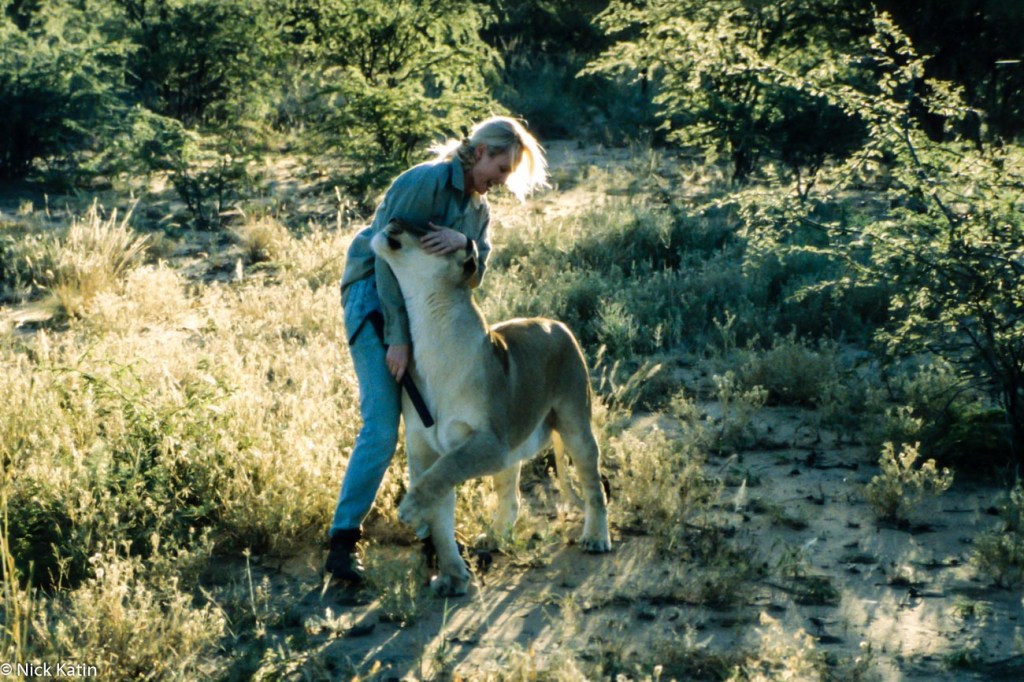
    Playing with a female Lion at Okinjima in Namibia.
    Playing with a female Lion at Okinjima in Namibia.
  • African shoestrings – Namibia Day Sixty six – Okinjima

    It is estimated that there are 2500 cheetahs, a quarter of the world’s population, roaming rural Namibia, that is outside of the national parks. And that’s where all the problems lie. The farms are ideal for cheetahs and leopards (the other big cat that Africat specialises in). In the National Parks and game reserves both these predators are in competition with larger predators like lions. On the farms there is no such competition. Unfortunately they can’t tell the difference between small game and small farm animals like calves, sheep or goats which upsets the farmer just enough for him to set traps or go hunting! That’s where Africat come in.

    Straight after heating up the shutter in our cameras and blistering our shutter finger, we were whisked off in open top 4WD vehicles to the leopard hide. There we all sat in a small marquee whilst Guy one of the guides chats about Africat.

    “When a farmer kills or captures a cheetah or a leopard it often leads to making the problem worse.” He began “when a predator holds a territory it will chase out any intruding predators. Once its removed other predators will move in and often divide up the territory, so instead of having just one animal to deal with the farmer ends up two or three times as many. What we do is to try and educate the farmers to manage their livestock better so that losses are minimised and both can live together. Of course we often meet resistance and in those cases we just ask the farmer not to kill the cats but just capture them and release them to us so that we can release them back into the wild away from that farm.”

    He also told us that there were several cheetahs and leopards roaming wild on this farm and hopefully a number of leopards will visit the hide this afternoon. It occurred to me that we appeared to be in an unfenced area and wouldn’t there be the chance that the leopards might find us more attractive than the slabs of meat. Dumb question Nick!

    “Big cats will only really attack a human if the cat is cornered, injured or senses that we are vulnerable”. Guy said “If it’s got a much easier alternative then it will always go for that. Of course it also associates humans with guns and that also acts as a pretty big deterrent”

    I asked him what happened to his heavily bandaged foot that he couldn’t walk on without the aid of crutch.

    “Oh that, this happened in the lion enclosure”

    There was a complete silence. Sensing this, Guy went on. “Chris (the other guide) and I went in to see the lions and during our work I stepped backwards from the lion and caught my foot on a rock and fell spraining my ankle. As I said these big cats sense when we are vulnerable and in this case she began to make a move towards me. Fortunately Chris was there and herded her off before she actually attacked.” He smiled “So she didn’t really attack me. I just didn’t take enough care, something that when you’re dealing with these animals could cost a life”.

    “Aren’t we seeing these lions in the morning?” I whispered to Sue, who ignored me.

    With a degree of caution we are fed into the small hide and watch as the guides leave meat in conspicuous places on the elevated rocky terrain immediately in front of us. It was getting towards sunset so the light was that golden colour which bathed the rocks in almost perfect light. Within a few minutes a leopard appeared followed a few minutes later by another to chew on the slabs of meat and then disappear. For the next hour there was a regular pattern of first one then the other appearing and then disappearing.

    The hide was totally closed in except for a long thin viewing open window that made us feel like we were so close. In fact it was a zoo in reverse we were the ones imprisoned for our safety whilst the animals roamed around us. At one time one of the leopards looked straight at us and darted off after someone dropped their lens onto the small shelf we were all leaning on. Apart from that the only sound was that of camera shutters as we all strived to get that perfect leopard shot. I couldn’t help feel that this was all a bit contrived even though the leopards are free to roam anywhere they want and are native to the area. But I’m not complaining leopards are one of the most elusive animals to view in Africa and to see them up close and for so long, is an experience not to be missed.

    I like leopards! They are such magnificent beasts, like the shark they appear to be the perfect hunting machine with their muscular shaped body, long tail and strong stature.

    If you like this then hit “follow” on the side bar

    A leopard eats it's prey amongst the rocks in Central Namibia
    A leopard eats it’s prey amongst the rocks in Central Namibia
  • African shoestrings – Namibia Day Sixty five – Okinjima

    Apart from a recreational park, Waterberg is also a breeding ground for some endangered animals. Animals like rhino, sable antelope and roan are protected on the plateau by its proximity to the terrain around it. We took a guided game drive in one of the two open topped 4WD’s that run daily. I mention the word open because a sudden downpour followed by persistent rain soaked us through to the skin. To add insult to injury the animals were hiding from us, probably wisely sheltering from the rain. We did manage to see one lonesome sable antelope briefly but that was it.

    Back in our tent we dried off and thought how nice it would be to sit in a nice cosy hotel room in front of a log fire. Of course we knew that the following night we would be doing something similar at Okinjima.

    I think I might have mentioned that of the two of us Sue is without doubt the animal lover. I love to see them in their natural environment and I can watch them for hours with a camera in my hands but I do not have the same love and concern for their welfare that Sue has. Somehow or rather she heard about the Africat Foundation, a non-profit organisation involved in the conservation and protection on Namibia’s cats. And I don’t mean pussycats!

    Their home is a place called Okinjima guest farm, a 50 kilometre drive from Waterberg. If you are reading this with the idea that it’s gonna be cheap on account of it being in this blog. Think again! At US$165.00 per night per person it cost almost as much as the twelve nights accommodation we had booked with the MET! But the cost was for full board and activities, so the only thing we had to pay for was alcohol.

    This was our treat! We would stay just the one night but make sure we were there spot on check in time and leave spot on check out time. We were going to get our moneys worth! The first thing we did after checking in was to have a swim and then a shower in the privacy of our own room. It’s a funny thing about having a shower. You get used to having to use communal showers and on the whole they had been pretty good, lots of hot water, reasonable flow and quite clean. But you get tired of undressing and dressing (the latter usually in a pool of water) in a matchbox. A shower feels so much better knowing that you can have it at your pace and leisurely get dry and dressed.

    The resort itself is a small area of terraced thatched units with the main building, a huge open thatched rondavel close by. Elsewhere there’s a swimming pool, a huge bird/animal hide and a patch of lawn between the main building and the rooms.

    We had lunch at 1pm and then returned for coffee and cake just before 3.

    It was just after my second helping of cake (I told you I was gonna get my money’s worth) that the action started. Three of the owners, Lisa, Donna and Rosalea brought out three cheetahs and feed them on the lawn. Click, click, click went our camera and those of the other guests as these women cuddled, stroked, feed and talked with these cheetahs. With the exception of one idiot, we all kept a respectable distance. I had never been this close to a wild animal of this stature before, every time I had seen cheetah I had the protection of a car body or wire fence between me and these beautiful beasts. The one idiot attempted to stroke one of them as if it were a domestic cat. I’m not sure who was quicker Lisa or the cheetah! The cheetah swiveled its head menacingly whilst Lisa dashed over and reprimanded the idiot and at the same time had the cheetah under control. These cheetahs were in fact quite tame they had all been rescued from hardship and then reared on the farm and were part of the family.

    If you like this then hit “follow” on the side bar

    A Cheetah on the lawn at Okinjima camp in Namibia
    A Cheetah on the lawn at Okinjima camp in Namibia
  • African shoestrings – Namibia Day Sixty four – Waterberg Plateau Park

    Our destination was the Bernabe de la Bat Resort in the Waterberg Plateau Park  (which sounds a lot more romantic than it is) some 300 kilometres south. We planned to see a couple of sights on the way, Lake Otijikoto and the Hobo Meteorite. Lake Otijikioto is one of the only two natural lakes in Namibia.
    This important fact didn’t really make it any more interesting. It’s just a collapsed limestone cavern that later filled with water and the only things of interest was its aqua blue colour and the fact that at its deepest (estimated to be 55 metres) lived some rusting ammunition and artillery. In 1915 the Germans were retreating from the South Africans and decided that dumping their weaponry into the lake to prevent those nasty South Africans having it was a master stroke.

    At least the lake was just off the main road.
    Not so the Hobo Meteorite! According to the Lonely Planet it was about 25 kilometres west of Grootfontein, which was 63 kilometres east of Otavi making it 38 kilometres from Otavi and a 76 kilometre round trip for us as we passed through Otavi.
    Easy! Well no, it was not! In fact the turn off, which was extremely hard to find, is a 76 kilometre round trip but the Meteorite itself was a 160 kilometre round trip!
    I guess we could have accepted that had this great artifact from the sky been a sight that would change our lives or at least been mildly interesting. It looks just like a rock (its mostly iron) partially buried in the ground with a little bit of landscaping to make it look pretty. Sure there was some interesting information on a board nearby but nothing we couldn’t have looked up on the internet.
    “So what did you expect?” I hear. I’m not sure but it was a long way to go for a lump of iron. If it had been green kryponite that glowed and changed colour, or throbbed like something from Star Trek, I would have been happy. But this thing just looked like something that had been found in another part of the country and brought here to make some extra cash and piss tourists like me off!

    The Bernabe de la Bat ‘Resort’ is nestled in the shadow of the 50 by 16 kilometre sandstone Waterberg plateau that stands around 150 metres high.
    The campsites were sheer luxury, grass. We hadn’t had grass since Daan Viljoen. No dust to find its way into your sleeping bag at night or blow into the tent by day. It was terrific.
    We actually spent the afternoon of our only full day there cleaning the dust out of the car. Considering how small it was, it seemed to hold an awful lot of sand.

    In Australia a big proportion of retirees, buy a caravan and do the round trip around Australia, sometimes for months, sometimes for years. In South Africa they head North to Zimbabwe, Zambia, Botswana and Namibia. Namibia is generally favourite amongst those from the Cape Town area. Here at Waterberg, we met three couples up from the ‘Cape’ travelling in convey. They were extremely friendly and helpful (even hanging up our washing whilst we were out walking).

    Speaking of walking we followed the only decent length walk trail, outside of the couple of long distance trails, in the park to a spot called mountain view at the top of the plateau. It was not a long climb but it gave us a bit of a workout after the day of driving we had the day before. The views at the top were certainly worth it, we could see for miles across the scrubby plains interrupted by the odd decaying sandstone hill but probably the best view was of the plateau rim with its sheer sided red, orange and green rock and vegetation.

    If you like this then hit “follow” on the side bar

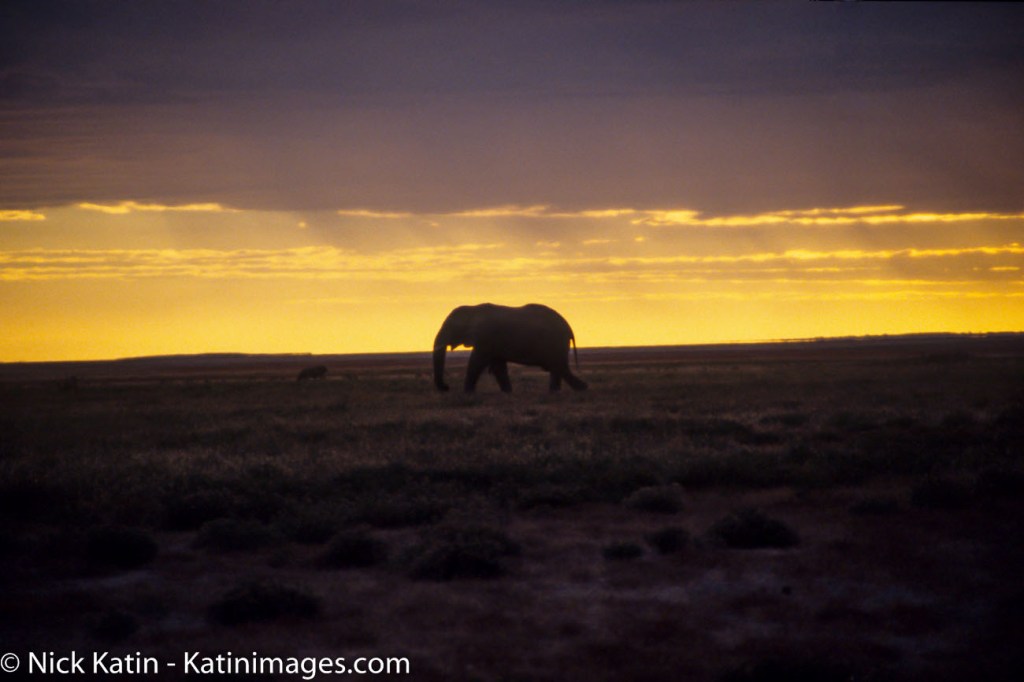
    An elephant strolling through the scurb at sunset in Etosha national Park, Namibia
    An elephant strolling through the scurb at sunset in Etosha national Park, Namibia


  • African shoestrings – Namibia Day Sixty three – Etosha NP

    We now on our way to Halali, the next rest camp that was 70 kilometres away, which should only have taken us around hour but this place was teeming with animals. Every waterhole had an abundance so we didn’t end up getting there until after midday some 4 hours later!
    This wildlife viewing slows you down!
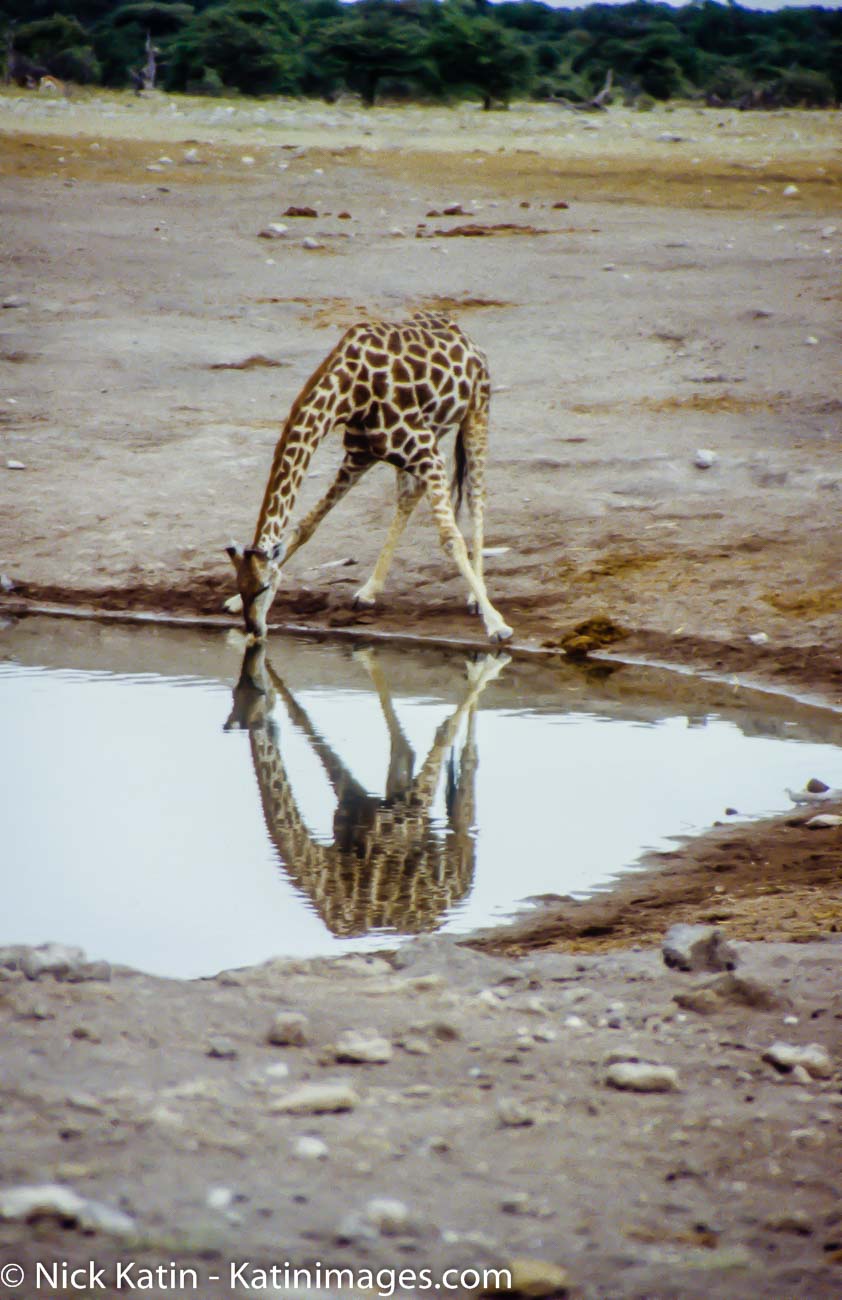
    But how can you hurry when a big herd of elephants turn up at waterhole that you’ve been watching for a few minutes or two or three giraffes bend over, legs splayed, to have a drink.

    At Halali we were back to camping after the dubious luxury of a chalet at Okaukuejo. It was fine, a bit dusty but there weren’t many other happy campers, so it was quite quiet.
    That was until an overlander with at least 20 people hanging off it parked next to us. Needless to say we didn’t get much sleep that night.

    Halali also had its own waterhole and that evening we saw a three black rhino again. We tried to work out whether it was the same three we had seen at Okaukuejo the previous evening. It seemed almost impossible that three rhino (one was a baby) would walk 70 kilometres in a day but who knows! As they lapped away at the water, a lioness and a couple of hyena appeared. They didn’t hang around long! One of the rhino continually went for them so that eventually they got the hint that they weren’t welcome to join the rhino family for a drink.

    Our morning game drive yielded more lions again. How boring! There were three males strolling down to Salvadora waterhole obviously thirsty and possibly hungry. We hung around for a while but they just found a shady tree and slept.
    Lions actually sleep or rest for around twenty-one hours a day, leaving just three hours to hunt and eat. It’s a little known fact that they actually have a very low kill hit rate but one decent kill can last them for almost a week. Of course these three guys probably weren’t thinking too much about actually hunting that’s a predominately female occupation. They actually looked like they were having a boy’s day out, a bit of strutting and a few drinks and whole lot of sleep.

    We had the same distracting problem getting to Namutoni the last of the rest camps in the afternoon, which again is 70 kilometres away.  Elephant, giraffe, gemsbok, etc all appeared from time to time at different water holes.

    Namutoni is home to the rather out of place Namutoni fort; a relic of German colonial days. Built in 1899 as an outpost for troops to control the Owambo people, it’s now tourist accommodation. In 1904 seven soldiers faced the impossible task of defending it against 500 warriors, needless to say they didn’t succeed.

    Namutoni had its own waterhole but for some reason it’s not as popular with the animals as the others at Okaukuejo and Halali, even though it’s a lot more picturesque. Still we couldn’t really complain we had seen a cheetah close up and fifteen giraffe on our late afternoon game drive earlier.

    It was time to leave Etosha. It really was an experience and great value for money in comparison to some of the other game parks in Africa. US$22.00 per day for a chalet and US$13.00 per day for a camp site including all the game viewing you can cram in during daylight hours is pretty good. Especially when generally speaking there’s so much game around.

    If you like this then hit “follow” on the side bar

    A giraffe takes time out to have a drink at a watehole in Etosha National Park in Namibia
    A giraffe takes time out to have a drink at a watehole in Etosha National Park in Namibia
  • African shoestrings – Namibia Day Sixty two – Etosha NP

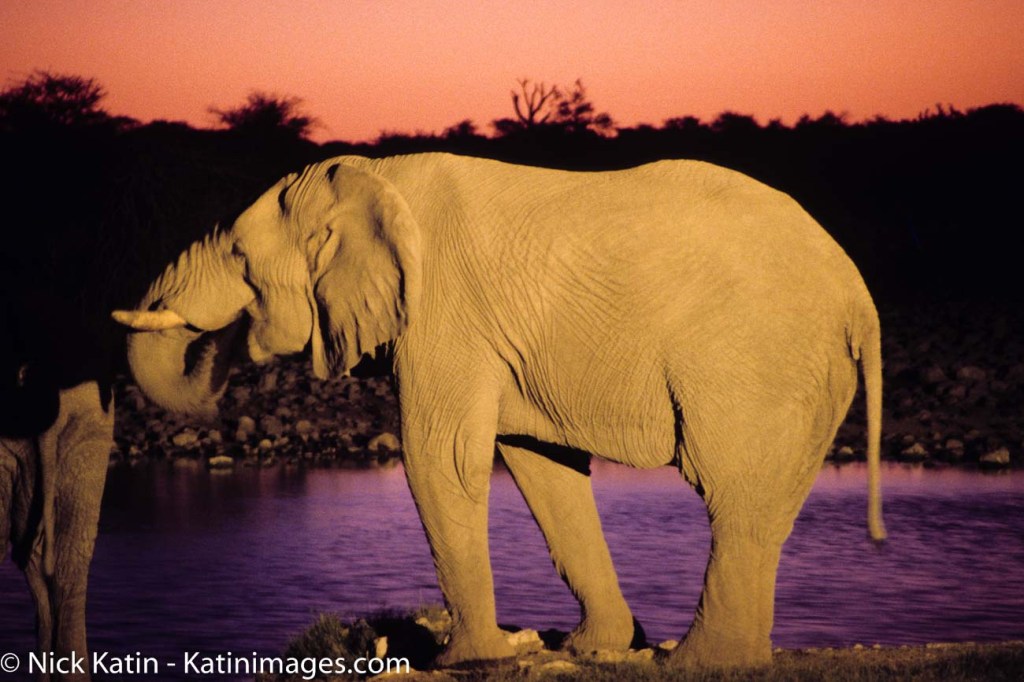
    Back at the camp we found a couple of seats by the illuminated camp water hole and waited for the show to start. As darkness came so did a herd of thirsty Elephants. They drank like there was no tomorrow. We thought that they would suck the water hole dry. But suddenly they all stopped and led by the boss bull all fifteen including five babies, trooped off, like a scene from Jungle Book, into the under growth and out of our sight.

    Later that night we were really privileged. Three black rhino sauntered down for a drink. Why were we privileged? Well the black rhino is probably the most famous endangered species in Africa. Due, mainly to poaching, there are a little over 3000 left after having a population of 60000 in 1970. It’s not my place to explain the mechanics of why these powerful beasts are exterminated ruthlessly for their horn so that the ‘misguided’ population of some Asian nations can use it for medicinal and aphrodisiac purposes. Nor is it my place to explain why the Yemeni insist that they must have daggers made of rhino horn.
    Suffice to say that due to both of these stupid ignorant beliefs a few ruthless businessmen make a fortune out of having a beautiful animal virtually wiped out from the surface of this planet and that sucks!

    Black rhino are also one of the ‘big five’. These five were the most prized ‘scalps’ by game hunters and if you think that’s just a relic of the past, then think again, there’s still plenty of opportunities on private land for game hunters to shoot defenseless animals for ‘sport’.

    Now the ‘big five’ are sought after for the best viewing. The other four are lion, leopard, buffalo and elephant and on that particular day we had seen three of them.
    For those of you thinking of game viewing in Africa, don’t knock yourself trying to see this group of animals. There is plenty of other wildlife to be seen that are just as enjoyable to watch. Game viewing is not a serious of ticks on a ‘to see checklist’ but an opportunity to watch Mother Nature at it’s wildest best.
    Anyway that’s enough winging and preaching for now.

    The next morning there was wildlife everywhere!………….. Giraffe, zebra, hyena, red hartebeest, impala and kudu to name just a few and then on then way back a huge bull elephant just ambling across the road just a few metres in front of us. It occurred to us at the same time that elephants have been known to charge if spooked, if this baby had turned on us this little ‘Chico’ would have been scrap metal within seconds.
    Needless to say I had the gear stick in reverse and the handbrake off, just as a precaution!

    The afternoon yielded different results. We went back to Okondeka hoping to see the same pride of lions. They were missing in action but what we did see was a male lion sitting in the shade of a thorny acacia tree, you know the ones, the trees that are shaped like an umbrella and are in almost every African sunset shot found in the glossy travel brochures.
    We didn’t realise that he was injured until he got up and strolled or rather limped away. We managed to follow him to his destination, a carcass that probably a few hours a go was live Zebra, going about his business of chewing a few blades of grass, before being brutally murdered for Monsieur lion’s dinner. Somehow the lion must have got injured during the kill, but that didn’t stop him chewing away and at the same time growling at the vultures and jackals who anxious to share the spoils.
    It was quite fascinating to watch. I felt like we were watching a discovery channel show!

    If you like this then hit “follow” on the side bar

    An elephant drinking at dusk at a camp waterhole in Etosha NP in Namibia
    An elephant drinking at dusk at a camp waterhole in Etosha NP in Namibia


  • African shoestrings – Namibia Day Sixty one – Etosha NP

    Before we left home the idea of picking up some casual work in Southern Africa had appealed. We emailed several lodges in Namibia and Botswana with no luck. However some of these lodges were quite helpful and invited us to drop in when we were in the area, hoping, of course, that we would stay as guests.

    One of these lodges was Camp Setenghi, who had an office in Outjo, the last decent sized town before Etosha. Wayne and Ilvia were genuinely friendly and interested in what we were doing and more than happy to offer advice with no strings attached. They still had no work and in fact warned us that it was illegal to work in Namibia without a work visa and that could lead to some unscrupulous employees taking advantage and basically ripping you off.

    We had actually already dismissed the idea of working in Africa. One of the pitfalls of middle age ‘backpacking’ is the fact that you are often parents as well. In our case our grown up sons were both working in London and we hadn’t seen either of them for quite a while. Working would have delayed any reunion, so it seemed a better idea to simply work for longer in England, where there appeared to be plenty of work and where we had no work visa issues.

    Etosha National Park is 22,000 square kilometres of animals!
    It doesn’t have the same international profile as Botswana’s Okavango Delta and Chobe, Kenya’s Maasai Mara or Tanzania’s Serengeti but it does have an abundance of wildlife that rivals any of it’s more famous counterparts.
    The name Etosha means ‘great white place’ after its main feature the mostly dry Etosha pan that is roughly 120 kilometres long and 72 kilometres wide and dominates the Park in area. Game viewing revolves mainly around the many natural and manmade waterholes that dot the southern edge of the pan. That’s not to say that game can’t be seen elsewhere, it’s just they’re the most likely spots.

    We stayed in a small chalet in Okaukuejo, the first rest camp. Each camp has a waterhole of it’s own and we were disappointed that our chalet with it’s hospital towels and décor wasn’t closer to it. But we soon forgot that and concentrated on the business of wildlife viewing.

    One of the beauties of Etosha is that it’s easy to self-game drive even in the little ‘Chico’. The roads are mostly gravel but are pretty firm so a 4WD is not required. As soon as we got settled in, we were off in search of wildlife.

    At the Okondelia waterhole there was an abundance. Zebra, Wildebeest, Gemsbok, Springbok, Jackals and the pièce de résistance, Lions, everyone’s favourite. We spotted one going for a kill and suddenly there were another seven, two females, one male and four young males, strolling down from the hill behind us towards the water hole to our front. Amazingly they just ambled around the five or six vehicles, that were all clambering for the perfect possie and photo, as if they weren’t there. One of them, a young male, got within 2 metres of the car and Sue nearly dropped the camera out of the window in her excitement.

    What incredible looking beasts they are, finely tuned, aerodynamically designed and perfectly shaped, they are nature at it’s handsomest. You can go to the best zoo’s in the world and see them up close but nothing beats seeing them on their own turf. In a zoo they are just a caged animal, here free to roam they are Lions! They have that spring to their step and sparkle in their eye. This is who they are!

    They all met up at the water hole for I suppose a bit of a sundowner. It was a great start marred only by some dickhead in a red Chico moving his car around to get a better shot at one of the other young males close to his car and frightening him in the process. He should have been dragged out of the car and literally thrown to the lions for dinner by the rest of us, who felt honoured enough just to sit still and experience mother nature at it’s best.

    If you like this then hit “follow” on the side bar

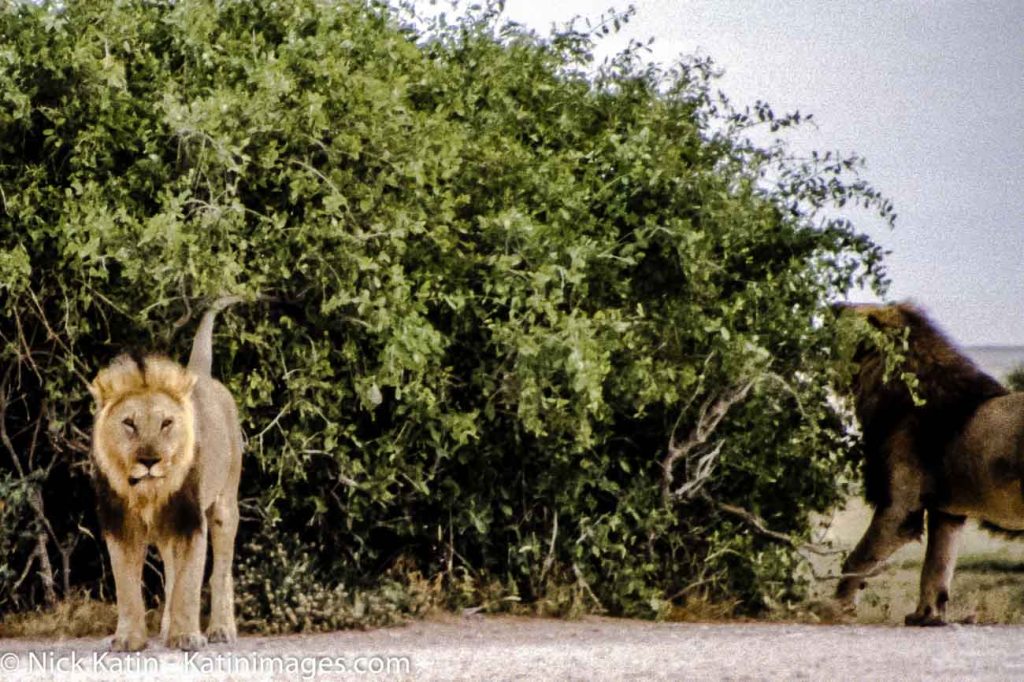
    Two lions hanging out together at Etosha National park in Namibia
    Two lions hanging out together at Etosha National park in Namibia
  • African shoestrings – Namibia Day Fifty six – Namib desert

    Dan Viljoen is a good place for hiking or even just casual walking. We sauntered along the 3 kilometre Wag-n-Bietjie trail to the Stengal Dam enjoying the twittering of birds and the gentle breeze and then at the dam watching a lone wildebeest and a family of warthogs go about their business.
    The park has plenty of game, none of which are at all dangerous. On the game drive we did after the walk, we spotted Mountain Zebra’s, Gemsbok, Springbok, Red Hartebeest, Kudu and two Wildebeest standing on a cliff edge with a backdrop of Windhoek in the distance.
    Coming from a country such as Australia where the wildlife is on the whole small in size and nocturnal in nature, it’s mind-blowing how much wildlife you can see on this continent. Even more mind-blowing is the thought of how much more there must have been before the arrival of Europeans, who brought hunting and poaching and the destruction of the animal’s habitat. Fortunately most African governments have recognised that preservation of these magnificent beasts is important not only to the environment but also to tourism and have set aside large areas for them to roam freely and safely.

    The Rooibes trail we followed the next morning was around 6 kilometres longer and was a good little hike through green hills covered in scrub brush and small acacia trees with panoramic views across to Windhoek before following a river bed. The final couple of kilometres let it down; taking us through a neglected part of the park that was overgrown and speckled with dumped used tyres. We’ve encountered several good walks in the past that have been spoilt by the last stretch. Its almost as if the track designer lost interest two thirds of the way and just ordered the trail builders to find the quickest and most convenient way back. Still it was a good walk and once again we saw plenty of wildlife.

    I managed to get hold of Werner, the car hire owner ,so that we could do something about the gaslight that wouldn’t work. We met him back in Windhoek at the Maerua shopping centre, Windhoek’s and probably Namibia’s biggest. We swapped lights did a bit of food shopping and headed out to our next destination, the Naukluft Camp in the Namib Naukluft National Park.

    The road to Rehobeth was 100 kilometres of flat bitumen and even in our little toy car we could get up a head of steam. What slowed us down considerably was the 130 kilometres of gravel road to Naukluft. We had, to be fair, been warned. Werner had told us to keep the windows closed to prevent dust getting in but driving in mid 30’s heat without air conditioning and no fresh air was just too much. From hereon in we knew that most of the roads we needed to use would be gravel so we had to get used it and if that meant driving with the windows down and sharing the car with grit, well too bad! So by the time we got to Naukluft we were just a little hot and dusty.

    If you like this then hit “follow” on the side bar

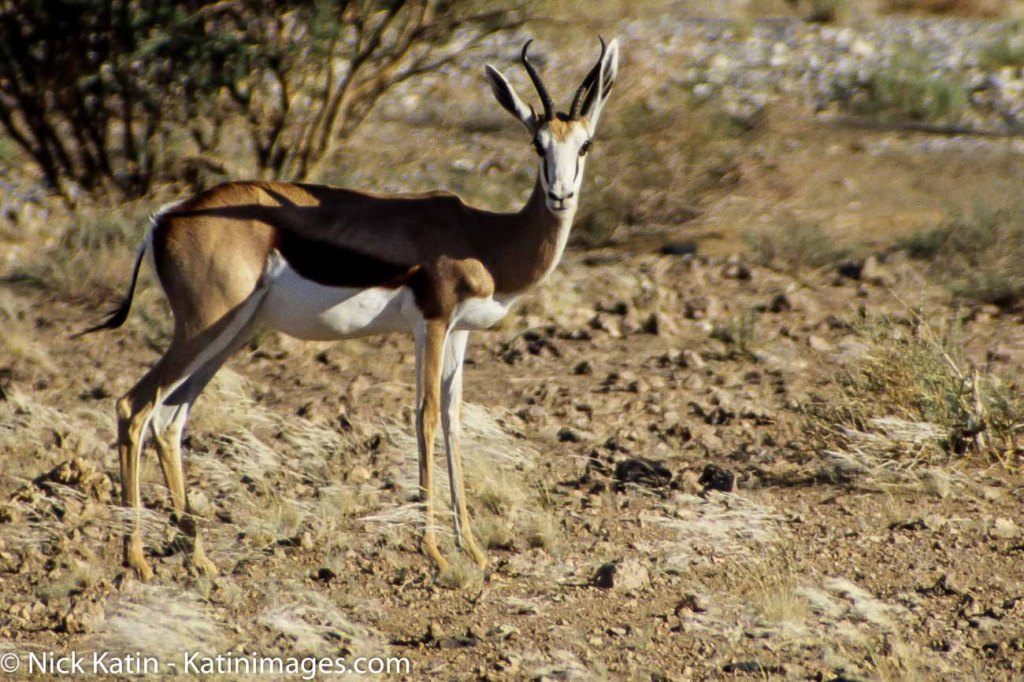
    It is extremely fast and can reach speeds of 100 km/h and can leap 4m through the air. The common name "springbok" comes from the Afrikaans and Dutch words spring = jump and bok = male antelope or goat.
    It is extremely fast and can reach speeds of 100 km/h and can leap 4m through the air. The common name “springbok” comes from the Afrikaans and Dutch words spring = jump and bok = male antelope or goat.
  • African shoestrings – Namibia Day Fifty five – Windhoek

    We had to organize the next three weeks because 90% of the attractions are in the National Parks, so unless you are on a tour you have to book in advance any accommodation with the Ministry of Environment & Tourism (MET) who manage the parks. There is of course plenty of private accommodation outside of these parks but the majority of these are expensive lodges close by or hotels, B&B’s and municipal camping grounds further afield.

    The MET office was located in the centre of Windhoek and the moment you enter the office you have that initial despairing feeling of hopelessness as African bureaucracy oozes from every desk, wall and official.

    We had the feeling that this could take all day.

    In the end it took about an hour and the guy behind the counter was really helpful and patient as we shuffled and reshuffled to try and fit in with their vacancies. “We’re not world class yet” he said “but we are getting there slowly, so we please be patient with us” …………this guy was good!

    Windhoek is pleasant enough, plenty of shops and the odd restaurant but strangely enough not many travel agencies that deal with budget trips to Botswana. We had been warned that it was probably not a good idea to wander around at night, so what do we do? Yes you’ve guessed it, walked back in darkness after a lengthy stint at the supermarket stocking up!

    Our hire car was a little Chico, again.

    I cannot stress the word ‘little’ enough. With all the camping gear, an additional mandatory spare wheel and our bags, it was touch and go whether we could actually get in ourselves. The biggest components were the two foam mattresses and a canvas tent similar to the one we had used in the Kalahari. On the back seat was a box full of camping gear like a single burner stove, gas bottle, cooking utensils etc. A sign that said in English and Bantu “Warning. Snake in Box” was stuck on both the side rear windows. I asked Werner, the Namibia Car Hire owner, manager and probably only employee, what that was about.

    “The blacks are afraid of snakes, so they’ll think twice about breaking into the car” Nobody was that thick I thought at the time. And sure enough a few days later as I filled up the car at a service station a couple of “blacks” were standing near the car laughing and pointing at the sign.

    Daan Viljoen Game Park was our first stop in this eighteen day self drive tour. It’s about 25 kilometres from Windhoek and it’s quite a peaceful place. Well it was when we first set up camp! But as is often the case a group of campers turned up and parked a few spots along deciding that we would all enjoy their ‘ghetto blaster’ playing rap and techno music as much as they would. Having just had to clean the tent of sand and dust, we weren’t impressed. Add that to the fact that the gas light jet was blocked (I nearly started a fire trying to get it to light) and we were really off to great start.

    If you like this then hit “follow” on the side bar

    A Wilderbest overlooks Windhoek, Nambia's capital
    A Wilderbest overlooks Windhoek, Nambia’s capital
  • African shoestrings – South Africa Day Fourty seven – Kalahari

    On that subject, of food, these tours feed you well. Whether it is a budget tour like ours or a five star tour, the tour companies must drum into the tour leaders that the guests must eat. I can just hear them now “Never mind the spectacular scenery or the animals, the object here is for the tourists to eat at least three big meals a day, and if possible morning and afternoon tea and equally as important on time!”

    On one tour we did in Kenya the 4WD got bogged in sand in Lake Nakuru and despite our protestations our guide insisted that we get a lift with a passing vehicle so that we wouldn’t be late for lunch. It was a long lunch because he turned up 6 hours later, covered in mud from head to toe. We would have much rather stayed and given him a hand.
    In Uganda on a Gorilla safari we had a guide called Charles. Charles had a small straw picnic hamper that he spent a great deal of time arranging and rearranging after use so that all the crockery would fit in a certain way. Watching him go through this ritual for the first time it, was merely amusing, by the time we had our last morning or afternoon tea it was all we could do to prevent ourselves from breaking into absolute hysterics, as he fastidiously and obsessively arranged everything first one way then another until satisfied and then sighed, contented with his final arrangement. What didn’t occur to him was that we could have quite happily saved him all this pain and skipped morning and afternoon tea!

    Strangely enough most tourists remember the food they have on these trips more than the experience they had! How often do you hear “Oh and the food was wonderful/crap”
    Maybe the tour operators have a point!

    We had some unwanted visitors that night. Jackals, like the baboons in Golden Gate come in darkness and scavenge anything they can get at. We weren’t affected but a group of school kids who were sleeping under the stars had a torrid time as the jackals ran off with all their stuff and scattered it around the camp or worse took it into the bush.

    The next day was our last of the tour and that meant heading back to Upington, 160 kilometres away, 60 on gravel, slowly at first so that we could search for any game. But once again it appeared that the script had been ignored. We were all now thoroughly depressed and ready to give up.

    Suddenly by the side of the road Roland exclaimed “Lion”. Sure enough right by the roadside lay two male lions asleep under a small but shady tree. The lions of the Kalahari are meant to be amongst the biggest in Africa and sure enough after seeing them up close, I can see why. They were big! They didn’t really entertain us apart from one of them standing up, moving 5 metres and plonking himself down again with a heavy thud before going back to sleep. But we didn’t care we had finished on a high and all of us had a bit of a smile on the dusty journey back to Upington.
    Mind you I think Rolands smile was more one of relief than joy. He had, at the beginning, dangerously bragged about how much game we would see in the park and felt personally responsible for any success or failure. Not that he should have done. Game watching is a bit like trying to win at the races; you can study the form but in the end it’s pretty much out of your control.

    If you like this then hit “follow” on the side bar

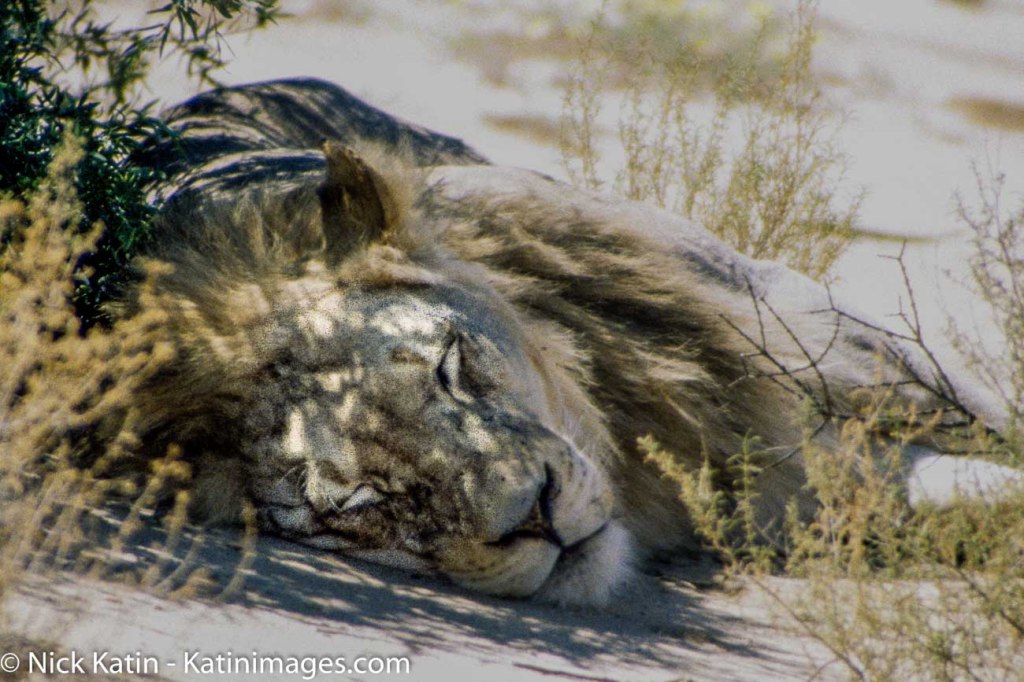
    A lion sleeps in the shade of an acacia tree in the Kalahari national park on the border of South Africa and Botswana
    A lion sleeps in the shade of an acacia tree in the Kalahari national park on the border of South Africa and Botswana
  • African shoestrings – South Africa Day Fourty six – Kalahari

    A night drive is a game drive, obviously, in the dark; well it was really in twilight as we set off just before sundown. The idea is to see lots of animals big and small as they cruised around in the coolness of dusk and then stop for a sundowner in the middle of nowhere. As it got darker so our reliance on the two spotlights grew and of course the obvious happened one of them blew. So the ten of us on the drive all had to squint into the dark to spot anything.
    We did actually see quite a few animals. But of course we didn’t see any of the more popular ones like lions, cheetah’s etc.

    Back at the camp we ate one of Roland’s culinary masterpieces under the light of plastic drink bottle covered candles.
    Now was the time for that beer as we got to know each other better.
    Simon & Hannah had just left school and were doing a bit of travelling before starting University in England. Alex, was visiting rellies in J’burg and I got the impression that they had shunted her onto this tour to get her out of their hair, she certainly was a little temperamental. Michelle was the quiet one. She had finished her Peace Corp stint in northern South Africa and this was her last days in Africa. Despite her quietness and the fact that she was American she had a great sense of humour. Well I think she did, she laughed at all my jokes.

    The tour kept rolling on, our next stop was the camp at Mata Mata, 127 kilometres north on a gravel road. The idea was to take it slow, have brekkie and lunch on the road and do a game drive at the same time.

    Well we saw heaps!

    Cheetahs and lions in the distance, black backed jackals, cape foxes, steenbok, gemsbok, wildebeest, springbok (these last our all from the antelope family) and the quaintly named long legged big bird, kori bustard.

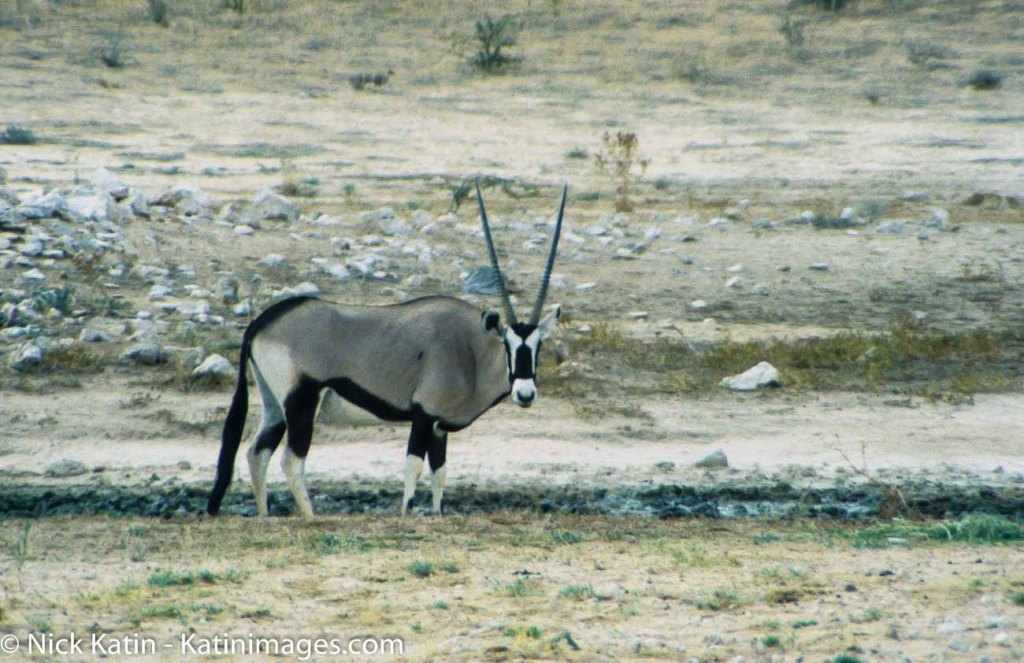
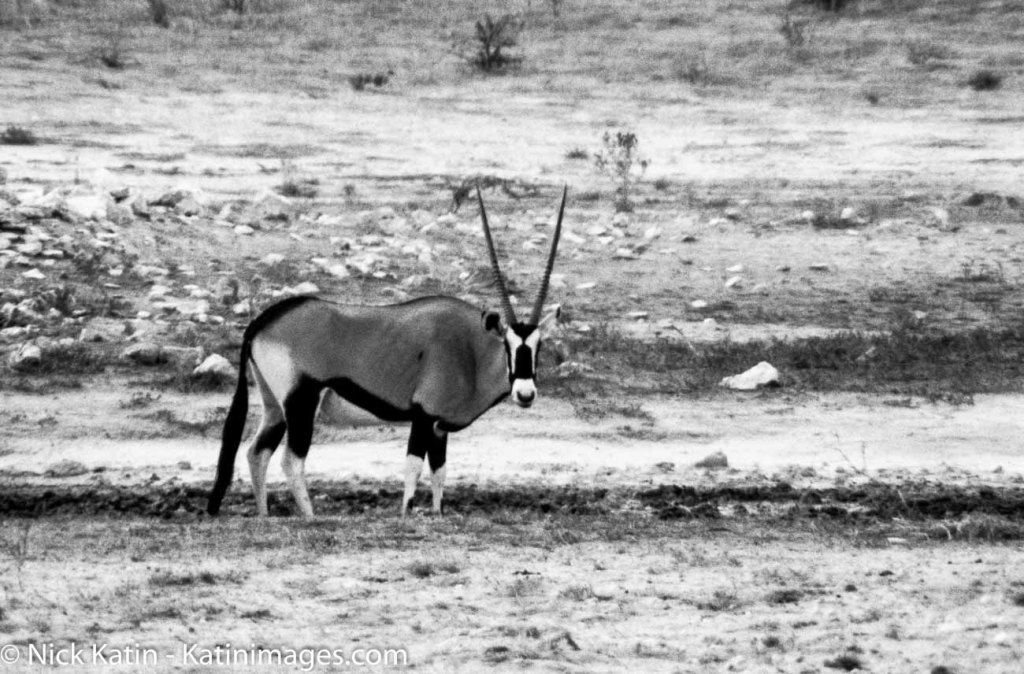
    The park was named after the Gemsbok, being quite common in the Kalahari. It’s a big animal at around 1.2 metres tall with striking fawn grey flanks, black legs and tail and metre high pointed horns. In my humble opinion, this is the most beautiful of all the antelope species found in Africa.

    The next day was pretty much the same format, as we drove on to Nossob, the last of the three camps, except the little critters must’ve sent out the message via the desert telegraph to hide when ever we came on the scene, because we saw virtually nothing.

    Nossob like Mata Mata was more basic than Twee Rivierien, but it did have an animal hide. Once again the animals didn’t read their scripts properly and forgot to come and see us. So we had to gain our entertainment from Roland who was busy being his industrious superhuman self. He was cooking spag bowl and fixing three punctures all at the same time. That night he told us stories of rangers cutting off their limbs to save their own lives after a predator attack in the bush. How he caught tick bite fever and was hospitalised for 9 weeks and how he had just recovered from a bout of Malaria which was really bad that year and had resulted in many deaths in central and eastern parts of South Africa. I think he has the philosophy of “never bugger up a good story for the facts”.

    Fortunately he told us these stories after we ate!

    If you like this then hit “follow” on the side bar

    A Gemsbok in the Kalahari national park
    A Gemsbok in the Kalahari national park
  • African shoestrings – South Africa Day Fourty four – Kalahari

    The plan had been to get to Augrabie Falls and camp there the night but it was a good 2-3 hours drive away and now it was too late. “So” said Roland “we’ll sleep the night in the dorm and head out early tomorrow”.
    He must have seen the look on Sue’s face, because he came up to us and said quietly “I’ve organised a double room for you two, m’dear”.

    That evening it was the Roland show! He’s an excellent cook and his yarns entertained us all. Apparently he’s done it all, played Rugby union for South Africa, seen some terrifying incidents involving Lions, Cheetahs and Leopards in his normal role of Kruger National Park ranger and lived a life that was reminiscent of some of the more famous novels about growing up in Africa.

    Roland’s dominance of the evening was interrupted by Katrina, another, in fact the only other guest at Yeho’s (do you call people staying at backpacker hostels, guests?). Katrina hailed from J’burg and was one of those ‘try hard’ hippies that are to be found running new age shops where relaxation music and the tinkling of wind chimes are designed to calm you enough to get out your credit card.

    She had just spent several days, finding herself in the Kalahari Desert! Well the Kalahari is roughly 700,000 square kilometres of red soil, sand dunes and very little vegetation and more importantly virtually uninhabited and uninhabitable. So the chances of you finding yourself are pretty high as you won’t find anyone else and unless you know what you are doing, your time with your newly found self will be extremely short! Katrina had never done anything like this before and had somehow survived and sat very satisfied with herself.
    Each to their own I suppose – not something I would do.

    We got to Augrabie Falls early enough for Breakfast. The name Augrabie is the Namaqua word “for place of great noise”. The Namaqua inhabit the north west corner of the Northern Cape and are one of the main Khoikoi tribes in South Africa, a people who were arguably one of the first inhabitants in the Cape.

    Augrabie Falls is on the Orange River and has over time carved its way through a rocky landscape and plunges down into rocky and almost lunar landscaped gorge below. The amount of water flowing down this almost vertical giant water slide is amazing considering it had been dry recently. After heavy rainfall the falls rise up along the sides of the gorge. That must be some spectacle!

    After seeing Mother Nature at its best we moved onto to see wine making at its worse. The Orange River Wine Cellar is nothing but a cheap bulk wine producer that fills bottles instead of casks and flagons. The wines tasted like flat coke!

    Still it was interesting how they had managed to carve these huge vineyards out of such an arid landscape. They couldn’t have done it without being so close to the Orange River and using the water to permanently irrigate the vines. They claim they are the second biggest individual wine producers in the world. Based on the amount of vines they had spread around, I for one wasn’t going to argue (that is apart from the fact that place seemed full of big beefy guys that looked like they had swapped punches with the best of them on the rugby pitch).

    If you like this then hit “follow” on the side bar

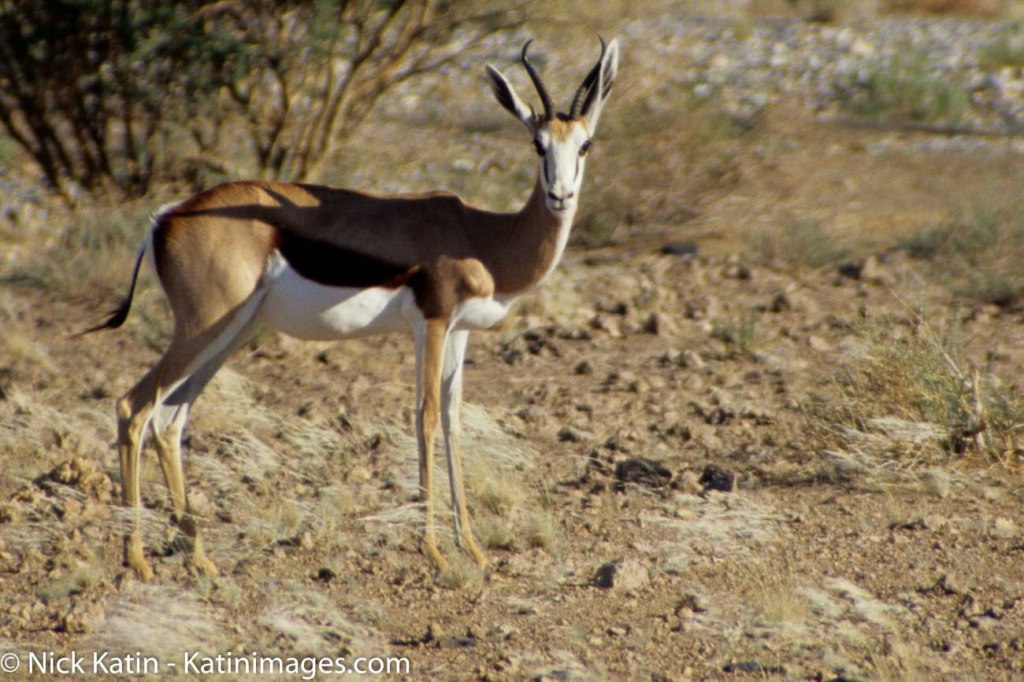
    Springboks are extremely fast and can reach speeds of 100 km/h and can leap 4m through the air. The common name "springbok" comes from the Afrikaans and Dutch words spring = jump and bok = male antelope or goat.
    Springboks are extremely fast and can reach speeds of 100 km/h and can leap 4m through the air. The common name “springbok” comes from the Afrikaans and Dutch words spring = jump and bok = male antelope or goat.
  • African shoestrings – South Africa Day Fourty – Stellenbosch

    The following day we ‘jumped ship’ and found a little apartment just out of town.
    Not that there was anything wrong with the Stumble Inn, it was just the noise from the other ‘guests’.
    I’d like to think that we haven’t we’ve lost touch with modern music but the repeated thumping of ‘techno’ music is not the best bedtime music as far as we were concerned.
    A young guy, John also from Perth, who was travelling around on his own, shared this opinion. In staying in the dorm, he was in a worse position than us and was getting fed up with being constantly disturbed as his fellow bedmates stumbled in and out of bed.
    Never really gave that much thought before. As a couple we always got a private room and had drawn a line in sleeping in a dorm. But anyone on their own is pretty well damned if they want privacy. They either pay more than double the cost for a double room (they are often more expensive per person than a dorm) or put up with sleeping in the same room as a load of strangers, have no privacy and in some circumstances be permanently on guard watching their belongings.

    Anyway we had enough of the Stumble Inn, we had lasted two nights, and for just a few more Rand we had a nice cosy little place tagged on onto someone’s house called “Kaveeltjie”. That someone was Gertie an extremely helpful and warm housewife with a couple of youngish kids. She picked us up at the tourist office in town and couldn’t do enough for us.

    One of the fascinating things about South Africa is the white Afrikaners. Most of these are descended from the original Dutch, German and French settlers and have been in South Africa since the seventeenth century. This is different from the whites of British heritage that have only been around since the nineteenth century. That in itself is interesting but what really fascinates me is that when you meet the Afrikaners is their own country they are totally different from your expectations. After all this is a race that is responsible for apartheid. A lot of these expectations are based on the media and those you meet in Australia who have left the country for good.
    Well we found them to be kind, friendly, warm and honest people. You almost get the feeling that they would give their lives for you. A lot of that comes from their strong religious beliefs, but I’ve met plenty of religious people over the years who will hardly acknowledge your existence let alone help you out in tight corner.
    These people also have an amazing attachment to their language, which for most of them is their first language, with English being used only whenever it’s really necessary.
    One particular lady we met on our first visit, actually pitied us for not being able to speak Afrikaans, saying it was such a shame that we were unable to use words that there was no equivalent for in English to describe the world around. At the time I wasn’t that convinced. But the more of these people I met the more I think there must be something in it. So many actually struggle to translate certain words from Afrikaans to English which tends to surprise as their English is usually so fluent.

    Any way Gertie fitted this mould, and was happy to give us a few pointers for our future travels and expeditions.

    If you like this then hit “follow” on the side bar

    A Gemsbok in the Kalahari national park in South Africa
    A Gemsbok in the Kalahari national park in South Africa
  • African shoestrings – South Africa Day Thirty-two – Cape Town

    Back in the guest house we learned what we had suspected that morning, Andre was a ‘know it all’ who liked to give you the benefit of his wisdom and experience in as many words as possible regardless of whether you asked for it or not.
    In fact listening to him politely, trying hard to stifle an epidemic of yawns wasn’t a shared duty as Sue somehow seemed to have a good reason to go to our room and would leave me stranded and bombarded by all this trivia, opinions and ‘expertise’.
    What did make us both chuckle was Andre’s insistence on stating “and that’s all there is to it” after every statement or monologue. After hearing it so many bloody times I can’t believe that we actually took this up as a catch cry as for the rest of our travels through Africa. We must have been brainwashed! For the life of me I cannot remember anything else that Andre said; but I do remember the fact that 90% of Andre’s commentaries were about the New South Africa.

    Henry on the other hand was far more interesting!
    Henry was a twenty-one year old black Student from Zambia studying at Cape Town University, South Africa’s and probably Africa’s best university and he was lodging at the guest house. Tall, lanky with tight cropped hair like so many of his generation, he was articulate and extremely mature for his age and spoke with some knowledge of the world today.

    That’s what’s so good about travelling, you meant the most interesting people in sometimes the most unexpected surroundings.

    We chatted to this guy in the kitchen as we both prepared our evening meals. He told us of his home near Lusaka in Zambia and how when he drove there from Cape Town, a journey of over 2000 kilometres, he could almost smell it as he crossed the border and first spots the Zambezi escarpment with now only 150 kilometres to go.
    His father was, we gathered an important government official and they wanted for little, except a university of quality close by, hence the 4000 kilometre round trip every time he went home.

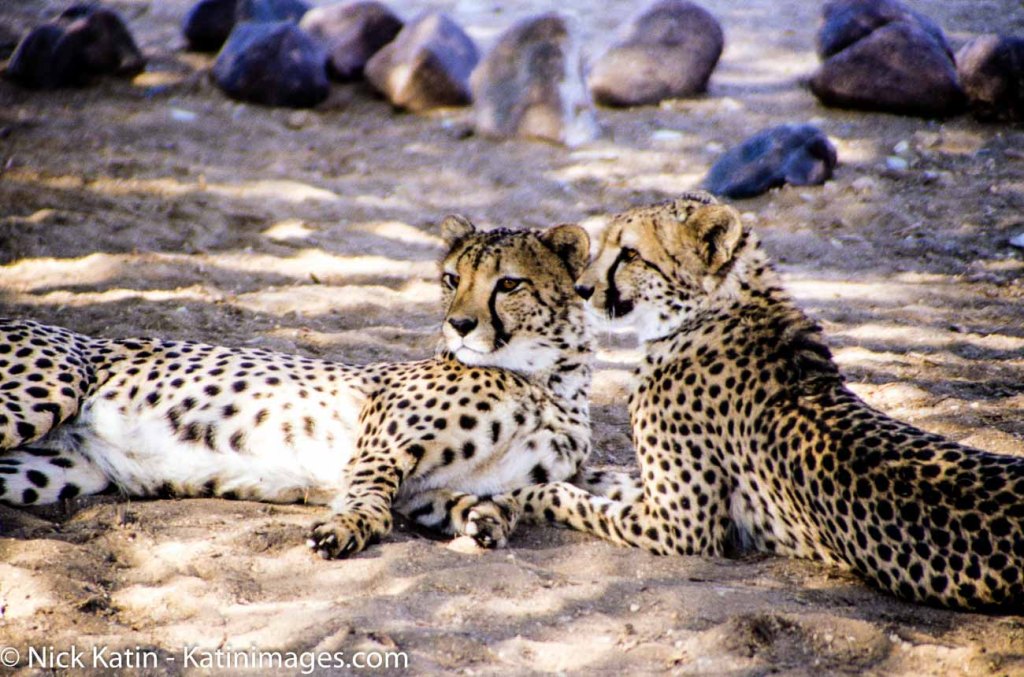
    Two cheetahs watch pensively in the Cheetah Outreach Project in South Africa
    Two cheetahs watch pensively in the Cheetah Outreach Project in South Africa
  • African shoestrings – South Africa Day Twenty-six

    The main reason that we had elected to stay in J’burg the extra night was to see Soweto.

    Soweto you say! Why would anyone want to see such a notoriously dangerous place?

    Well, most tourists visiting South Africa regardless of budget have minimal contact with black South Africans. Very few get to visit black townships or satellite towns because of their reputation or lack of opportunity.
    Hotels and all levels of accommodation, tour companies and other tourist facilities are still in the main, owned and run by white South Africans and generally black South Africans tend to keep their distance particularly from white tourists.
    Not surprisingly Soweto has had the biggest media coverage and for most represents South Africa at its worse. It has in reality, been a war zone ever since that fateful day in June 1976 when many black students were killed by police in a march against the use of the Afrikaans language in black schools.
    So to see such an infamous place is to observe black South Africa.

    Of course we were not stupid enough to go in on our own. Soweto is now a tourist attraction, so there are a number of tours that are run chiefly by black South Africans.

    Like most people I expected to see squalor and poverty on a large scale and it stopped me in my tracks to see that parts of Soweto were just like any other middle class suburb in the world. Nic Mbewe, our guide and Padwana his driver lived all their lives in Soweto and as he explained “There are basically three types of housing in Soweto, upper for the educated with good jobs who are moving out because they can, middle for those with jobs and the poor end of town for those who have nothing”.
    To be contuined………

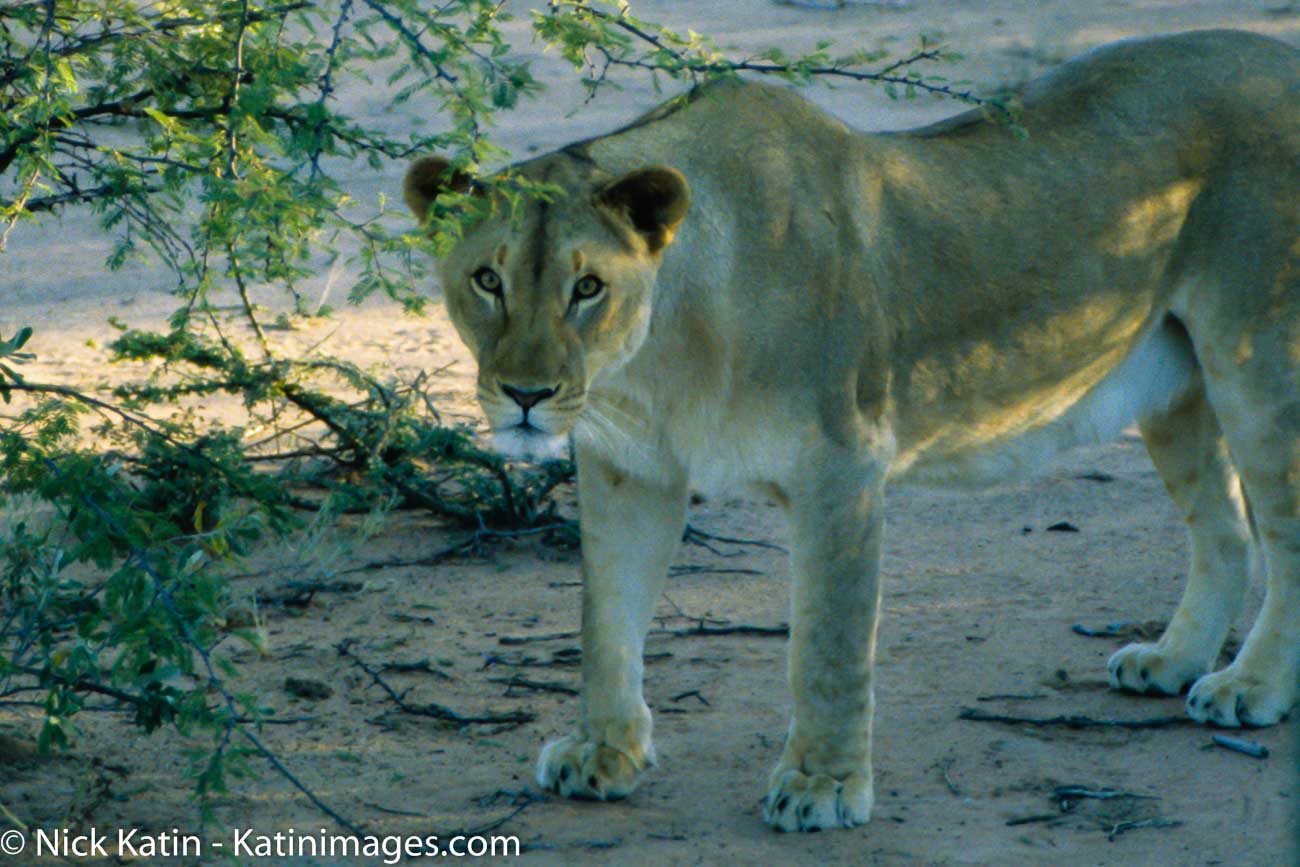
    A lioness underneath bush peers at it's potential prey in Namibia
    A lioness underneath bush peers at it’s potential prey in Namibia