Katin Images Travel Photography

Travel Photos, Travel Photography Tips and Software

Tag: namibia

  • 6 ways to prevent getting up to go the toilet at night – A “Michael Hyatt” style guide.

    It’s Wednesday and our bathroom renos started yesterday. By bathroom renos I mean BOTH bathrooms which means that we are without a toilet and shower.
    We arranged a portable toilet and shower to be placed outside in the carport about 50m away from the side door of the house, and for the moment we have to go through our partially covered patio and then step down some slippery steps. So going to the toilet is an adventure.
    Needless to say, doing the middle of the night toilet trip is something you really don’t want to have to do.
    So after listening to Michaels Hyatt’s podcast “Achieve More by Sleeping More, I thought of a few ways in the true Michael Hyatt style that we all could all develop to prevent this ritual.
    After all, whilst it’s not every day that you renovate bathrooms there are times that you just don’t want to get up. If it’s cold, if you are camping or staying in a caravan, sharing a bathroom etc. etc.
    So here are my 6 ways to prevent getting up to go the toilet

    1. Don’t drink anything
    I mean it just because you’re are meant to drink 2 point something Litres per day doesn’t mean you have to.

    2. Don’t go to sleep
    There’s plenty of successful people who survive on less than 2 hours of sleep. They have the odd health issue but who cares at least you don’t have to get up.

    3. Don’t drink anything after 4PM
    If you can’t do 1. Then do this. After all, if you go to bed at 10 then you’ve got 6 hours to get rid of all your fluid.

    4. Don’t get up
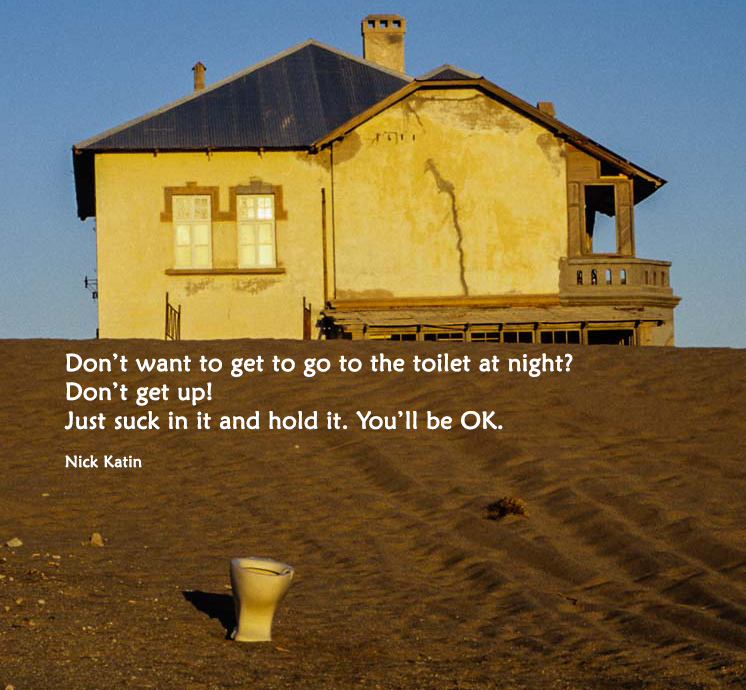
    Just suck in it and hold it. You’ll be OK.

    5. Have an accountability partner
    If you share your bed with someone else, then there’s a good chance that they too will need to get up to pee during the night as well. Just have an agreement that both of you hold each accountable to NOT get up.

    6. Don’t drink diuretics after 4PM
    This is actually a more serious one. Diuretics are things like alcohol and caffeine and they make you pee. So don’t drink ‘em! You’ll be considered pretty antisocial at the pub or a restaurant but you will have the satisfaction of not having to get up in the night whilst everyone else who is drinking will.
    9N_15

    So what about if you have to get up but don’t want to have walk too far
    Here’s 6 tips on that as well:

    1. Pee in the kitchen (or any other close by) sink – easier for blokes I think!
    2. Find a nearby tree
    3. Pee out of the window – again easier for blokes
    4. Wear a nappy
    5. Have small chemical toilet
    6. Have a potty

    So there you go. Can you think of anything I’ve missed? How many of you have been in the same situation? What have you done?

    Feel free to comment below
    Oh and Michael, feel free to use this if you think it will be useful for your readers.
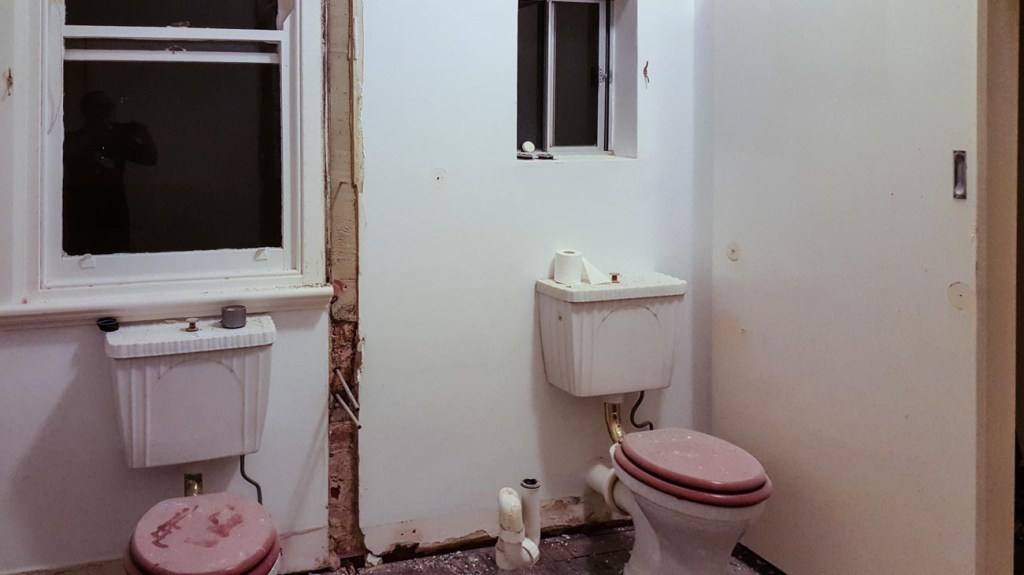
    This was once two bathrooms!
    This was once two bathrooms!
  • African shoestrings – Namibia Day Seventy-Six Botswana/Namibia

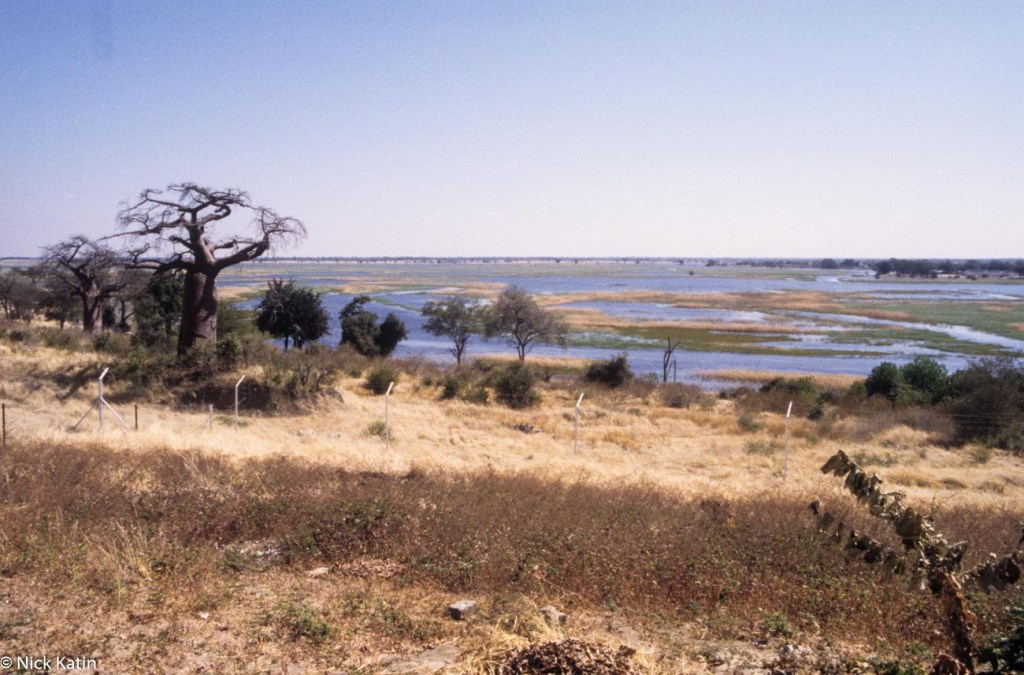
    At Rundu we saw for the first time since the Fish River now some 1200 kilometres south a riverbed that actually had water! The Okavango River separates Namibia from the infamous Angola and was at the time experiencing its highest water levels for fifteen years. Considering that no other river in Namibia, except for the Orange River that separates Namibia from South Africa, has water in it, this was a sight for sore eyes. Well every silver lining has a cloud! Ngepi camp is on the river about 50 kilometres east of Rundu and the only access road to the camp was flooded due to the high river level. This meant we had to leave our comfy minibus and wade the final stretch through the overflowing river, a river know to have the odd croc or two!

    The camp itself was a bush camp but with all the basic modern amenities in the form of open air toilets and showers separated by a bamboo walls and a pole barring the entrance to indicate if in use. Our tents had already been erected for us close to the riverbank, which was a lot steeper than where the road had passed it.

    We were briefed on the next 6 days by Neil and then Paul and then after dinner Neil again. Neither of them were actually coming with us, Neil, a South African was the manager and Paul an American had just returned from the delta. I actually took an instant dislike to Paul; he took a holier than thou attitude as he explained that the tour was a local community based tour. By that he meant that the polers (I’ll explain this later) all came from the same village and using them to canoe tourists around the delta was a good way of helping the local communities and villages. He was quite right of course but he didn’t have to be such a prick about it!

    We had heard that there were hippos and crocs in the Okavango but we didn’t expect to hear hippos chewing grass right outside our tents. Chomp! Chomp! They went all night or so Sue said the next morning. I slept through the whole thing!

    At 7.30 am we were shunted onto an overland truck to pass through the flooded road and then loaded back into our minibus to drive onto our next destination, Sapepo on the Okavango Panhandle in Botswana. Crossing into Botswana was unremarkable except for one thing the Namibian border post building was a shameful shack in comparison to the brand new buildings at the Botswana post. Botswana is an expensive place to visit when it comes to national parks and reserves. It costs around US$25.00 per day per person in park fees unless you are part of guided group i.e. Safari. By comparison Etosha cost US$3.00! The Botswana government’s rationale is that they don’t want the mass tourism of Kenya so they spend very little on infrastructure in the parks and charge high fees to restrict the number of visitors. From our experience trying to independently travel through Botswana is not easy either, especially on a tight budget. There are many obstacles, like extremely limited public transport, and gaining access to the parks and reserves, so the vast majority of tourists end up touring Botswana with tour operators who know the country; but don’t stay any longer than they have to. So I guess so far its only partially working!

    The Botswana/Namibia border was also the first place that we went through the passport swapping routine. This is not an illegal act of changing identity but simply changing nationality. So we gave Namibia our Aussie passport, that we had so far been using, for our exit stamp and Botswana our British passport for an entry stamp. Now bear with me why I explain why we did this. South Africa, Namibia and Botswana offer fee free visitors visas at the border for both Australian and British passport holders. Zambia charges British passport holders and Zimbabwe charges Australians however Zambia doesn’t charge anyone who enters the country with an official tour operator. This tour was going to leave us in Zambia from where we would cross the border into Zimbabwe. So why didn’t we just swap when we got to the Zimbabwe border? Well, a lot of third world countries don’t like this practice particularly if looks like it’s being done to avoid paying a fee (which it usually is of course). So it’s likely to be a lot less problematic if you choose to swap whilst in a group as the immigration officer is often too busy to check for an exit stamp from the adjoining country. As it happened the Namibian immigration officer did ask us on our way back a few days later, as to where our previous entry stamp into Namibia was. When we explained that we had used another passport he shrugged his shoulders and allowed us through. However as they don’t charge for visas I don’t suppose he cared.

    Unfortunately the last part of this grand plan let us down. We knew that Tanzania required you to purchase a visa but it was cheaper to purchase in advance when traveling independently and we also knew that it cost US$50 for a British passport and only US$10 for an Australian. So when we went to the Tanzanian embassy in Harare two weeks later we obviously produced our Australian passports for stamping. We were politely told that they could only stamp the passport that we had used to enter Zim on. But we could take our chances at the border post when we arrived although there were no guarantees. Having experienced problems before at a Tanzanian border post four years ago we paid up and shut up and thus ended up worse off than if we had just used our Aussie passports throughout, which being the patriots that we are, was our preferred option.

    If you like this then hit “follow” on the side bar

    Ngoma bridge Border on the Chobe River Botswana and Namibia
    Ngoma bridge Border on the Chobe River Botswana and Namibia


  • African shoestrings – Namibia Day Seventy five – Windhoek

    In most African towns and cities there are plenty of curio and souvenir shops, a lot of them tacky and often overpriced and Windhoek was no exception, we did however find tucked away in an old renovated warehouse that once housed a brewery, the Namibia crafts centre. This place sold only artifacts and souvenirs made by local Namibian communities and the profits go back into the community. We bought some bits and pieces from the one of the Namibia women’s communities and came away with that warm and fuzzy feeling that comes from knowing that you have helped people who have so much less than you. After all a lot of souvenirs and curios are often mass produced by large wealthy companies and sold in markets and small shops with the pretense that they have been hand made by the seller themselves. In some of the instances, this is achieved by the use of nothing more than slave labour. So it’s good to see that places like the Namibia crafts Centre, are beginning to appear more and more. So to all you future travelers I urge you to seek out these places and buy!

    Out last night at the Cardboard box was spent socialising. We met Andre, our driver for the Botswana tour that started the following day. Andre had only just started as a tour guide and as it turned out he remained with us for the all but the last day of the 6 day tour. A white Namibian he was a nice guy who like all novices made up for a lack of experience with lots of enthusiasm.

    We also met Sharon an attractive girl from somewhere in Queensland who was travelling around southern Africa on her own. Somehow or other an American called Jed (aren’t they all?) got into the conversation. He was a young guy also travelling on his own and was heading south whilst we were heading north so we swapped notes for a time. He of course had done everything and in comparison to us was travelling a lot ‘rougher’. Within ten minutes of the conversation it became pretty obvious that these two were in the process of starting a ‘romantic’ relationship and we were in the way. Sue, of course, spotted this first and tried to drag me away. I wasn’t going until I had extracted as much info as possible from Jed. Eventually we left our two lovebirds and made our way over to a young German bloke who bored us with tales of his travels in Australia.

    We set off at 6.30 am to start our tour of Botswana. Its run by a crowd called Audi camp who are basically logistics experts. They seem to take a bit of a tour here and another one there and make a complete package. I guess we had four components to our trip, the transport to Audi’s main camp Ngepi in Caprivi in the far north of Namibia, the Okavango Delta, Chobe National Park and transport to Livingstone in Zambia. All these components could be purchased separately but as we needed transportation to Zimbabwe (Livingstone is about 10 kilometres from Victoria Falls in Zimbabwe.), it suited our purpose to do it this way.

    We were actually an hour and a half late setting off because Andre had to pick up another traveler, Louise, from the station.

    It’s a long ten and a half hour drive and the most notable point was crossing the ‘red line’ between Grootfontein and Rundu. It’s actually a veterinary control fence. Livestock bred north of this fence are banned from being moved south or being sold overseas in order to prevent any spread of disease to the rich cattle farms of the south. But it’s much more than that. Namibia like most of South Africa is fairly westernised and I suppose could almost be classified as a first world country.

    Except for north of the red line.

    The change is as dramatic as it is sudden. We went from large open spaces punctuated by population centres of varying sizes to a world of traditional and tribal villages that dot the roadside. Clusters of mud and thatch houses, surrounded by reed or bamboo fencing, were populated by cattle, goats and other livestock wandering aimlessly and feeding by the side of the road. Women were gathering wood or water and then returning with their pickings on their head.
    This is the Africa most of us expect to see!

    If you like this then hit “follow” on the side bar

    The inhospitable Skelton Coast in Namibia
    The inhospitable Skelton Coast in Namibia


  • African shoestrings – Namibia Day Seventy four – Windhoek

    Spitkoppe is an attractively shaped mountain on the main drag between Swako and Windhoek (we were now heading back to Windhoek). Its been called the Matterhorn of Africa due to its similarity in shape. Well, maybe but it’s a bit like comparing Fish river Canyon with the Grand Canyon, once you’ve seen the real thing comparisons aren’t helpful.

    What was fascinating was the little community camp ground at the foot of the mountain. Run by the local women’s development corporation, it had a basic bar constructed of stone with a shady pergola attached and some half finished thatched chalets. The toilets were long drops stuck in the middle of the desert with shade cloth doors and hesian or bamboo walls, whilst the showers were similar in construction with gravity fed water. There were even some ‘natural’ camp sites quite away from the rest of the camp, which is why they must have been called ‘natural’; after all if you got up in the middle of the night for a pee only the most conscientious are likely to walk 200 metres to relieve themselves. We were tempted to stay there but decided against it, in order to make some time to our next destination, Gross-Barmen Hot Springs.

    Gross-Barmen was a MET resort and we were a bit concerned that as we hadn’t booked anything, it might be full. Well we shouldn’t have worried, even though it was late in the afternoon and a Sunday there was only one other site in use. We had an ablution block and a kitchen for our own exclusive use for the two nights that we stayed there.

    As the name suggests the main attractions were the baths. There were 2: one to put minerals into your body and the other to cook them out again and leave you looking like a red double decker London bus with skin as creviced as Mount Everest. Wow, that thermal bath was hot!

    These baths, in fact were the only attractions. We had only selected it as was within striking distance of Windhoek and we decided that it was a good place to ‘veg’ for a day.

    Our site was on the edge of the campsite and probably about 500 metres from the staff accommodation. On our second night, the staff decided to have a party, or at least that’s what it sounded like. So from about 10 pm till the early hours of the morning we treated to some popular African music, trouble was that it was all the same and I don’t mean it sounded all the same; it was the same! There was one particular song that was played over and over and over… We actually found out by hearing it again sometime later that it was Sum’Bulala by Brenda a smash hit in Southern Africa.

    We spent the next 3 nights back at the Cardboard Box in Windhoek. Our camping tour through Botswana didn’t start until Friday and as it was Tuesday when we left Gross-Barmen we had to cool our heels for 3 days. Werner came and picked up the hire car and was pretty good about the bill from Hennie. He did however charge us for a small crack in the windscreen and a broken gas light glass, the former happened on the road back from Sossusvlei as a Landcruiser coming in the opposite direction rounded a bend and chucked up most of the loose gravel between us. We really didn’t have a problem with either and I think, in a weird sort of way, we were quite sad to hand back the little Chico that we had become quite attached to.

    Apart from some sojourns into Windhoek we spent most of that time reading and deciding what we were going to do after the tour had finished.

    We spent a couple of hours following the Hofmeyer walk on the outskirts of the city. At least we thought we followed the walk until we came across a sign towards the end, pointing in a different direction. It didn’t matter too much, the point of the walk is too see elevated views of the cityscape and its surrounds and we had achieved that. We finished that off with an indulgence trip to Gathemann’s, a colonial style café famous for its great terraced outdoor area and lots of mouth-watering cakes and pastries. Unfortunately neither the cakes nor the coffee lived up to its reputation and we just had to be content with the activity of people watching from the terrace.

    If you like this then hit “follow” on the side bar

    A Cape Fur Seal at Cape Cross Seal colony in Namibia
    A Cape Fur Seal at Cape Cross Seal colony in Namibia


  • African shoestrings – Namibia Day Seventy Two – Swakopmund

    Our final day in Swako was actually spent in Walvis Bay, a small town, 30 kilometres south. We checked out of our comfy accommodation thinking we would find something in Walvis Bay, a decision we were later to regret.

    This little nondescript town was never actually colonised by the Germans. The British who controlled the Cape colony (South Africa) and laid claim to it in 1878 and didn’t let go of it until 1994, four years after Namibia’s independence. This natural harbour’s popularity is because it’s the only decent port north of Luderitz and south of Luanda in northern Angola and has been a very strategic political, defensive and commercial position to hold.

    Now Walvis Bay’s main attractions are its bird life, in particular flamingoes, and Dune 7.

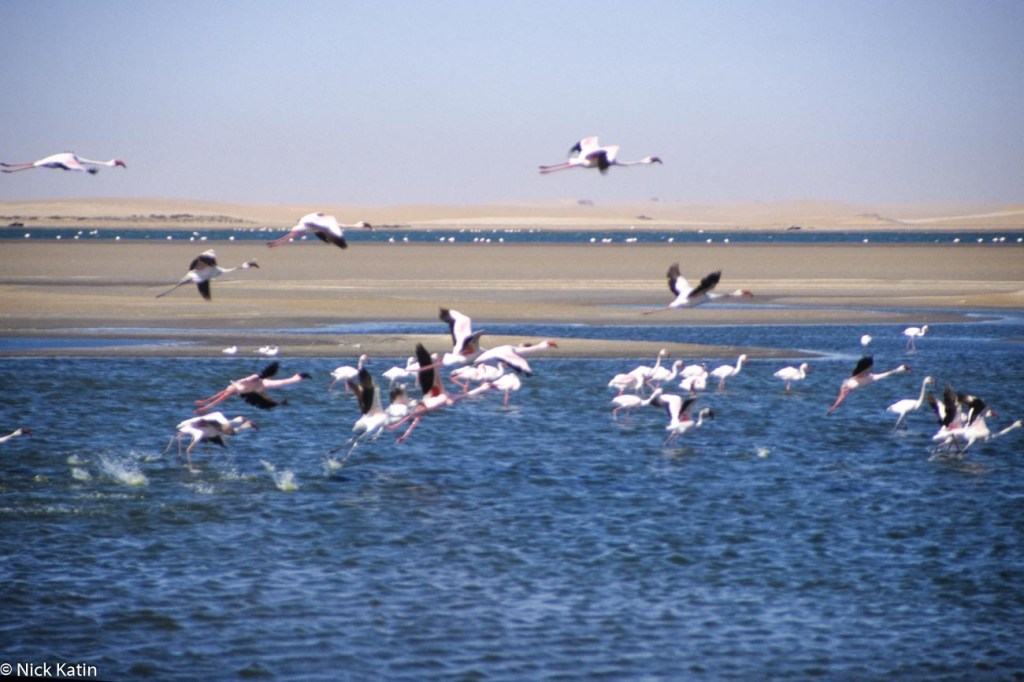
    Dune 7 is large stand-alone sand dune north east of the town that rises above the bleak landscape and overlooks the noisy goods train railway. The locals’ flock to it in their droves to walk, run, sandboard or simply sit at the picnic tables in its shadow eating sandy sandwiches or gritty sausages. The bird life on the other hand is much more interesting. The lagoon just to the south of the town is home to half of southern Africa’s flamingo population plus pelicans, gulls and plovers to name just a few. Close by is the Raft a pub/restaurant housed in a wooden building sitting on stilts over the water.  A couple of beers in there gave us a brief respite from the ever-increasing wind and in a rash moment we decided to return for dinner that night.

    I have to say that it was one of the most amazing dining experiences either of us had ever had. The meal was nice we had some of the local fish species, Kobaljai and Steenbras and it was all pretty good including the service. What stole the show were the flamingos! From where we were sitting we could see the floodlight water and all night there was this constant flow of flamingos walking back and forwards doing their best to imitate the huge walking box robots from the Stars Wars movies. These wonderfully colourful waders gave us a show neither of us will ever forget!

    What is forgettable however is the smelly cramped dog box of a unit we ended up staying in overnight back in Swako. We hadn’t managed to find anything cheap enough in Walvis Bay so we rang a place back in Swako without knowing what it was like. The women who answered the phone said yes it was free that night and the cost was N$100 plus $30.00 for laundry. OK I thought we don’t want any laundry done we’ll take it. What the laundry turned out to be was the cost of washing the bed linen after you had used it, assuming that you hadn’t brought your own. Well after sleeping the night in this matchbox with less facilities than a prison cell and having to listen to her winging about this that and anything else she happened to be an expert on, we told her to get stuffed, politely of course! Needless to say we headed out of there as soon as the sun was up.

    Every town or city has the Café, the place to be seen at and usually has a specialty or two. Swako was no exception. The Café Anton was a trendy, probably in some eyes pretentious, indoor/ outdoor café overlooking the main beach. After such a shitty night we thought we’d treat ourselves to morning tea in the shape of a couple of German pastries and (finally) some good coffee before heading out. No doubt about its popularity, the locals were arriving in droves for both coffee and pastries and breakfast. It was a fitting end to our stay in Swako. It had been the only place in Namibia where we could take time out to get our fix of some western culture.

    If you like this then hit “follow” on the side bar

    Flamingos at Walvis Bay in Namibia
    Flamingos at Walvis Bay in Namibia


  • African shoestrings – Namibia Day Seventy One – Swakopmund

    Everybody (that is mainly the white population) was friendly and seemed to have either German or Afrikaans accents. Wilma our landlady, a white Namibian of German heritage was a third generation Namibian, But she had been brought up to speak German in school and at home and spoke English with a strong German accent.

    Despite our immediate liking for Swako our second day turned out to be quite expensive. We had to send a fax relating to our house to Australia which cost the princely sum of N$31.50. Sue was still not feeling quite right so a trip to the doctor cost N$100 who immediately ordered a blood test (another N$36). Fortunately the blood test cleared Sue of Malaria, which was our main concern. But it didn’t answer the question as to why she was still feeling disorientated. The doc put it down to the Lariam that we were taking. It’s a strong anti malarial drug with a bad reputation for side effects such as disorientation, hallucinations, anxiety and nightmares. The last time we had taken it we had both experienced the latter two but this time I hadn’t experienced any side effects and up until Sue had been sick nor had she.

    We had been quiet happy just to laze around Swako for the couple of days that we were there but as always curiosity got the better of us. Swako is at the edge of the Namib Desert, so we had almost done a full circle on our tour of Namibia. This part of the desert holds a few surprises or so we were led to believe by the Lonely Planet and the Swako tourist office. That was enough for us and we were off having a look. In fact it was more of a ‘so what’ tour rather than a scintillating safari into the desert. I say ‘so what’ because unless you’re a botanist or a historian most of the items on the signposted Welwitschia drive mean very little. The Swako tourist office gave us a handout called “The Welwitschia Plains-a scenic drive” with thirteen numbered stone beacons to watch out for. Each of these beacons are positioned at places of interest along the drive. The first stop was at little cluster of lichen; the next was at a couple of bushes called the Dollar and the Ink. So far we’re yawning and wishing that we had stayed in bed.

    Oxwagon tracks remarkably preserved from decades ago and just as remarkably almost impossible to see were next and followed by something much more interesting, the Swakop valley moonscape. This dark brown and wheat coloured pitted and crated landscape was formed by 1000’s of years of erosion and is very much reminiscent of the moon’s landscape. Not that I’ve been there of course but those who know this sort of things say it is.

    Our interest began to wane again, as more lichen was sign posted. Apparently the lichen of the Namib Desert is the most extensive in the world. I suppose a botanist would find that fascinating but we’re still stifling those yawns. Our interest was rekindled by a much bigger expanse of moonscape. Created this time by a non-existent river cutting it’s way through softer material. Even my imagination was finding it hard to imagine any river flowing through this dry and inhospitable landscape.

    A heap of junk left behind by the South African army in 1915 was considered notable enough to be the next point of interest. Somehow I cannot see how even 85 year old broken bottles and rusting cans are a great tourist attraction!

    The next two beacons are not even worth us getting out of the car. A couple of ridges of Dolerite (what’s that I hear you say, forget it, it’s in the dictionary) were somewhere around.

    Then we had a small patch of vegetation dressed up as picnic spot. Apparently the river that I had trouble picturing earlier actually runs deep underground and in some spots is high enough for some trees and bushes to tap into.

    Speaking of vegetation, the Welwitschia drive is named after a unique ‘tree’ that has also been described as a living fossil. The next and penultimate stops are for these strange looking ‘trees’. They are apparently dwarf trees and are related to pine trees but you would never know that by looking at them. They look like straggly low lying semi tropical palms that have had a bad day. In fact if you saw one anywhere else you wouldn’t even stop to have a second glance. The point of interest is however that they somehow thrive in this hostile environment and are totally unique to the Namib Desert and get this; live for up to 1500 years.

    Our last stop on this spell binding drive was a let down after the Welwitschia. An abandoned iron ore mine from the 1950’s is really nothing but a hole in the ground.

    If you like this then hit “follow” on the side bar

    A Cape Fur Seal at Cape Cross Seal colony in Namibia
    A Cape Fur Seal at Cape Cross Seal colony in Namibia
  • African shoestrings – Namibia Day Seventy – Swakopmund

    Hentiesbaai is another fishing spot but it does have a sort of quaint character, (compared to Terrace Bay everything has character) with a decent looking beach and some ‘beachy’ looking houses with palm trees and lots of liquor shops. Hennie found us a cheap apartment next to his garage and the shopping centre.

    We had the luxury of a TV in this place and as it seemed like years since we had watched any, we just crashed in front of it.

    It was cable TV too except there was nothing much on. Most of it came from South Africa and watching South African TV is most disconcerting. They have this habit of changing languages continuously. We were watching their rugby equivalent of the footy show when the interviewer began to interview a rugby player in English. Problem was we could understand the interviewer’s questions but didn’t have a clue as to how the player answered as he was speaking in Afrikaans. Weird!


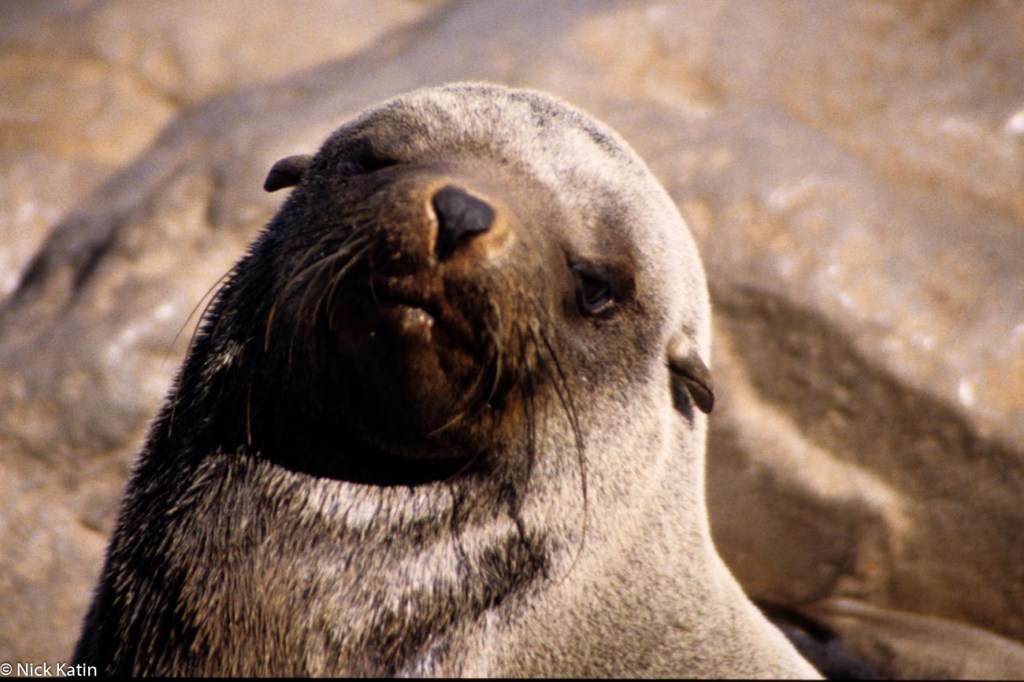
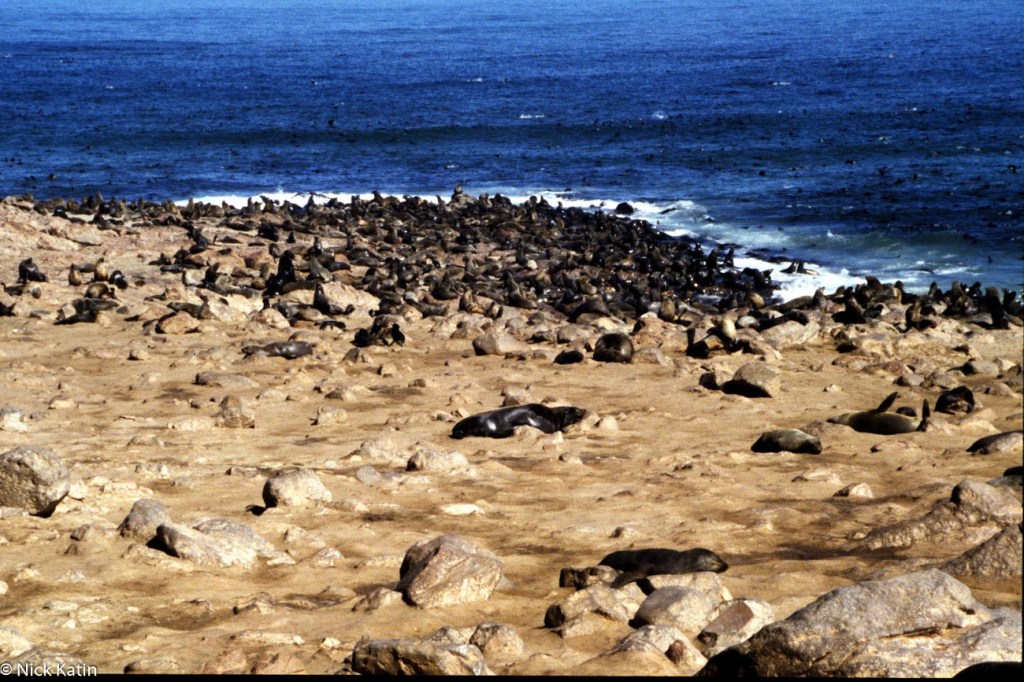
    Cape Cross is smelly. Not just a bit smelly but it stinks. The 100,000 Cape fur seals that call this home really know how to put visitors off. I’ve never seen so many seals! Big ones, little ones, dark ones and grey ones, old and young, male and female, some on the rocks or beach sunbaking, others in the water. Just a huge mass of blubber and seal shit! The Cape fur Seal is distinguished from other seals by the fact it has ears (with all the noise they were making I think they would be better off without them!). They are only found on the West Coast of Southern Africa, as they don’t migrate as a rule. They are quite big in size, the average male weighs around 187 kg but increases its weight to as much as 360 kg at the beginning of the breeding season due to the accumulation of food reserves in the form of blubber. It was for this reason that there are warning signs everywhere not to disturb the seals and cause them to stampede. These huge males can easily crush a small ten kg pup and it’s one of the main causes of the 27% mortality rate.

    Cape Cross itself was named after the cross that the Portuguese Diego Cao, the first European to set foot on the coast of Namibia, erected in honour of the Portuguese king. The original cross is actually in the Berlin museum but there are a couple of replicas erected in the same spot.

    This weird Namibian coastal climate played tricks with us all day. When we left Hentiesbaai in the morning and headed north it was really hot but as soon as we got we got to Cape Cross it cooled down about fifteen degrees. Driving back down through Hentiesbaai it was hot again and then as we approached Swakopmund (or Swako as it’s known by the locals) it cooled right down again

    Swako is a bigger more up market version of Luderitz. It’s a mixture of German, Western and African culture forced together onto the cold Atlantic and carved out of the desert. Its flat featureless topography has been brightened up by some colourful buildings and lots of German Bakerae’s and Bearhaus (bakeries and pubs) on almost every street. Along the promenade there’s these huge date palms on either side of the walkway with houses of varying colours and beach architecture sandwiched between the palms and the beach. German architecturally historic buildings were dotted along most streets in between the many restaurants and trendy curio shops. It felt good to back in western culture for a time. We didn’t camp here either. Why camp when you can stay for in a small, well equipped and centrally positioned self contained unit for N$100 (US$10) per night. Yup! We were going to like ‘Swako’!

    Cape Cross in Namibia is a colony of Cape Fur Seals
    Cape Cross in Namibia is a colony of Cape Fur Seals
  • African shoestrings – Namibia Day Sixty nine – Hentiesbaai

    Terrace Bay is desert, black stone beaches and a grey sick looking ocean that yielded an endless abundance of fish. This is serious stuff! A couple of guys caught 82 fish each one weighting around seven or eight kilos off the beach! I don’t know that much about fishing but I do know that there are few places left in Australia where you could get a catch like that without a boat.

    A few others must have caught a bucketload as well as it was being offered around (cooked that is) by one of the other groups at dinnertime.

    This group was led by the ‘knowitall’ you know the type, there’s one in every gathering or group. Even though they were speaking Afrikaans his body language and actions told us “I know it all and I’m going to tell you”.

    We were in the bar and he and his friends and family walk in and he just took over the bar. Frans, the barman, must hate arseholes like him just walking behind the bar and helping himself simply because they all arrived together and poor old Frans was a bit slow in keeping up.

    Relaxing for a day or so gave Sue a chance to recover, which she did although she still felt off colour. I was hoping that the bracing air and relaxation would clear up my catarrh but that still stuck to me so much so that in frustration I started a course of antibiotics that we had brought with us.

    The Skeleton park is infamous for its shipwrecks that dot the coast after hitting one of the treacherous sand banks and some bright spark thought the name ‘Skeleton’ was appropriate. It was one of these shipwrecks that got us into what we thought at the time was big trouble. Our next destination was Swakopmund some 350 kilometres south on the coast, via the Cape Cross seal colony. Bearing in mind our ‘reluctance’ to leave ‘Terrible’ bay, we set out early to ensure we had time.

    Well we made good time along the salt road to the park gate at Ugab and then turned off to see one of these shipwrecks. The road had another of these heavily corrugated surfaces that have you bouncing around everywhere and just moving forward at more than 30 kilometres an hour was a struggle. Suddenly a buzzer went off and the oil light flashed on the dash. We both said “Shit!” stopped and turned off the engine. Like any part time mechanic, I was quite capable of opening the bonnet and checking the oil. Plenty there! I checked to see if the filter was loose. No that was ok as far as I could tell. Now we’re in a hire car which is less than a year old and still covered by it’s warranty, somehow fiddling with it didn’t seem the right option without authority. After all it’s my credit card imprint they’ve got as a deposit. So we did the right thing and slowly drove back. It didn’t seem to mind if we drove it at 20 kilometres an hour.

    It took forever to get back to Ugab. There’s not a lot at Ugab in fact there’s not even a phone. Fortunately they did have a more modern method of communication than the pigeon, a two-way radio. The gatekeeper radioed the nearest mechanic in Hentiesbaai a small town some 137 kilometres away. His only option in these circumstances was to bring a tow truck.

    All we could do now was wait and wait! Eventually Hennie turned up around 3 hours later which I guess wasn’t too bad. He took a quick look at the car and then we loaded into the back of his truck whilst we both climbed into the front.

    Hennie was born and raised in Namibia and despite being white considered this was as much his country as anyone else. We talked about the fish, the up coming Rugby world cup (Namibia actually had a team entered) and life in general in Hentiesbaai. Hennie told us that there was around 200,000 whites in Namibia and then turned to us and asked “How many blecks ‘ave you goot in yoor ‘ountry?” When I replied that we had about 300,000 aboriginals. He looked at us and said “Thets nothin man, we got 3 million of them!”

    Of course it turned out that there was nothing wrong with the car other than a loose wire on the oil switch in the engine which had somehow shaken loose. It cost N$1235 (US$124.00) to get us picked up from Ugab and I had to break the news to Werner. “We’ve fixed the problem mate” I told Werner on the phone and proceeded to tell him about the oil switch. We had already rang him and told him what had happened and needed permission for Hennie to look at the car which Werner got from Volkswagen. “Thing is, it’s cost N$1235.00 and they want to know how you gonna pay for it?” There was a pause. Somehow I had this picture of Werner looking to the heavens and saying “why me”. Anyway we ended up paying for it on proviso that he would settle with us when we returned the car.

    If you like this then hit “follow” on the side bar

    The inhospitable Skelton Coast in Namibia
    The inhospitable Skelton Coast in Namibia
  • African shoestrings – Namibia Day Sixty eight – Terrace Bay

    It didn’t start well. We had to cut short the tour of the rock paintings, as Sue was once again sick. What we did see (or what I saw) of it was fascinating. Some of the works are engravings that date back over 6000 years and appear to be still as clear as the day they were created. Fortunately Sue had the presence of mind not to leave a remnant of her stomach over any of them. Somehow I don’t think she enjoyed it one single bit.

    We had no choice but to press on. Sue had been sick twice now and I was starting to get concerned, but civilisation was now closer at Terrace Bay. The state of the roads didn’t help either. The road back to the main ‘drag’ was full of potholes and those irritating corrugations that leave you still stammering for hours.

    The road to Skeleton Coast was marginally better. There were less potholes but still plenty of corrugations and loose stones that had us slipping and sliding from time to time. It was slow going and bloody hot! Sue began to perk up the closer we got as she slowly recovered much to my relief. She had slept most of the way but really hadn’t missed much.

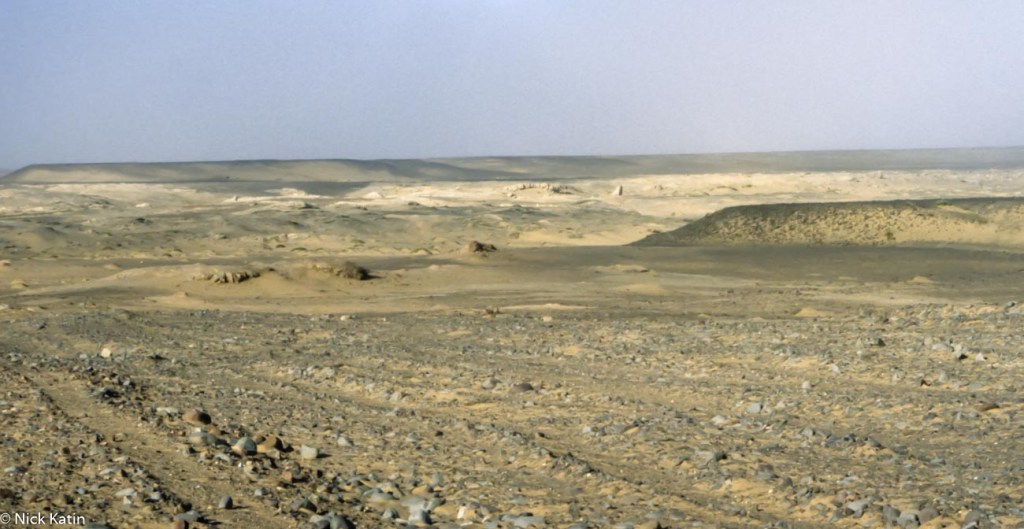
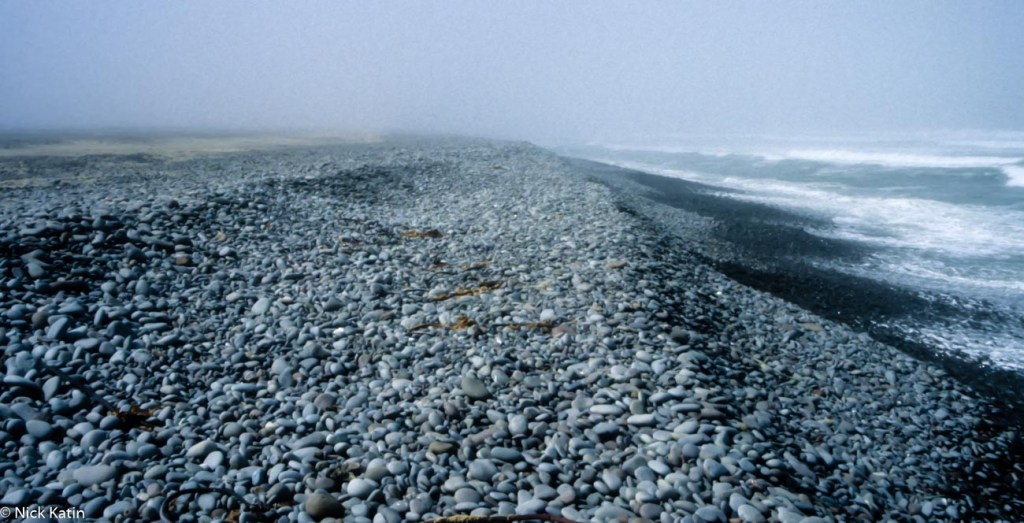
    The Skeleton Coast is as inhospitable as it comes. A waterless terrain of grey sand dunes and gravel plains for as far as the eye can see greeted us as we entered the park at the Springbokwater gate. I was amazed to actually see someone at the gate. The smiling gatekeeper with his house surrounded by a little patch of grass, an oasis continually under pressure from the relentless marching sand. He checked our passes and waved with a big grin on his face as we passed through. Did he know something we didn’t?

    The coastline of Namibia is an enigma. A desert that stops right at the waters edge. Certainly there are other examples of similar coastlines elsewhere. Our own North West of Australia is very inhospitable but at least it has some vegetation and even trees at the equivalent latitude. The difference is the temperature of the ocean. The Atlantic in this part of the world is bloody cold, consequently it just doesn’t create enough moisture to make it rain so this area averages less than 50mm (2″) per year! What the cold ocean does do however is keep the temperature down. Just as we experienced in Luderitz the temperature drops sharply at about 100 kilometres inland from the coast. Particularly when a southerly breeze is blowing (as it does most of the time) and covers the coast with a cool layer of fog. We went from a hot, dusty environment to a cool, almost cold, misty but still dusty environment in almost seconds. It was like walking into an air-conditioned shopping centre after having spent time walking in 35-degree heat. The change was that dramatic!


    There are many places that we have visited over the years that have not been what we expected and we have sometimes asked ourselves briefly “what are we doing here?” Terrace Bay is one of those places that begged the question continuously.

    It’s a small basic resort sandwiched between the ocean and the desert 3 million miles from anywhere and full of white South African and Namibian leisure fisherman all jabbering away in Afrikaans. We got chatting to a group from Paarl in South Africa and they even asked us what we were doing there. “Therre’s nothing ‘ere but fish” one of them said. It did have a restaurant where you have to eat, as full board is obligatory, a bar and a small shop with very little. The accommodation was reasonably comfortable. A few fibro semi detached huts with rather sparse self-contained rooms were dotted around the place.

    Fortunately we only had two nights here. We spent the rest of the day and the next day, relaxing, reading, sleeping and for a brief time, exploring.

    If you like this then hit “follow” on the side bar

    Playing with a female Lion at Okinjima in Namibia.
    Playing with a female Lion at Okinjima in Namibia.
  • African shoestrings – Namibia Day Sixty seven – Twyfelfontein

    We got back to the resort in enough time to have another shower (our third) before dinner. Dinner brought us kudu steaks again and again it was the texture that put me off confirming after this second ‘chew’ that the kudu is safe from me in the future. Unfortunately there were no other choices so it was that or go hungry! Nonetheless the remainder of the food was good and really became secondary to the conversation we were having with a South African couple and a couple of journalists from Zambia who now live in New York. We were enjoying the conversation so much that it was almost an inconvenient interruption to be called to the night hide to see a porcupine munch on another slab of meat left there to attract him.

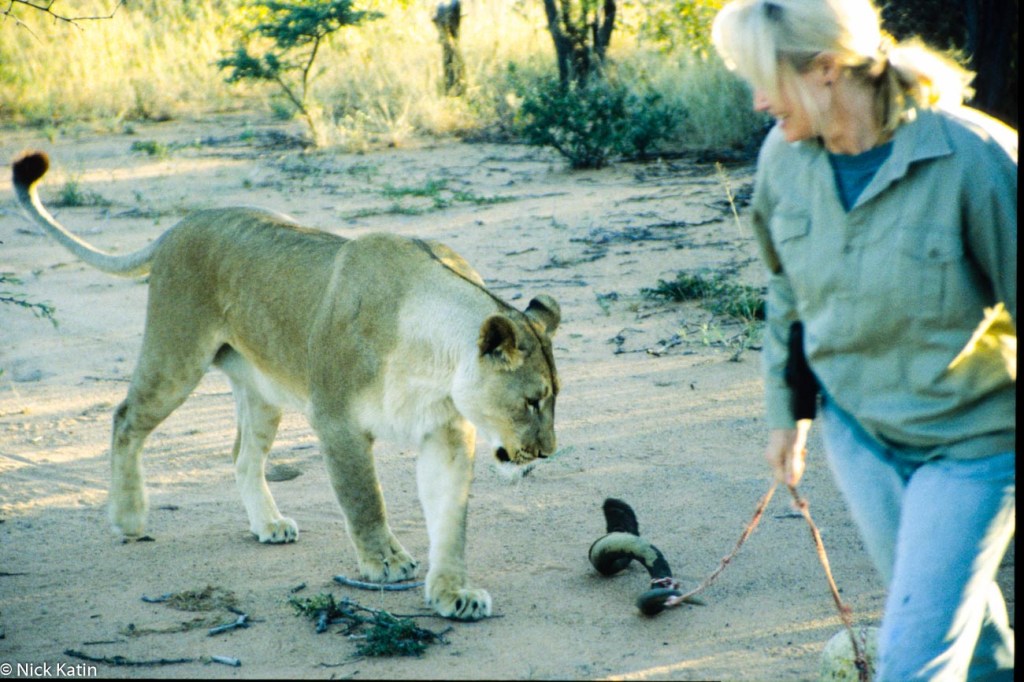
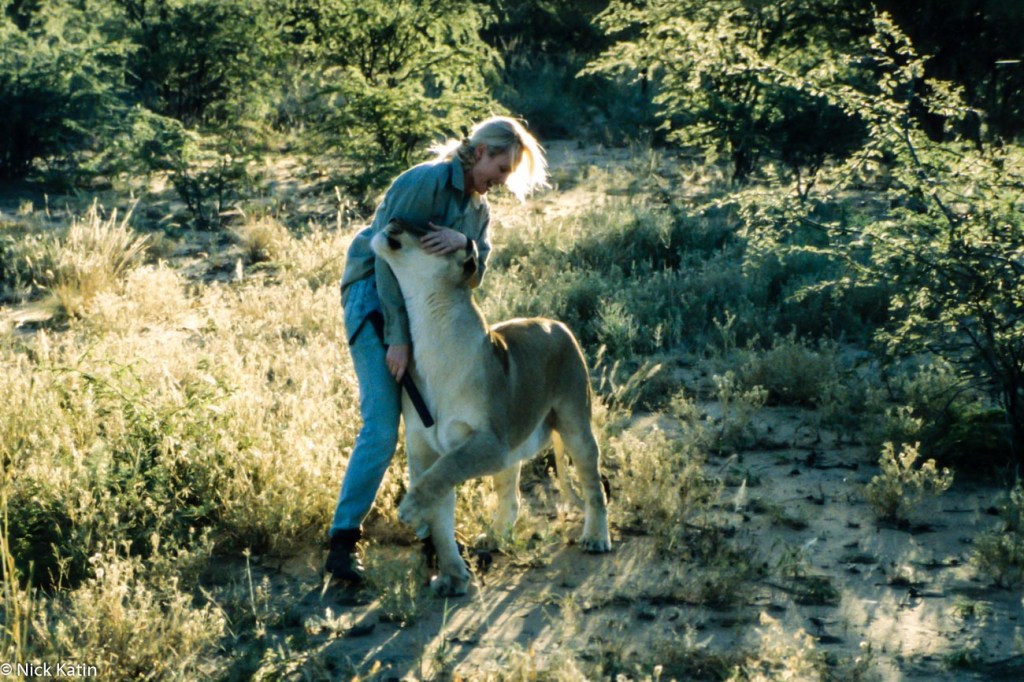
    It was all go the next morning. Up at 6 and into the huge long grassed paddock that was the lion’s enclosure, on the back of an open safari truck. These three lions (one female, Tess and two males, Matata and Tyson) were rescued from brainless people who kept and mistreated them in captivity. Even though they were now part of the family, it was intended that they would be relocated back out into the wild. Watching Donna and Roselea Hanssen play with them, I wondered whether how that could ever be. These animals were domesticated and appeared to me to be just big playful pussycats and then I remembered Guy’s story yesterday and made sure that I stayed well within the safety of the truck.

    Our final ‘activity’ was a guided bushmen walk trail. Chris our guide (who I noticed showed a healthy respect for the lions in the way he held on tightly to his rifle) took us on a track littered with bushmen artifacts, ‘home comforts’ and tools.

    It was interesting without being riveting. The bushmen like many other traditional peoples had no concept of ‘waste’. Everything had a use. A small animal would provide not only food but also pelts for warmth, fat for cooking and skin for shelter. It’s a principle that appears to be have lost over the centuries by Europeans.

    Back to the lodge and we only had a few minutes to vacate our room before Brunch (they like you out of the rooms by 9 am) which we enjoyed under the watchful gaze of the resident warthog.

    On the drive out Sue was feeling pretty crook and we hadn’t got far when I had to stop whilst Sue got rid of the contents of her stomach. From then on she slept whilst I drove onwards to Terrace Bay in the Skeleton Coast Park, some 380 kilometres away, in the blazing heat of the desert.

    As half of the road was gravel, there was no way we were going to make it in a day so our overnight stay was near Twyfelfontein where some of the finest rock art in Africa is found.

    Not so fine was the Abu-Huab Camp. Another dust hole masquerading as a ‘rustic and natural desert camp” in the middle of nowhere. Once again we had to put up with dust and sand blowing into every crevice and orifice. Sue was still crook and lay most of the time in the tent and I still had the remnants (in the form of catarrh and dry throat) of the cold I had caught nearly 3 weeks ago at Fish River Canyon.

    We were back down to the realities of independent budget travelling with a bump. No comfy bed in a dustless air-conditioned room for us that night. As darkness descended Sue gradually regained some strength to sit outside whilst I eat and we actually began to enjoy relaxing under the gaze of the millions of stars that lit the night sky with their pinpricks of light scattered in and around the milky way. That was until Sue almost put her foot on a scorpion, which could have put us right in the ‘shit’. Somehow this wasn’t the sort of place where emergency medical treatment would have been easy to find. That was enough for us, our beds were calling. Hopefully tomorrow would bring a better day.

    Playing with a female Lion at Okinjima in Namibia.
    Playing with a female Lion at Okinjima in Namibia.
  • African shoestrings – Namibia Day Sixty six – Okinjima

    It is estimated that there are 2500 cheetahs, a quarter of the world’s population, roaming rural Namibia, that is outside of the national parks. And that’s where all the problems lie. The farms are ideal for cheetahs and leopards (the other big cat that Africat specialises in). In the National Parks and game reserves both these predators are in competition with larger predators like lions. On the farms there is no such competition. Unfortunately they can’t tell the difference between small game and small farm animals like calves, sheep or goats which upsets the farmer just enough for him to set traps or go hunting! That’s where Africat come in.

    Straight after heating up the shutter in our cameras and blistering our shutter finger, we were whisked off in open top 4WD vehicles to the leopard hide. There we all sat in a small marquee whilst Guy one of the guides chats about Africat.

    “When a farmer kills or captures a cheetah or a leopard it often leads to making the problem worse.” He began “when a predator holds a territory it will chase out any intruding predators. Once its removed other predators will move in and often divide up the territory, so instead of having just one animal to deal with the farmer ends up two or three times as many. What we do is to try and educate the farmers to manage their livestock better so that losses are minimised and both can live together. Of course we often meet resistance and in those cases we just ask the farmer not to kill the cats but just capture them and release them to us so that we can release them back into the wild away from that farm.”

    He also told us that there were several cheetahs and leopards roaming wild on this farm and hopefully a number of leopards will visit the hide this afternoon. It occurred to me that we appeared to be in an unfenced area and wouldn’t there be the chance that the leopards might find us more attractive than the slabs of meat. Dumb question Nick!

    “Big cats will only really attack a human if the cat is cornered, injured or senses that we are vulnerable”. Guy said “If it’s got a much easier alternative then it will always go for that. Of course it also associates humans with guns and that also acts as a pretty big deterrent”

    I asked him what happened to his heavily bandaged foot that he couldn’t walk on without the aid of crutch.

    “Oh that, this happened in the lion enclosure”

    There was a complete silence. Sensing this, Guy went on. “Chris (the other guide) and I went in to see the lions and during our work I stepped backwards from the lion and caught my foot on a rock and fell spraining my ankle. As I said these big cats sense when we are vulnerable and in this case she began to make a move towards me. Fortunately Chris was there and herded her off before she actually attacked.” He smiled “So she didn’t really attack me. I just didn’t take enough care, something that when you’re dealing with these animals could cost a life”.

    “Aren’t we seeing these lions in the morning?” I whispered to Sue, who ignored me.

    With a degree of caution we are fed into the small hide and watch as the guides leave meat in conspicuous places on the elevated rocky terrain immediately in front of us. It was getting towards sunset so the light was that golden colour which bathed the rocks in almost perfect light. Within a few minutes a leopard appeared followed a few minutes later by another to chew on the slabs of meat and then disappear. For the next hour there was a regular pattern of first one then the other appearing and then disappearing.

    The hide was totally closed in except for a long thin viewing open window that made us feel like we were so close. In fact it was a zoo in reverse we were the ones imprisoned for our safety whilst the animals roamed around us. At one time one of the leopards looked straight at us and darted off after someone dropped their lens onto the small shelf we were all leaning on. Apart from that the only sound was that of camera shutters as we all strived to get that perfect leopard shot. I couldn’t help feel that this was all a bit contrived even though the leopards are free to roam anywhere they want and are native to the area. But I’m not complaining leopards are one of the most elusive animals to view in Africa and to see them up close and for so long, is an experience not to be missed.

    I like leopards! They are such magnificent beasts, like the shark they appear to be the perfect hunting machine with their muscular shaped body, long tail and strong stature.

    If you like this then hit “follow” on the side bar

    A leopard eats it's prey amongst the rocks in Central Namibia
    A leopard eats it’s prey amongst the rocks in Central Namibia
  • African shoestrings – Namibia Day Sixty five – Okinjima

    Apart from a recreational park, Waterberg is also a breeding ground for some endangered animals. Animals like rhino, sable antelope and roan are protected on the plateau by its proximity to the terrain around it. We took a guided game drive in one of the two open topped 4WD’s that run daily. I mention the word open because a sudden downpour followed by persistent rain soaked us through to the skin. To add insult to injury the animals were hiding from us, probably wisely sheltering from the rain. We did manage to see one lonesome sable antelope briefly but that was it.

    Back in our tent we dried off and thought how nice it would be to sit in a nice cosy hotel room in front of a log fire. Of course we knew that the following night we would be doing something similar at Okinjima.

    I think I might have mentioned that of the two of us Sue is without doubt the animal lover. I love to see them in their natural environment and I can watch them for hours with a camera in my hands but I do not have the same love and concern for their welfare that Sue has. Somehow or rather she heard about the Africat Foundation, a non-profit organisation involved in the conservation and protection on Namibia’s cats. And I don’t mean pussycats!

    Their home is a place called Okinjima guest farm, a 50 kilometre drive from Waterberg. If you are reading this with the idea that it’s gonna be cheap on account of it being in this blog. Think again! At US$165.00 per night per person it cost almost as much as the twelve nights accommodation we had booked with the MET! But the cost was for full board and activities, so the only thing we had to pay for was alcohol.

    This was our treat! We would stay just the one night but make sure we were there spot on check in time and leave spot on check out time. We were going to get our moneys worth! The first thing we did after checking in was to have a swim and then a shower in the privacy of our own room. It’s a funny thing about having a shower. You get used to having to use communal showers and on the whole they had been pretty good, lots of hot water, reasonable flow and quite clean. But you get tired of undressing and dressing (the latter usually in a pool of water) in a matchbox. A shower feels so much better knowing that you can have it at your pace and leisurely get dry and dressed.

    The resort itself is a small area of terraced thatched units with the main building, a huge open thatched rondavel close by. Elsewhere there’s a swimming pool, a huge bird/animal hide and a patch of lawn between the main building and the rooms.

    We had lunch at 1pm and then returned for coffee and cake just before 3.

    It was just after my second helping of cake (I told you I was gonna get my money’s worth) that the action started. Three of the owners, Lisa, Donna and Rosalea brought out three cheetahs and feed them on the lawn. Click, click, click went our camera and those of the other guests as these women cuddled, stroked, feed and talked with these cheetahs. With the exception of one idiot, we all kept a respectable distance. I had never been this close to a wild animal of this stature before, every time I had seen cheetah I had the protection of a car body or wire fence between me and these beautiful beasts. The one idiot attempted to stroke one of them as if it were a domestic cat. I’m not sure who was quicker Lisa or the cheetah! The cheetah swiveled its head menacingly whilst Lisa dashed over and reprimanded the idiot and at the same time had the cheetah under control. These cheetahs were in fact quite tame they had all been rescued from hardship and then reared on the farm and were part of the family.

    If you like this then hit “follow” on the side bar

    A Cheetah on the lawn at Okinjima camp in Namibia
    A Cheetah on the lawn at Okinjima camp in Namibia
  • African shoestrings – Namibia Day Sixty four – Waterberg Plateau Park

    Our destination was the Bernabe de la Bat Resort in the Waterberg Plateau Park  (which sounds a lot more romantic than it is) some 300 kilometres south. We planned to see a couple of sights on the way, Lake Otijikoto and the Hobo Meteorite. Lake Otijikioto is one of the only two natural lakes in Namibia.
    This important fact didn’t really make it any more interesting. It’s just a collapsed limestone cavern that later filled with water and the only things of interest was its aqua blue colour and the fact that at its deepest (estimated to be 55 metres) lived some rusting ammunition and artillery. In 1915 the Germans were retreating from the South Africans and decided that dumping their weaponry into the lake to prevent those nasty South Africans having it was a master stroke.

    At least the lake was just off the main road.
    Not so the Hobo Meteorite! According to the Lonely Planet it was about 25 kilometres west of Grootfontein, which was 63 kilometres east of Otavi making it 38 kilometres from Otavi and a 76 kilometre round trip for us as we passed through Otavi.
    Easy! Well no, it was not! In fact the turn off, which was extremely hard to find, is a 76 kilometre round trip but the Meteorite itself was a 160 kilometre round trip!
    I guess we could have accepted that had this great artifact from the sky been a sight that would change our lives or at least been mildly interesting. It looks just like a rock (its mostly iron) partially buried in the ground with a little bit of landscaping to make it look pretty. Sure there was some interesting information on a board nearby but nothing we couldn’t have looked up on the internet.
    “So what did you expect?” I hear. I’m not sure but it was a long way to go for a lump of iron. If it had been green kryponite that glowed and changed colour, or throbbed like something from Star Trek, I would have been happy. But this thing just looked like something that had been found in another part of the country and brought here to make some extra cash and piss tourists like me off!

    The Bernabe de la Bat ‘Resort’ is nestled in the shadow of the 50 by 16 kilometre sandstone Waterberg plateau that stands around 150 metres high.
    The campsites were sheer luxury, grass. We hadn’t had grass since Daan Viljoen. No dust to find its way into your sleeping bag at night or blow into the tent by day. It was terrific.
    We actually spent the afternoon of our only full day there cleaning the dust out of the car. Considering how small it was, it seemed to hold an awful lot of sand.

    In Australia a big proportion of retirees, buy a caravan and do the round trip around Australia, sometimes for months, sometimes for years. In South Africa they head North to Zimbabwe, Zambia, Botswana and Namibia. Namibia is generally favourite amongst those from the Cape Town area. Here at Waterberg, we met three couples up from the ‘Cape’ travelling in convey. They were extremely friendly and helpful (even hanging up our washing whilst we were out walking).

    Speaking of walking we followed the only decent length walk trail, outside of the couple of long distance trails, in the park to a spot called mountain view at the top of the plateau. It was not a long climb but it gave us a bit of a workout after the day of driving we had the day before. The views at the top were certainly worth it, we could see for miles across the scrubby plains interrupted by the odd decaying sandstone hill but probably the best view was of the plateau rim with its sheer sided red, orange and green rock and vegetation.

    If you like this then hit “follow” on the side bar

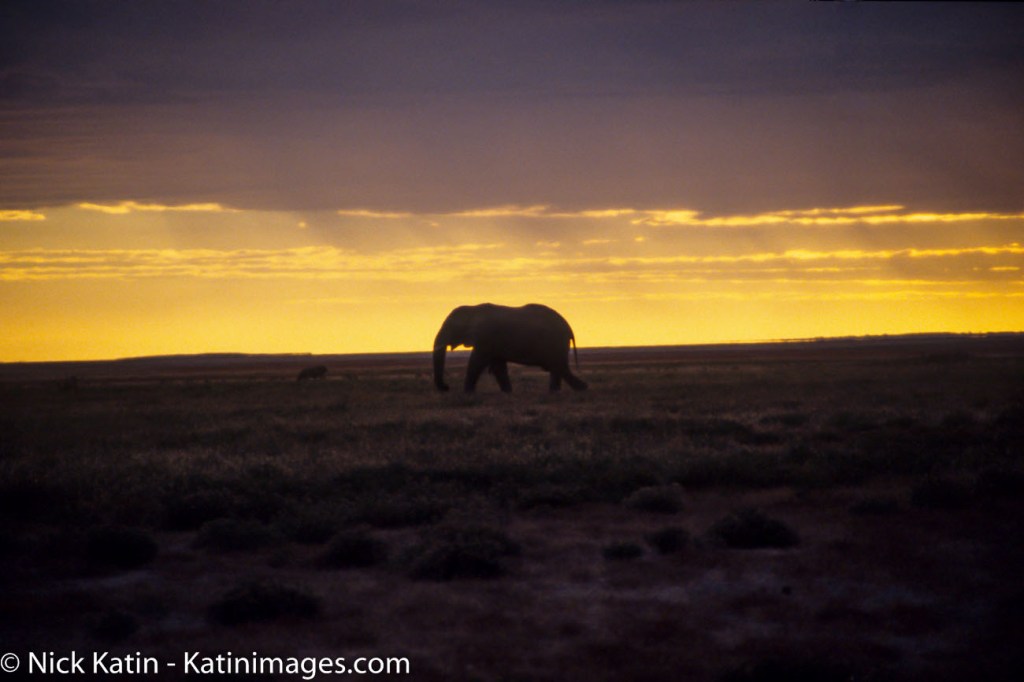
    An elephant strolling through the scurb at sunset in Etosha national Park, Namibia
    An elephant strolling through the scurb at sunset in Etosha national Park, Namibia


  • African shoestrings – Namibia Day Sixty three – Etosha NP

    We now on our way to Halali, the next rest camp that was 70 kilometres away, which should only have taken us around hour but this place was teeming with animals. Every waterhole had an abundance so we didn’t end up getting there until after midday some 4 hours later!
    This wildlife viewing slows you down!
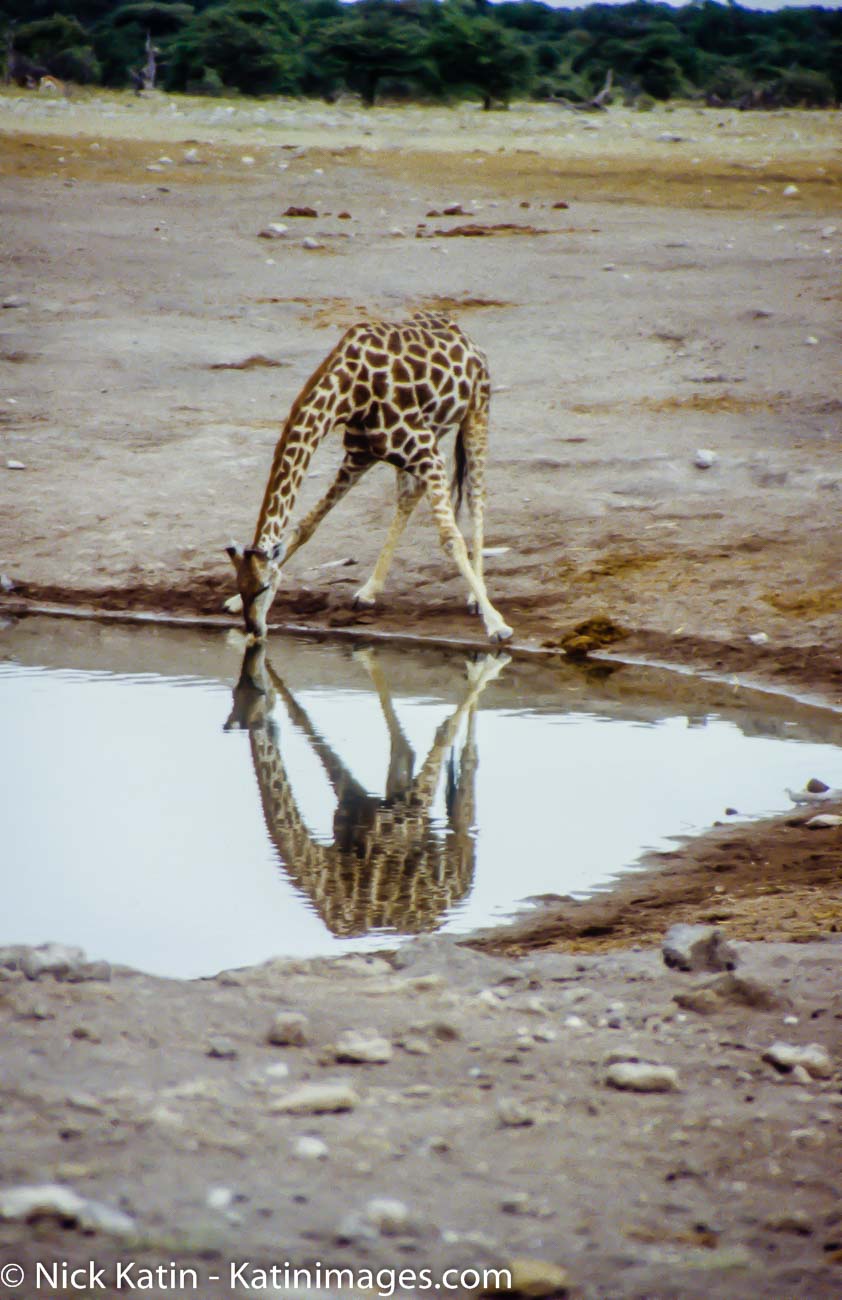
    But how can you hurry when a big herd of elephants turn up at waterhole that you’ve been watching for a few minutes or two or three giraffes bend over, legs splayed, to have a drink.

    At Halali we were back to camping after the dubious luxury of a chalet at Okaukuejo. It was fine, a bit dusty but there weren’t many other happy campers, so it was quite quiet.
    That was until an overlander with at least 20 people hanging off it parked next to us. Needless to say we didn’t get much sleep that night.

    Halali also had its own waterhole and that evening we saw a three black rhino again. We tried to work out whether it was the same three we had seen at Okaukuejo the previous evening. It seemed almost impossible that three rhino (one was a baby) would walk 70 kilometres in a day but who knows! As they lapped away at the water, a lioness and a couple of hyena appeared. They didn’t hang around long! One of the rhino continually went for them so that eventually they got the hint that they weren’t welcome to join the rhino family for a drink.

    Our morning game drive yielded more lions again. How boring! There were three males strolling down to Salvadora waterhole obviously thirsty and possibly hungry. We hung around for a while but they just found a shady tree and slept.
    Lions actually sleep or rest for around twenty-one hours a day, leaving just three hours to hunt and eat. It’s a little known fact that they actually have a very low kill hit rate but one decent kill can last them for almost a week. Of course these three guys probably weren’t thinking too much about actually hunting that’s a predominately female occupation. They actually looked like they were having a boy’s day out, a bit of strutting and a few drinks and whole lot of sleep.

    We had the same distracting problem getting to Namutoni the last of the rest camps in the afternoon, which again is 70 kilometres away.  Elephant, giraffe, gemsbok, etc all appeared from time to time at different water holes.

    Namutoni is home to the rather out of place Namutoni fort; a relic of German colonial days. Built in 1899 as an outpost for troops to control the Owambo people, it’s now tourist accommodation. In 1904 seven soldiers faced the impossible task of defending it against 500 warriors, needless to say they didn’t succeed.

    Namutoni had its own waterhole but for some reason it’s not as popular with the animals as the others at Okaukuejo and Halali, even though it’s a lot more picturesque. Still we couldn’t really complain we had seen a cheetah close up and fifteen giraffe on our late afternoon game drive earlier.

    It was time to leave Etosha. It really was an experience and great value for money in comparison to some of the other game parks in Africa. US$22.00 per day for a chalet and US$13.00 per day for a camp site including all the game viewing you can cram in during daylight hours is pretty good. Especially when generally speaking there’s so much game around.

    If you like this then hit “follow” on the side bar

    A giraffe takes time out to have a drink at a watehole in Etosha National Park in Namibia
    A giraffe takes time out to have a drink at a watehole in Etosha National Park in Namibia
  • African shoestrings – Namibia Day Sixty two – Etosha NP

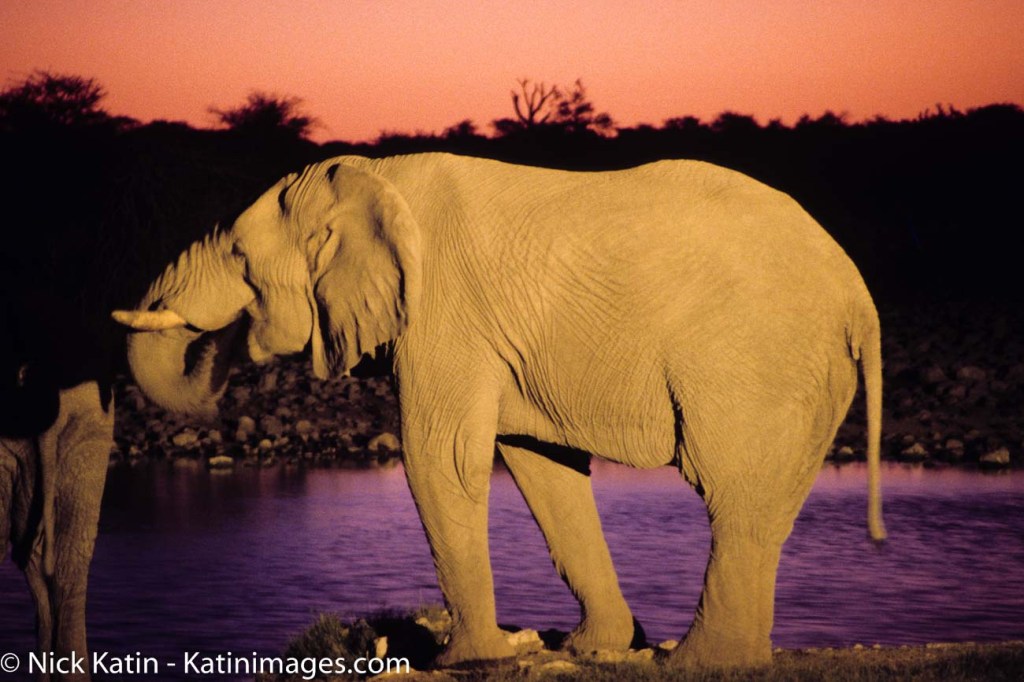
    Back at the camp we found a couple of seats by the illuminated camp water hole and waited for the show to start. As darkness came so did a herd of thirsty Elephants. They drank like there was no tomorrow. We thought that they would suck the water hole dry. But suddenly they all stopped and led by the boss bull all fifteen including five babies, trooped off, like a scene from Jungle Book, into the under growth and out of our sight.

    Later that night we were really privileged. Three black rhino sauntered down for a drink. Why were we privileged? Well the black rhino is probably the most famous endangered species in Africa. Due, mainly to poaching, there are a little over 3000 left after having a population of 60000 in 1970. It’s not my place to explain the mechanics of why these powerful beasts are exterminated ruthlessly for their horn so that the ‘misguided’ population of some Asian nations can use it for medicinal and aphrodisiac purposes. Nor is it my place to explain why the Yemeni insist that they must have daggers made of rhino horn.
    Suffice to say that due to both of these stupid ignorant beliefs a few ruthless businessmen make a fortune out of having a beautiful animal virtually wiped out from the surface of this planet and that sucks!

    Black rhino are also one of the ‘big five’. These five were the most prized ‘scalps’ by game hunters and if you think that’s just a relic of the past, then think again, there’s still plenty of opportunities on private land for game hunters to shoot defenseless animals for ‘sport’.

    Now the ‘big five’ are sought after for the best viewing. The other four are lion, leopard, buffalo and elephant and on that particular day we had seen three of them.
    For those of you thinking of game viewing in Africa, don’t knock yourself trying to see this group of animals. There is plenty of other wildlife to be seen that are just as enjoyable to watch. Game viewing is not a serious of ticks on a ‘to see checklist’ but an opportunity to watch Mother Nature at it’s wildest best.
    Anyway that’s enough winging and preaching for now.

    The next morning there was wildlife everywhere!………….. Giraffe, zebra, hyena, red hartebeest, impala and kudu to name just a few and then on then way back a huge bull elephant just ambling across the road just a few metres in front of us. It occurred to us at the same time that elephants have been known to charge if spooked, if this baby had turned on us this little ‘Chico’ would have been scrap metal within seconds.
    Needless to say I had the gear stick in reverse and the handbrake off, just as a precaution!

    The afternoon yielded different results. We went back to Okondeka hoping to see the same pride of lions. They were missing in action but what we did see was a male lion sitting in the shade of a thorny acacia tree, you know the ones, the trees that are shaped like an umbrella and are in almost every African sunset shot found in the glossy travel brochures.
    We didn’t realise that he was injured until he got up and strolled or rather limped away. We managed to follow him to his destination, a carcass that probably a few hours a go was live Zebra, going about his business of chewing a few blades of grass, before being brutally murdered for Monsieur lion’s dinner. Somehow the lion must have got injured during the kill, but that didn’t stop him chewing away and at the same time growling at the vultures and jackals who anxious to share the spoils.
    It was quite fascinating to watch. I felt like we were watching a discovery channel show!

    If you like this then hit “follow” on the side bar

    An elephant drinking at dusk at a camp waterhole in Etosha NP in Namibia
    An elephant drinking at dusk at a camp waterhole in Etosha NP in Namibia