

Tag: Mountain
-
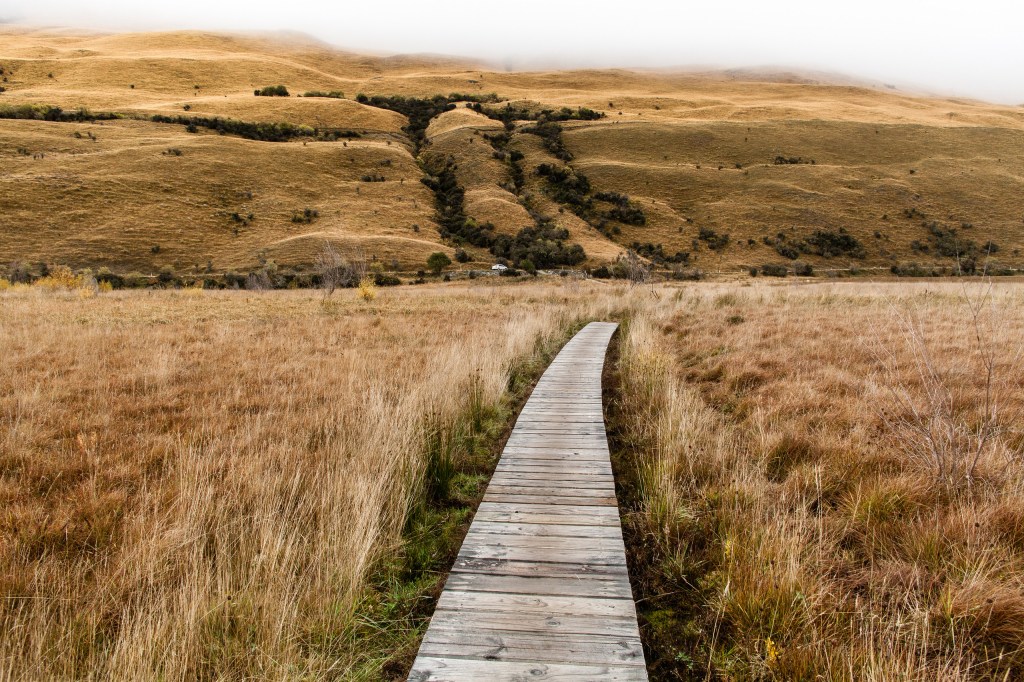
Boardwalk
A boardwalk section of a wall around Moke Lake nr Queenstown, New Zealand. Click on the image for a larger view -

Mount Fuji from the Lake Kawaguchi-Ko area

Mount Fuji from the Lake Kawaguchi-Ko area. Click on the image for a larger view. Share this:
-
African shoestrings – Zimbabwe Day Ninety-Six Harare
We moved on the next day to an area called the Vumba Mountains around 250 kilometres to the north. This small area of high country also borders Mozambique and is much more green and lush than Chimanimani. In fact it’s reminiscent of the Dandenong ranges near Melbourne with its eucalypts, rhododendron and tree ferns. We booked into the Ndunda Lodge, an inexpensive thatched lodge nestled amongst the trees and surrounded by manicured lawns and bushy gardens that housed a multitude of bird life. The Botanical gardens are the big attraction in the Vumba. They overlook the Bvumba valley and the surrounding mountains and are expertly manicured outside of the thick rainforests. The forests themselves have lots of trails that allow closer contact with nature. As we strolled around we had the distinct feeling that we were being watched.
The Samango Monkey is as elusive as they are rare. They are unique to the Eastern Highlands and have this birdlike call and it was these little buggers that kept a watchful eye on our movements. No doubt it wasn’t just us that attracted our attention, we had a four-legged companion. Gypsy was the lodge sheepdog and for some reason known only to herself, wanted to lead us through the gardens stopping occasionally to look around as if to say “hurry up I haven’t got all day, you know”
But without doubt the best attraction in the area is Tony’s Coffee Shoppe. It serves nothing but coffee and cakes. I don’t know why but I expected Tony to be white. Maybe its because the concept is mainly a western rather than an African indulgence or maybe it’s the name Tony. Either way Tony and his waiters were dressed in bow ties and long white aprons and served each table as if it were in a fine dining restaurant. The cakes were absolutely terrible! Rich, gooey and laced with alcohol we pigged out and washed it down with coffee spiked with chocolate. Is that gross or what!
Another long drive took us to Harare, capital of Zimbabwe and the drop off point for the hire car that had somehow managed to get us there without further problems and despite all the extra weight we were carrying from our indulgence at Tony’s.
As far as historians can tell the Shona were the first inhabitants of this area and called it Ne-Harawa after one of their chiefs. It actually means “The One Who Does Not Sleep” which is quite an apt name for a now bustling metropolis. The poms arrived in the late nineteenth century and as is their way decided to settle here and construct a few buildings and called it Fort Salisbury again after one of their chiefs the British prime minister of the time Robert Cecil the Marquis of Salisbury. What Ho!
At independence in 1980 it was renamed Harare a sort of anglised variation on the original. Now of course it is like most other Southern Africa cities a mix of western and African culture. High rise office buildings, shopping centres and colonial buildings dominate the landscape with two large African markets offering the usual bargains and rip off’s.
We have a general aversion to most cities but Harare wasn’t so bad. Mind you we had been there before. At that time we had an overnight in the Sheraton courtesy of our travel agent. What I remember most about that stay was the power cut to the whole city fifteen minutes after we landed and at the same time as the bags were being wheeled out on a two large flat baggage trolleys (no automatic carousel here). With the aid of a fellow Aussie traveler’s torch we managed too locate our bags before anyone else decided to add to their collection of bags.
This time our arrival was by road and relatively uneventful until we dropped off the hire car. The attendant there had our credit card imprint and whilst we were there, phoned for authorisation only to be denied. We left it with him and went on to our accommodation. We rang him some time later and he had still no luck. In the end he sent his offsider to us with the existing credit card docket and a new one for a different card which I signed and all was well.
We didn’t think anything of it. In a place like Africa the lines of communication are often interrupted and mistakes are frequent.
However we did attempt to use the original card another time and came across the same problem. We were now down to our backup visa and we didn’t know why! It wasn’t until we reached England some 4 weeks later that we realised why. Two items appeared on our statement that we knew nothing about. The first was an additional transaction from the service station in Bulawayo that we had used on our way to Masvingo, the second was for A$1629.11 paid to the Amabhantu Safari Coy in Bulawayo. This last one was a worry we had never heard of the company; never bought anything for that amount and had not been anywhere in Bulawayo at the time of the transaction. Obviously these transactions had taken us over our credit limit and hence the authorisation rejections.
To the Commonwealth banks credit they acted quickly and cancelled both amounts and referred it to their fraud department and that was the last we heard of it.Footnote:
Take control of your blog’s images now by signing up here to get “Eleven easy ways to improve your marketing photography”
A guide on how to start improving your images to help you take control of your marketing.
That link again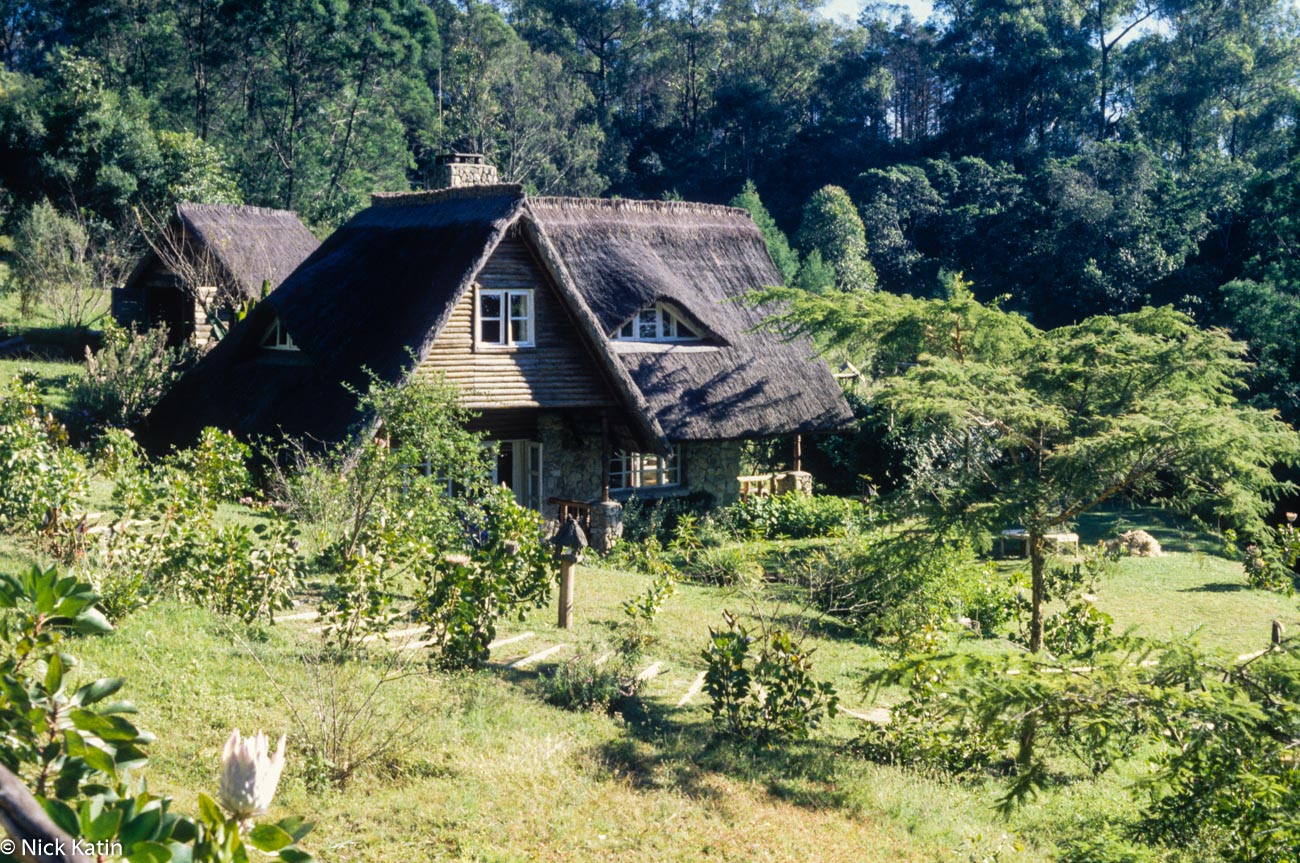
Tony’s coffee house in the Vumba in Zimbabwe Share this:
-
African shoestrings – Zimbabwe Day Ninety-Five Chimanimani Zimbabwe
From Great Zim. we drove to the small village of Chimanimani in the Eastern Highlands. Located at the eastern border with Mozambique, Chimanimani also gives its name to a national park and a mountain range. We had been told that there’s great walking and views to be had and that there was a great place to stay just outside the village called Heaven’s Lodge. It wasn’t a bad place but it wasn’t fantastic either. A sort of backpacker’s retreat with little chalets dotted around the large grassy paddock that sloped down the hill. The chalet we had was cold and the door wouldn’t stay shut unless we propped something against it on the inside but the view across the surrounding green hills and down into the lowlands from where we had just come wasn’t bad.
The mountain range of Chimanimani was 19 kilometres away, well at least the starting point for all walk tracks at Mutekeswane base camp was. There was vehicle access as far as this but we had heard that the road was in bad condition so bearing in mind the temperamental nature of our car’s battery terminal we decided to catch the lodge shuttle. We made the right decision! The road was as bad as it gets. This time there was no bitumen between the potholes, it was just one unceasing pothole punctuated by large boulders. However as is the norm for transport in general in Africa it was half an hour late which meant we had less time to walk.
The track we took up to the mountain hut was called Bailey’s Folly. No one could tell me why it was called this but it didn’t take long to realise that the track was aptly named. A track in name but not in structure, it was basically a way marked with stone cairns (when we could find them) through rough rocky and slippery terrain. I will say that the first section through a forest of Msasa trees was well marked and an easy climb, it was just the second bit that was frustrating. I’m one of those orderly people who like to follow a well defined track, even if difficult and not have to keep trying to figure out where we are and if we going in the right direction which in this instance we often found that we weren’t. Once the track reached high ground it leveled out and then become a lot easier to follow until we reached the Mountain Hut.
The views at the hut were worth the effort. We could see right across the flat yellow grassed valley to the mountains of Mozambique just across the border. Mount Dinga Chimanimani’s highest was directly in front of us and Skeleton Pass was to the right. Our intention was to go on to Skeleton Pass. The ranger living at the hut told us that it was only about a fifty minute walk away but to avoid the muddy section of the paddock that lay between us. Skeleton Pass is actually a major trade route between the two countries. Even from the hut we could see tiny figures strolling to and from the border (it’s unmanned) as if just walking down to the local shop. In fact during the wars both countries have had over the years, it was also a major guerrilla route for arms and people.
After a thirty minutes or so of trying to avoid the quagmire we seemed to getting nowhere and by now had lost sight of the pass and any clear track. It was now midday and we only had until 4.30 pm to get to the pass and back and then down to base camp to meet the shuttle. As it took us two and half hours to get to mountain hut there just didn’t seem quite enough time. So reluctantly we turned back and to our dismay ended back down the mountain an hour early. Still it was just as hard coming down as it had been going up so we were grateful for a rest, a drink and the obligatory sugar injection in the form of a chocolate bar.
Our companions for the bumpy ride back to Heaven lodge were Andy and Caroline, an English couple from Oxford on a three week holiday. They had originally booked to go to Zaire but had to cancel due to the turmoil that was happening there and decided to come to Zimbabwe instead. I mention this because Zaire is not your usual holiday destination; in fact Zimbabwe would not have been either a few years ago. These places were once the domain of the die-hard rough and tough travelers like us!
We had dinner with them at a restaurant called the Msasa Café run by a couple of women who by the looks of them regretted not being old enough to experience the sixties and go to Woodstock. Mind you they may have been hard to take seriously but their food most certainly wasn’t. It was the best we had since leaving South Africa.
If you like this then hit “follow” on the side bar
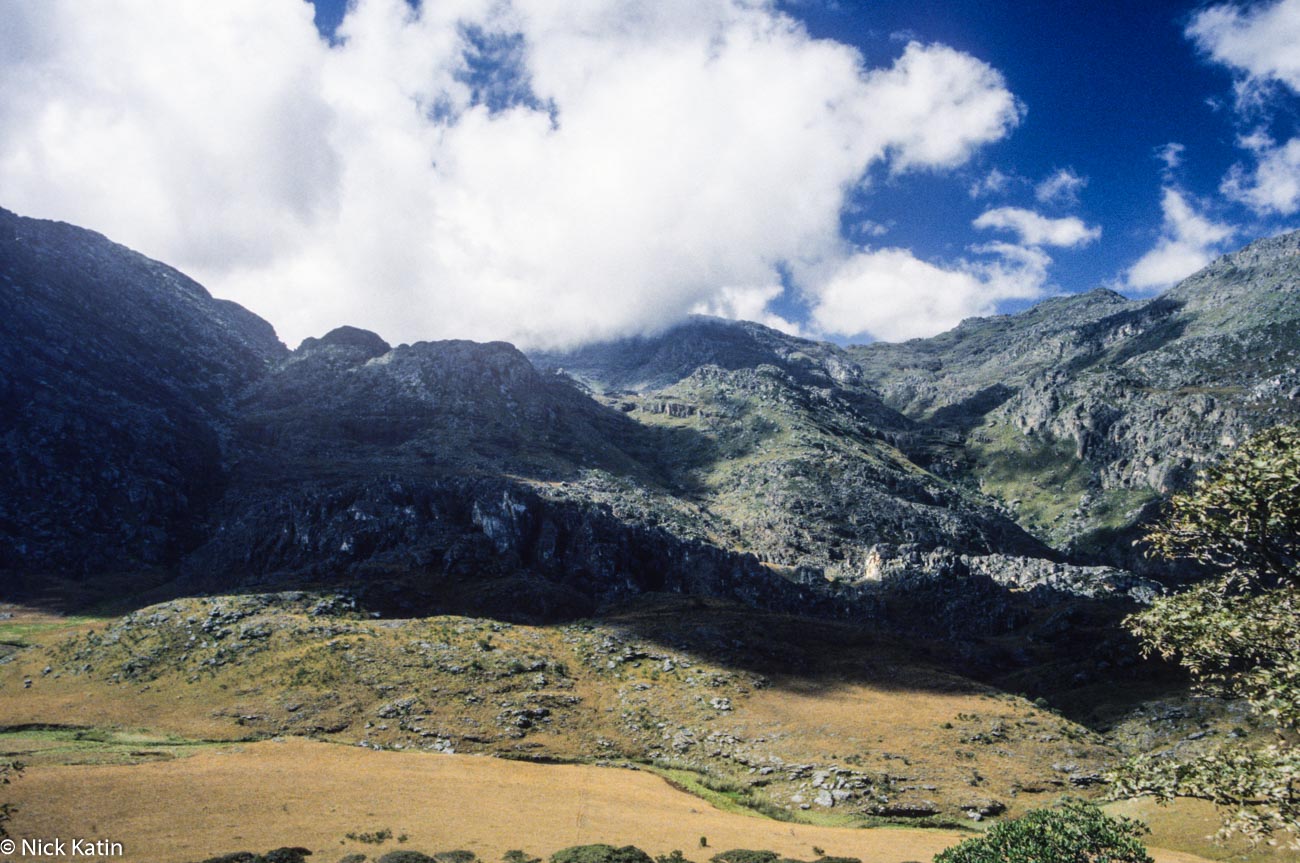
Mountain Hut at the top of the Chimanimani rnage in Zimbabwe Share this:
-
African shoestrings – South Africa Day Thirty-eight – Stellenbosch
It was time to leave Cape Town, not as we thought at the time forever, but for a few days. We were off to the winelands!
Stellenbosch has two dominant influences, the wine industry and the local student population that studies at the Afrikaans-language University of Stellenbosch. Fortunately these two influences compliment each other and the result is a trendy, lively place that seems to have avoided the social problems that dogs the rest of South Africa. It’s also the second oldest town in South Africa and hence has many well preserved architectural gems. Gleaming white Dutch Gable buildings interspersed with the odd flat or thatched roof were everywhere.
We attempted to follow a walk trail that passes the most notable buildings and landmarks. But gave up following it exactly. There were just too many to look at!We ended up at the Die Bergkelder a big cooperative winery that owns many labels and small vineyards in the area. They have an interesting but fairly pedestrian tour of the winery and we got to taste some wines from their biggest label Fleur Du Cap. Silly thing was that to taste some other wines, you were directed to the main tasting area, which by the time the tour finished at 4.30 pm, had closed. Obviously they don’t need the business that badly!
The Stumble Inn is a name that conjures up visions of a quaint little guesthouse with period piece architecture and furniture. Not quite. It’s a converted house of no specific beauty that now serves as a Backpackers, our third! …….We were determined to get the hang of these places.
Neil, the owner (we think) took one look at us and must have decided that at our age we needed to be in a quiet room away from the living areas. It was pretty much the same, soft beds, hand me down furniture, décor that varied in style, standard and colour. A big back yard was dotted with small tents whose occupants were all in a state of undress and trying hard to be the first to get a melanoma.
If you like this then hit “follow” on the side bar
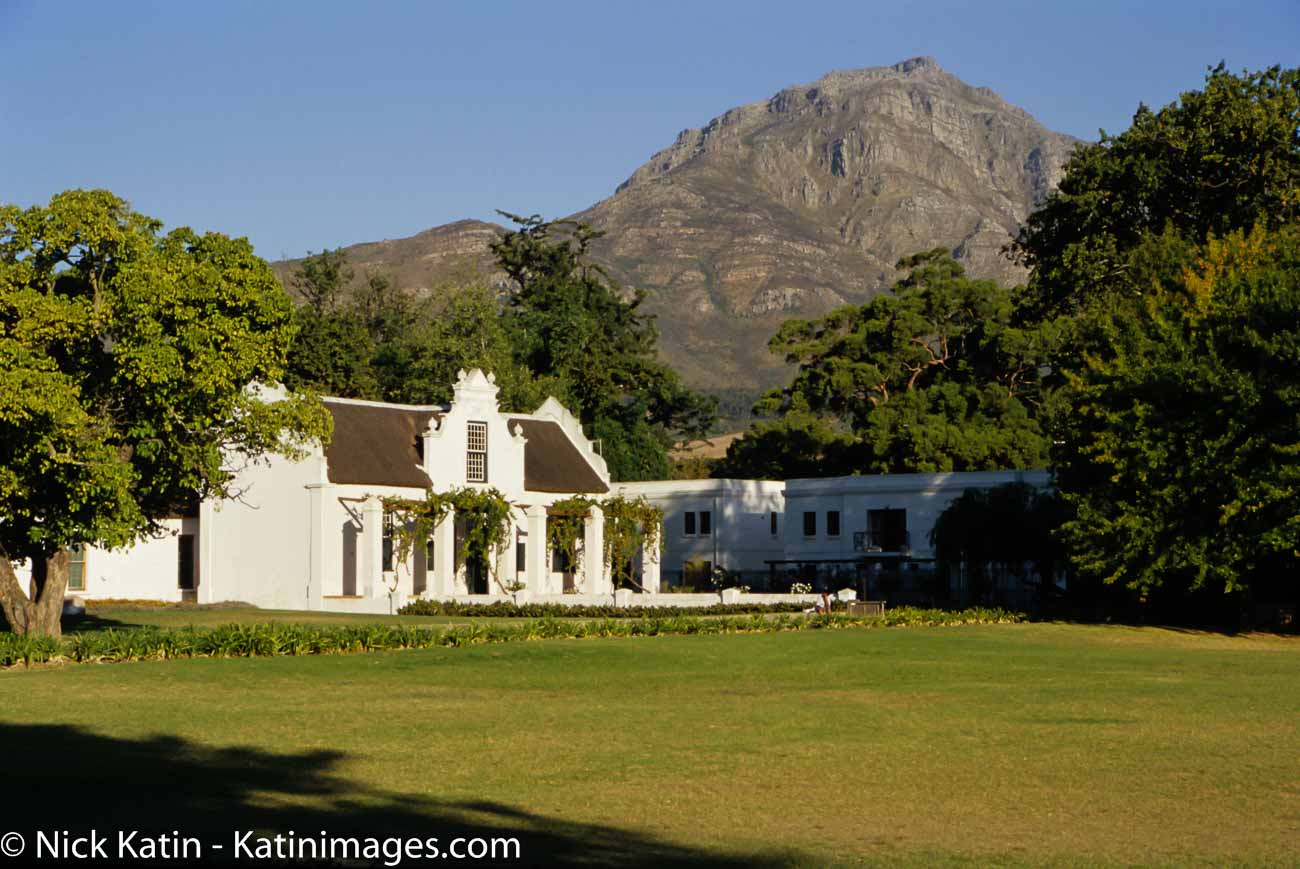
A small winery near Stellenbosch beneath the Stellenbosch Mountains Share this:
-
African shoestrings – South Africa Day Twenty-four
It was as the guy from Budget was driving away that a rather worrying thought crossed my mind.
What if he wasn’t a Budget employee and had just easily hoisted a car from two unsuspecting and naïve tourists! The fact that he was standing in the Budget car park with a Budget jacket might mean nothing; that could have been part of the ‘sting’. I decided that I would take an aggressive approach if it turned out I was not paranoid.“Why let a car thief stand in your car park with your uniform on was going to be my approach”, I was going to take it up to them!
I was awoken from my absurd fantasy by more of these backpacker hostel touts ceaselessly badgered us to stay in their hostels.Apparently since the end of apartheid in 1994 there have been numerous hostels sprouting up in the more popular tourist spots especially J’burg and Cape Town.
I don’t how many there are in J’burg but It appeared that each one had a tout at the airport.As it happened we had booked a night in the ‘Airport backpackers’ before flying to Cape Town on our freebie flight.
This was our first experience of a backpackers and we had been strangely comforted by the fact that the female voice on the other end of the phone had been Aussie when we booked a few days before.
So when Gerard picked us up at the airport in old beaten up VW golf and proceeded to apologise for the damp in our room, dropping the price of the room by 20%, our comfort was soon replaced by some trepidation.
This was heightened by the fact that we had to wait whilst Gerard seem to spend rather a long time getting it ready before allowing us to move in.Actually our room wasn’t that bad, the only pieces of furniture were a soft, uneven bed and a rickety wardrobe. The smell of damp caused by a leaking shower next door was just about tolerable.
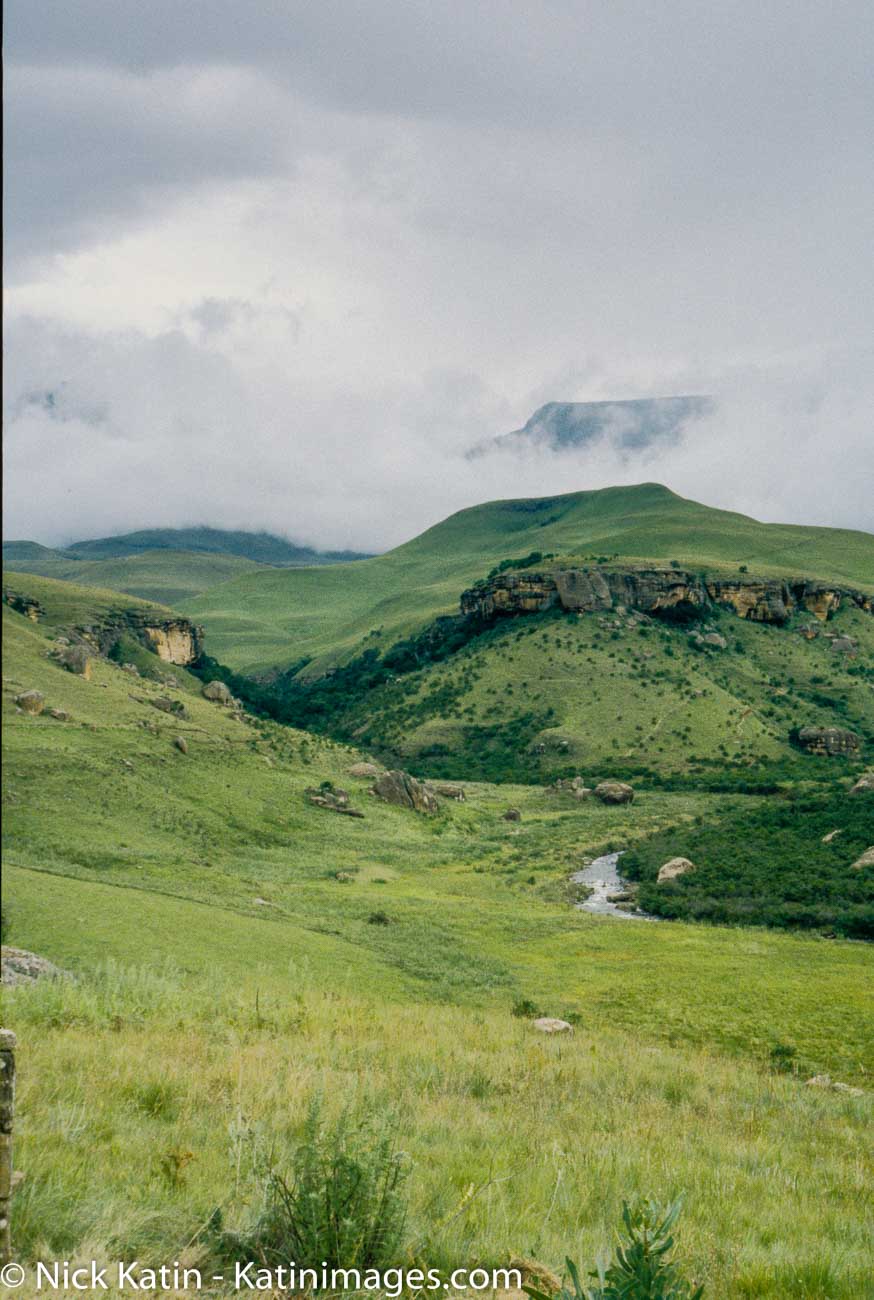
Lying at the southern end of the central Drakensberg Giant’s Castle, which gets its name from the outline of the peaks and escarpment that combine to resemble the profile of a sleeping giant, is essentially a grassy plateau that nestles among the deep valleys of this part of the Drakensberg. Share this:
-
African shoestrings – South Africa Day Twenty-three
We found the Isandlwana battlefield quite eerie and moving. Monuments and unmarked graves in the form of stone cairns (piles of small rocks and stones for anyone that doesn’t know what a cairn is) dot the base of the hill, marking spots where they believe certain events or deaths took place.
There is a memorial to the Zulu dead but somehow we didn’t really get the feeling that the local Zulu population hold this site as sacred, cattle and rustlers just strolled across the field without any reverence to the memorials around them.For those history buffs I didn’t mention the other two wars that were fought in this area, namely the first war of independence and the Anglo Boer war.
Both of these wars were fought between the British and the Afrikaners or Boers and eventually led to the British having complete control of South Africa, despite a crushing defeat in the former.
It was in the Anglo Boer war that the first ever concentration camps were used, this time by the British, who imprisoned Boer women and children 26,000 of whom died in the camps.Ironically the Boers regained control of South Africa, this time peacefully, through the ballot box in 1910 and only relinquished it in 1994, again through the ballot box in the country’s first multi racial election.
At this stage we were still 360 Km’s from J’burg and had to drop the hire car back to the airport the next morning. So after staying the night in rondavel on a rather strange property called Carla Mai we headed out early to J’burg.
Now you most of you who’ve ever hired cars would know that you are meant to return them with a full tank. At J’burg airport this was a hassle! We had tried unsuccessfully to find one close to the airport and thought there’s bound to be one there. Do you think we could find one! ………..No!
After circling, getting lost and losing our sense of direction, we gave up and somehow managed to find the Budget car park and office. There they have stewards who guide you to a parking spot and one of these guys very obligingly jumped in the car and took us to the nearest fuel station 30 seconds away! Following this he dropped us off at the international terminal and took the car back to Budget.
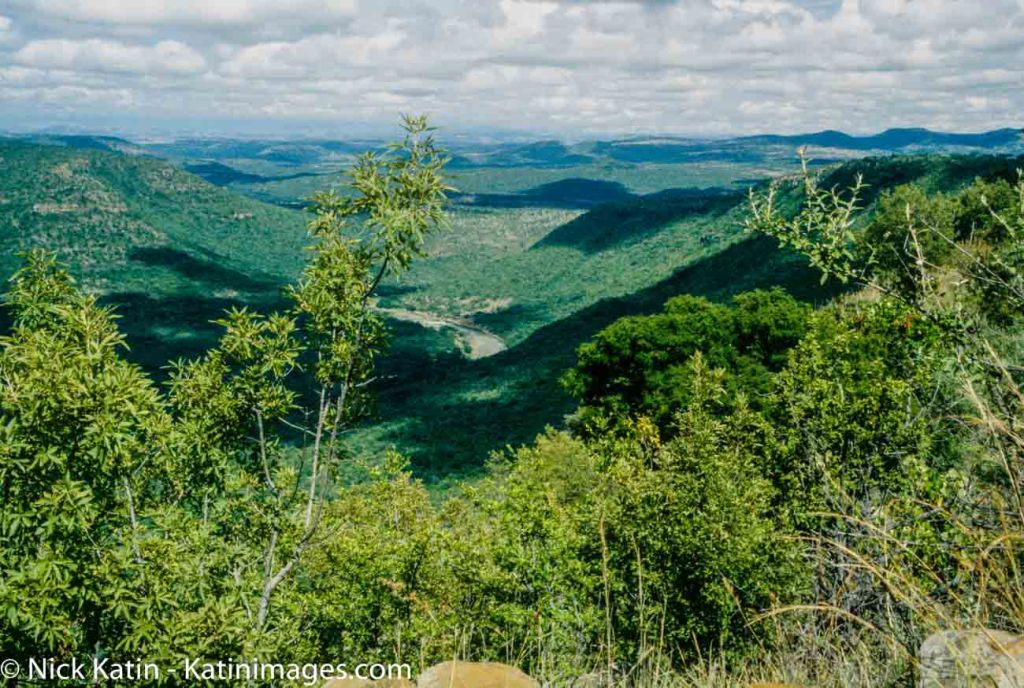
Lying at the southern end of the central Drakensberg Giant’s Castle, which gets its name from the outline of the peaks and escarpment that combine to resemble the profile of a sleeping giant, is essentially a grassy plateau that nestles among the deep valleys of this part of the Drakensberg. Share this:
-
African shoestrings – South Africa Day Twenty-two
In the middle to the end of nineteenth century a large group of Afrikaners, (descendants of the original, mainly Dutch, French and German settlers) trekked their way their way from the Cape after the British took control of the Cape colony. This was called the Great Trek.
When they got to Natal they found the Zulu’s here and after trying to negotiate for some land ended up fighting them.Now the British were also there and they had already claimed the land but started to feel threatened by a build up in Zulu numbers, eventually, you’ve guessed it, another war, called unimaginatively the Anglo-Zulu war, broke out.
Two famous battles were fought in this war, Isandlwana and Rorke’s drift.Four years ago we stayed in Dundee and visited both the local Talana museum, a resource of information and displays about all the battles and events of these wars, and the scene of Rorke’s drift. The heroic effort by 139 British soldiers to hold off 4000 Zulu’s was immortalised by the movie Zulu. It starred Michael Caine and Stanley Baker and we loved it, henceforth our desire to see the real thing! It’s one of those places that requires a lot of imagination.
None of the original buildings are there and the grassland that was there at the time has been overrun by scrub due to years of overgrazing. But the museum, available literature and markers that are dotted around go some way towards transporting you back into time.Now the whole reason for us coming back to this area was to see the other Battlefield, Isandlwana.
What happened at this hill a few hours before the Battle of Rorke’s Drift was horrific. I won’t bore you with the complex maneuvers that took place beforehand except to say in summary that the British had issued an ultimatum demanding this, that and the other, which the Zulu’s ignored, triggering off a British invasion of Zululand. The British centre force accidentally stumbled on the main Zulu force at Isandlwana, which spoilt the Zulu’s plan for a surprise attack. So they attacked anyway and in two hours 20,000 men surrounded the British and annihilated 1400 of the 1800 British soldiers. Some of the survivors found their way to Rourke’s Drift and helped fortify the position together with the small force that had been left there to guard a river crossing and supplies.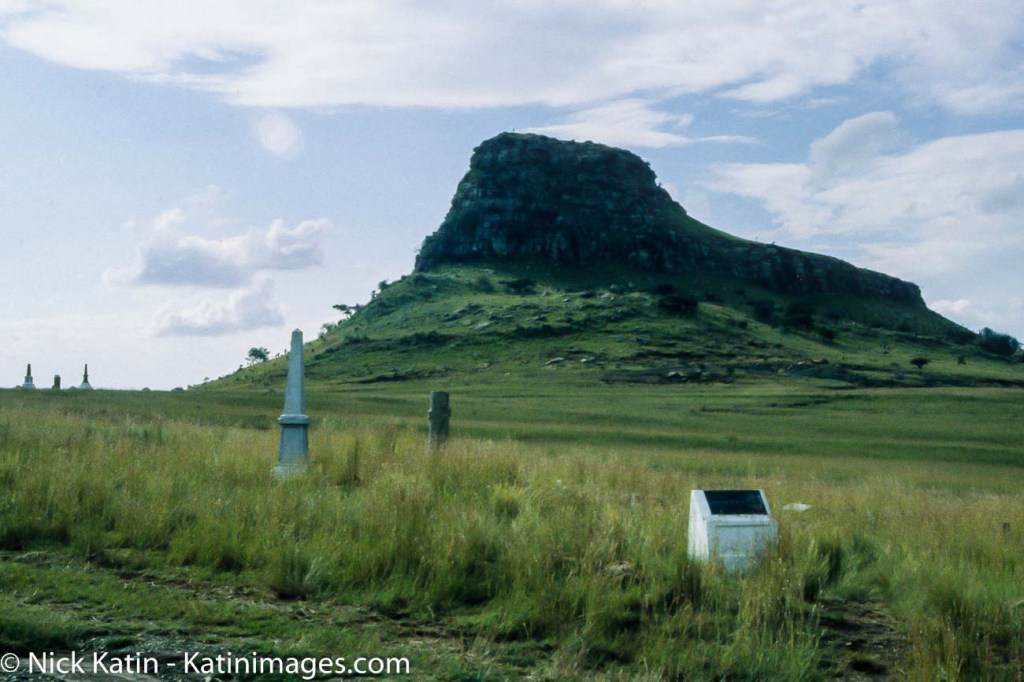
The Isandlwana battlefield where the Zulus destroyed 80% of the British forces in Kwazulu-Natal in South Africa Share this:
-
African shoestrings – South Africa Day Twenty-one
What Giant’s castle is really known for is its 5000 Bushmen Rock Paintings and the twelve species of Antelope and from our experience it’s a lot easier to see the former than the latter. With one of the park rangers we went to Main cave, one of the two sites open for viewing. He pointed out and interpreted a lot of the paintings that date from early man through to as recent as one hundred years ago, just before the bushman left this area forever.
From Main Cave we followed the River walk alongside the quaintly named two Dassie Stream. Dassies are small animals that resemble giant hamsters and are about the size of a large domestic cat and seem to be everywhere in Southern Africa. Somebody with a fertile imagination spread a story about their closest relative being an Elephant!
Back to the pub at White Mountain lodge. We got talking to Peter, a young white teacher there with a school group. He actually was one of the few that wasn’t thinking of leaving South Africa despite the fact that educational standards for all students were slipping fast due to a chronic lack of funds. Peter had relations in Australia and had been to Perth so he knew the alternatives. I wondered as we talked whether he would change his mind if/or when he has kids.
South Africa is a land of undeniable natural beauty, it has the mountains, beaches, gorges and desert, it also has an abundance of wildlife, plus of course a fascinating cocktail of cultures. But one of its greatest attractions is its colourful history.
In an area centered around the quiet farming town of Dundee in the province of Kwazulu-Natal, lies the Battlefield Route. This self guided tour takes in attractions historical events and obviously battles in this pretty part of the country. It was here that incredibly four wars were fought in the middle to the end of nineteenth century. More on that next week
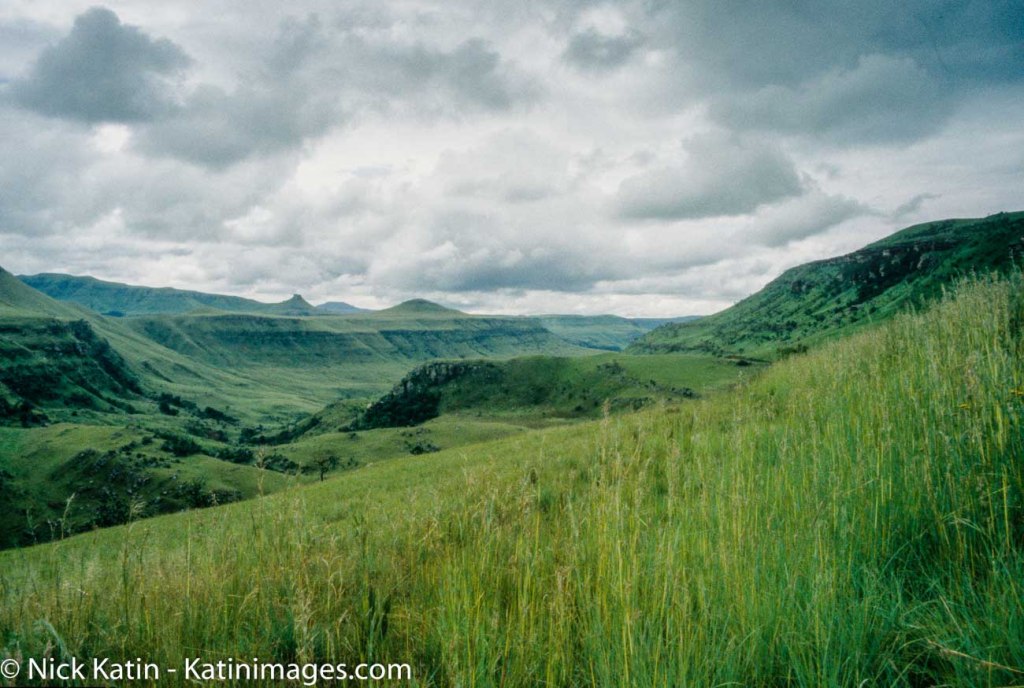
Lying at the southern end of the central Drakensberg Giant’s Castle, which gets its name from the outline of the peaks and escarpment that combine to resemble the profile of a sleeping giant, is essentially a grassy plateau that nestles among the deep valleys of this part of the Drakensberg. Share this:
-
African shoestrings – South Africa Day Twenty
The accommodation at Royal Natal was more than we wanted to pay so we took our chances on the road.
Peering through the gloom we knocked on several doors of motels and B & B’s all of which were full!
Eventually we managed to find a huge chalet at a rather sterile Drakensville Resort. This place was a holiday village full of suburban fibro homes and unfriendly people. I felt like we were back in the 50’s in one of those American suburbs that are the scene for a horror or serial killer movie but without the pumpkins.This was definitely a white man holiday camp! There was not at a black face to be seen!
What was to been seen however were little weevils in the bag of rice we bought at the shop there. Either added for flavour or it had been on the shelf for a while we took it back and ended up with another bag which guess what, also had weevils.
We gave up trying to cook a rice dish went to bed and left early the next morning.By contrast White mountain lodge is a quaint resort with white thatched roof cottages and cabins overlooking a large lake with lots of physical activities like canoeing and walking and less strenuous ones like the pub to keep guests occupied. Needless to say the latter was were we ended up that night after spending the day at Giant’s castle game reserve.
Named after one of the highest peaks in the park, this is real high country with the highest mountain in the Drakensberg, the 3409 metre Injasuti Dome, located here. It’s not as spectacular as Royal Natal but it is quite awe inspiring. Huge perfectly curved peaks of various sizes covered in grassland dominate the landscape, particularly at the eastern and southern borders of the park. Down in the valleys the landscape is covered in walking tracks and fast flowing rivers.
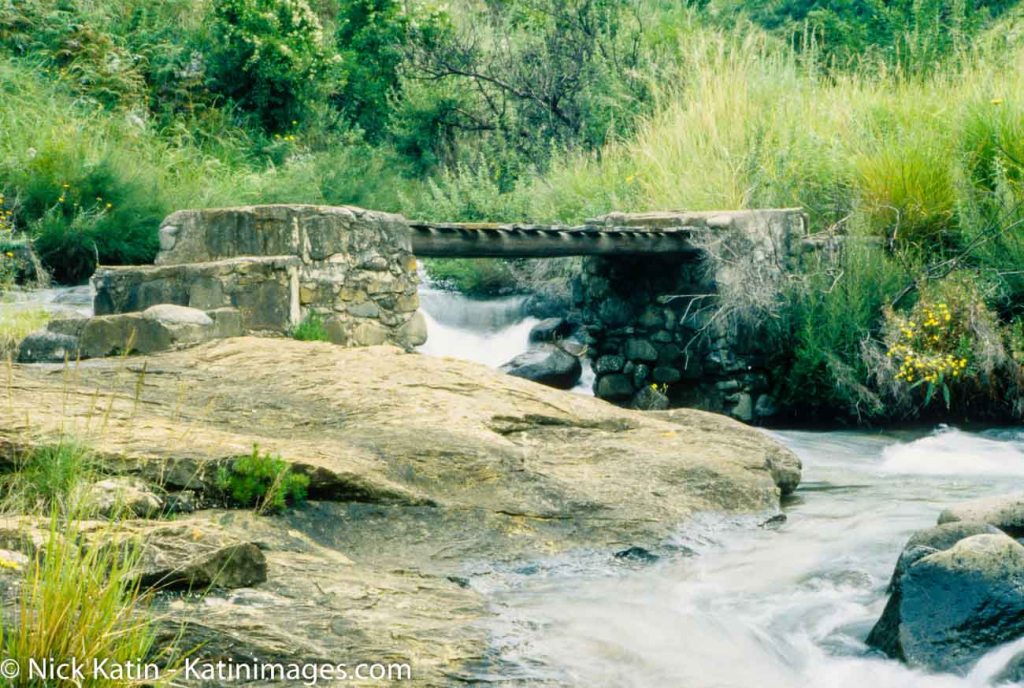
Lying at the southern end of the central Drakensberg Giant’s Castle, which gets its name from the outline of the peaks and escarpment that combine to resemble the profile of a sleeping giant, is essentially a grassy plateau that nestles among the deep valleys of this part of the Drakensberg. Share this:
-
African shoestrings – South Africa Day Nineteen
The most popular walk in the park is the Gorge walk. Talk to any South African who has been here and they will have almost certainly hiked the Gorge track.
About a year later we worked with a South African in England and his reaction was “You’ve done the gorge walk! I can’t believe it!” Anyone would think we had kidnapped Nelson Mandela and dragged him with us!Anyway I don’t know what all the fuss is about. Even at a 22.5 kilometres roundtrip it’s an easy track that starts in the middle of the park and ends at the Amphitheatre.
However with little time and brooding dark thunderstorm clouds hovering above us we set off to do this walk in an afternoon. There was another South African couple (they’re everywhere) who we followed then eventually led, that were looking nervously at the thickening and darkening clouds. “She’ll be right, Mate” I said encouragingly as we past them for what seemed to be the tenth time. The problem with that theory was that it wasn’t shared by what seemed to be an army of Black Africans who were all going in the opposite direction.
They had been maintaining the trail and I suppose might have been knocking off for the day.The walk itself was great! We skirted ridges, climbed gentle grassed hills, passed through small patches of rainforest, crossed creeks and the river Tugela before popping up at the gorge itself.
And that was where we had to stop!
We had run out of time.
If we carried on into the gorge we would have been faced with crossing the fast running Tugela a number of times plus hoisting ourselves out of the gorge using a chain ladder; all of which would have slowed us down. So with darkness probably only a couple of hours away we did the sensible thing and turned back.
All the way back we grumbled to ourselves that we should have gone on and to hell with the circumstances. We stopped grumbling about 5 minutes out of the park when the heavens opened, the sky lit up and bellowed. In 5 seconds flat we couldn’t see a thing!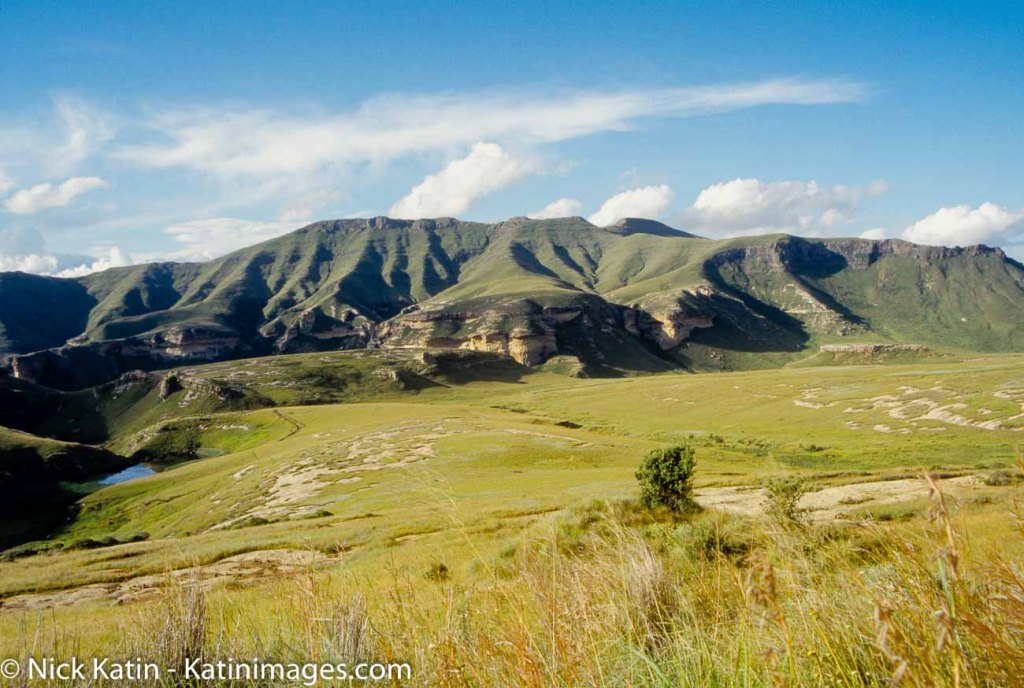
Some of the scenery found in the Golden Gate National Park in the Drakensberg ranges in South Africa Share this:
-
African shoestrings – South Africa Day Eighteen
Being in Southern Africa we did however see lots of Baboons.
Let me rephrase that we actually heard them first as they went from rubbish bin to rubbish bin, in the early hours of the morning, scavenging at whatever scraps were to be had. They left crap everywhere and they were still dining on the fruits of their spoils when we got up.
I noticed that no one made any attempt to ‘sho’ them away, this was apparently for a good reason, “they’re bloody vicious little pricks,” said the South African guy staying in the next hut. “Baboons are a problem all over Southern Africa” he continued “most parks have baboon proof bins to prevent all this mess”.He and his wife were up from Durban some 300 kilometres south for a few days and like nearly all white South Africans we came across seemed to know someone in Perth.
Back in the last days of Apartheid a lot of whites left for Australia and either settled in Sydney or Perth.
Perth attracted a lot due simply to its proximity to South Africa and with a similar beach life style, it has a lot in common with Durban. In fact there was a saying “will the last one leaving for Perth please turn out the lights”.Royal Natal National park is the Drakensberg. Huge jagged peaks form the spectacular and well known “Amphitheatre”. Looking like the bottom row of perfectly level teeth (you know the ones, the actress’s from ‘Days of our Lives’ all have them) with an incisor, Mount Amery (3143 metres and Sentinel (3165 metres, standing at either end, this wall of rock dominates the park. It has a mythical look about it that makes you think that beyond it lies a different world waiting to be discovered.
Well actually there is, Lesotho!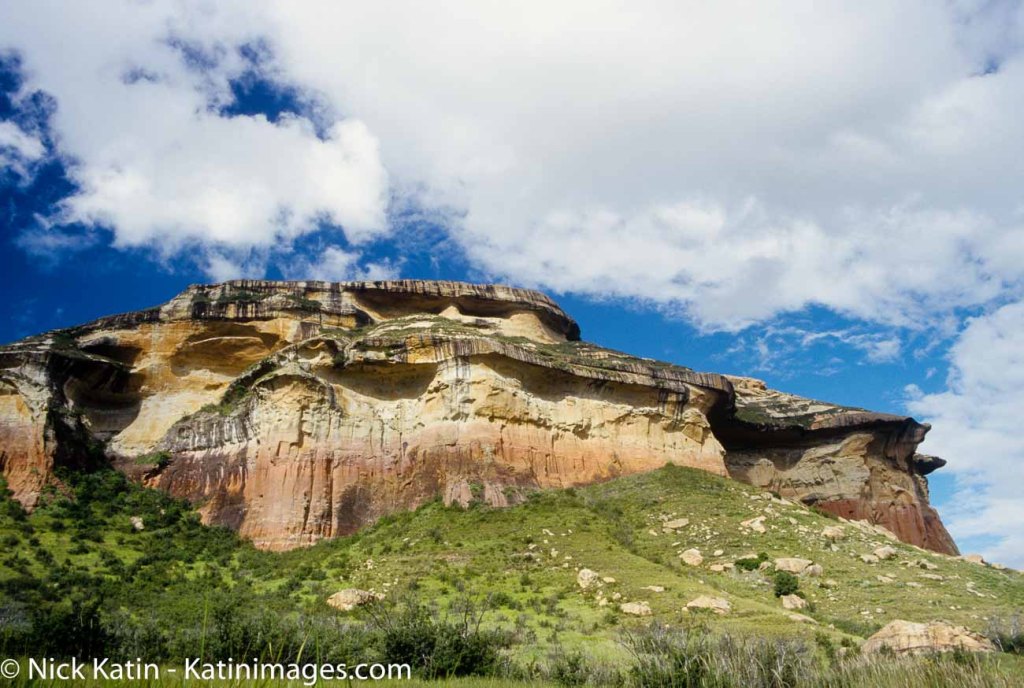
Some of the scenery found in the Golden Gate National Park in the Drakensberg ranges in South Africa Share this:
-
African shoestrings – South Africa Day five
Our next destination was a place called Malealea Lodge located in a remote part of the South West of Lesotho.
Malealea Lodge is known for it’s Pony and Walk treks amongst other things.
We had managed to contact them from home not only to find out info but to ask about the security of entering Lesotho on our own.
Before we left Australia we had taken the precaution of checking with the Department of Foreign Affairs and the British Foreign Office web sites to see if they had any travel warnings about any of the countries we proposed to visit. Well they had!
Both advised that travel to and in Lesotho should not be taken independently.
Apparently about 6 months before there was a protest by the opposition party at the election results.
The government declared a state of emergency and called in the South African army. This triggered off a two day violent protest with protesters looting and destroying many of numerous South African businesses in the capital Maseru.
This unfortunately placed Lesotho on the ‘places not to visit’ list. We ‘ummed’ and ‘aahed’ about this but after talking to Di Jones, one of the owners of Malealea, decided to stick to the plan. DI had assured us that there had been no problems since and had been driving around herself without any hint of trouble.
If by chance you’re not a great fan of mountains then whatever you do don’t go to Lesotho it’s absolutely covered in them.
It is one of only two countries in the world to be completely encircled by another country, South Africa, (the other being San Marino) and is the size of Belgium but it’s dominated by the mountain ranges of the Drankensberg and the Maloti. In fact its lowest point is over 1000 metres.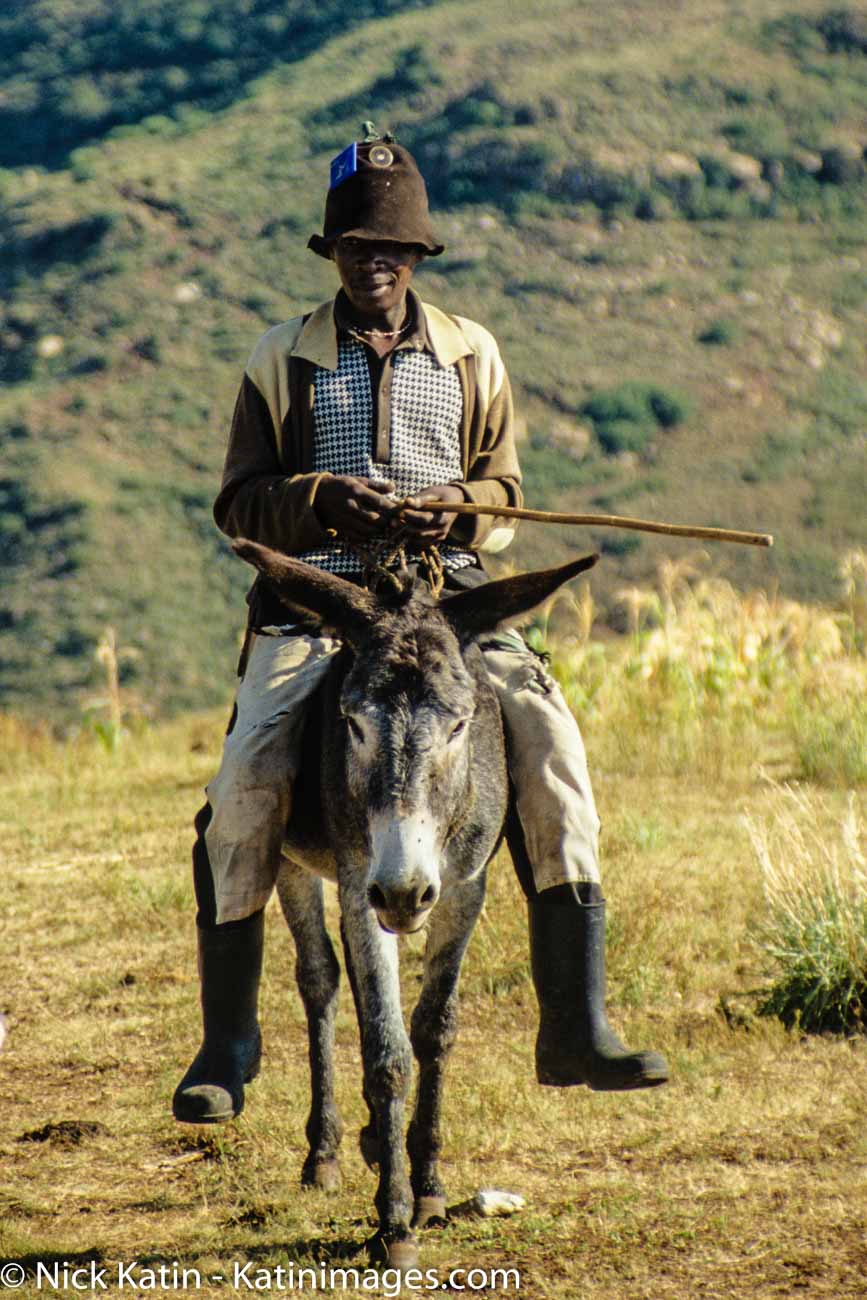
In the mountainous Lesotho, ponies are the major form of transport. Share this:
-
African shoestrings – South Africa Day three
The women at the tourist information place in Ficksburg told us that this place was considered weird by the locals but she herself thought it was “quite nice”. The Lonely Planet described it as a “dare to be different” sort of a place and gave it such a rap that we had to see it for ourselves
Rustlers Valley Guest Lodge is not a place that we will ever forget in a hurry. The 15 kilometre potholed dirt track to its door is not easily forgotten, especially the bone jarring last five kilometres or so.
Now we’re deep in the heart of Free State, formerly Orange Free State. This is Boer country, about as god fearing and conservative as you get. So to find a hippie commune smack bang in the middle is absolutely amazing!
VW Kombi’s, teepees, suspicious looking patches of vegetation and escapees from the sixties dotted the place. But it was comfortable. The scenery was pretty good too. The Maloti range overlooked us in the west and the plains stretched out to the east with odd line of sandstone hills and grassy slopes here and there. Mostly there actually, because we made the mistake of following the “extensive network of tracks” up and around them until the tracks petered out or were so overgrown that only a machete and a chain saw would have got us further. to be continued………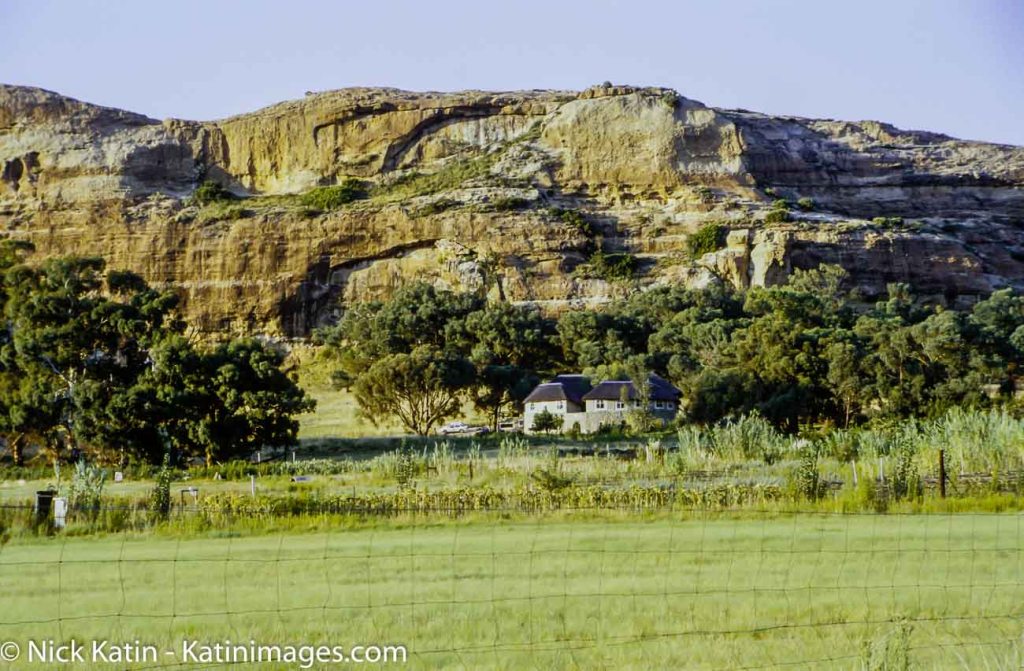
Rustlers Valley Lodge in the shadow of the malotti Hills in Free State, South Africa Share this:
-
Alaska Marine Highway photo
Last year I travelled the inside passage on the Alaska marine highway. Not on a cruise ship but on the ferry from Bellingham, near Seattle, to Alaska. More on that in the future. Came back with a lot of images which I am slowly working my way through. The weather was at best, pretty awful to begin with but it made for some interesting skies and scenery. This one is an example. Its not as it appears at first glance, black and white. 1/125 @ f11 100mm ISO100
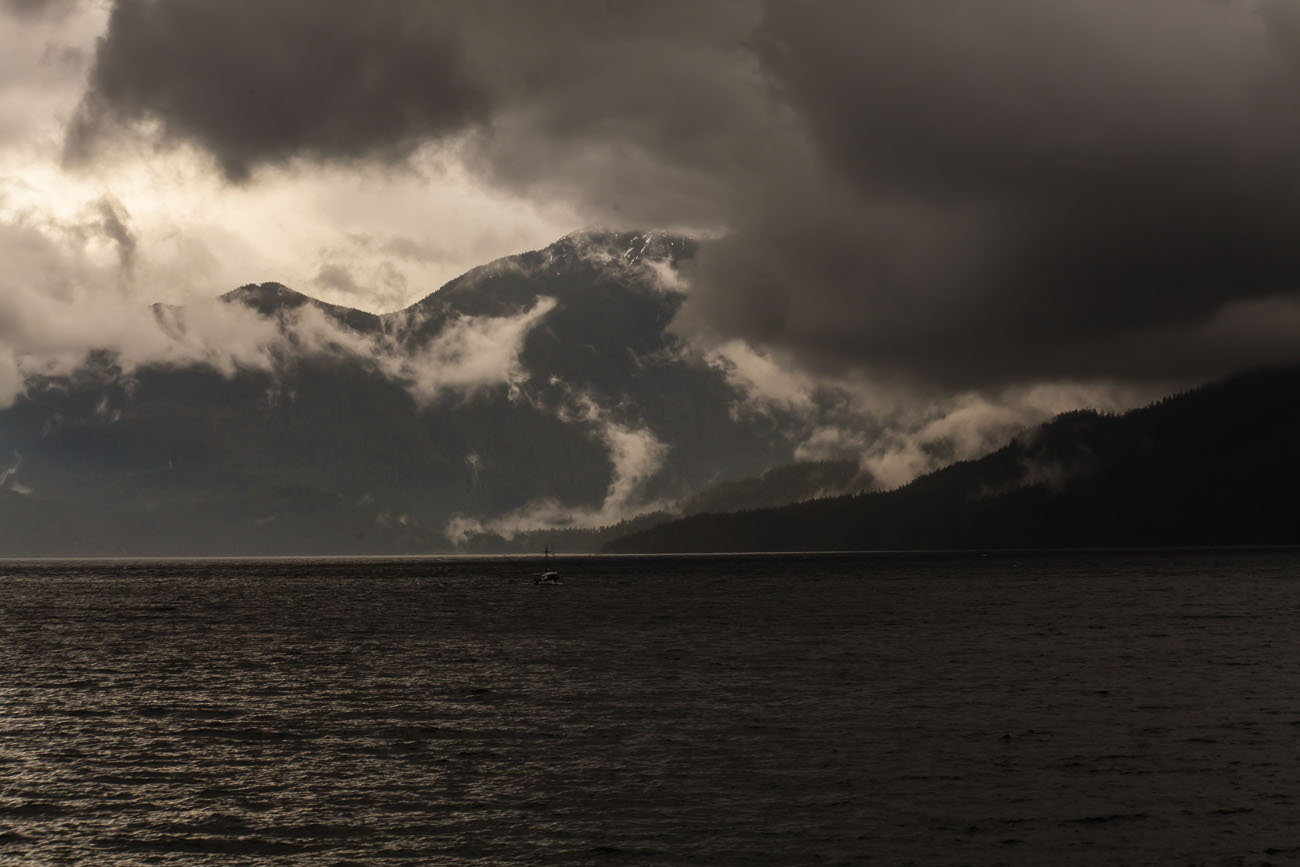
Misty Mountains near Bellingham WA at the beginning of the Alaska marine highway and the inside passage.©2013 Nick Katin To buy a print of this photo, go to Alaska marine highway photo. To licence or share this photo email or contact us
Share this:


 Katin Images Travel Photography