Katin Images Travel Photography

Travel Photos, Travel Photography Tips and Software

Blog

  • African shoestrings – Namibia Day Fourty nine – Fish River Canyon

    Our goal was to get to the Fish River Canyon around 120 kilometres away and Keetmanshoop was the closest large town. The catch was that there was no easy way there unless you hired a car, which a lot of people did. We had looked at that this and found the cost too exorbitant. Thanks to the Lonely Planet we had found an alternative.

    The Fish River Lodge offered reasonable packages including transfers from Keetmanshoop. We were picked up from La Rochelle by Riet just after lunchtime. Riet and Louie own and run the Fish River Canyon but with a strange twist. She (Riet) lives in Keetmanshoop with the kids and he lives at the lodge. An arrangement they have had for the last 3 years.

    Tough on your marriage!

    Both were from Cape Town and like many others had moved away from the turmoil of South Africa in search of better and safer life. As she told this we were looking out of the car window at a dull brown, rocky, flat treeless plain that somehow didn’t inspire us at all. Then she remarked that anybody coming here who has seen the Grand Canyon in the States must be so disappointed when they see the Fish River Canyon. Well, we had seen the Grand Canyon, so things weren’t looking good!

    The lodge is located about 40 kilometres north of Hobas, the canyons main tourist and information centre. There’s another area of activity further south at Ai-Ais Hot Springs resort, so we were starting to have doubts as to whether we were in the right place!

    As soon as we got there Louie gave us a beer each and whisked us off in the back of a Ute to the canyon 10 kilometres away. We drove down a rather bone jarring track onto the canyon floor and stopped there for a swim in the murky red Fish River. It was such a remote and desolate landscape, that the last thing you would expect is to see ten or so people suddenly appear along the floor of the canyon! This was a group hiking the Fish River hiking trail. Without exception they were all soaked in sweat and dust as they tore off their backpacks and all, bar a couple, jumped in fully clothed. Louie then took us back up to the canyon edge and to a viewpoint to watch the sunset.

    The lodge itself was pretty basic. With just two showers and toilets between six rooms; it was a cross between an old shack and a backpackers hostel. Apart from the lodge there was a dorm set away down the slight hill that the lodge stood on. Converted from a stable, it was a lot cooler than the lodge.

    And then there was Louie!
    Rough and ready, there were no airs and graces about Louie. He was one of those blokes you’d find down any pub tossing it down and talking gibberish with the rest of them. That we could handle!
    His singing was another matter!
    After tea he would bring out the guitar and sing the only song he knew “The horse with no name” for those of you born since the heady sixties, this was a big hit by a band called America. And ever since Louie sung it, I’ve been scarred for life. Talk about or see a desert and that damn “In the desert you can’t remember your name” comes into my head.

    If you like this then hit “follow” on the side bar
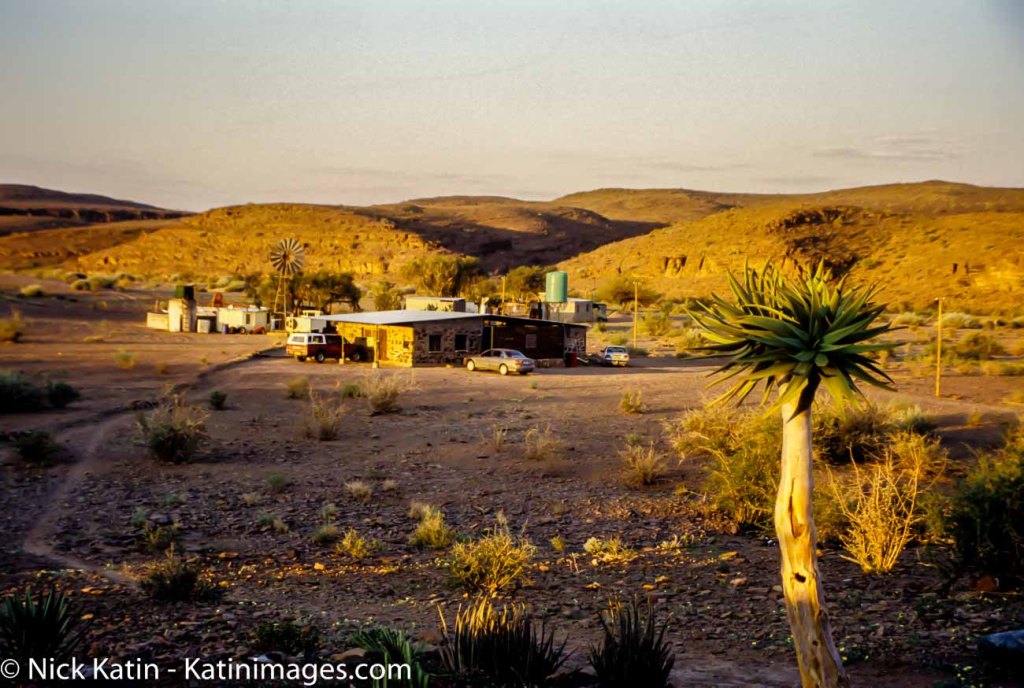
    Fish river lodge, Fish river Canyon, Namibia
    Fish river lodge, Fish river Canyon, Namibia
  • African shoestrings – Namibia Day Fourty eight – Keetmanshoop

    We got back to Upington in the early afternoon and were ‘treated’ to a wimpy!
    A wimpy for those of you who don’t know, is the British equivalent to McDonalds and just about serves up the worse hamburgers you can get from a fast food restaurant (well at least this one did). Mind you as far as I’m concerned most fast food places are like that. The first two or three bites taste pretty good ’cause your hungry the rest resemble cardboard and have you thinking why did I bother? Because you’re hungry of course!

    We set up camp in the local Caravan Park, where the others were sleeping the night. We had a bus to catch to Keetmanshoop in Namibia that night and Hannah and Si were catching one to Cape Town. But we had enough time to rest up for awhile and watch the locals set up their caravans and crack open a few tinnies.
    This was, according to Roland “duchy country”. Duchy refers to the ‘real’ Afrikaners, people who had ancestry back to the first Dutch settlers in the seventeenth century. I had tipped Roland to be a ‘duchy’ but he apparently was not from that stock.

    A couple of them came up and started chatting to us. These guys were big bulky blokes who had tinnies almost disappearing inside their massive hands. They were the archetypal beer swilling rugby and cricket mad South Africans that most of the world recognises as the white South African. We had a bit of banter over rugby and cricket and they asked us over to the local bar to watch a rugby super twelves game with them. I was hanging out to do something like that but our bus departure time wouldn’t allow that and Michelle and Alex rightly felt it was not a good idea for them to go alone.

    The Intercape Mainliner to Keetmanshoop was 45 minutes late leaving, which allowed us plenty of time to say our good-byes. Roland was like a mother hen with our bags, making sure that they were loaded on carefully and near the front, as our stop was one of the first. We had all given him a generous tip in foreign currency, which he collects, so he was happy as a lion rolling in the Kalahari sand!

    The bus ride itself was an another overnight job and would have been pretty uneventful except for South African customs wanting everyone off the bus so that their sniffer dogs could sniff around presumably on the possible scent of weapons. We eventually got to Keetmanshoop at 3 am and were met by George from the La Rochelle B&B our overnight stop. We had booked a night here, figuring that arriving at 3 am in a strange town, without a place to stop the night was not a good idea.

    George was the first of many ‘Germans’ that we met in Namibia. Even though Namibia was only a German colony for thirty-one years from 1884 until 1915, its influence in certain areas is still very strong amongst descendents of that era. George was we were later to find out a typical example. He had been born in Namibia but still spoke with a fairly strong German accent and the B&B itself was very central European in its style and ambience. All dark wood and German style trinkets and furniture.

    If you like this then hit “follow” on the side bar

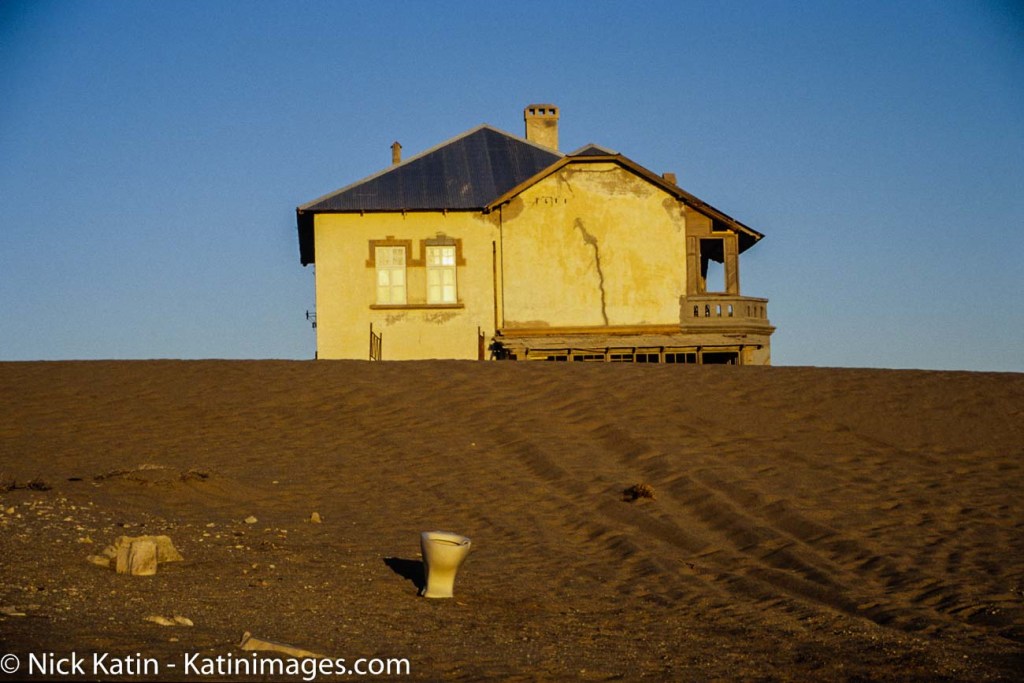
    The ruins of the ghost town of Kolmanskop in the Namib desert in southern Namibia, a few kilometres inland from the port town of Lüderitz
    The ruins of the ghost town of Kolmanskop in the Namib desert in southern Namibia, a few kilometres inland from the port town of Lüderitz
    The ruins of the ghost town of Kolmanskop in the Namib desert in southern Namibia, a few kilometres inland from the port town of Lüderitz
    The ruins of the ghost town of Kolmanskop in the Namib desert in southern Namibia, a few kilometres inland from the port town of Lüderitz
    The ruins of the ghost town of Kolmanskop in the Namib desert in southern Namibia, a few kilometres inland from the port town of Lüderitz
    The ruins of the ghost town of Kolmanskop in the Namib desert in southern Namibia, a few kilometres inland from the port town of Lüderitz
  • African shoestrings – South Africa Day Fourty seven – Kalahari

    On that subject, of food, these tours feed you well. Whether it is a budget tour like ours or a five star tour, the tour companies must drum into the tour leaders that the guests must eat. I can just hear them now “Never mind the spectacular scenery or the animals, the object here is for the tourists to eat at least three big meals a day, and if possible morning and afternoon tea and equally as important on time!”

    On one tour we did in Kenya the 4WD got bogged in sand in Lake Nakuru and despite our protestations our guide insisted that we get a lift with a passing vehicle so that we wouldn’t be late for lunch. It was a long lunch because he turned up 6 hours later, covered in mud from head to toe. We would have much rather stayed and given him a hand.
    In Uganda on a Gorilla safari we had a guide called Charles. Charles had a small straw picnic hamper that he spent a great deal of time arranging and rearranging after use so that all the crockery would fit in a certain way. Watching him go through this ritual for the first time it, was merely amusing, by the time we had our last morning or afternoon tea it was all we could do to prevent ourselves from breaking into absolute hysterics, as he fastidiously and obsessively arranged everything first one way then another until satisfied and then sighed, contented with his final arrangement. What didn’t occur to him was that we could have quite happily saved him all this pain and skipped morning and afternoon tea!

    Strangely enough most tourists remember the food they have on these trips more than the experience they had! How often do you hear “Oh and the food was wonderful/crap”
    Maybe the tour operators have a point!

    We had some unwanted visitors that night. Jackals, like the baboons in Golden Gate come in darkness and scavenge anything they can get at. We weren’t affected but a group of school kids who were sleeping under the stars had a torrid time as the jackals ran off with all their stuff and scattered it around the camp or worse took it into the bush.

    The next day was our last of the tour and that meant heading back to Upington, 160 kilometres away, 60 on gravel, slowly at first so that we could search for any game. But once again it appeared that the script had been ignored. We were all now thoroughly depressed and ready to give up.

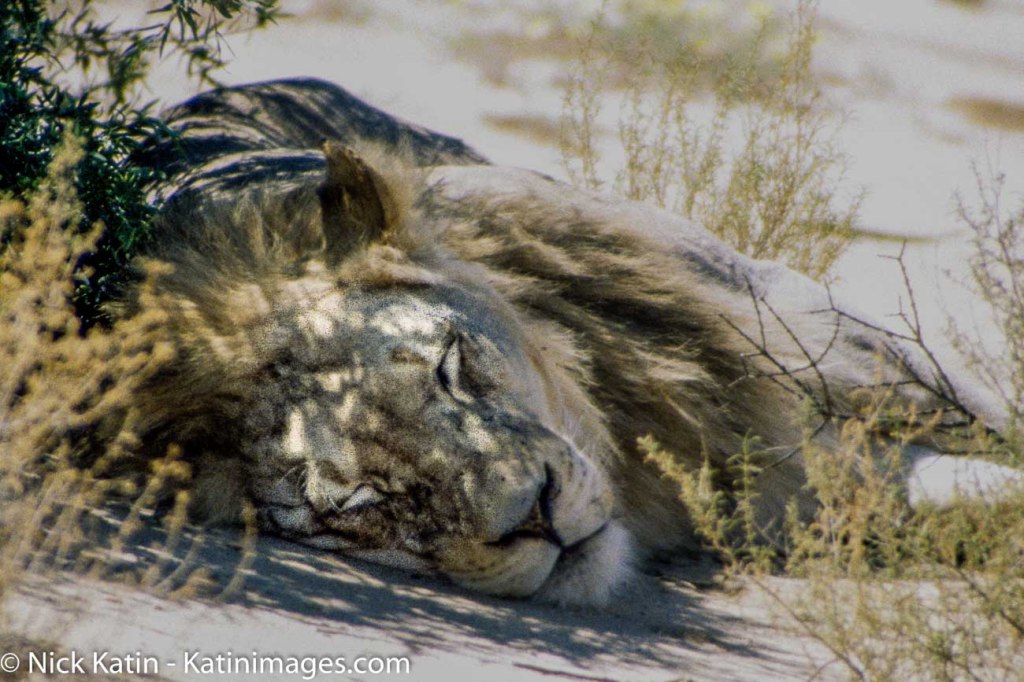
    Suddenly by the side of the road Roland exclaimed “Lion”. Sure enough right by the roadside lay two male lions asleep under a small but shady tree. The lions of the Kalahari are meant to be amongst the biggest in Africa and sure enough after seeing them up close, I can see why. They were big! They didn’t really entertain us apart from one of them standing up, moving 5 metres and plonking himself down again with a heavy thud before going back to sleep. But we didn’t care we had finished on a high and all of us had a bit of a smile on the dusty journey back to Upington.
    Mind you I think Rolands smile was more one of relief than joy. He had, at the beginning, dangerously bragged about how much game we would see in the park and felt personally responsible for any success or failure. Not that he should have done. Game watching is a bit like trying to win at the races; you can study the form but in the end it’s pretty much out of your control.

    If you like this then hit “follow” on the side bar

    A lion sleeps in the shade of an acacia tree in the Kalahari national park on the border of South Africa and Botswana
    A lion sleeps in the shade of an acacia tree in the Kalahari national park on the border of South Africa and Botswana
  • African shoestrings – South Africa Day Fourty six – Kalahari

    A night drive is a game drive, obviously, in the dark; well it was really in twilight as we set off just before sundown. The idea is to see lots of animals big and small as they cruised around in the coolness of dusk and then stop for a sundowner in the middle of nowhere. As it got darker so our reliance on the two spotlights grew and of course the obvious happened one of them blew. So the ten of us on the drive all had to squint into the dark to spot anything.
    We did actually see quite a few animals. But of course we didn’t see any of the more popular ones like lions, cheetah’s etc.

    Back at the camp we ate one of Roland’s culinary masterpieces under the light of plastic drink bottle covered candles.
    Now was the time for that beer as we got to know each other better.
    Simon & Hannah had just left school and were doing a bit of travelling before starting University in England. Alex, was visiting rellies in J’burg and I got the impression that they had shunted her onto this tour to get her out of their hair, she certainly was a little temperamental. Michelle was the quiet one. She had finished her Peace Corp stint in northern South Africa and this was her last days in Africa. Despite her quietness and the fact that she was American she had a great sense of humour. Well I think she did, she laughed at all my jokes.

    The tour kept rolling on, our next stop was the camp at Mata Mata, 127 kilometres north on a gravel road. The idea was to take it slow, have brekkie and lunch on the road and do a game drive at the same time.

    Well we saw heaps!

    Cheetahs and lions in the distance, black backed jackals, cape foxes, steenbok, gemsbok, wildebeest, springbok (these last our all from the antelope family) and the quaintly named long legged big bird, kori bustard.

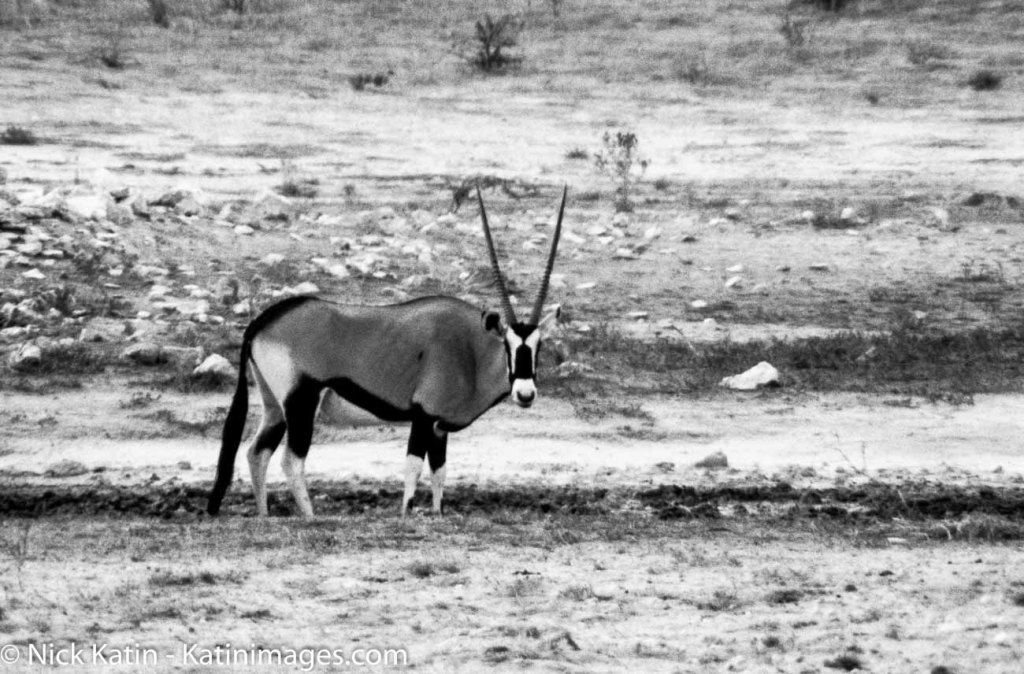
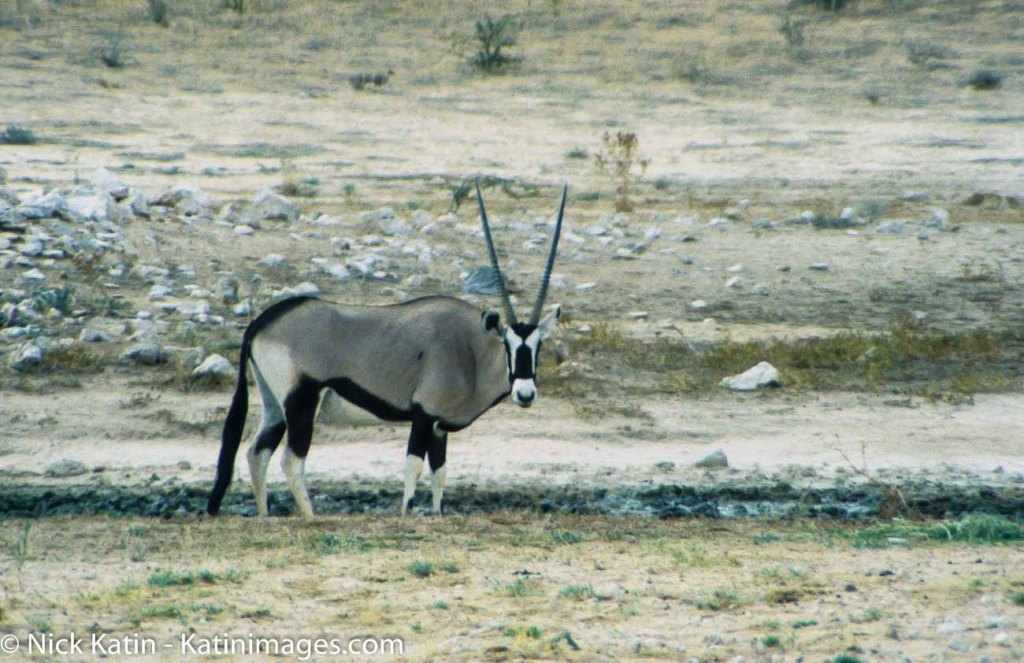
    The park was named after the Gemsbok, being quite common in the Kalahari. It’s a big animal at around 1.2 metres tall with striking fawn grey flanks, black legs and tail and metre high pointed horns. In my humble opinion, this is the most beautiful of all the antelope species found in Africa.

    The next day was pretty much the same format, as we drove on to Nossob, the last of the three camps, except the little critters must’ve sent out the message via the desert telegraph to hide when ever we came on the scene, because we saw virtually nothing.

    Nossob like Mata Mata was more basic than Twee Rivierien, but it did have an animal hide. Once again the animals didn’t read their scripts properly and forgot to come and see us. So we had to gain our entertainment from Roland who was busy being his industrious superhuman self. He was cooking spag bowl and fixing three punctures all at the same time. That night he told us stories of rangers cutting off their limbs to save their own lives after a predator attack in the bush. How he caught tick bite fever and was hospitalised for 9 weeks and how he had just recovered from a bout of Malaria which was really bad that year and had resulted in many deaths in central and eastern parts of South Africa. I think he has the philosophy of “never bugger up a good story for the facts”.

    Fortunately he told us these stories after we ate!

    If you like this then hit “follow” on the side bar
    A Gemsbok in the Kalahari national park
    A Gemsbok in the Kalahari national park
  • African shoestrings – South Africa Day Fourty five – Kalahari

    The Kalahari Gemsbok Park is the South African section of one of the largest protected areas in Africa. The other section being the Gemsbok National Park in Botswana together they contain two million hectares of dry semi-desert and desert land. Incredibly this area supports nineteen species of predators, 215 species of birds, countless antelope and the odd bushmen.

    Like most we had heard of “the Bushmen of the Kalahari” mainly through that crazy movie “The Gods must be Crazy”. To actually come across one, in fact a family, living (to a certain extent) how their ancestors did over many centuries was somewhat sobering.
    We came across them on our way to the closest and biggest of the three camps in the park, Twee Rivieren.
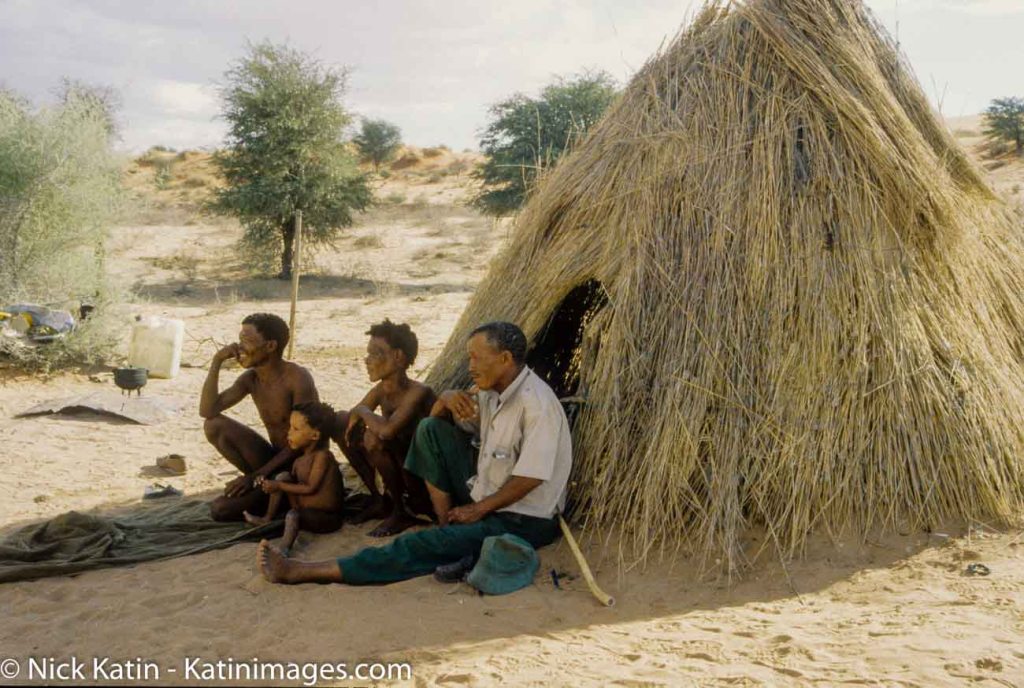
    Roland stopped and got out of the minibus, and in almost Crocodile Dundee fashion started a conversation with them in a mixture of San (Bushmen) and Afrikaans. I was impressed Roland knew his stuff. He crouched down with head of the family who wore nothing but a Springbok loincloth. His wife and his brother too wore loincloths and his small son was happy to wear nothing at all.
    Their home was a Tepee style grass house by the side of the road with just dirt floors and no other protection. To one side hung the family name in a small basic frame made from branches of one of the few trees that grew here. Against this frame rested a bow and arrow and the skull of a Gemsbok. To one side sat the shell of a Pangolin, a rare small animal that is almost entirely covered with brown, horny, overlapping scales and slightly resembles an Armadillo. According to the Bushmen they’re insides are really tasty and the shell if left outside their ‘house’ will bring good luck. The thought of catching one is enough to be put me off, I’m not sure I liked the look of those sharp scales and I’m certainly not into eating its insides, good luck or not!

    This though wasn’t poverty, this was people contentedly living life as they found it and were friendly and more than happy to pose for the five or so cameras that appeared with us as we too got out of the bus.
    In the past we have often been approached for payment by the ‘models’ when taking pictures. In this case they seemed so genuinely happy to pose that payment wasn’t an issue. Roland told us later that even though both the men worked for the National Park, money wasn’t really a big thing with them. All I can say is that they must be the only ones in the world!!

    Twee Rivieren was a welcome sight after the 240 kilometre ride from Upington. It’s a sealed road for about 180 and then becomes gravel for the rest. That makes for a hot dusty ride and now would have been a great time to wash down the dust with a tinny or two and a swim (there’s a swimming pool). But the camp had a night drive starting about 30 minutes after we arrived, so we had to rush to erect our tents and then be ready.

    If you like this then hit “follow” on the side bar

    The San people or Bushmen of the Kalahari.
    The San people or Bushmen of the Kalahari.
  • African shoestrings – South Africa Day Fourty four – Kalahari

    The plan had been to get to Augrabie Falls and camp there the night but it was a good 2-3 hours drive away and now it was too late. “So” said Roland “we’ll sleep the night in the dorm and head out early tomorrow”.
    He must have seen the look on Sue’s face, because he came up to us and said quietly “I’ve organised a double room for you two, m’dear”.

    That evening it was the Roland show! He’s an excellent cook and his yarns entertained us all. Apparently he’s done it all, played Rugby union for South Africa, seen some terrifying incidents involving Lions, Cheetahs and Leopards in his normal role of Kruger National Park ranger and lived a life that was reminiscent of some of the more famous novels about growing up in Africa.

    Roland’s dominance of the evening was interrupted by Katrina, another, in fact the only other guest at Yeho’s (do you call people staying at backpacker hostels, guests?). Katrina hailed from J’burg and was one of those ‘try hard’ hippies that are to be found running new age shops where relaxation music and the tinkling of wind chimes are designed to calm you enough to get out your credit card.

    She had just spent several days, finding herself in the Kalahari Desert! Well the Kalahari is roughly 700,000 square kilometres of red soil, sand dunes and very little vegetation and more importantly virtually uninhabited and uninhabitable. So the chances of you finding yourself are pretty high as you won’t find anyone else and unless you know what you are doing, your time with your newly found self will be extremely short! Katrina had never done anything like this before and had somehow survived and sat very satisfied with herself.
    Each to their own I suppose – not something I would do.

    We got to Augrabie Falls early enough for Breakfast. The name Augrabie is the Namaqua word “for place of great noise”. The Namaqua inhabit the north west corner of the Northern Cape and are one of the main Khoikoi tribes in South Africa, a people who were arguably one of the first inhabitants in the Cape.

    Augrabie Falls is on the Orange River and has over time carved its way through a rocky landscape and plunges down into rocky and almost lunar landscaped gorge below. The amount of water flowing down this almost vertical giant water slide is amazing considering it had been dry recently. After heavy rainfall the falls rise up along the sides of the gorge. That must be some spectacle!

    After seeing Mother Nature at its best we moved onto to see wine making at its worse. The Orange River Wine Cellar is nothing but a cheap bulk wine producer that fills bottles instead of casks and flagons. The wines tasted like flat coke!

    Still it was interesting how they had managed to carve these huge vineyards out of such an arid landscape. They couldn’t have done it without being so close to the Orange River and using the water to permanently irrigate the vines. They claim they are the second biggest individual wine producers in the world. Based on the amount of vines they had spread around, I for one wasn’t going to argue (that is apart from the fact that place seemed full of big beefy guys that looked like they had swapped punches with the best of them on the rugby pitch).

    If you like this then hit “follow” on the side bar

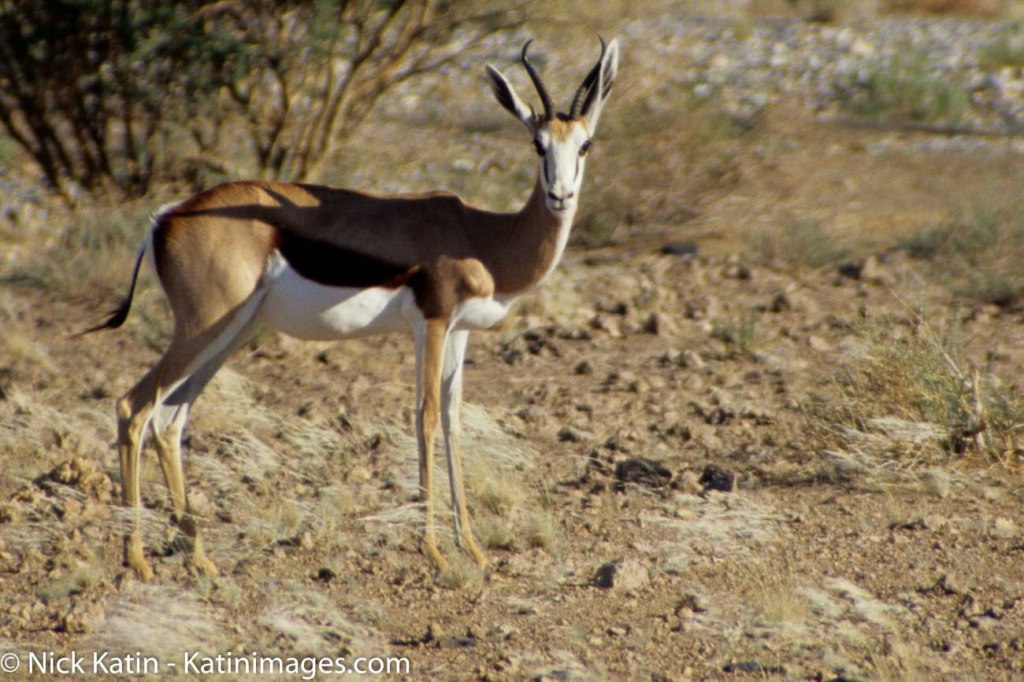
    Springboks are extremely fast and can reach speeds of 100 km/h and can leap 4m through the air. The common name "springbok" comes from the Afrikaans and Dutch words spring = jump and bok = male antelope or goat.
    Springboks are extremely fast and can reach speeds of 100 km/h and can leap 4m through the air. The common name “springbok” comes from the Afrikaans and Dutch words spring = jump and bok = male antelope or goat.
  • African shoestrings – South Africa Day Fourty three – Kalahari

    We got into Upington around 5 am and had planned to sit around the bus station until dawn and then find our way to Yeho’s.
    Trouble was that the bus station was just a kerbside stop and the office was closed that time in the morning. Fortunately the gods smiled on us and a local tour operator, who was actually looking for a German tourist he was there to pick up (she didn’t show), gave us a lift to Yeho’s.
    Livingstone weren’t due until midday so the owner let us catch up with some sleep in the deserted dorm.

    Upington is one of those nothing towns. Situated in the far Northern Cape on the main road to Nambia it’s a purely functional place. So there’s not a lot to see or do in the town itself apart from grabbing supplies from the two well stocked supermarkets there.

    A big majority of the food we had eaten since we left home had come from supermarkets. If you’re going to travel cheaply then one of the first expenses you can cut down on is food.
    Now you can do that either very drastically by eating very little or nothing at all or just by shopping smartly at the local supermarket. The former has a common problem associated with it called starvation and disease, so we elected to be smart.
    In these first three weeks of travel I had been in more supermarkets than I had for the last ten years.
    Actually South African supermarkets are on the whole quite good, well stocked with a good selection of food, refrigerated cold drinks cans and an excellent bakery. Some places like Upington were poor on fresh produce but that’s understandable.

    Yeho’s was a fifteen minute walk away from the town centre and once we recharged ourselves with some food from one of the supermarkets we wondered around the town, checked our email, made a futile attempt at trying to arrange accommodation for our next destination at Fish River Canyon in Namibia and wondered back.

    We got word that Livingstone were running behind due to a reassuring mechanical problem with the minibus and they ended up arriving 5 hours or so late.

    Did we know they had arrived! One minute we were quietly sitting in the garden reading, the next we seemed surrounded by what seemed like a crowd of 20 but was only actually 5! Having picked this tour from a backpackers I guess it was highly unlikely that other members of the tour would be around our age.
    But these guys were babies!
    There was Alexandre (Alex) a German girl from Dresden (around twenty), Hannah, a well-spoken English girl and her boyfriend Simon (Si) who were eighteen and Michelle, an American Peace Corp girl who at twenty five, was a pensioner in comparison.

    And then there was Roland, the tour leader. Roland makes an instant visual impact. A big guy, he had a pot belly, a full beard and tightly cropped hair, with a big round earring and gives the impression of someone normally found on a big Harley Davidson terrorising the local town folk. He had that guttural South African accent and spiels as good a yarn as Wilbur Smith. We could see straight away by Roland feigning to chuck Alex into the pool that all these guys had already clicked together on the journey down from J’burg.

    If you like this then hit “follow” on the side bar
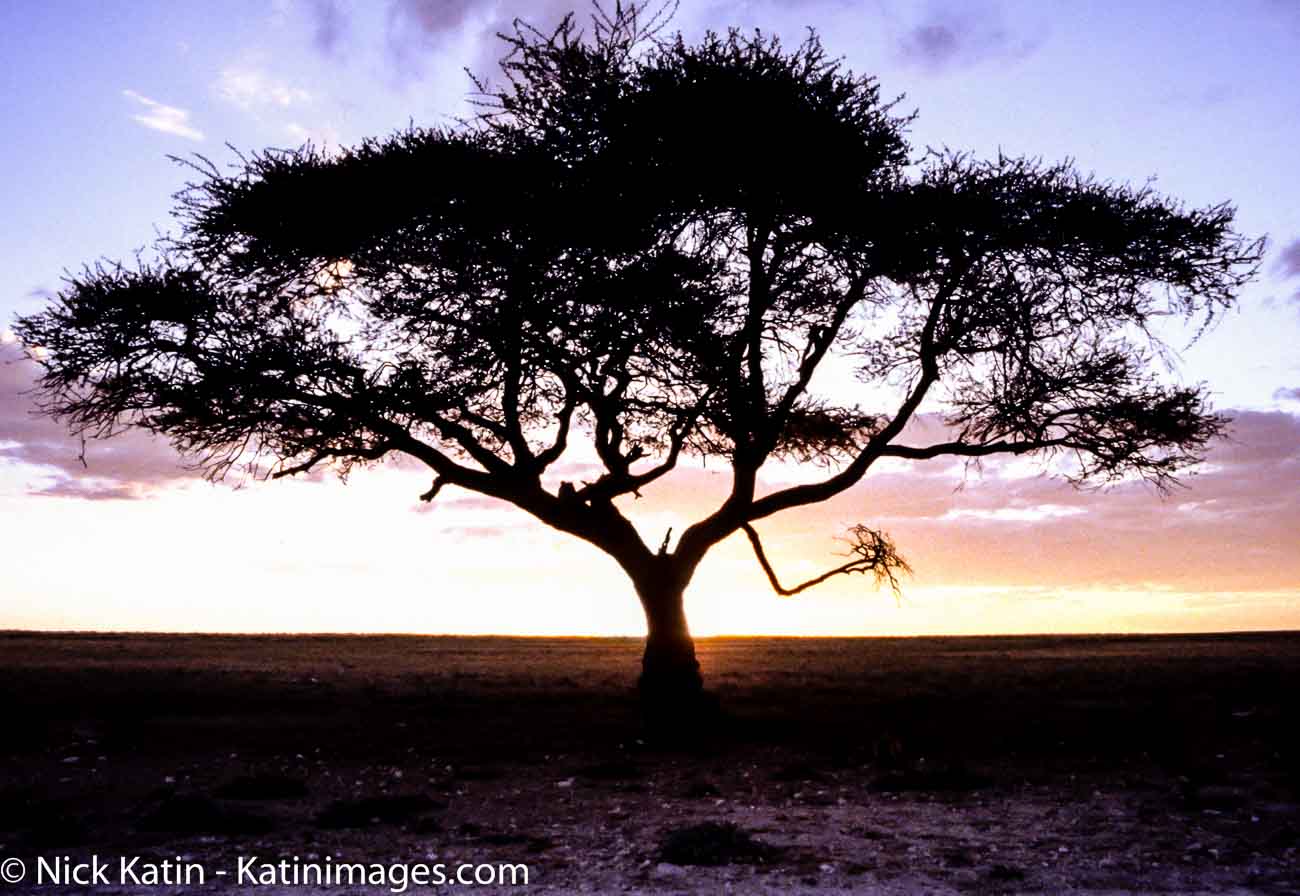
    An Umbrella Thorn Acacia at sunset on the savannah of South Africa. It's a native to Africa.
    An Umbrella Thorn Acacia at sunset on the savannah of South Africa. It’s a native to Africa.
  • African shoestrings – South Africa Day Fourty two – Kalahari

    Sunday was the day we left Stellenbosch and made our way to Upington. The arrangement was for us meet with the tour group, who go by the rather colonial name of Livingstone Trails, at the Yeho Backpackers in Upington itself. It was now time to brave the local transport system. Up until now we had somehow managed to get from A to B in either a hire car or in the case of J’burg to Cape Town by plane. This trip meant we had to catch the train from Stellenbosch to Cape Town and there catch the Intercape Mainliner, one of the many long distance bus companies that cover South Africa and some its neighbours.

    We had settled comfortably into that semi conscious state experienced by most train travelers until we just started to stop at a place called Bellville. The guy sitting opposite us said “Mister air you going to kip Town, ’cause if you are, you need to be on that train there and it leaves any minute”. He pointed to a train right next to us sitting waiting with the engine running. As he finished and the train came to a stop almost everyone in the train rushed off.

    “Oh shit” Sue and I said collectively.

    We grabbed our bags and followed the masses as they headed down the platform steps into the tunnel, back up again on the next platform and then straight onto the train seconds before it began to pull away. Breathless and sweating I asked the same guy where the train we had been on was going. “Back to Stellenbosch and there isn’t another train to Cape Town for about another hour” he added “It’s a Sunday, man, they always do this on a Sunday” We thanked him appreciatively and found a seat.

    The bus ride was pleasant enough. As it was an overnight trip, we managed to get some sleep in between the hostess; a buxom blonde haired imitation of a German farm girl who we affectionately named ‘Big Bertie’, giving us coffee, rusks and biscuits and the odd stop to swap drivers and hostess. That intrigued me. I certainly don’t begrudge a change of staff for such a long journey (894 kilometres and ten hours) but these guys had a bed tucked away behind the luggage compartment that they had to share. As the first shift driver was quite thin and short I feared for his safety having to sleep next to ‘Big Bertie’. If the bus had to slam on the brakes, she could roll right over and flatten him!

    If you like this then hit “follow” on the side bar

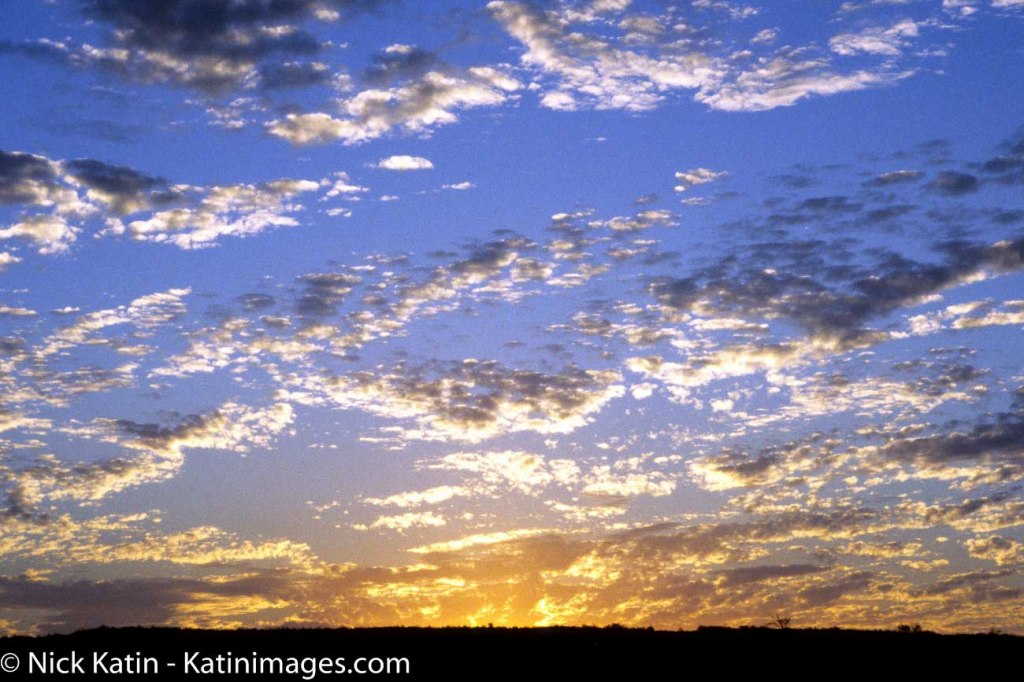
    Sunset over the Kalahari
    Sunset over the Kalahari
  • African shoestrings – South Africa Day Fourty one – Stellenbosch

    One of these future expeditions was the now confirmed Kalahari trip that left in three days time from a place called Upington in the far north, so we thought we’d just relax and hang around Stellenbosch in the meantime.

    Strangely enough after a day just ambling around, we got bored!  It’s not that we hadn’t been anywhere, we had visited the wine museum, a cheese factory and tried for the second time the main tasting cellar at the very inhospitable Die Bergkelder. It just seemed a bit dull! So the next day we upped the ante and hired a Volkswagen Chico, . This was our first introduction to this car. To describe it as small is an understatement. It’s tiny! But as you will see later on, its name would be immortalised in our memory banks forever.

    We visited more wineries after a bit of hike in the Jonkershoek nature reserve, a mountainous area of small trees and scrub.

    Generally the wineries in South Africa are of two worlds, there’s the breezy new world; similar to wineries in Australia with smiling friendly people, trendy cafes and restaurants with plenty of facilities for visitors or the dour starchy old world; whose employees obviously believe they have that rare skill in being able to weigh up potential customers by their dress.
    These people are dinosaurs instead of seizing an opportunity to introduce new people to drinking wine they take the approach that if you don’t look like buying a dozen bottles you’re not worth the effort. Travelers dressed in shorts and a tee shirt obviously fit the mold, after all if you’re travelling on the cheap then you’re not going to buy more than a single bottle to drink with your can of baked beans that night.

    Wrong!

    The only thing that stopped us buying a couple of cases of wine and sending it home to Australia was the fact that nobody could tell us the actual cost supposedly on account of Aussie customs having a variable duty. Still the dinosaurs didn’t stop our enjoyment as we visited four wineries, two of which were standouts. Funny thing the friendlier the staff the better the wine. In the case of Hartenberg not only were the staff and surroundings excellent but the wines were also pretty bloody good too.

    South Africa already has one own unique grape variety (cultivars in South Africa, varietals in Australia), called Pinotage that is well known throughout the world. Hartenberg introduced us to another but this time almost obscure unique South African red varietal called Pontac and it tasted bloody good!
    As you can guess wine is one of my passions and given the platform I could talk about it forever.
    My final comment about the South African wineries (they actually call them wine farms) is the amazing settings. Nearly every one of them has a mountainous backdrop, mainly because the Jonkershoek range cuts through and scatters itself around the whole area. It’s not particularly high, one of the highest is Twin Peaks (no, not the Twin Peaks) at around 1494 metres but they are dramatic, rising from the flat plains or in the case of the winelands, foothills covered in vines. And of course most of these wineries have positioned their cafés and restaurants to take full advantage of the location.
    Having a casual meal with a good bottle or two with that sort of view is one of life’s great pleasures and temptations, which we didn’t unfortunately succumb too.

    If you like this then hit “follow” on the side bar
    Wine tasting glasses
    Wine tasting glasses
  • African shoestrings – South Africa Day Fourty – Stellenbosch

    The following day we ‘jumped ship’ and found a little apartment just out of town.
    Not that there was anything wrong with the Stumble Inn, it was just the noise from the other ‘guests’.
    I’d like to think that we haven’t we’ve lost touch with modern music but the repeated thumping of ‘techno’ music is not the best bedtime music as far as we were concerned.
    A young guy, John also from Perth, who was travelling around on his own, shared this opinion. In staying in the dorm, he was in a worse position than us and was getting fed up with being constantly disturbed as his fellow bedmates stumbled in and out of bed.
    Never really gave that much thought before. As a couple we always got a private room and had drawn a line in sleeping in a dorm. But anyone on their own is pretty well damned if they want privacy. They either pay more than double the cost for a double room (they are often more expensive per person than a dorm) or put up with sleeping in the same room as a load of strangers, have no privacy and in some circumstances be permanently on guard watching their belongings.

    Anyway we had enough of the Stumble Inn, we had lasted two nights, and for just a few more Rand we had a nice cosy little place tagged on onto someone’s house called “Kaveeltjie”. That someone was Gertie an extremely helpful and warm housewife with a couple of youngish kids. She picked us up at the tourist office in town and couldn’t do enough for us.

    One of the fascinating things about South Africa is the white Afrikaners. Most of these are descended from the original Dutch, German and French settlers and have been in South Africa since the seventeenth century. This is different from the whites of British heritage that have only been around since the nineteenth century. That in itself is interesting but what really fascinates me is that when you meet the Afrikaners is their own country they are totally different from your expectations. After all this is a race that is responsible for apartheid. A lot of these expectations are based on the media and those you meet in Australia who have left the country for good.
    Well we found them to be kind, friendly, warm and honest people. You almost get the feeling that they would give their lives for you. A lot of that comes from their strong religious beliefs, but I’ve met plenty of religious people over the years who will hardly acknowledge your existence let alone help you out in tight corner.
    These people also have an amazing attachment to their language, which for most of them is their first language, with English being used only whenever it’s really necessary.
    One particular lady we met on our first visit, actually pitied us for not being able to speak Afrikaans, saying it was such a shame that we were unable to use words that there was no equivalent for in English to describe the world around. At the time I wasn’t that convinced. But the more of these people I met the more I think there must be something in it. So many actually struggle to translate certain words from Afrikaans to English which tends to surprise as their English is usually so fluent.

    Any way Gertie fitted this mould, and was happy to give us a few pointers for our future travels and expeditions.

    If you like this then hit “follow” on the side bar

    A Gemsbok in the Kalahari national park in South Africa
    A Gemsbok in the Kalahari national park in South Africa
  • African shoestrings – South Africa Day Thirty-nine – Stellenbosch wine route

    What the Stumble Inn did have and what backpackers all have is plenty of information in the form of a notice board and flyers. The flyers were mostly from other backpackers and other forms of budget accommodation plus the odd restaurant and attraction or tour from all parts of Southern and Eastern Africa.
    We even saw a flyer from a backpackers in England! This is really an excellent idea and a great way to pick up info whilst travelling. Some of the busiest places even have an ‘expert’ who can arrange almost everything for you, but most have people with enough knowledge to book tours and accommodation and guide visitors to local attractions.
    We took advantage of this when we saw an ad on the notice board for a six day camping tour of the Kalahari called the “6 day Kalahari experience”. Neil booked it for us but we still had to wait for confirmation.

    Of course for us the biggest attraction in Stellenbosch was the wine route. This is a route that you follow to 29 different wineries, if you’re up to it!
    We decided to hire push bikes and just visit a few. Selecting the flattest route we enjoyed ourselves riding through the vineyards and stopping off at three different wineries.
    Staff at all these places were friendly, informative and happy to give us some of their time. And even though I am unashamedly biased towards Australian wines, the wines were pretty good too, especially at a place called Jordon.
    Most of these wineries had character white washed buildings of the dominant Cape Dutch style with an excellent backdrop of mountains and vines. The fourth and last winery, Spiers, was more like a theme park. Two restaurants, a café, conference and banquet centre, Cheetah Park and a deli from which we bought picnic supplies, made us forget that it was actually a winery. We sat around the lake and ate without a care in the world as we watched families enjoying the park like atmosphere in the warm sunshine.

    All this tranquility and relaxation came to an abrupt end, when we discovered one of the bikes had a puncture. Somehow we had a feeling that a place like this wouldn’t have any facilities to repair punctures for tourists pleasantly warmed by the gentle sipping of wine.
    We rang the Stumble Inn and Neil said he would come and pick up us. He had actually warned us about these giant thorns that are found in the grass. Even though we had been especially careful to avoid riding over grass, one little prick had created another bigger prick in the tyre!

    Well every cloud has a silver lining. Whilst we were waiting we went on the Spiers cellar tour and tasting. Peter, our young host was very entertaining even though he had this annoying habit that’s crept into our society, of saying, “you’re welcome” after being thanked for answering a question.

    We ended up waiting around for a fair bit of time after the tour before Neil picked us up and then charged us for the privilege!

    If you like this then hit “follow” on the side bar
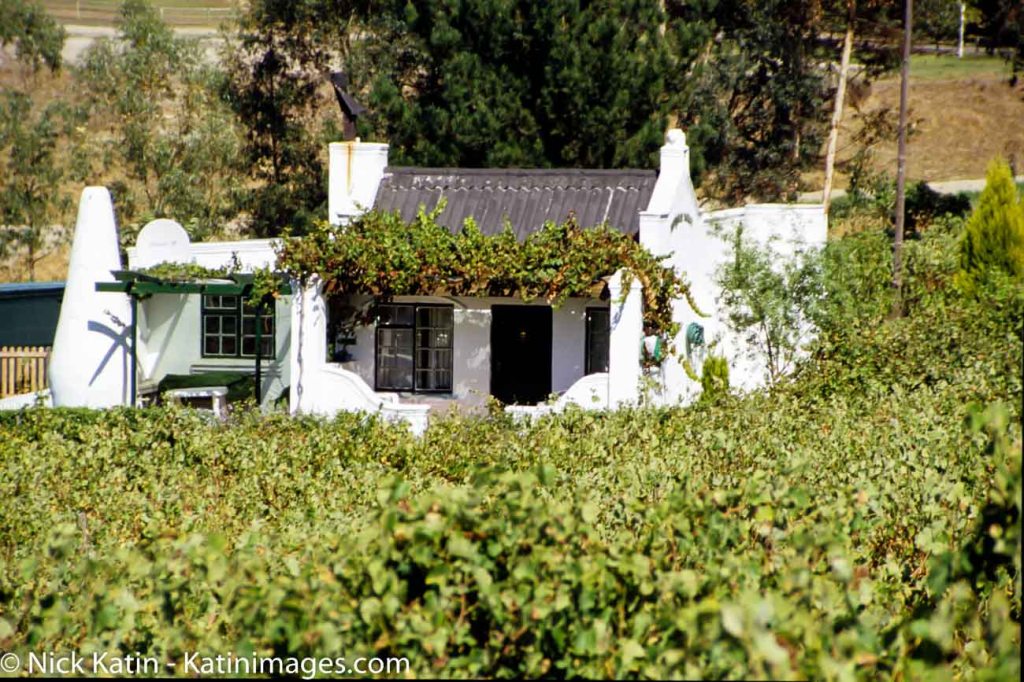
    A small winery near Stellenbosch beneath the Stellenbosch Mountains
    A small winery near Stellenbosch beneath the Stellenbosch Mountains
  • African shoestrings – South Africa Day Thirty-eight – Stellenbosch

    It was time to leave Cape Town, not as we thought at the time forever, but for a few days. We were off to the winelands!

    Stellenbosch has two dominant influences, the wine industry and the local student population that studies at the Afrikaans-language University of Stellenbosch. Fortunately these two influences compliment each other and the result is a trendy, lively place that seems to have avoided the social problems that dogs the rest of South Africa. It’s also the second oldest town in South Africa and hence has many well preserved architectural gems. Gleaming white Dutch Gable buildings interspersed with the odd flat or thatched roof were everywhere.
    We attempted to follow a walk trail that passes the most notable buildings and landmarks. But gave up following it exactly. There were just too many to look at!

    We ended up at the Die Bergkelder a big cooperative winery that owns many labels and small vineyards in the area. They have an interesting but fairly pedestrian tour of the winery and we got to taste some wines from their biggest label Fleur Du Cap. Silly thing was that to taste some other wines, you were directed to the main tasting area, which by the time the tour finished at 4.30 pm, had closed. Obviously they don’t need the business that badly!

    The Stumble Inn is a name that conjures up visions of a quaint little guesthouse with period piece architecture and furniture. Not quite. It’s a converted house of no specific beauty that now serves as a Backpackers, our third! …….We were determined to get the hang of these places.

    Neil, the owner (we think) took one look at us and must have decided that at our age we needed to be in a quiet room away from the living areas. It was pretty much the same, soft beds, hand me down furniture, décor that varied in style, standard and colour. A big back yard was dotted with small tents whose occupants were all in a state of undress and trying hard to be the first to get a melanoma.

    If you like this then hit “follow” on the side bar

    A small winery near Stellenbosch beneath the Stellenbosch Mountains
    A small winery near Stellenbosch beneath the Stellenbosch Mountains
  • African shoestrings – South Africa Day Thirty-seven – Rhodes Memorial Cape Town

    Just up the road from Observatory, we found the Rhodes Memorial. A little gem of a place!

    Cecil John Rhodes, founder of the famous De Beers Diamond Company and British Empire builder had a big influence on the way Southern Africa was carved up politically in the nineteenth century. He was Prime Minister of the Cape Colony from 1890-95 but by then he had already made his fortune through Kimberley Diamond Mines and a huge Gold strike near J’burg.
    He established British Colonial power in Rhodesia (later Zimbabwe), Northern Rhodesia (Zambia) and Bechuanaland (Botswana) to name but a few.
    Mind you he profited personally from these ventures as he established a few more gold mines on the way.

    Strangely enough he’s probably better known for the Rhodes scholarship. Something he established by way of his will devoting most of his wealth to this noble cause. The scholarship even today still sends winners from countries other than Great Britain to study at Oxford University.
    From an Australian point of view the most (in)famous winner was the then beer swilling Bob Hawke, arguably it’s most popular Prime Minister ever.

    Well they’ve built a memorial to this guy (Rhodes, not Hawke) on the slopes of Devil’s Peak. It’s a bit like a mini coliseum, all columns and bronze statues of Lions bordering impressive bluestone granite steps that lead to a bronze bust of Rhodes. Really over the top stuff!

    We found out about this place from a couple of white University students who we chatted to on one of our many minibus trips. We’re harden pro’s now. That same bus was also driven by, much to our surprise, a white guy, so times are definitely changing.

    Actually they said that the little café next to it was worth a visit. In fact it was almost more fascinating than old Rhodes. To coin a phrase “it was just so colonial”. Wicker chairs and small round tables were scattered around the garden.
    Nothing scattered about the young white waiters though, about six of them stood guard at the front of the garden, in their gleaming white shirts and black bow ties, waiting to pounce on unsuspecting prospects. It was the sort of place that had this been England or even Australia, would have made your wallet tremble. But this is South Africa and even our pitiful dollar made it real value for money. Mind you we only had coffee and cake!

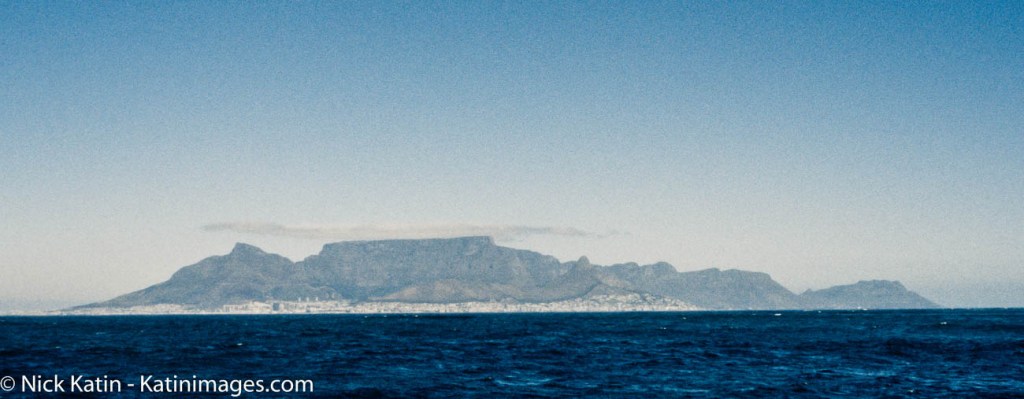
    Table Mountain in Cape Town from Robben Island former prison of Nelson Mandela
    Table Mountain in Cape Town from Robben Island former prison of Nelson Mandela


  • African shoestrings – South Africa Day Thirty-six – Cape of Good Hope

    We got an even closer look at the Cape the next day after picking up a cheap hire car from the unknown (to us anyway) Atlantic Car Hire. The plan was to explore the peninsula for the day and drop off the car in Stellenbosch, centre of the South Africa’s wine industry and some 40 odd kilometres away and still be within the free 150 kilometre mileage. What we didn’t realise was that drop off and pick up mileage were also included so we ended up having to fork out more money at the end of it than we had budgeted for!

    Nonetheless the Cape Peninsula is a beautiful spot. This is white man country, large two storey houses, apartment blocks and trendy little village’s front onto the white sandy beaches on both sides of the peninsula.
    No black or coloured townships here, just Cappuccino’s, designer labels and more BMW’s and Merc’s.
    Along the western side the famous Chapman’s Peak Drive is up there with the rest of the world’s great scenic drives. Carved into solid rock, this winding 10 kilometres of bitumen has several lookout points to avoid accidents caused by sightseers slowing down to admire the panoramic scenery at every bend. I’m not sure that worked. Cars screech to snail pace as they suddenly realise that they want to stop at the lookout they are in the process of passing!

    Somehow that day we managed to visit the World of Birds and Groot Constania the Southern hemisphere’s oldest winery, follow Chapman’s Peak Drive, tour the windy Cape of Good Hope Nature Reserve and explore the trendy the St. Tropez of South Africa, Clifton.

    We finished up having fish & chips from ‘Fish & Chips at the Rack’ in Hout Bay supposedly “the Capes best Fish and Chips” and then somehow finding our way back to the guesthouse in the dark with an extremely basic map.

    The Cape of Good Cape, a rocky headland on the Atlantic coast of the Cape Peninsula, South Africa.
    The Cape of Good Cape, a rocky headland on the Atlantic coast of the Cape Peninsula, South Africa.


  • African shoestrings – South Africa Day Thirty-five – Table Mountain Cape Town

    In our previous visit to Cape Town we had taken the cable car to the top of the 1000 metre Table Mountain (and back down again).
    This time, we promised ourselves, we would walk to the top and catch the cable car down. Today was a public holiday and even minibuses would be few and far between so we had to brave another of Andre’s lectures as he very kindly gave us a lift into the city.

    From there it was just a short walk to the main track that winds up the Platteklip gorge the easiest way up from the that side of the mountain.
    There are two very distinct features about Table Mountain, the fact that from a distance it appears to have as the name suggests a completely flat top and it’s “tablecloth”. The tablecloth is cloud that regularly rolls in and covers the top for anything like a few minutes to the rest of the week. This phenomenon usually happens around mid- morning so we wanted to ensure that we got up there early enough to see the 360° views.
    Last time we got to the top we had about 5 minutes before our vision was reduced to about 5 metres. This time we hadn’t even got up to the top before it rolled in, reducing visibility to a few metres and slowing our already slow progress.

    The track was a winding trail that zig zagged awkwardly and was strewn with large boulders and obviously designed for mountain goats. Worse still we had the challenge of having to clamber around hundreds of people all with the same idea. Now we had to pick our way through damp mist and poor visibility. Being as I said a public holiday, the last thing was I would have expected would to be find teenage school groups. But there hundreds of the little shits who, as well as some adults, seemed oblivious to the fact that there was actually a trail with lots of signs asking us to keep to it.

    But the gods did smile on us as we approached the top, the ‘tablecloth’ disappeared as quickly as it had appeared and we were able to spend a good hour and a bit admiring the great views. Table Mountain is at the end or the beginning of a small range called the twelve apostles that travel south and reduce in size at the beginning of the Cape Peninsula. It had cleared enough for us to see the famous Cape of Good Hope some 70 kilometres away at the end of the peninsula.

    Cape Town from Table Mountain
    Cape Town from Table Mountain