Katin Images Travel Photography

Travel Photos, Travel Photography Tips and Software

Category: africa

  • African shoestrings – Mozambique Day One Hundred and One Bordertown

    With a GDP of only US$104 per person Mozambique is one of the poorest countries in the world. The Portuguese up and left in the mid 1970’s after decades of plundering the country and a fifteen year war of independence. They took with them valuable skills and capital reserves leaving behind nothing but chaos.

    A Marxist state eventuated and before long the cherished ideas of socialism had the country’s economy in tatters. A civil war that left 900,000 people dead, 1.3 million refugees and a countryside strewn with over 1 million unexploded land mines followed. Finally, in 1990 peace reigned and with the aid of the United Nations a democracy of sorts emerged. The economy is still dependent on foreign aid and its infrastructure is only now being rebuilt. Soon after our visit a devastating flood decimated the country setting back its efforts to rebuild.

    The Tete corridor is an area of Mozambique that juts out between Zimbabwe and Malawi. A lot of the guerrilla warfare during the civil war was staged here leaving behind a legacy of land mines and poverty. This is the area we needed to cross on this bus to get to Malawi.

    After several stops for police checks and simply to avoid the huge crater called potholes in the road we got to within 100 kilometres of the Malawi border and it was getting late!

    The Mozambique border post at Zobue apparently closes at 6 pm and there was some real concern that we might not make it.

    As we got closer there was an awful sound of clonking and scraping as the driver changed gears. Finally, as the bus began to climb a steep hill, it stalled and came to a standstill. It was almost dark as the driver restarted the engine and then attempted with no luck to select first gear. Some of us got off to lighten the load but that made no difference. As we got back on the driver rolled the bus back down the hill so that he could make a run back up in second gear. I shook my head in disbelief. We’re rolling backwards down a hill in the dark, in the middle of nowhere, in the infamous Tete corridor of Mozambique. If he goes off the road there’s a chance that a landmine could be waiting for us and then its ‘good night Irene’. In fact, we did meet a truck going up as we were going down but it overtook us without any mishap. Eventually we got going and the bus limped into Zobue sometime later. Of course the border was by now closed, although only just, and despite some animated conversation outside one of the border official’s house, it stayed that way.

    Then the fun began. Most of the travelers on the bus were apparently from Malawi, going home after doing a bit of shopping in Harare or having a break from working in Zimbabwe. They did not take kindly to this situation and I had to interfere to stop the bus driver from being lynched. They accused him of being in league with the town traders who they believed would profit from our enforced overnight stay. I can’t say I was convinced. The town wasn’t exactly busting with tempting designer label goodies or food stores. The hotel was full, which was just as well as it looked and smelt like the pits. The only place that appeared to be initially open was a small tin shack of a store that sold cold beer and by that time we sure needed a drink. Within a few minutes more tin shacks opened and vendors came to us with fruit, potato chips, drinks and various currencies.

    Initially the place was quite scary. Apart from the street sellers, there were street kids and other suspicious individuals hovered around, including a man with a rifle who was obviously guarding something but we were never able find out what. With Portuguese sounding to us just like Spanish, the whole town reminded us of one of those dusty, rundown Mexican or South American towns portrayed in the movies. All we needed was Clint Eastwood to ride in on a mule wearing a Mexican poncho and wide brimmed hat, cigar in mouth and the comparison would be complete.

    We spent the next six hours on the steps, watching our bags on the top of the bus, of what we think was the town hall within full view of the bus. It was one of the most bazaar experiences of my life sitting there guarding our bags from a distance, drinking beer, listening to Led Zeppelin (Jenny had a tape player) and playing cards whilst the man with the rifle wandered around looking for something to guard.

    Andy and Jenny told us of their search for land on the North Mozambique coast (when they eventually get there) for a tourist camp. Due to the bad roads and infrastructure, the only way to that part of Mozambique was via Malawi and they were set to meet up with other members of this venture in Blantyre, the only other major town in Malawi.

    Eventually sleep got the better of us and we returned to the bus to risk sleep and luggage stealing. Sleep was rather fretful, with snoring from half the passengers that were asleep and constant chatter from the other half that were not, adding to our rather cramped conditions.

    At first light I ran up to an overland truck that had also got there too late to cross the border, to see if we could get a lift. It was driven by a young woman from New Zealand, a relative neighbour, and the travelers were all women, a single guy’s paradise I thought. They were going as far as Dar es Salaam. This was our eventual destination and they would take us both for US$40 each. We were in business or so I thought. Our problem was getting our bags and the bus driver refused to offload them until we had crossed the border into Malawi. The bus somehow limped the kilometre between border posts and they then began to offload the baggage for the Malawi customs officials. The overlander was already there and I appealed to the driver to wait. She said they would and then promptly drove off never to be seen again!

    Footnote:

    Take control of your blog’s images now by signing up here to get “Eleven easy ways to improve your marketing photography”
    A free guide on how to start improving your images to help you take control of your marketing.
    That link again
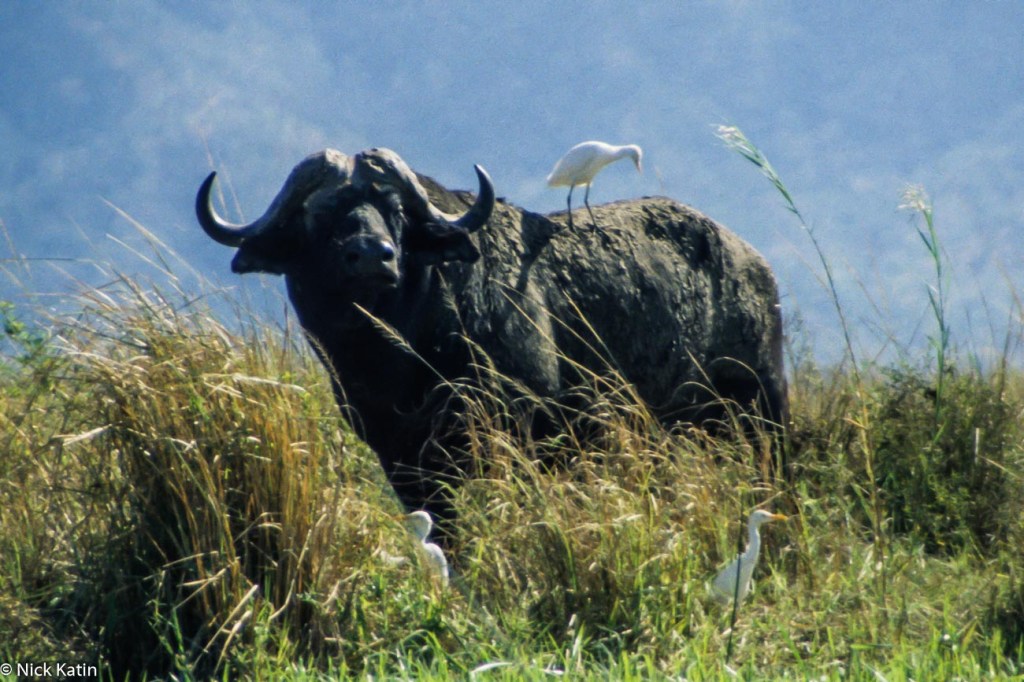

    Buffalo near the Zambezi River watching canoes in Zimbabwe
    Buffalo near the Zambezi River watching canoes in Zimbabwe


  • African shoestrings – Zimbabwe Day One Hundred Harare

    Our last session of paddling was a mere 6 kilometres to our final destination, Nyamepi Camp in Mana Pools National Park. All in all we had paddled a total of 58 kilometres and by the time we had finished we all felt strong and confident enough to have gone on for another three days. When we were asked later on what had been the best thing we had seen and done whilst travelling this always comes to mind. It had been one of the greatest experiences of our lives!

    We were back in Harare at around 10 pm and settled into our very ordinary (especially at the price of US$65 per person) room in the annex of the Bronte Hotel. This was meant to be our treat but the room was tired and old and really was no more comfortable than an average priced motel found in anywhere in the western world. What was nice about the Bronte was the hotel lobby and gardens and we made sure that we fully enjoyed having our breakfast, a drink in the afternoon and a coffee after dinner in the tropical colonial style gardens. Dinner was actually the best event of the day (we had spent a good few hours at the Tanzania embassy obtaining our visas). The Italian Restaurant Fat Mama’s in the Russell Hotel was obviously the local white and ex-pats hangout and I could see why. Great food, great atmosphere and great prices!


    The next few days were taken up with transport and what I call the bus rides from hell! What follows next is reality but not necessarily typical of public transport in this part of the world. Of all the people we met during our travels we were the only ones who seemed to cop the experiences that I’m about to describe. It just seemed to happen to us!

    Bus ride from hell number one started with a pick up at our hotel, early the next morning, by the bus company Ute to take us the Mbare bus station across town. On his way (in fact out of his way) the driver went via Possum lodge and picked up two other unsuspecting white passengers.

    The bus station was chaotic and frightening. People came from everywhere grabbing at our bags and us. Someone grabbed one of our bags and with me still hanging onto it, led us onto the bus and then asked for our passports. What then confused us was another guy sitting further down the bus also asking for our passports and at the same time shouting “Watch your bags, watch your passports, watch everything!”

    This guy was obviously in charge and we held onto the passports until we reached him. The other guy mysteriously disappeared and there was no doubt in my mind that had we relinquished our passports to him that would have been the last we would have seen of them.

    Once we found our seats we could see the chaos and crap outside the bus. I say crap because the diesel fumes were noxious and those working in the area had paper filters fitted over their mouths and noses.

    The seats we had were one row from the back and directly behind the other white couple who seemed to have handled the situation a with lot more cool than we had. Our bags were on the seat behind and we had three seats all to ourselves. This wasn’t going to be so bad we thought as eventually the bus got going. But that was as good as it got! Fifteen minutes later it stopped at the bus depot to pick up double the amount of passengers and probably triple the amount of luggage. There is a rule in Africa; don’t allow your bags to sit on the roof of any vehicle ’cause there’s a big chance you won’t see them again. Even the locals hang onto their bags. This time despite our protests we knew we had no choice; there was hardly enough room for all the passengers let alone the bags.

    I got out of the bus and stood and watched as they loaded the bags on to roof. The only other white guy, Andy stood next to me. Andy was a Zimbabwean and his girl friend Jenny was from South Africa.

    “So what happens now” I asked

    “I dunno” he said

    “You’re the local”

    “Yeah but I’ve never traveled on one of these before”

    The bus driver, conductor and other helpers finished covering the bags with a huge tarp and tying it all down and we were beckoned back onto the bus.

    Oh well I thought not much we can do now as we got back onto the bus.

    We had now lost our spare seat to a small quiet man who spent most of the time dozing. His head flopped about as if connected to his body by a rubber neck and often ended up on my shoulder. We westerners are funny like that we cringe at someone encroaching on our space. I had to keep shrugging him off and I swear that if I had some rope I would have tied his head to the back of the seat.

    The bus actually set off at 8.15 surprisingly only one and half hours late. It didn’t take long for part of the tarp to come away and start flapping against the side of the bus and on our first refreshment stop it was retied well enough to last around fifteen minutes before it started flapping again.

    After that stop we acquired a rather sinister looking uniformed man who checked a few passports and then disappeared and then reappeared half an hour later to collect a Z$70 ‘border fee’ from everyone. It was the last of our Z$ and I had the feeling that we were being ‘had’ especially when no receipt was forthcoming even when asked for. This fee was apparently to ease the pain going through the Mozambique border post.

    At the Nyamapanda border our passports were collected by this bloke and he made a sort of half hearted inspection of our bags before giving our passports and presumably money to the Mozambique officials. We had to wait around for about an hour whilst all this ‘officialdom’ was dealt with.
    This was the pits.
    The Zimbabwe side was not too bad but the Mozambique post was an old dilapidated shack with a couple of holes in the ground masquerading as public toilets a few metres away. They stunk! The stench was almost visible from 10 metres away.

    The whole area was full of persistent moneychangers, curio sellers, drink sellers and sellers of anything else they could rip you off with. It was the first of only two times that we were glad to get back onto the bus.

    Footnote:

    Take control of your blog’s images now by signing up here to get “Eleven easy ways to improve your marketing photography”
    A free guide on how to start improving your images to help you take control of your marketing.
    That link again

    Dug out canoes at the Okavango Delta In Botswana
    Happier times -Dug out canoes at the Okavango Delta In Botswana


  • African shoestrings – Zimbabwe Day Ninety-Nine Zambezi River

    Later that morning with us bringing up the rear as usual we were paddling alongside an island to avoid a pod of hippos.
    Suddenly a flurry of activity brings four hippos scurrying out of the bush and into the water just metres in front of Peter and Greg. They disappeared into deep water and four pairs of eyes popped up about twenty metres from us and watched as we tentatively crept past getting as close as we could to the bank.

    After such an exhausting morning (we had covered 20 kilometres as well) we were thankful for a stop for lunch and a couple of hours siesta followed by a swim in the shallows later in the afternoon under the watchful gaze of a few hippos.

    Still by the time we had got to our overnight stop at a deserted beach we were all pretty much exhausted and aching. The excellent food and some elephants strolling down to the water’s edge for a drink a mere 150 metres away soon resuscitated us.
    We were now in Mana Pools National Park and the hunting camps and other signs of humanity gave way to thorny bushveld and groves of Acacia and other trees. It was a full moon and as it rose it lit our campsite with a soft glow and turned a nearby perfectly formed thorny Acacia tree into a silhouette.

    The distant roar of a lion, the call of hyena and the munching of the hippos nearby seemed to be with us all during the evening and overnight. Despite our soreness, exhaustion and apprehension this was as good as it gets!

    Peter and Greg allayed our fears somewhat about hippos. Apparently like most wild animals they only attack only when they feel threatened. The stories of canoes being turned over are greatly exaggerated and usually caused by accident. In deep water a hippo may be right underneath the canoe and its occupants totally unaware, so if it decides to pop up and you’re in the way, bad luck!

    These guys seem to know their stuff. Peter was from the Shona, the most populous people in Zimbabwe and Greg was a young white guy from a farming family. When talking amongst themselves they spoke Shona. It seems that even though English is the official language Shona is more commonly spoken. They also told us of our biggest danger. “We (meaning Peter and I) will stand guard overnight to watch for Zambians paddling across from the other side. They ‘ave been known to raid a campsite and steal belongings from the tents and canoes whilst everyone slept.” Greg said.

    Great I thought, we have to watch out for crocs and hippos by day and thieving Zambians by night.

    Our final full day at 24 kilometres was a lot shorter and allowed us to leisurely enjoy the sun rising over the Zambezi.
    This was our best day!
    The river was mostly a series of tranquil channels and the wildlife was everywhere. Lots of hippos to be seen but none that were close enough to trouble us; a herd of elephants on the Zambian side; more elephants near our lunch spot; waterbuck, buffalo and impala also darted in around the national park edge, whilst little bee eaters probed small openings they had created as entrances to their nests inside the cliff face of the riverbank. But the piece ‘d’ resistance was yet to come. Swimming in a shallow channel we dried off and under Peters leadership we approached, by foot through the water, a large pod of hippos. We got within four metres of them as they watched us whilst closely bobbing up and down, ears flapping and noses snorting. They were watching us as warily as we were they. I snapped away around ten shots only to realise that I had the camera still set for a much dimmer light. By the time I reset, the hippos were almost completely submerged and moving away. Curses!

    Ten metres beyond them an elephant descended the bank and paddled across the deeper channel up ahead to join his mates strutting on a small island. Later that afternoon we stopped our paddling and drifted as we watched more elephants frolic in the water just in front of us. Peter was pretty keen on ensuring that we didn’t get too close but some other canoeists were foolishly a lot closer and came very close to having their canoes turned into firewood.

    Five kilometres on and it was time to set up camp for the last night on another sand island. First we had to navigate our way through a narrow channel with, you’ve guessed it, another pod of hippos in the way. No drama. Peter and Greg slapped their paddles against their canoes and off they went to safer waters.

    On dry land we were all busting and Sue managed to grab the spade before anyone else and headed off to an inconspicuous place. She was had been so absorbed with finding a hidden spot that it wasn’t until relief had come that she realised that there was a hippo lying on the bank asleep a mere five metres away. Any alien who had no prior knowledge of humanity would have gone away thinking what strange toilet rituals we have once he saw this mad women running towards us waving a spade with one hand and holding up her shorts with other!

    Footnote:

    Take control of your blog’s images now by signing up here to get “Eleven easy ways to improve your marketing photography”
    A guide on how to start improving your images to help you take control of your marketing.
    That link again

    Elephants in the Zambezi River walking across the river in Zimbabwe
    Elephants in the Zambezi River walking across the river in Zimbabwe
  • African shoestrings – Zimbabwe Day Ninety-Eight Zambezi River

    We got to the Bronte at 5.00 am the next morning ready and waiting for our guide Peter and his offsider Greg who both turned up at 6.00 am with a driver Showee.
    We were heading for Chirundu some seven hours drive away via Breakfast at Chinhoyi and picking up the final two other members of our group at Makuti, Peter and Susan. They were Aussies as well, like us travelling on a tight budget and (shock horror) were about our vintage.

    Chirundu is a small town set on the river and serves as a border post with Zambia. It’s here that the real business begins.

    A leisurely lunch was followed by a lesson on Canoeing and some tips about animal behaviour. This last topic made us all sit up and listen. “Iiif you are feced with hippo, den puddle towards shallow water und keep you distance. Iiif a hippo charges und turns oover de canooo den geet into anoother”.

    Great!

    I noticed that Peter (the Aussie) had some bad scratches on his legs and arms. “Oh that. We were charged by a hippo in Matusadona and I jumped into a very thorny bush” he said.

    This was getting worse!

    Now it was time to get on the water. The canoes were twenty-foot Canadian style (whatever that meant) and we climbed in after all our bags and supplies were loaded into the middle of the canoe. If this baby turned over not only would we get wet but so would all our belongings.

    That afternoon we covered 16 kilometres and it felt like 100! I had the rear seat so the art of steering was all mine to conquer and needless to say our progress was a series of zig zags along the fast flowing water.

    This part of the Zambezi is around 800 kilometres downstream of Victoria Falls and 140 kilometres from the eastern edge of Lake Kariba and the infamous Kariba Dam. I say infamous because when it was built in the 1950’s, nature (in the form of the god Nyaminyami according to the local Tonga tribe) did its damnedest to destroy the project with three unprecedented floods and a heat wave causing the deaths of many workers and severe damage to the work in progress.

    The river was wide with the seemingly uninhabited terrain of mountains and hills of Zambia on the north side and the steep riverbanks dotted with hunting camps of Zimbabwe on the south. In between both banks, islands of marshy wet lands split the river creating tranquil channels with lush grasses and lily like growth. With the current flowing with us it all seemed very easy at the beginning. But it didn’t take long to realise that I needed to get the hang of this steering quick smart to avoid the hippos that seemed to be lurking around every corner and the odd croc that lay patiently at the water’s edge.

    By the time we reached our destination a small sandy island a couple of hundred metres from the Zimbabwe side, we were ready to rest.
    As with the rest of trip there are no washing or toilet facilities here. A spade with a toilet roll at the water’s edge is as good as it gets.
    After we erected our tents around the dining table and the fireplace, Peter and Greg presented a feast fit for kings.
    Amazingly we had steak and fresh vegetables washed down with the local Myuku red.
    Add that to the good conversation and the odd snort of a hippo and roar of a lion and I felt like we were in paradise.

    Not so Sue.
    Her arms ached from the paddling, she was also concerned as to whether she could paddle the 38 kilometres the next day and she felt really worried about the hippos.
    We later attributed the latter to the malaria tablets, Lariam that we taking. One of its side effects is anxiety and as you can see there was plenty to get anxious about.

    If Sue was worried about hippos the day before then the morning doubled her fear. Soon after we set off we rounded the bend and the channel narrowed.
    Suddenly out from the tall grass on the left bank, rushed a huge hippo straight into the water towards the opposite bank.
    Steering and stopping a two berth canoe was still beyond Peter’s and my capabilities as first our canoe, then Peter and Susan’s jackknifed into the bank. We both came to a halt facing back the way we had just come, a few metres from where the guides were waiting patiently in their canoe.
    Peter (the guide) opened his hand, drew it down his face and took a deep breath. “OK” he said, “You can’t turn around here so you’ll both have to go back and turn around keeping as close as you can to this bank”

    Peter and Sue set off first and successful negotiated the turn. We (well actually me) didn’t do so well. We ended up with such a huge turning circle that before we knew it we were heading directly for the spot in the water where the hippo had last been sighted. There was nothing we could do except, as I yelled to Sue

    ” Paddle for fucks sake just paddle!”

    Which is exactly what we did as the canoe passed right over the top of the hippo as the others watching in amazement or was it amusement.

    Footnote:

    Take control of your blog’s images now by signing up here to get “Eleven easy ways to improve your marketing photography”
    A guide on how to start improving your images to help you take control of your marketing.
    That link again

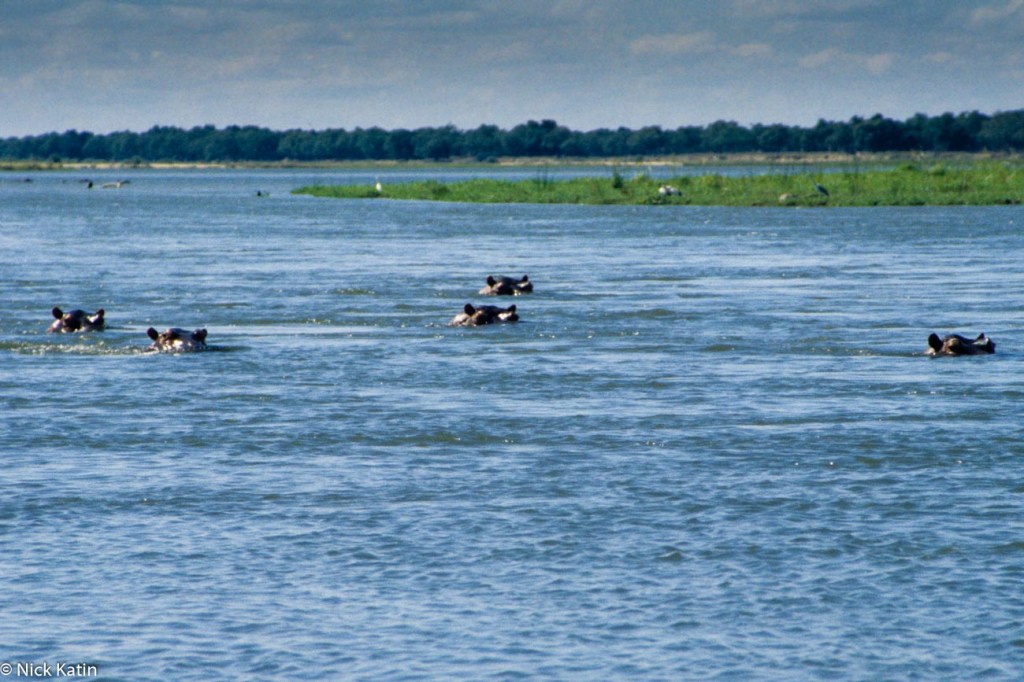
    Hippos in the Zambezi River watching canoes in Zimbabwe
    Hippos in the Zambezi River watching canoes in Zimbabwe
  • African shoestrings – Zimbabwe Day Ninety-Seven Harare

    Possum Lodge had such a quaint name for a backpackers hostel that we felt we had to stay there. We ended up in a small (and I mean small) wooden cabin in the back yard listening to something that is described as ‘Techno’. The main bar and recreation areas are outside and not that far away from our cabin consequently we could hear everything as if we were actually there at the bar and it was horrendous. I’m sorry but call me out of touch, old fashioned or just plain ignorant but I cannot for the life of me see how anyone can enjoy this type of sound (its not music).
    Its mind numbing headache material that’s produced by people with little or no musical talent (if they have its well-hidden) on electronic devices and computers not on musical instruments. Fortunately for us it was eventually changed to rap (see I’m not that single-minded) and then even better turned off at 11.30 pm.

    We had a whole day in Harare to do a couple of chores. The next four days were to be spent canoeing the Zambezi and then we would return to Harare where we would catch a bus to Lilongwe the capital of Malawi, which meant having to cross the infamous Tete corridor in Mozambique. So chore number one was getting a transit pass from the Mozambique embassy, a three-day visa that allowed you just enough time to get to Malawi.

    Just before getting in the long queue we thankfully discovered that we needed two passport photos instead of the one we had been led to believe was required. We found a stall around the corner that obviously does a roaring trade in passport photographs of tourists who like us have been caught short and then have to pay through the nose for them.

    Back to the embassy and half way through the hour and half queue we discovered that unlike every other embassy this one only accepts local currency not US currency.
    I left Sue in the queue and went off to find the nearest bank or ATM and after a sweaty search eventually found one about a couple of k’s away and got back just as Sue was about to be served by a grumpy and unhelpful official. Later that day we returned to queue for another half hour to pick up our passport that we had somewhat nervously left behind for them to stamp.

    Chore number two was visiting the Goliath safaris office in the slick looking Bronte Hotel. There we reluctantly paid for the canoe safari and made the final arrangements with the two very friendly and helpful girls that manned the office.
    They also helped us organise a taxi to bring us from the backpackers to the Bronte in the early hours of the next morning to get picked up for the safari. The Bronte looked that good that we decided to treat ourselves to a bit of luxury and book a room for a couple of nights there when we got back. We just needed a rest from backpackers and camping to remind ourselves of what we were missing.

    Chore number three was booking the bus to Lilongwe at Possum Lodge.

    Chore number four was buying a torch and a few supplies for the next few days and chore number five was trying unsuccessfully to find a guide book on Zanzibar.

    The final chore was checking our e-mail at Possum Lodge which was so painfully slow that you wondered whether it would have been quicker to use the old fashioned lick the stamp method.

    Somewhere in between all these chores we found a great little restaurant called the The House Café in a small shopping centre not far from the Bronte and bumped into John and Alice (our companions on the Audi camp trip through Botswana) for the second time in twenty four hours. The first was at Possum lodge the night before.

    Footnote:

    Take control of your blog’s images now by signing up here to get “Eleven easy ways to improve your marketing photography”
    A free guide on how to start improving your images to help you take control of your marketing.
    That link again

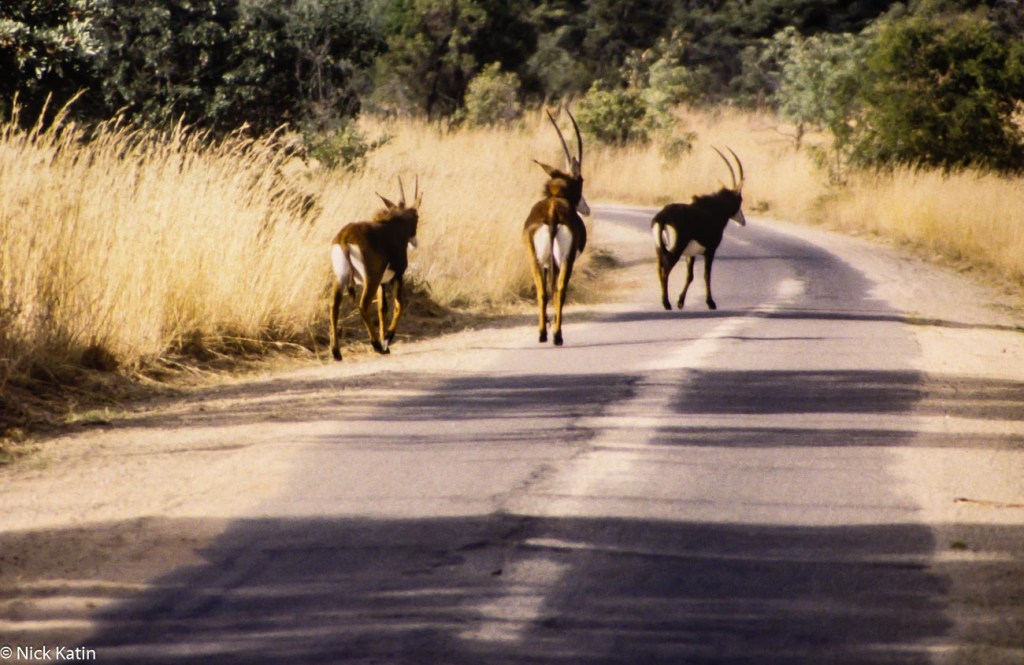
    Sable walking on the park road in Matobo NP Zimbabwe
    Sable walking on the park road in Matobo NP Zimbabwe
  • African shoestrings – Zimbabwe Day Ninety-Six Harare

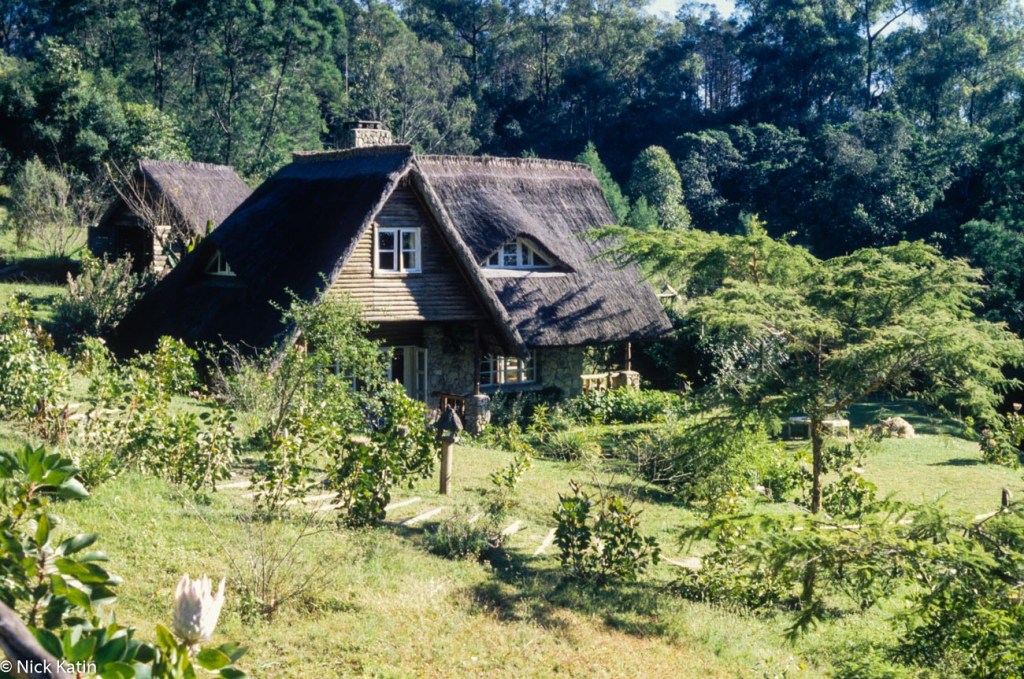
    We moved on the next day to an area called the Vumba Mountains around 250 kilometres to the north. This small area of high country also borders Mozambique and is much more green and lush than Chimanimani. In fact it’s reminiscent of the Dandenong ranges near Melbourne with its eucalypts, rhododendron and tree ferns. We booked into the Ndunda Lodge, an inexpensive thatched lodge nestled amongst the trees and surrounded by manicured lawns and bushy gardens that housed a multitude of bird life. The Botanical gardens are the big attraction in the Vumba. They overlook the Bvumba valley and the surrounding mountains and are expertly manicured outside of the thick rainforests. The forests themselves have lots of trails that allow closer contact with nature. As we strolled around we had the distinct feeling that we were being watched.

    The Samango Monkey is as elusive as they are rare. They are unique to the Eastern Highlands and have this birdlike call and it was these little buggers that kept a watchful eye on our movements. No doubt it wasn’t just us that attracted our attention, we had a four-legged companion. Gypsy was the lodge sheepdog and for some reason known only to herself, wanted to lead us through the gardens stopping occasionally to look around as if to say “hurry up I haven’t got all day, you know”

    But without doubt the best attraction in the area is Tony’s Coffee Shoppe. It serves nothing but coffee and cakes. I don’t know why but I expected Tony to be white. Maybe its because the concept is mainly a western rather than an African indulgence or maybe it’s the name Tony. Either way Tony and his waiters were dressed in bow ties and long white aprons and served each table as if it were in a fine dining restaurant. The cakes were absolutely terrible! Rich, gooey and laced with alcohol we pigged out and washed it down with coffee spiked with chocolate. Is that gross or what!

    Another long drive took us to Harare, capital of Zimbabwe and the drop off point for the hire car that had somehow managed to get us there without further problems and despite all the extra weight we were carrying from our indulgence at Tony’s.

    As far as historians can tell the Shona were the first inhabitants of this area and called it Ne-Harawa after one of their chiefs. It actually means “The One Who Does Not Sleep” which is quite an apt name for a now bustling metropolis. The poms arrived in the late nineteenth century and as is their way decided to settle here and construct a few buildings and called it Fort Salisbury again after one of their chiefs the British prime minister of the time Robert Cecil the Marquis of Salisbury. What Ho!

    At independence in 1980 it was renamed Harare a sort of anglised variation on the original. Now of course it is like most other Southern Africa cities a mix of western and African culture. High rise office buildings, shopping centres and colonial buildings dominate the landscape with two large African markets offering the usual bargains and rip off’s.

    We have a general aversion to most cities but Harare wasn’t so bad. Mind you we had been there before. At that time we had an overnight in the Sheraton courtesy of our travel agent. What I remember most about that stay was the power cut to the whole city fifteen minutes after we landed and at the same time as the bags were being wheeled out on a two large flat baggage trolleys (no automatic carousel here). With the aid of a fellow Aussie traveler’s torch we managed too locate our bags before anyone else decided to add to their collection of bags.

    This time our arrival was by road and relatively uneventful until we dropped off the hire car. The attendant there had our credit card imprint and whilst we were there, phoned for authorisation only to be denied. We left it with him and went on to our accommodation. We rang him some time later and he had still no luck. In the end he sent his offsider to us with the existing credit card docket and a new one for a different card which I signed and all was well.
    We didn’t think anything of it. In a place like Africa the lines of communication are often interrupted and mistakes are frequent.
    However we did attempt to use the original card another time and came across the same problem. We were now down to our backup visa and we didn’t know why! It wasn’t until we reached England some 4 weeks later that we realised why. Two items appeared on our statement that we knew nothing about. The first was an additional transaction from the service station in Bulawayo that we had used on our way to Masvingo, the second was for A$1629.11 paid to the Amabhantu Safari Coy in Bulawayo. This last one was a worry we had never heard of the company; never bought anything for that amount and had not been anywhere in Bulawayo at the time of the transaction. Obviously these transactions had taken us over our credit limit and hence the authorisation rejections.
    To the Commonwealth banks credit they acted quickly and cancelled both amounts and referred it to their fraud department and that was the last we heard of it.

    Footnote:

    Take control of your blog’s images now by signing up here to get “Eleven easy ways to improve your marketing photography”
    A guide on how to start improving your images to help you take control of your marketing.
    That link again


    Tony's coffee house in the Vumba in Zimbabwe
    Tony’s coffee house in the Vumba in Zimbabwe


  • African shoestrings – Zimbabwe Day Ninety-Five Chimanimani Zimbabwe

    From Great Zim. we drove to the small village of Chimanimani in the Eastern Highlands. Located at the eastern border with Mozambique, Chimanimani also gives its name to a national park and a mountain range. We had been told that there’s great walking and views to be had and that there was a great place to stay just outside the village called Heaven’s Lodge. It wasn’t a bad place but it wasn’t fantastic either. A sort of backpacker’s retreat with little chalets dotted around the large grassy paddock that sloped down the hill. The chalet we had was cold and the door wouldn’t stay shut unless we propped something against it on the inside but the view across the surrounding green hills and down into the lowlands from where we had just come wasn’t bad.

    The mountain range of Chimanimani was 19 kilometres away, well at least the starting point for all walk tracks at Mutekeswane base camp was. There was vehicle access as far as this but we had heard that the road was in bad condition so bearing in mind the temperamental nature of our car’s battery terminal we decided to catch the lodge shuttle. We made the right decision! The road was as bad as it gets. This time there was no bitumen between the potholes, it was just one unceasing pothole punctuated by large boulders. However as is the norm for transport in general in Africa it was half an hour late which meant we had less time to walk.

    The track we took up to the mountain hut was called Bailey’s Folly. No one could tell me why it was called this but it didn’t take long to realise that the track was aptly named. A track in name but not in structure, it was basically a way marked with stone cairns (when we could find them) through rough rocky and slippery terrain. I will say that the first section through a forest of Msasa trees was well marked and an easy climb, it was just the second bit that was frustrating. I’m one of those orderly people who like to follow a well defined track, even if difficult and not have to keep trying to figure out where we are and if we going in the right direction which in this instance we often found that we weren’t. Once the track reached high ground it leveled out and then become a lot easier to follow until we reached the Mountain Hut.

    The views at the hut were worth the effort. We could see right across the flat yellow grassed valley to the mountains of Mozambique just across the border. Mount Dinga Chimanimani’s highest was directly in front of us and Skeleton Pass was to the right. Our intention was to go on to Skeleton Pass. The ranger living at the hut told us that it was only about a fifty minute walk away but to avoid the muddy section of the paddock that lay between us. Skeleton Pass is actually a major trade route between the two countries. Even from the hut we could see tiny figures strolling to and from the border (it’s unmanned) as if just walking down to the local shop. In fact during the wars both countries have had over the years, it was also a major guerrilla route for arms and people.

    After a thirty minutes or so of trying to avoid the quagmire we seemed to getting nowhere and by now had lost sight of the pass and any clear track. It was now midday and we only had until 4.30 pm to get to the pass and back and then down to base camp to meet the shuttle. As it took us two and half hours to get to mountain hut there just didn’t seem quite enough time. So reluctantly we turned back and to our dismay ended back down the mountain an hour early. Still it was just as hard coming down as it had been going up so we were grateful for a rest, a drink and the obligatory sugar injection in the form of a chocolate bar.

    Our companions for the bumpy ride back to Heaven lodge were Andy and Caroline, an English couple from Oxford on a three week holiday. They had originally booked to go to Zaire but had to cancel due to the turmoil that was happening there and decided to come to Zimbabwe instead. I mention this because Zaire is not your usual holiday destination; in fact Zimbabwe would not have been either a few years ago. These places were once the domain of the die-hard rough and tough travelers like us!

    We had dinner with them at a restaurant called the Msasa Café run by a couple of women who by the looks of them regretted not being old enough to experience the sixties and go to Woodstock. Mind you they may have been hard to take seriously but their food most certainly wasn’t. It was the best we had since leaving South Africa.

    If you like this then hit “follow” on the side bar

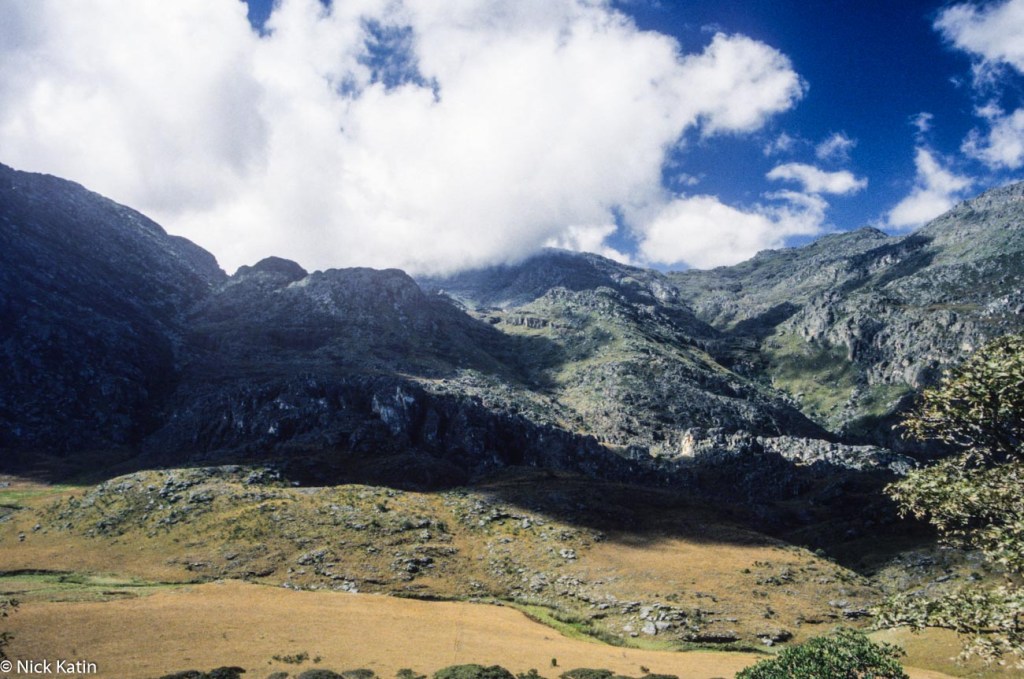
    Mountain Hut at the top of the Chimanimani rnage in Zimbabwe
    Mountain Hut at the top of the Chimanimani rnage in Zimbabwe


  • African shoestrings – Zimbabwe Day Ninety-Four Masvingo Zimbabwe

    Before we set off to The Great Zimbabwe National Monument, we had to fix that damn battery lead once and for all and get some money out of the bank.
    Let me tell you that the former was a lot easier than the latter. There’s only one ATM in Masvingo and that wasn’t working so I went inside the bank armed with my visa card whilst Sue waited in the car. Like you I’ve heard the stories of various people getting to the end of a long queue and then being told that they were in the wrong queue.
    Well that’s what happened not once but THREE times!
    The last queue led to a sourpuss of women who allowed a police officer with two fistfuls of US dollars to push in front of me.
    Somehow I didn’t feel that this was the right place or time to protest despite my now seething frustration which was now shared by Sue who had come in to see why it was all taking so long. Eventually we got thrown our money from just about the most unhelpful, rudest and (why not!) ugliest teller that must exist anywhere in the world. It had taken an hour and a half!

    Our faith was somewhat restored in Zimbabwe by the ruins of the National monument. This place is no ordinary ruins. Its what’s left of a great city and to do it justice we felt we needed more than just a booklet. Francis was one of the several guides that wait just inside the entrance for the opportunity to guide tourists around the ruins for a measly US$4.00. Concise, articulate and to the point Francis brought to life the history and civilization of this place as he lead us around the square kilometre site.

    “The name Zimbabwe comes from this city. In Shona language it means ‘great stone houses’” he explained. “It was not until independence that the government accepted de fact dat it was not peoples from another continent that built this place but indigenous Africans”

    Those “indigenous Africans” were the ancestors of the modern day Shona, the dominant tribe of modern Zimbabwe and its not surprising that the early colonists had doubts about the origins of this city. By the time they had arrived the indigenous people of the time lived in mud huts not in stone constructions and cities such as Great Zimbabwe were deserted and left to crumble by the ravages of time.

    In the thirteenth century having already occupied this area for 100 years or more the Shona commenced construction of the ‘Hill complex’ followed later by the rest of the city. The Hill was believed to be the seat of power and the Great Enclosure is the biggest single ancient structure in sub- Saharan Africa.
    At its height the city housed a population of 20,000 people and held influence over what is now Botswana, Mozambique and South Africa. During the fourteenth and fifteenth century trade powered its power and influence.
    The Swahili traders supplied gold, porcelain from China, Persian crockery and a wealth of trinkets from the Indian sub-continent. The city became rich, well at least the Royal Family did, as it became more powerful. There was even a legend that this was once the home of King Solomon and the Queen of Sheba. But in the late fifteenth century local resources where beginning to run out and its population began to dwindle as, bit by bit they left for greener pastures.
    By the middle of the sixteenth century the city was deserted.

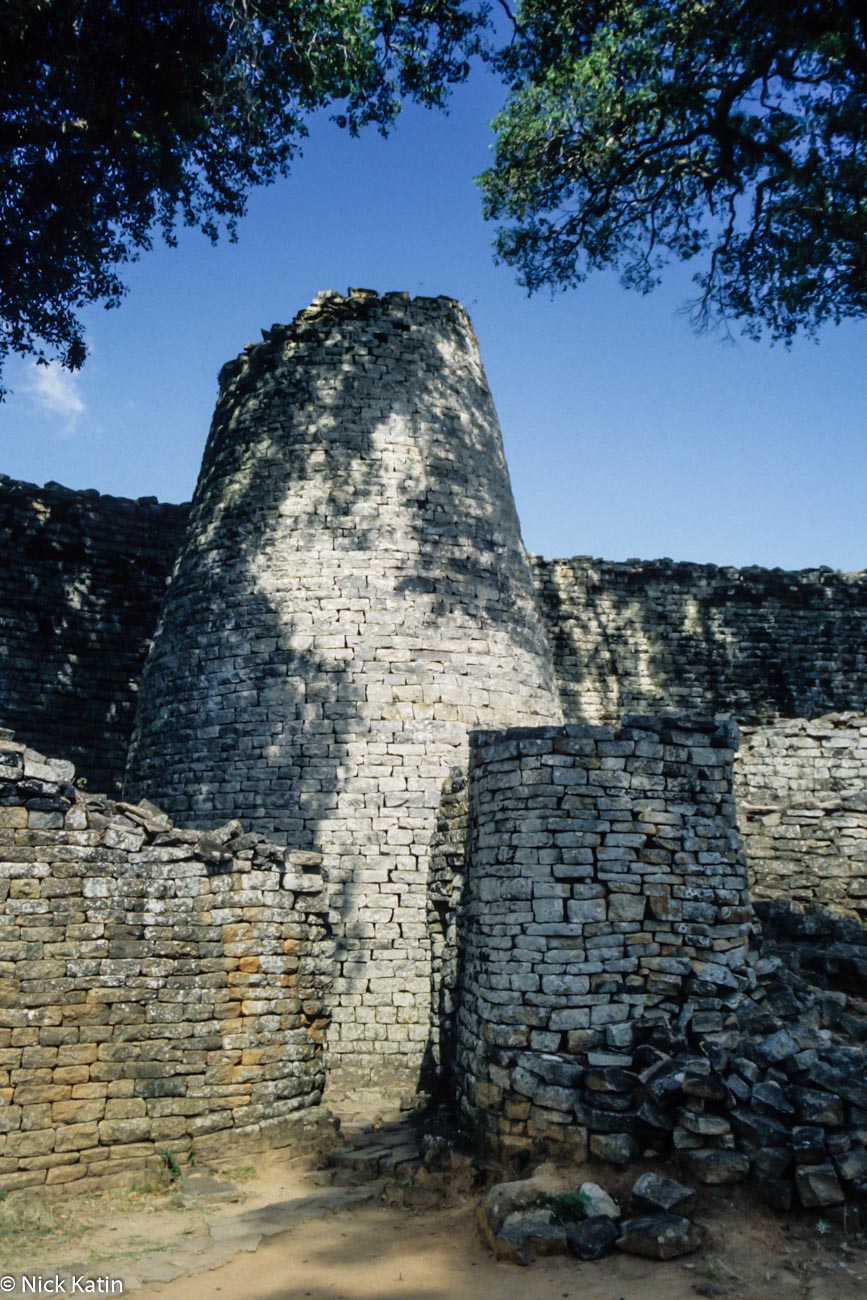
    Francis walked us through the hill complex pointing out the ingenious architecture of the stone walled enclosures. Built amongst huge boulders most of these enclosures were built from uniform sized blocks and regular courses that are used still to this day. But without doubt the most stunning area is that of the Great Enclosure. It has a walled circumference of 250 metres, the walls have a height of 11 metres and a thickness of 5 metres in some places.

    Both it and the 10 metres conical tower that sits at one end is still the subject of speculation about its function. In the late nineteenth and early twentieth centuries treasure hunters and amateur Indiana Jones lookalikes removed any evidence that might have shed a light on why this huge structure was built but theories range from a court for the King’s wives to an initiation school. This last theory is based on the possibility that the tower represents a phallic symbol. All I can say is that someone must have a vivid imagination!

    Francis pointed out the peculiarity of the gradual change in blocks from that of poorly matched to that of well-cut at the highest end. Obviously they must have improved their block building skills (or found a better builder) as they built this enormous circular grey wall and at that point there is another wall actually inside the enclosure mirroring the outside wall. This forms a narrow passage that runs for about a third of the enclosure’s circumference and eventually leads to the conical tower from one of the entrances.

    “Dis wall is cunsideered to be de most advunced structure in Great Zimbabwe. Just loook at de way dey have tappered de couses at de top to make it stable”.

    I was impressed. I could just imagine a congregation of dignitaries dressed in colourful traditional dress walking through this passage in single file towards the tower and about to initiate some teenager into adulthood in some sort of painful ceremony. How lucky we are these days the only pain we go through at puberty is zits and girls.

    If you like this then hit “follow” on the side bar

    Tower in the Great Enclosure at the Great Zimbabwe National Monument near Mavingo, Zimbabwe
    Tower in the Great Enclosure at the Great Zimbabwe National Monument near Mavingo, Zimbabwe
  • African shoestrings – Zimbabwe Day Ninety-Three Masvingo Zimbabwe

    The next day was one of those days. Our early morning game drive yielded very little wildlife. It was our last opportunity to see wildlife in Hwange as we then commenced the 630 kilometre journey to Masvingo in the southeast. On the way out we flagged down by a ranger who asked us to drop off a couple of youngsters at the main road. No problem we thought. Except when we got to the main road they didn’t have a clue as to where they were. We obviously couldn’t leave them there and drive away with a clear conscience, so we ended up taking them into the actual town of Hwange 10 kilometres in the opposite direction, where they lived. This must have distracted me because it wasn’t until we had traveled a fair distance towards Bulawayo that we realised that we did not have as much fuel as I had thought. We found much to our dismay that there was not a single open petrol station between Hwange and Bulawayo. We were now sweating on whether we would have enough to reach Bulawayo. We did of course but as soon as I turned the key to drive off after gratefully refueling, you’ve guessed it, nothing happened. The battery lead had again come adrift. After again some basic repairs we were back on the road still sweating but these time about the battery lead. Worse still it was now getting late and that meant driving in the dark.

    So what, you say!……………… Well, driving in the dark in somewhere like Zimbabwe is a challenge. Firstly, once out of the cities and major towns there is very little street lighting. Secondly, there are lots of pedestrians on the road who are not easily visible as they mostly wear dark clothing and are obviously black skinned. Lastly, the other vehicles on the road had at best, blinding headlights and at worst none at all but most seemed to have only one headlight working which meant that it was impossible to tell whether the vehicle coming in the opposite direction was either a motorbike or a car on the wrong side of the road!

    Our intention had been to book a night at a place called Clovelly Lodge in Masvingo on our way. Do you think we could find a pay phone that worked? No! It wasn’t until we reached Masvingo itself that we managed to ring them, find out if they still had a room free and get directions. Needless to say we got there somewhat stressed and it didn’t help that we were immediately pushed into the dining room where dinner was now being served up (it was full board).

    Clovelly was run by Bruce and Iris an elderly English couple who basically felt that the current situation in Zimbabwe was becoming intolerable for any whites to stay. At the same time they were trapped. Their assets and money were now worth very little outside of the country and that made it very hard for them to leave. Now of course with all the recent publicity of white farms being hijacked by black war veterans, I often think of people like Bruce and Iris and wonder of they ever found a way out.

    By this time we had verbally booked a Canoe safari on the Zambezi to start in a few days time, so it was with great interest that we listened to a couple of German guys who were also staying there. They had just finished that same trip and had cut short their stay in Africa to fly home on account of one of them being badly bruised down one side of his body. Apparently they had been sleeping in their tent when a hippo trampled right over the top of the tent and poor old Klaus. Peter on the other hand slept through the whole thing and didn’t realise what had happened until the next morning when he awoke to see his mate writhing in pain and the tent collapsed and torn down one side. “What the fuck were you doing last night?” he had asked.

    We later found out that hippos have their own paths from land to water and if by chance you happen to be between a hippo and water on one of these trails then he (or she) is not going to politely side step around you. That is apparently what happened to these guys. Fortunately for us they had used a different safari company so we could hopefully presume that there was little chance of that happening to us.

    Now there was a reason we were in Masvingo. The town itself is just one of those typical small towns that can be found almost anywhere else with wide streets crisscrossing in the style of towns and cities established in the late nineteenth century. Its only real claim to fame is the general consensus that it was the first white settlement in Zimbabwe but that is not, in today’s political climate, much of a tourist attraction. What we were there for was not actually in Masvingo but 25 kilometres south. The Great Zimbabwe National Monument is one of Southern Africa’s greatest historical ruins.

    If you like this then hit “follow” on the side bar

    Two hippos grazing by the side of the Zambezi River in Zimbabwe
    Two hippos grazing by the side of the Zambezi River in Zimbabwe


  • African shoestrings – Zimbabwe Day Ninety-Two Hwange

    The restaurant at Main Camp, run down or not was excellent value for money. Waiters in white tuxedos with gleaming teeth and pens poised ready to take orders were at our beck and call. This was not five star but it had the sort of character that only Africa has. A sort of colonial outdoor setting with smells of fresh cooking, candlelit tables and a quiet hubbub of guests enjoying the experience. Occasionally we would here the roar of a lion or the laugh of a hyena. This was so good that we could forgive the preoccupation black African waiters have with whisking your empty plate away almost at the same time as the cutlery hits the empty porcelain. The one thing the Europeans must have instilled in these guys was to ensure that nobody sat at a restaurant table with an empty plate or cup in front of them. “Never mind carrying out maintenance on rail carriages, lodges, roads or even vehicles just make sure there’s no empties left on the table!”

    Trouble is this obsession is starting to spread. Even in Australia young waiters are doing the same thing. What happened to being allowed to leisurely play with your spoon in an empty cup or at least wait until other diners at your table had finished?

    Sinamatella camp is 120 kilometres away, two thirds of which is a sealed road but at least a third of that is the usual tar between the potholes. In fact the unsealed section was a lot better than the majority of the sealed section. We decided to take our time and maybe have a game drive at the same time. Initially the animals seemed to be their usual shy selves; then at a waterhole we spotted two leopards, a male and female. The female was nervous and disappeared pretty smartly. The male on the other hand was totally unfazed and nonchalantly crossed the road in front of us, even having the gall to stop and look at us before disappearing into the scrub. At the next waterhole we spotted six elephants in convoys of three. From then on we seemed to see something new at every waterhole. The next 50 kilometres was spent concentrating on avoiding the potholes, so for all we knew there could have been a pride of lions nearby and we wouldn’t have known.

    The pièce de résistance came at Modava dam 14 kilometres from Sinamatella. There were three or four hippo standing out of the water, which is rare to see especially during the middle of the day, followed shortly after by two white rhino coming down to the water for a drink. A South African couple in the hide told us these two had apparently only just been released into Hwange from Matobo. This retired South African couple were driving around Southern Africa having a great time with their Landcruiser and camping gear. What a way to spend your retirement!

    Sinamatella itself is a lot smaller than main camp and is spectacularly sited on top of an outcrop or mesa (flat topped hill) with 180 degree views for as far as you can see. The restaurant and chalets all back onto a great view of the lower flats and the Sinamatella River where from time to time a distant elephant or giraffe would stop and chew the low thorny scrub. It was a lot drier here so there was fewer waterholes and pans for the animals, making game harder to spot.

    As at main camp they conduct guided walks. This time we were the only takers and Ndlovu, our guide, set up a good pace as we set off down the face of the hill. Ndlovu was short on words in comparison to Douglas but there was no doubting his eyes. He spotted a baby giraffe close by and took us as close as he could to an elephant that, as always, was munching away. Elephants spend most of their waking time munching and are also the vandals of the African wildlife social chain. Everywhere they go they leave a trail of destruction as they tear of branches and knock down trees with their powerful trunks and tusks.

    The restaurant at Sinamatella was called the Elephant and Dassie and was equally as good as the Waterbuck at Main camp. Here though we had quite a number of uninvited guests looking for a free feed, honey badgers. Honey badgers are small mammals that resemble the badger in size, shape, and habits, but apparently are a lot more aggressive and like eating honey as well as bees and animal flesh. These things scurry around the restaurant looking for scraps and then up and over the lodges at night as the pitter patter of their feet awoke us from time to time.

    If you like this then hit “follow” on the side bar

    Elephants in Hwange NP in Zimbabwe
    Elephants in Hwange NP in Zimbabwe


  • African shoestrings – Zimbabwe Day Ninety-One Hwange

    Main camp is’ as the name suggests’ the centre of Hwange. It has most of the facilities, accommodation and the National Park office. It was here that we had to check in and try and organise our spare night.

    The female official was not exactly helpful. “Yus we cun give you anuther lodge for dat night” After establishing that meant we had to change lodge I asked whether we could stay in the same lodge instead of changing. “Noo. Thaat is noot possible” There was no point in pursuing the issue further she wasn’t going to be any more helpful and that was that. She wouldn’t even give us the key to our first lodge until 2 pm. ‘Rules are rules’ in African government.

    We consoled ourselves with a beer in the rather tired Waterbucks head and then attempted to find a picnic spot.

    The road we took was so bad that we gave up after a while but then came face to face with a herd of elephants that came perilous close to the car. Hwange has one of the largest populations of elephants in the world at around 30,000 and most of them seem to be crossing the road right in front of us.

    You know sometimes I can’t help myself, I just had to get a little bit closer to get that ‘great’ shot. It began to occur to me that we might be a little too close when one of the elephants turned and looked us rather menacingly and made to charge us. That was it, I was in reverse and began to move backwards so fast that the elephant was impressed enough to change his mind and went back to his herd. These guys are to be taken very seriously!

    The lodge was quite comfortable if somewhat (like everything else) rundown. It was completely self contained with a bedroom, kitchen, bathroom and lounge. It even had a braai and a shady veranda. Better still we had a cleaner who came in to make the beds and do the dishes. But the best thing was that it was so cheap. US$4 per night! At that price rundown or not it was a bargain.

    Hwange covers 14,600 square kilometres of hot, dry and dusty scrub interspersed with clumps of umbrella acacia trees and dotted with a few waterholes. It’s at these waterholes that most of the wildlife congregate, so most of us just drive from waterhole to waterhole looking for the most exciting wildlife we can find.
    It’s sort of strange how we can become blasé so quickly about the wildlife that we do see. Everyone wants to see the big cats and rhinos.
    At Nyamandhlovu (Nya to its visitors) Pan there is a platform where visitors get out of their car and sit for a while. Here we saw almost everything we had seen before wildebeest, kudu, giraffe and even elephants and still we wanted more.

    We visited this spot again the next day but had to return back to camp when I noticed a nail in one of the tyres. Repairing and replacing tyres was a big enough business in Hwange to justify having a permanent workshop there, so getting it fixed was not a problem.
    In the afternoon we returned to Nya and after an hour or so we got back into the car, turned the key and got nothing but a click. Now picture the scene we’re in the middle of an African wildlife park where the only time you can get out of the car is to quickly climb onto the platform and we’ve broken down. My first reaction was to get out of the car to have lift the bonnet. My second reaction when Sue pointed out that I could be risking my life in doing this was panic and then I got out of the car and lifted the bonnet but with my attention very much on the landscape around me rather than the slumbering piece of metal below me.

    Fortunately there was an armed guard who we hadn’t seen nearby and he made his presence known by coming over and without a word just stood guard close to the car. The problem was the battery lead had come loose from the terminal connection and with my limited tool kit and my great versatility as a mechanic, I had it up and running in no time.

    Back at main camp we washed down a ‘coldie’. Actually it wasn’t a beer but a gin and tonic. Gin was so cheap at US$1.00 for half a bottle that we thought we could save a little bit of money. Trouble was a gin and tonic without ice was like having a warm beer, it just wasn’t the same so that idea was abandoned after while and we went back to beer which at least we could have cold and was still only around US$0.80 each.

    That afternoon we went on a guided walk to the nearby Sedina Pan and back. Douglas our guide had good sense of humour and led us through the bush to the pan where we sat and watched in the hide for a while. Whilst peering through slot in the hide Douglas pointed towards one end of the pan. “What dooo yoou see my friend?”

    “What should I be seeing?’ I replied thinking that there was a lion or something equally as interesting.

    “Oh I don’t know. My eyes are not sooo goood”

    What was the point in having a guide whose “eyes are not so good”? We were relying on him to spot those animals that us mere tourists never spot!

    The other two other couples on the walk were from France and USA. I’ve come to the conclusion that yanks who go overseas must all have training before they leave because they all seem act the same way. Once again they wore the obligatory designer label safari gear, were loud and this time had a video camera that they talked to. That was irritating. We would be watching quietly for some wildlife when behind me would come the murmur “heere we ‘re watching quietly for some anemals in Seedona Paan” I’m sure whoever watched that video was bored shitless! I shushed him and neither of them spoke to us again until the end of the walk.
    Later we saw both couples having dinner together in the Waterbuck restaurant ignoring us as we walked past. Some people are just so petty!

    As it turned out Douglas didn’t actually need his eyes. On the way back we walked across a grassy plain full of zebra, wildebeest, jackals, baboon, giraffe and incredibly two kudu having a scrap within a couple of metres of us.

    If you like this then hit “follow” on the side bar

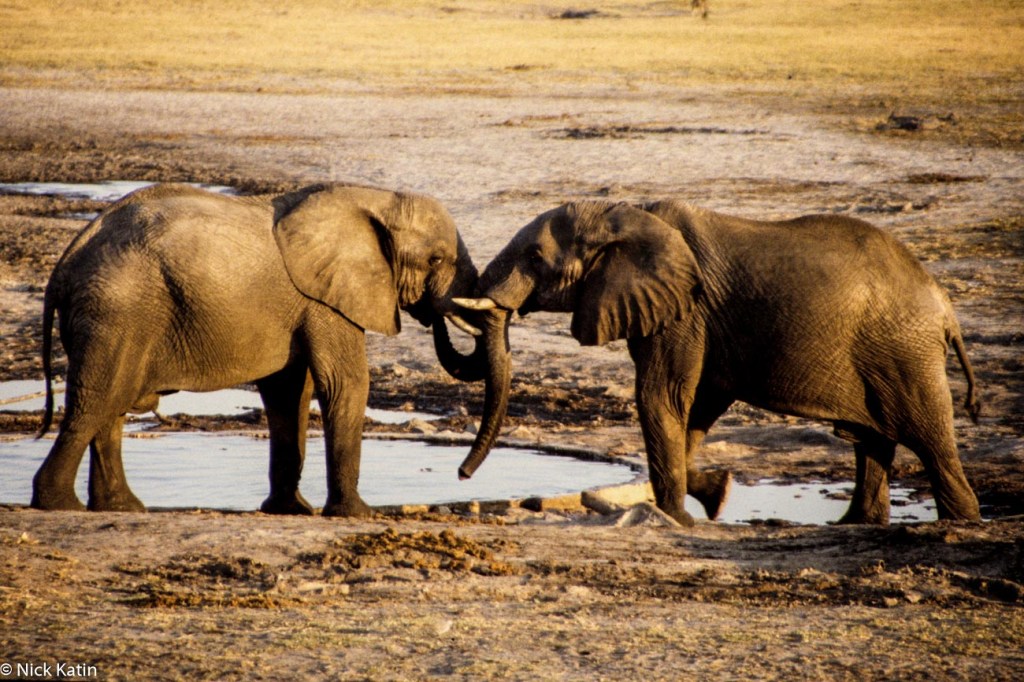
    Two elephants mixing it up at a Hwange NP waterhole in Zimbabwe
    Two elephants mixing it up at a Hwange NP waterhole in Zimbabwe


  • African shoestrings – Zimbabwe Day Ninety Bulawayo

    Cecil Rhodes is buried at a spot he called the “view of the world” but is also called Malindidzimu (dwelling place of the benevolent spirits). So taken was he with what could be seen at the top of this granite mountain that he nominated this place as his last resting place. It’s an eerie place, as the huge boulders that mark the spot appear to be positioned by Rhodes himself. He was a powerful man but somehow his power did not stretch that far.

    On the way back to Bulawayo we stopped off at Tshabalala Wildlife Sanctuary. Admission is free if you paid to see Matobo on the same day.

    Its an excellent park as there are no predators and we could get out of the car and just stroll around the many giraffes, impala and zebra to name just three. Our only fear was of being accidentally kicked by a giraffe due to their inability to see us beneath its torso and we being such a long distance away from their head. They are soooo tall!

    The following day just the two of us (Mark and Nicky left for Harare via the overnight train the previous evening) visited the Khami ruins.

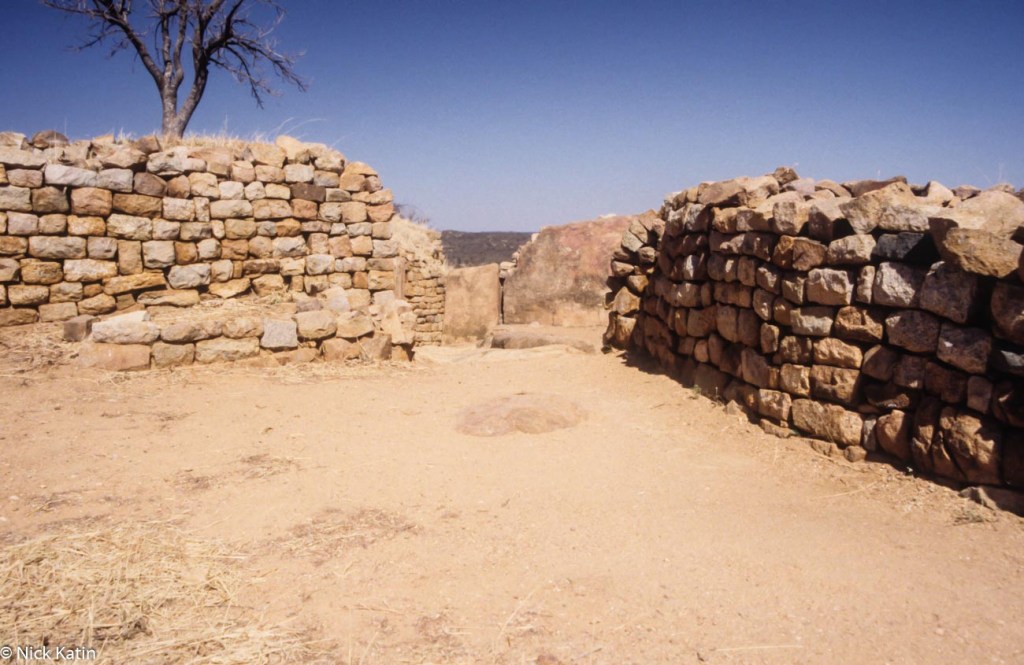
    Zimbabwe has several ruins dotted around the southwest and central parts of the country, the origins of which are often shrouded in mystery and varying theories. I can honestly say that Khami ruins did not leave me with lasting memory of mystique or intrigue. It’s a rather neglected and run down and the trail guide written and published by The National Museums and Monuments of Zimbabwe was ten years old and ventured very little on the taxing subject of who built this mini city. Like the Lonely Planet, it suggests that the Torwa people inhabited it until ousted by the much more powerful Rozwi who attempted to destroy Khami and from the looks of it needn’t have bothered as recent neglect seems to have done a much better job. The most recent theory given to us by Burkes Louise was the possibility that Indians from the Asian sub-continent might have been the original builders and architects.

    The ruins are divided into two different areas, the hill complex and the southern area. The most notable thing about the latter was its proximity to a really smelly reservoir. The hill complex on the other hand is not as spread out and had a concentration of stone walls and terracing surrounding it on quite a prominent mount. On the hill itself are tiers of huts or at least the remains of them. This apparently was the home of Mambo king of the Torwa; where he lived with his entourage. I guess it was interesting but not enough to keep us there too long.

    Across town in the opposite direction and around 24 kilometres from Bulawayo is Chipangali Animal Orphanage. This centre for injured, sick and ‘homeless’ animals was on our list of must see’s. It looks more like a zoo than a wildlife sanctuary. There were lots of cages and enclosures housing the various animals like lions, leopards, rhino, hyenas, and even crocs and snakes to name a few. Lots of these animals are perfectly fit but could not survive if returned to the wild. For instance, once a lion has had close contact with humans it loses its fear of man and becomes a risk to both man and itself. Chipangali also has breeding programs for cheetahs and rhino, so there were large enclosures for both of these animals. What always amazes me is how these places keep going. Obviously under resourced and running out of space somehow they seem to just soldier on and make the best of a bad thing. If I had one criticism it was there was very little info on why individual animals were there. Something like: “Petra (the lioness) was shot by a poacher and rescued by Tarzan, who traveled for three days carrying her to safety. She now has made a full recovery but has developed this habit for pounding her chest with her front paws and hence cannot be released back into the wild.”

    We goofed! As I said earlier we passed Hwange National Park by train to get to Bulawayo just because we wanted to travel in a train and we were under the delusion that hire cars were cheaper in Bulawayo than Vic Falls. As we now know, the train ride was a disappointment and hire cars cost pretty much the same. So now we had to back track 330 kilometres each way. It’s a long drive too, three and half hours to be exact to arrive at Main camp.

    If you like this then hit “follow” on the side bar

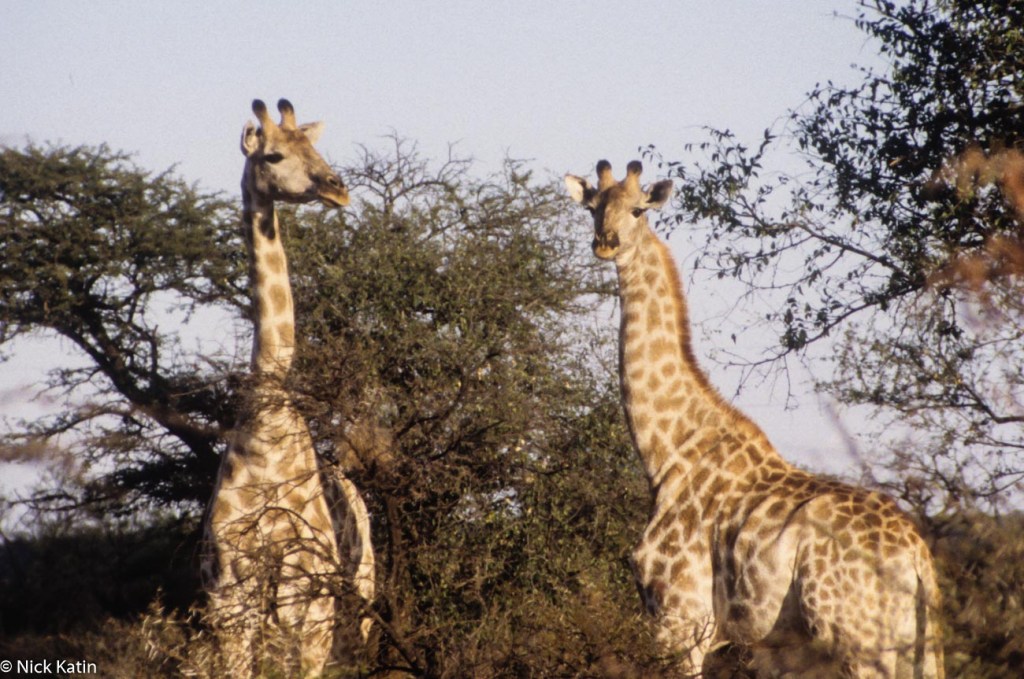
    Giraffe at the "on foot" Tshabalala NP in Zimbabwe
    Giraffe at the “on foot” Tshabalala NP in Zimbabwe


  • African shoestrings – Zimbabwe Day Eighty Nine Bulawayo

    We had some neighbours in a tent at Burkes, Mark and Nicky. Mark was Irish and Nicky was Welsh a powerful combination. As we got to know each other Sue and I started to discuss our home, Perth and I noticed that both of them had gone into a sort of trance and their eyes began to moisten. Were they on drugs I wondered or maybe mentally ill. No, nothing so sinister. Apparently they had met each other in Perth and had such a great time during their six month stay there that us prattling on about how good it was just brought tears to their eyes.

    Perth was one of the many places that they had been, South America, the Himalayas and India to name but three, all of which we had targeted sometime in the future. These guys were getting around on the smell of old guidebook. Their budget made ours look like the national account of a small country. Somehow they managed to spend only US$1000 per month between the two of them. We were by then exceeding our original budget of A$100.00 (US$60.00) a day by the handsome tune of 25% almost double the amount Mark and Nicky were spending and we thought we were doing well! The fact is that they actually missed out on a few things simply because they didn’t want to spend the money. They wouldn’t for example hire a car, so unless an attraction was accessible by public transport, which a lot of sights in Southern Africa are not, or a budget tour then they missed out. Similarly, if the entry fee was high then they would not go or only one would go. They also carried their own tent and managed to camp pretty much everywhere and like us eat out of supermarkets. Personally I think that we are often in these places possibly only once in our lives and to miss experiencing or seeing something simply because of mere money is missing the point. But that’s their decision. They did contribute to the cost of our hire car for a day so that they could come with us to see Matobo National Park.

    Matobo is around 34 kilometres south of Bulawayo and is one of Zimbabwe’s great Parks. Matobo means ‘bald heads’ and was so named by Mzilikazi, king of the Matabele who with his people arrived in the early nineteenth century, fleeing the ruthless Zulu king Shaka. Mzilikazi was referring to the impressive granite peaks that dominate the majority of the park. Some of these peaks are sacred to the African people and supposedly even just to point to them brings bad luck.

    Of course like so many places in Southern Africa the San people were there first. There are hundreds of caves dotted all around the park that house ancient rock paintings.

    The white man also has left some history. Cecil Rhodes is buried in a grave hewn out of rock at the summit of one of the granite peaks. Baden-Powell was inspired during a visit to this area to form the Boy Scout movement and its national training grounds are located in Matobo.

    But we were there to see animals. The largest part of Matobo is taken up by the Whovi Game Park and it’s here that mainly white and some black rhino have been reintroduced and are thriving thanks mainly to armed guards that deter poachers. Of course there are lots of other game including the elusive leopard and the ever present variations of antelope. In fact, it’s meant to have the largest concentration of leopards and also black eagles in the world. Needless to say we didn’t see either. What we did see were a family of white rhino (mum, dad and two little ones) lumbering along the road side by side just in front of us as we turned a bend and applied the brakes to bring us to a jarring halt. Not that we hadn’t been jarred through to the bones up until now; the road was a typically bitumen or dust between the potholes track that we now almost routinely encounter.

    Rhino are such ugly and at the same time beautiful beasts. They move with an ease that contradicts their size but look patently dumb! Of course the latter may because they can’t see, they rely on sound and smell to keep them on their guard against any unfriendlys. It is possible to tell the difference between a black and a white rhino. The white rhino has a wide mouth, somehow over the years the word ‘wide’ has been became white, and stands around 2 metres tall, weighs around 1.5 tonnes and is quite docile. The black rhino has a vertical mouth with a triangular shaped lip, stands around 1.5 metres tall, weighs around 1 tonne and is the most aggressive of the two. A Kruger ranger once told us that a white rhino is a grazer and the black is a browser. Why I remember this has nothing to do with the subject but more to do with the way that this Afrikaans speaking guy pronounced his ‘R’s. They seemed to roll around in his mouth, dig down into his throat come back up through his nose, back into his mouth and sound like a cross between a cat’s purr and a lion’s roar. But I digress. For those of you who haven’t worked it out yet a grazer chomps at the vegetation at ground or low bush level and browser, not wanting to hurt their back, intelligently chomps at the vegetation at head height, i.e. larger bushes and small trees.

    Despite these white rhino being quite docile we decided to stay a safe distance away. It did occur to me whilst slowly following them down the road that had they turned around and decided to charge, I would not have the luxury of being able to do a three point turn. Reversing at high speed along this minefield of a road was probably more dangerous than standing our ground. Of course the rhino weren’t the least bit interested in us they were quite happy going for a family walk along the road until I think even they got fed up with the potholes and disappeared into the thick bush. We saw more rhino towards the end of the day but not before seeing hippos and crocs hanging out at the Mpopoma dam and a few giraffes from the distance. In this area of the park there are two viewing platforms and picnic spot where you can get out of the car. The view from one of these platforms is as typical of the African Savannah as you will find. A grassy plain dotted with clumps of umbrella acacia trees, single umbrella acacia trees stood away from these groups as if exiled, spread before us. In the distance we could see a couple of giraffes that were casually wondering across towards their lunch whilst we ate ours and watched Africa play out its life.

    If you like this then hit “follow” on the side bar

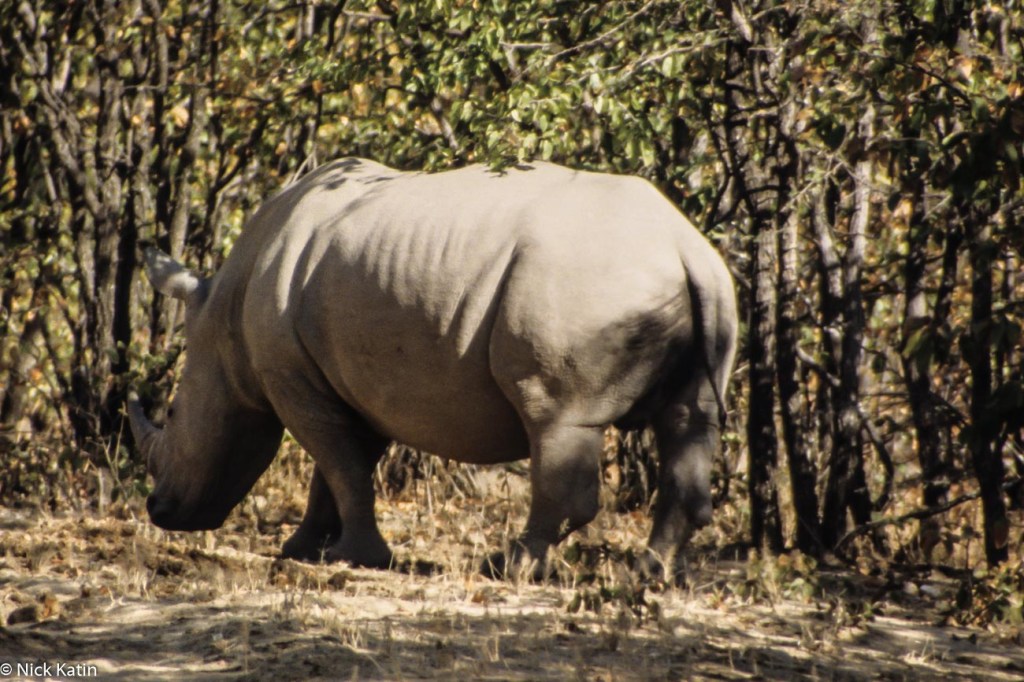
    Rhino rolling in the dirt in Matobo NP Zimbabwe
    Rhino in Matobo NP Zimbabwe


  • African shoestrings – Zimbabwe Day Eighty Eight Bulawayo

    Our actual room was part of a block of four away from the house and quite tidy although as in most things in this country a bit run down. We made ourselves comfy and then getting a lift from Louise headed out to the centre of town to hunt down a cheap hire car and book our accommodation at our next destination, Hwange National Park. To book this accommodation (which by the way is almost mandatory) we had to go to the National Parks Booking Agency in Bulawayo. The main booking office is in Harare and they are not connected by any sort of technology except an unreliable fax. Consequently, we had to request certain dates and places and come back the next day to see if we had won lotto after they faxed head office to check availability.

    We almost got what we asked for……………. There are two camps in Hwange, Main Camp and Sinamatella and we asked for two nights at Main and one at Sinamatella. What we got was one at each with a night’s gap between the two. We weren’t particularly worried as we had heard that there are lots of no-shows (no deposit is required with the booking) so we had good chance of plugging that gap.

    The hire car we managed to get was a Nissan Sunny that had seen better days. A few chips on the paintwork, a couple of small dents, an interior of heavily worn upholstery and a windscreen with a huge crack across the passenger side gave this car ‘character’ and it was also the best of a bad bunch at the price we wanted to pay. We hired it for ten days to travel around Zimbabwe and drop it back in Harare.

    We were rapidly getting the idea that maintenance was a dirty word in Zimbabwe everything seemed in need of repair or simple maintenance. Apparently its been a slow almost unnoticeable deterioration that has been going on since 1980 the year of independence, even though for a time in the eighties Zimbabwe enjoyed a prosperity unequalled at that time on the African continent. So we were sort of hoping that this car had been maintained sometime in its long life.

    The centre of Bulawayo wasn’t quite as run down as other parts but didn’t particularly excite us. It’s just a functional town, its wide streets built around a grid system full of unexciting functional buildings. Even the museum didn’t enthuse us. It just seemed a well ordered assembly of rooms that housed hundreds of stuffed animals.

    What Bulawayo did have was Haefelis!……… Located on Fife Street, Haefelis was a little gem of a café that served cakes, fresh bread, rolls, coffee and pizza. This was the local trendy hangout and a good place to wile away some time, people watching. This was the place of the new Africa or certainly the one the world would like to see if not necessarily some of the African politicians. Young well-dressed Black and White Africans mingled with each other, laughing and joking, putting the world to rights and obviously enjoying each other’s company. Of course in modern day Zimbabwe whites make up less than 1% of the population so their influence should be minimal but still important.

    The bigger racial conflict over the years has been the two dominant tribes, the Shona (75%) and the Ndebele (18%). At the end of the ‘bush war’ that lead to independence in the seventies these two groups came close to starting a civil war and now live side by side in an often uneasy atmosphere. As a tourist there is no real evidence of this except the odd incident that gets a mention in the national or local newspapers. Local Europeans who, as in South Africa, tend to dominate the tourism industry and probably have a slightly different perspective than some of the Shona or Ndebele, fed us our information.
    We heard quite a few times how simple the majority of the population were and how difficult it was for the farmers or other local employers to get consistent productive work from their employees. If that’s true then as more whites and consequently valuable skills leave the country then the bigger the hole Zimbabwe will find itself in unless it takes steps to educate and teach its population the skills necessary to prosper.
    Now don’t get me wrong I’m not in favour of turning all these African countries into western societies and I’m fully aware that everybody was doing just fine until Europeans came along and tried to ‘civilise’ the various African tribes. But the damage is done and the clock only goes in one direction so westernisation is all we have got until someone comes up with something better, which I might add there must be, after all a society that’s produced McDonalds, Emnem, bell bottoms and Ronald Reagan can only be improved on.

    If you like this then hit “follow” on the side bar

    Khiami Ruins near Bulawayo in Zimbabwe
    Khiami Ruins near Bulawayo in Zimbabwe


  • African shoestrings – Zimbabwe Day Eighty Seven Bulawayo

    In Canada I was asked how Niagara Falls compared to Victoria Falls. I said bluntly that whilst the Zimbabweans had made a bit of a mess of the town the area around the falls was still protected and in a natural setting. Somehow the North Americans had turned the falls into a Disney meets nature theme park and built something ugly on almost every square inch of land around the falls.

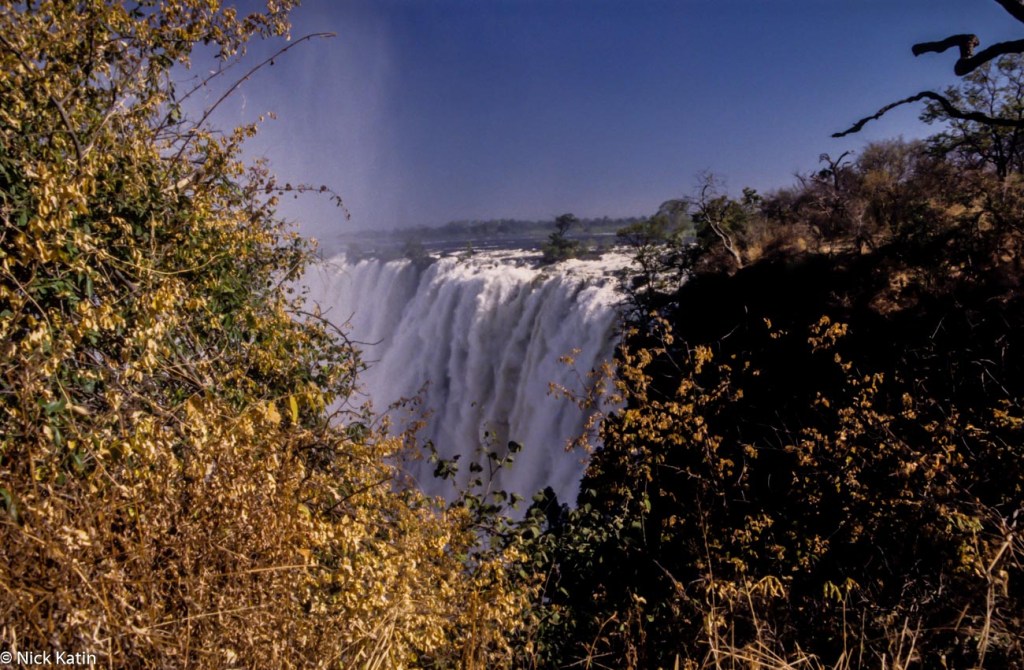
    And that is the great thing about Victoria Falls. Surrounded by rainforest created from the mist that the falls generates, you can imagine that what you are seeing now is pretty similar to what David Livingstone saw when he stumbled across it in the mid 1800’s. As I explained previously last time we had been here the water level had been a lot lower. Now the falls were torrential and mist was everywhere, not enough to spoil the view as on the Zambian side but enough to get us wet again. Probably the most dramatic view is to be had from Cataract View. This requires a climb down a steep stairway into the gorge and it’s from here that we found the classic view found in all good coffee table books. There are many other view points along the path that parallels the falls. The closer ones were a waste of time but the ones further away enabled us to get a sense of scale and that’s when you realise how awesome this place is. Its as if there are billions of tiny droplets of water dropping 100 metres into the gorge, each one independent of each other and then coming together as one seething mass of water on impact at the bottom. We stood and watched this incredible creation of nature for sometime before leaving and finding somewhere to toss some fluid down into our abyss and watch the world cup cricket.

    We were a bit disappointed with our coupe on the train. We’re not sure whether it was the luck of the draw or the fact that we booked second class but we didn’t get the wood paneling, red velour upholstery and brass of a bygone era. Instead we got metal paneling and grey dull upholstery. Most trains in Zimbabwe run overnight on long journeys and run very slowly! It took ten hours to travel a distance of 439 kilometres or twice as long as it would have done by car. But we had, so we thought at the time, some good reasons to travel by train; it would save on accommodation, it was cheaper to hire a car in Bulawayo than Vic Falls and I liked trains. Whilst I’m not in the train spotter league, I find it quite comforting to sit or lie down listening to the rhythmic ‘clatter de clatter’. I was to be disappointed, just as we would nod off to the gentle swaying of the carriage the train would stop at some imaginary station in the middle of nowhere and then spent the next thirty minutes shunting. Add that to the fact that the doom and gloomers had been at us in Vic Falls, warning us to keep our windows locked to guard against straying arms that appear at stations and whip away your possessions and never to leave your coupe unattended, and you can see why we got very little sleep. To add insult to injury we discovered that hire cars cost the same in Bulawayo as they do in Vic Falls after all!

    Louise from Burkes Paradise Backpackers met us at the station at around 7 am and whisked us away to a reasonable size house on a reasonable size property away from the centre of town. Louise and her husband Colin were caretaker managers whilst the owner Alan Burke was away and whilst they were pretty helpful they were obviously new to the game. As with white South Africans white Zimbabweans were fearful for their future under the current regime. Certainly they had good reason, Zimbabwe’s economy was in tatters, inflation was out of control and there was no money to pay the souring national debt or anything else for that matter. Of course since we left the country it’s gone from very bad to chaotic with the well publicised grabs of white owned farms that have resulted in crop failures of massive proportions and therefore very little left to export. The Z$ is worth nothing outside of Zimbabwe, so those who choose to get out, leave with very little unless they were smart enough to have some investments overseas. To a lot of whites still there, Zimbabwe is their home and has been for a least a couple of generations so leaving the country is the last resort.

    Not that they’ve been there all that long. The remarkable Cecil Rhodes managed to obtain mining rights from the Ndebele tribe for his British South Africa Company as late as 1888. From then on the area that is now Zambia and Zimbabwe was settled by whites and the long running conflict between black and white that still continues today was born. Eventually after ten years of fighting between the Shona and Ndebele on one side and white settlers on the other, Southern Rhodesia started to push for self-government, which was eventually achieved in 1923. Thirty years later, along with Northern Rhodesia (present-day Zambia) and Nyasaland (present-day Malawi), it became part of the Federation of Rhodesia and Nyasaland. This federation lasted a mere ten years, when the other two countries obtained independence as Zambia and Malawi. Rhodesia, as it was now called, started negotiations on their independence. But with no plan to involve black Africans, the Poms rejected this proposal. Eventually the white government led by Ian Smith got pissed off by this and declared independence anyway. It wasn’t until 1980 after a lot of bloodshed, two different governments and Britain regaining control, that free elections were held. Robert Mugabe’s Zimbabwe African National Union-Patriotic Front (ZANU-PF) won the election easily and the rest as they say is history!

    If you like this then hit “follow” on the side bar

    Victoria Falls from the Zambia side
    Victoria Falls from the Zambia side