
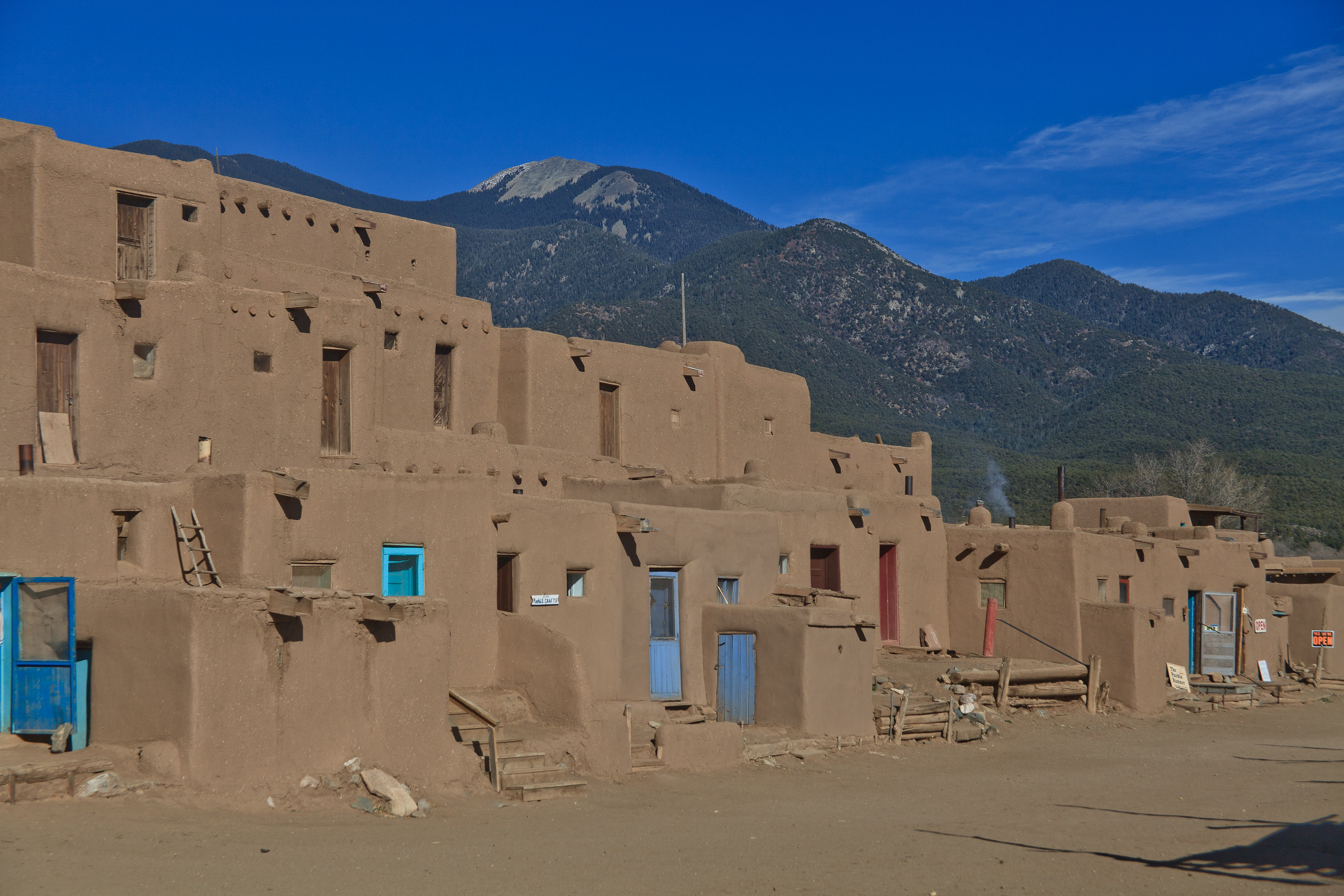
Tag: Ruins
-
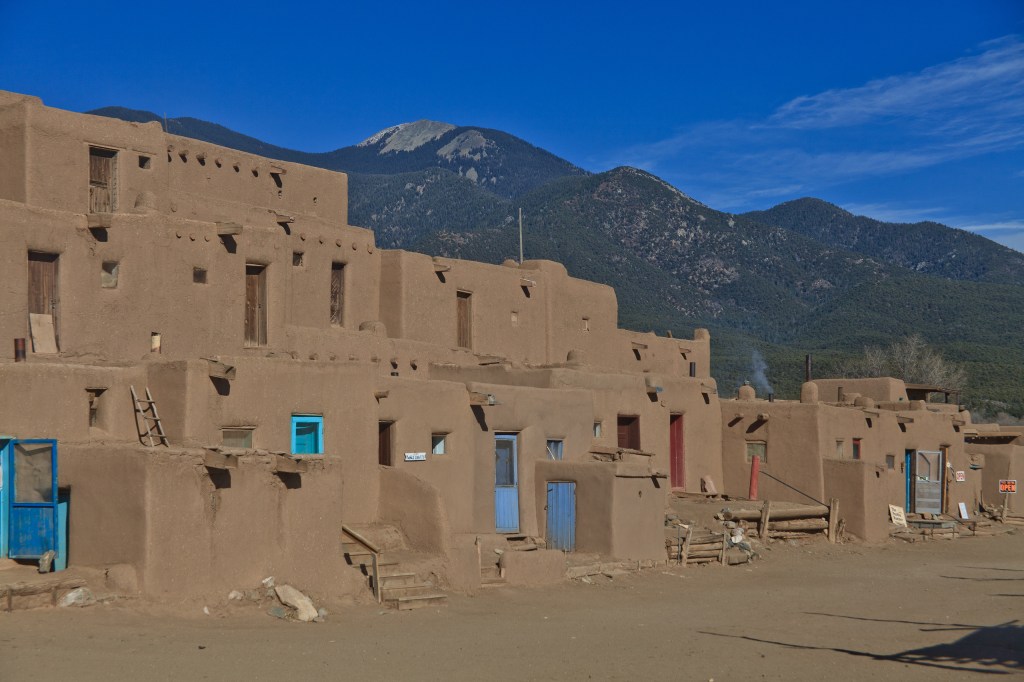
Pueblo Ruins
The ruins of Taos Pueblo in Taos, New Mexico, USA predates the Spanish arrival in the Americas. Click on the image to view a larger version. -
African shoestrings – Zimbabwe Day Eighty Eight Bulawayo
Our actual room was part of a block of four away from the house and quite tidy although as in most things in this country a bit run down. We made ourselves comfy and then getting a lift from Louise headed out to the centre of town to hunt down a cheap hire car and book our accommodation at our next destination, Hwange National Park. To book this accommodation (which by the way is almost mandatory) we had to go to the National Parks Booking Agency in Bulawayo. The main booking office is in Harare and they are not connected by any sort of technology except an unreliable fax. Consequently, we had to request certain dates and places and come back the next day to see if we had won lotto after they faxed head office to check availability.
We almost got what we asked for……………. There are two camps in Hwange, Main Camp and Sinamatella and we asked for two nights at Main and one at Sinamatella. What we got was one at each with a night’s gap between the two. We weren’t particularly worried as we had heard that there are lots of no-shows (no deposit is required with the booking) so we had good chance of plugging that gap.
The hire car we managed to get was a Nissan Sunny that had seen better days. A few chips on the paintwork, a couple of small dents, an interior of heavily worn upholstery and a windscreen with a huge crack across the passenger side gave this car ‘character’ and it was also the best of a bad bunch at the price we wanted to pay. We hired it for ten days to travel around Zimbabwe and drop it back in Harare.
We were rapidly getting the idea that maintenance was a dirty word in Zimbabwe everything seemed in need of repair or simple maintenance. Apparently its been a slow almost unnoticeable deterioration that has been going on since 1980 the year of independence, even though for a time in the eighties Zimbabwe enjoyed a prosperity unequalled at that time on the African continent. So we were sort of hoping that this car had been maintained sometime in its long life.
The centre of Bulawayo wasn’t quite as run down as other parts but didn’t particularly excite us. It’s just a functional town, its wide streets built around a grid system full of unexciting functional buildings. Even the museum didn’t enthuse us. It just seemed a well ordered assembly of rooms that housed hundreds of stuffed animals.
What Bulawayo did have was Haefelis!……… Located on Fife Street, Haefelis was a little gem of a café that served cakes, fresh bread, rolls, coffee and pizza. This was the local trendy hangout and a good place to wile away some time, people watching. This was the place of the new Africa or certainly the one the world would like to see if not necessarily some of the African politicians. Young well-dressed Black and White Africans mingled with each other, laughing and joking, putting the world to rights and obviously enjoying each other’s company. Of course in modern day Zimbabwe whites make up less than 1% of the population so their influence should be minimal but still important.
The bigger racial conflict over the years has been the two dominant tribes, the Shona (75%) and the Ndebele (18%). At the end of the ‘bush war’ that lead to independence in the seventies these two groups came close to starting a civil war and now live side by side in an often uneasy atmosphere. As a tourist there is no real evidence of this except the odd incident that gets a mention in the national or local newspapers. Local Europeans who, as in South Africa, tend to dominate the tourism industry and probably have a slightly different perspective than some of the Shona or Ndebele, fed us our information.
We heard quite a few times how simple the majority of the population were and how difficult it was for the farmers or other local employers to get consistent productive work from their employees. If that’s true then as more whites and consequently valuable skills leave the country then the bigger the hole Zimbabwe will find itself in unless it takes steps to educate and teach its population the skills necessary to prosper.
Now don’t get me wrong I’m not in favour of turning all these African countries into western societies and I’m fully aware that everybody was doing just fine until Europeans came along and tried to ‘civilise’ the various African tribes. But the damage is done and the clock only goes in one direction so westernisation is all we have got until someone comes up with something better, which I might add there must be, after all a society that’s produced McDonalds, Emnem, bell bottoms and Ronald Reagan can only be improved on.If you like this then hit “follow” on the side bar
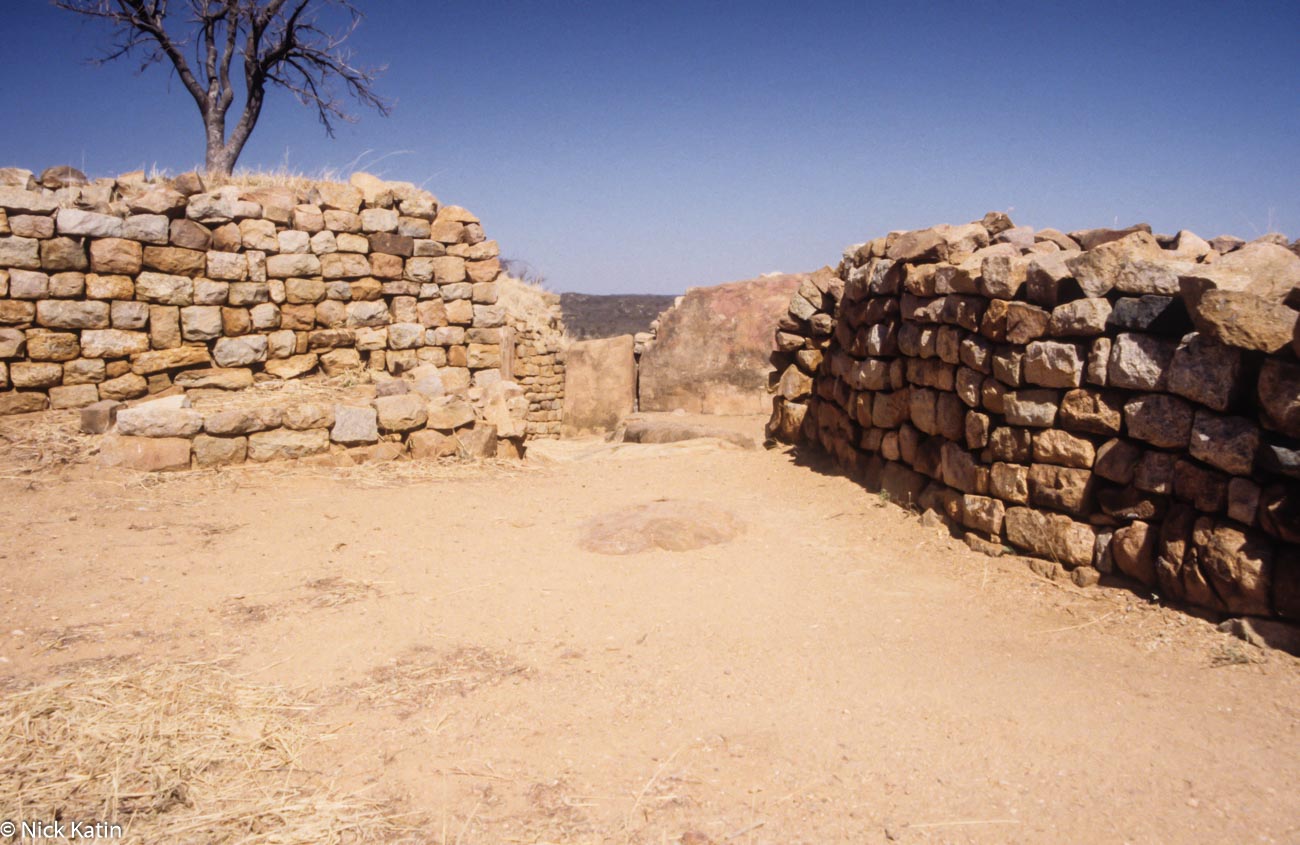
Khiami Ruins near Bulawayo in Zimbabwe Share this:
-
African shoestrings – Namibia Day Fifty four – Windhoek
Strangely enough the train actually got into Windhoek at 6.15 am, on time!
We had managed to sleep a little despite the noise and the fact that my seat leaned to one side and changed on its own accord from recline to upright once in a while.
That’s the thing about Africa the colonialists had put in all this infrastructure and then pulled out leaving the Africans to maintain it. With few exceptions, Africans are not big on maintenance, so the little jobs are just left until it actually it becomes bigger & then bigger again and a full-scale breakdown occurs.We had managed to book a room in the Cardboard Box; a backpackers hostel a couple of kilometres walk from the station. Now it was time to test out these backpacks. With the big ones on our back and the daypacks on our front and feeling like a couple of packhorses, we trudged in the general direction of our destination.
There were several times in the course of our travels that I wondered what we were doing. And this was one!Here we were walking along early in the morning in a strange town with our wardrobes on our back, through who knows what kind of district and being continual ‘honked’ by eager taxi drivers to stay with people younger than our own kids.
We could be in our comfortable home having breakfast on the patio, or better still asleep in our four star hotel provided for us by Abercrombie & Kent or another equally famous and expensive Tour Company.
The Cardboard box was open but its ‘reception’ was closed when we got there.
We dropped our packs and slumped into the usual overused ready to throw out couches and waited.This turned out to be the friendliest hostel we had stayed in so far.
Owned by a couple of local white guys it was run by two girls, Irene & Louise. Irene was Irish and Louise was English and like most of the people who run these places they came here travelling and ended up staying a while.
The hostel also had a their own travel agent with plenty of info on tours, local attractions and adjoining countries like Botswana, which is where we were headed next. These guys turned out to be pretty handy in organising our next few weeks.At home we had we had worked out how we were going to get as far as Windhoek by public transport but had drawn a blank from there to anywhere else in Namibia and then on to Botswana and Zimbabwe. It had become obvious to us that for us to see what we wanted to see in Namibia and then to go to Botswana we would have to either hire a car or join a tour or overlander.
We ended up doing both.
Regular backpacker tours run from Windhoek to the Okavango Delta and Chobe National Park in Botswana and then drop you off in Livingstone, Zambia, which is right next to Victoria Falls in Zimbabwe. We didn’t book that right away as we hoped we could find a cheaper tour that maybe spent a bit more time in Botswana but we now knew it was there.
The next thing we did was get Cardboard Box to organise a cheap hire car and some camping gear whilst we trundled off into the city to organise the next 3 weeks in Namibia.
If you like this then hit “follow” on the side bar
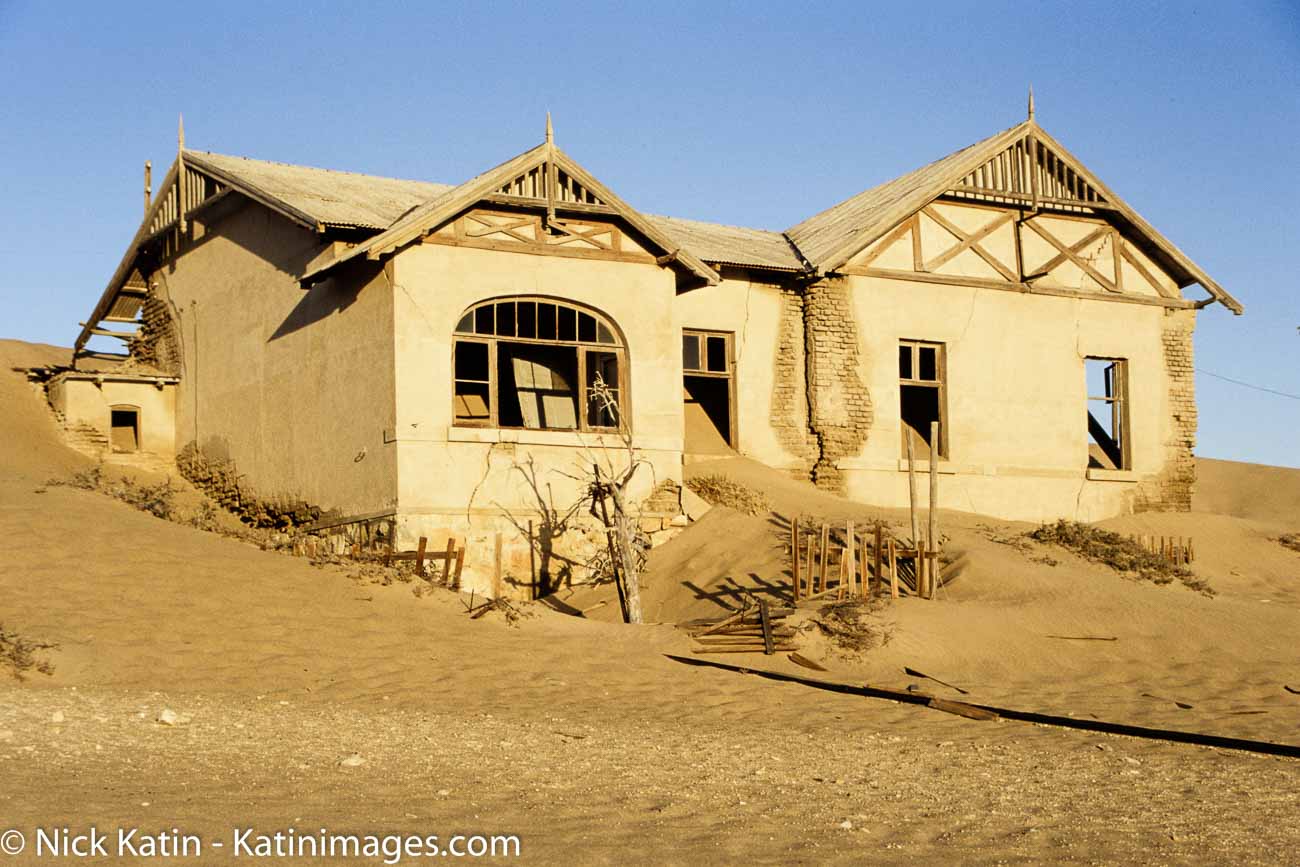
The ruins of the ghost town of Kolmanskop in the Namib desert in southern Namibia, a few kilometres inland from the port town of Lüderitz Share this:
-
African shoestrings – Namibia Day Fifty three – Luderitz
Diamonds were discovered around Luderitz relatively late in 1908. The Orange River and some of the islands off the coast had yielded some good results from around 1866. A chance discovery by a railway worker sparked off a ‘diamond rush’ and the establishment of Kolmanskop.
In its heyday it supported a wealthy, mainly German, population of 300 with a hospital, school, bowling alley, theatre and casino. Its only problem had been water that had to be carted from Cape Town. In 1956 the mines were closed and workers were shifted to Oranjemund 200 kilometres south. The town was abandoned and since then has battled to stay afloat in a sea of sand.Some of these old buildings had been partly swallowed by the sand dunes, whilst others still stood proudly above the sand.
Wondering around, a black and white picture formed in my mind of well dressed people going about their business, men tipping their hats to the ladies, horse drawn carriages or model T fords honking as they passed by friends, butchers, bakers and barbers.This image was only partly reinforced by our return later that morning to do the guided tour. What was also reinforced was why the sand had been so successful in claiming some of the town. The wind was painful! Millions of tiny particles of sand stung any bare skin and got into our eyes, ears, and anywhere else there was an opening. The picture I now had was of windblown deserted streets as the town’s residents all stayed inside waiting for these almost daily mini sandstorms to ease.
The journey back to Keetmanshoop on the bus would have been fairly uneventful had we not spotted the worlds only desert horses, some distance from the highway. These horses somehow survive in this harsh environment without aid except for their only source of water, a man made water hole, installed especially for them. They are feral and what’s even weirder is that nobody knows for sure where they came from originally. There are plenty of theories of shipwrecked, or abandoned German cavalry horses.
I liked the theory that they were once stud horses from the stock of a Baron who lived in a castle nearby. The thought of a European aristocrat living in this harsh environment and pretending that he was still in lush green Bavaria or wherever is just so typical of European colonisation.The bus arrived in Keetmanshoop one hour late, which by African time is actually the equivalent of two hours early! Fortunately that really didn’t impact on us as we still had a two hour plus wait for the overnight train to Windhoek. The train itself left an hour late thanks to a bureaucratic conductor insisting that he checked all tickets at snail like speed as passengers boarded. Had one of his colleagues not intervened and presumably told him in Bantu that he was a stupid prick and to go and do something more useful like tie himself to the rail tracks in front, we would probably still be waiting to board the train.
We had traveled by train in Africa some 4 years before so we sort of knew what to expect. What we had not experienced on these other journeys but had been told about was the videos. A small TV screen sits above the doorway adjoining the next carriage and blasts out the latest movie at decibel level that makes most rock concerts seem quiet. It wouldn’t have been quite so bad if the movie had been half-decent! This was California Man known as Encino Man in Australia and some other parts of the world. It was absolute crap!
If you like this then hit “follow” on the side bar
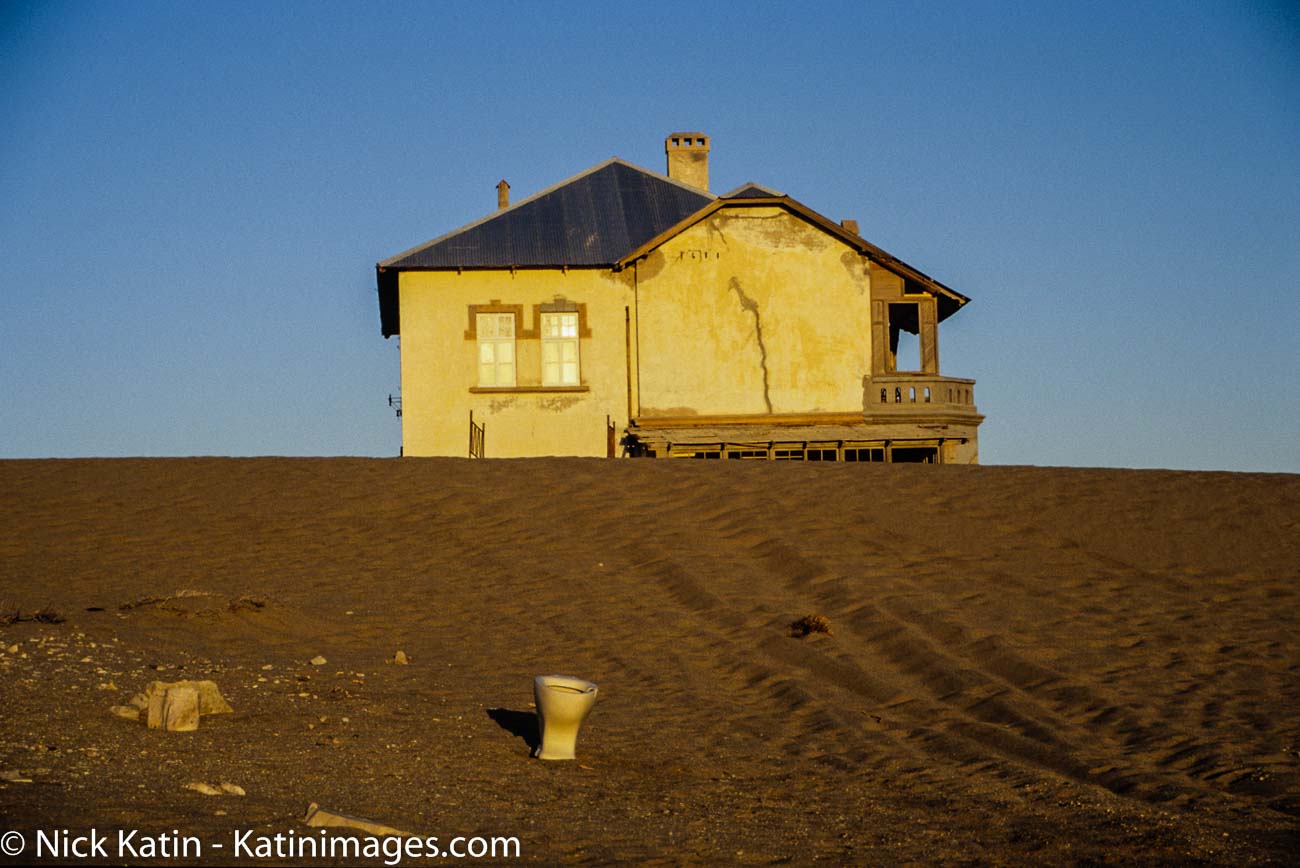
The ruins of the ghost town of Kolmanskop in the Namib desert in southern Namibia, a few kilometres inland from the port town of Lüderitz Share this:
-
African shoestrings – Namibia Day Fifty two – Luderitz
Luderitz is the arsehole of the world! I’m sorry, I know that there are plenty of people who live there and love the place but I had to say it!
Someone, somewhere decided that they would put Luderitz about 350 kilometres from anywhere on the way to nowhere and then have the gall to make it sound appealing enough for you to make the effort, only to find that there is actually nothing there!
Look it’s all very twee having these Bavarian style buildings that house teahouses and pastry shops sandwiched between the desert and the Ocean but if I wanted to see German character I would go to Germany.We stayed a couple of nights and managed to keep ourselves busy. The backpackers was quite comfy and more importantly quiet, we virtually had the place to ourselves.
Most of the ‘attractions’ are spread out away from the town so you either hire a car or go on a tour. We chose the former as the tours weren’t running very frequently and were quite expensive. One tour we did do however was the “West Coast Experience” on the schooner ‘Sedina’. Two hours on a boat, one hour motoring to a desolate spot called Halifax Island and one hour sailing back.
Actually it wasn’t really that bad, we got to see lots of Cape Fur Seals, Heaviside Dolphins and some really smelly Jackass Penguins plus an old whaling station. But the terrain was so desolate, just sand and rock, no colour, trees or shrubs just a naked bleak landscape. I wondered, shivering in the cold and wet from the continual splashing of seawater, what the suicide rate was here.
The scenery didn’t change much during our self-drive tour; it just got windier, to the point that just getting out of the car was a challenge. We wanted to walk across the wooden bridge to get a closer look at the Cape Fur Seal colony at Diaz Point but the wind was just too strong! The rock actually got darker and bleaker as we drove around the peninsular that faces Luderitz, if the moon is like this, I don’t want to go there! Even the scattering of a few flamingoes on Agate Beach didn’t raise our spirits. What did though was Kolmanskop!
Kolmanskop is literally the jewel in the dreary Luderitz crown. A once thriving diamond mining town, now deserted and thanks to a few hardy souls, a tourist attraction.
It borders the Sperrgeibiet, 20,000 Km2 of desert set aside for diamond mining and a prohibited area. In fact a permit is needed to visit the town. We managed to get a couple of Sunrise to Sunset permits so that we could photograph the town at sunrise.
Boy! Was that a good decision! At 6.00 am the light was perfect and the buildings literally glowed in the golden light. Even better the wind was non-existent and as the only visitors to this eerie ghost town, we snapped away to our hearts content in comfort.If you like this then hit “follow” on the side bar
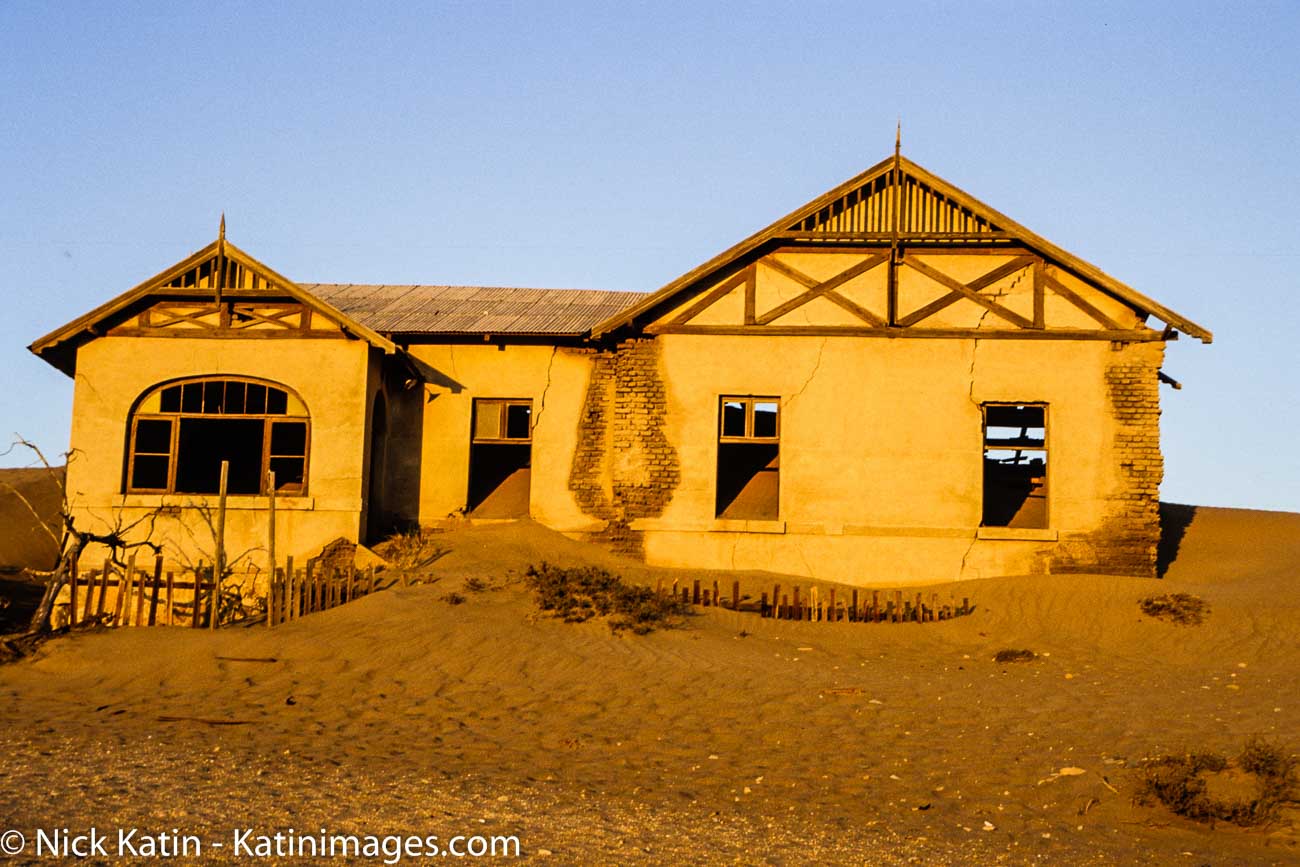
The ruins of the ghost town of Kolmanskop in the Namib desert in southern Namibia, a few kilometres inland from the port town of Lüderitz Share this:
-
African shoestrings – Namibia Day Fourty eight – Keetmanshoop
We got back to Upington in the early afternoon and were ‘treated’ to a wimpy!
A wimpy for those of you who don’t know, is the British equivalent to McDonalds and just about serves up the worse hamburgers you can get from a fast food restaurant (well at least this one did). Mind you as far as I’m concerned most fast food places are like that. The first two or three bites taste pretty good ’cause your hungry the rest resemble cardboard and have you thinking why did I bother? Because you’re hungry of course!We set up camp in the local Caravan Park, where the others were sleeping the night. We had a bus to catch to Keetmanshoop in Namibia that night and Hannah and Si were catching one to Cape Town. But we had enough time to rest up for awhile and watch the locals set up their caravans and crack open a few tinnies.
This was, according to Roland “duchy country”. Duchy refers to the ‘real’ Afrikaners, people who had ancestry back to the first Dutch settlers in the seventeenth century. I had tipped Roland to be a ‘duchy’ but he apparently was not from that stock.A couple of them came up and started chatting to us. These guys were big bulky blokes who had tinnies almost disappearing inside their massive hands. They were the archetypal beer swilling rugby and cricket mad South Africans that most of the world recognises as the white South African. We had a bit of banter over rugby and cricket and they asked us over to the local bar to watch a rugby super twelves game with them. I was hanging out to do something like that but our bus departure time wouldn’t allow that and Michelle and Alex rightly felt it was not a good idea for them to go alone.
The Intercape Mainliner to Keetmanshoop was 45 minutes late leaving, which allowed us plenty of time to say our good-byes. Roland was like a mother hen with our bags, making sure that they were loaded on carefully and near the front, as our stop was one of the first. We had all given him a generous tip in foreign currency, which he collects, so he was happy as a lion rolling in the Kalahari sand!
The bus ride itself was an another overnight job and would have been pretty uneventful except for South African customs wanting everyone off the bus so that their sniffer dogs could sniff around presumably on the possible scent of weapons. We eventually got to Keetmanshoop at 3 am and were met by George from the La Rochelle B&B our overnight stop. We had booked a night here, figuring that arriving at 3 am in a strange town, without a place to stop the night was not a good idea.
George was the first of many ‘Germans’ that we met in Namibia. Even though Namibia was only a German colony for thirty-one years from 1884 until 1915, its influence in certain areas is still very strong amongst descendents of that era. George was we were later to find out a typical example. He had been born in Namibia but still spoke with a fairly strong German accent and the B&B itself was very central European in its style and ambience. All dark wood and German style trinkets and furniture.
If you like this then hit “follow” on the side bar
The ruins of the ghost town of Kolmanskop in the Namib desert in southern Namibia, a few kilometres inland from the port town of Lüderitz The ruins of the ghost town of Kolmanskop in the Namib desert in southern Namibia, a few kilometres inland from the port town of Lüderitz The ruins of the ghost town of Kolmanskop in the Namib desert in southern Namibia, a few kilometres inland from the port town of Lüderitz Share this:
-
Gran Pyramid Uxmal, near Merida, Mexico photo

Gran Pyramid Uxmal, near Merida, Mexico. is one of the top Maya digs © 2010 Nick Katin The Yucatan peninisula is home to some of the worlds greatest pyramids. Chichen Itza is the most famous but this one at Uxmal near Merida is, in my humble opinion, just as gob smacking and without the tourists. There are many other ruins but the Gran Pyramid is the show stopper. Despite it being the middle of the day I was able, with the aid of my trusty polariser, to capture some good light and the white fluffy clouds.
Share this:


 Katin Images Travel Photography