Katin Images Travel Photography

Travel Photos, Travel Photography Tips and Software

Tag: landscape

  • African shoestrings – South Africa Day Nineteen

    The most popular walk in the park is the Gorge walk. Talk to any South African who has been here and they will have almost certainly hiked the Gorge track.
    About a year later we worked with a South African in England and his reaction was “You’ve done the gorge walk! I can’t believe it!” Anyone would think we had kidnapped Nelson Mandela and dragged him with us!

    Anyway I don’t know what all the fuss is about. Even at a 22.5 kilometres roundtrip it’s an easy track that starts in the middle of the park and ends at the Amphitheatre.
    However with little time and brooding dark thunderstorm clouds hovering above us we set off to do this walk in an afternoon. There was another South African couple (they’re everywhere) who we followed then eventually led, that were looking nervously at the thickening and darkening clouds. “She’ll be right, Mate” I said encouragingly as we past them for what seemed to be the tenth time. The problem with that theory was that it wasn’t shared by what seemed to be an army of Black Africans who were all going in the opposite direction.
    They had been maintaining the trail and I suppose might have been knocking off for the day.

    The walk itself was great! We skirted ridges, climbed gentle grassed hills, passed through small patches of rainforest, crossed creeks and the river Tugela before popping up at the gorge itself.
    And that was where we had to stop!
    We had run out of time.
    If we carried on into the gorge we would have been faced with crossing the fast running Tugela a number of times plus hoisting ourselves out of the gorge using a chain ladder; all of which would have slowed us down. So with darkness probably only a couple of hours away we did the sensible thing and turned back.
    All the way back we grumbled to ourselves that we should have gone on and to hell with the circumstances. We stopped grumbling about 5 minutes out of the park when the heavens opened, the sky lit up and bellowed. In 5 seconds flat we couldn’t see a thing!
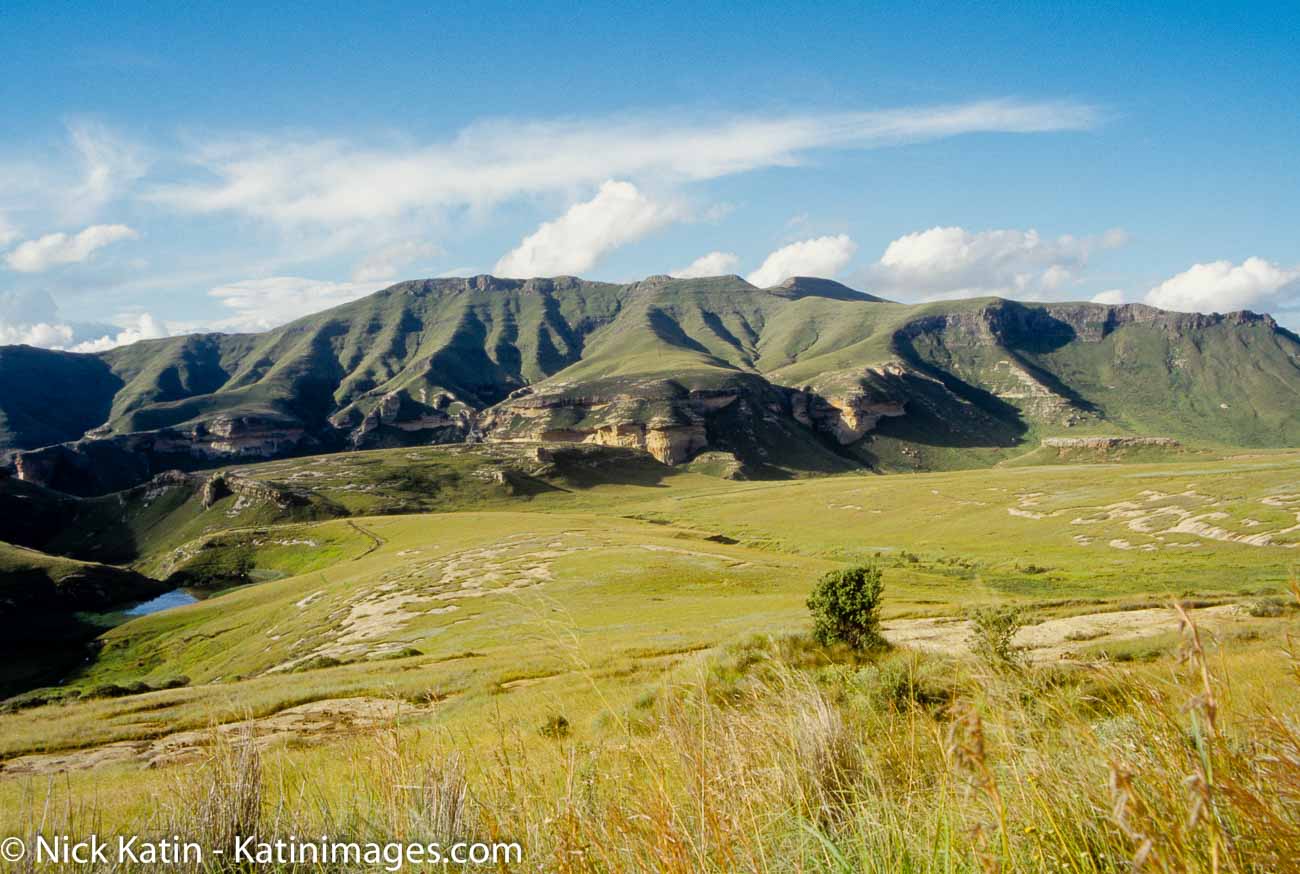
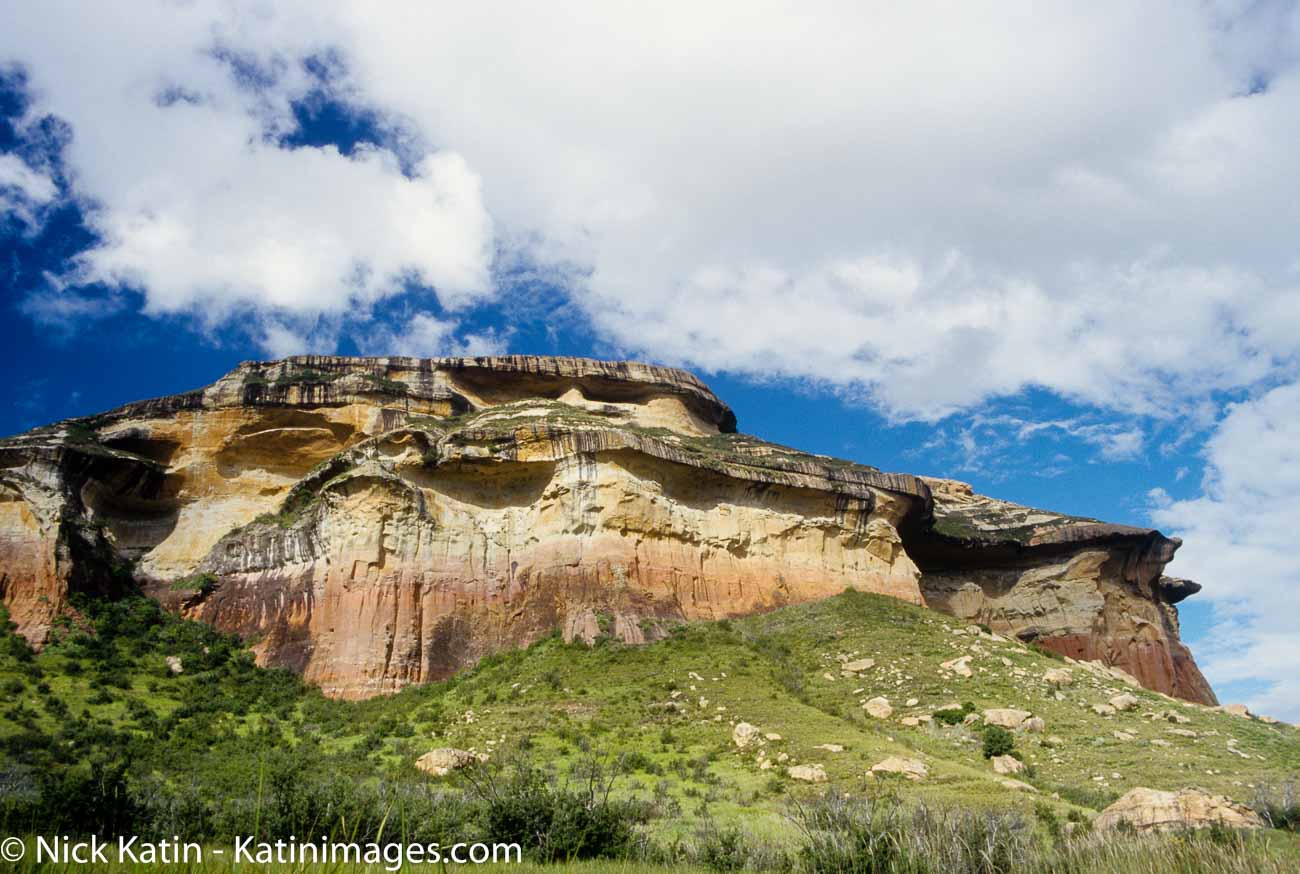
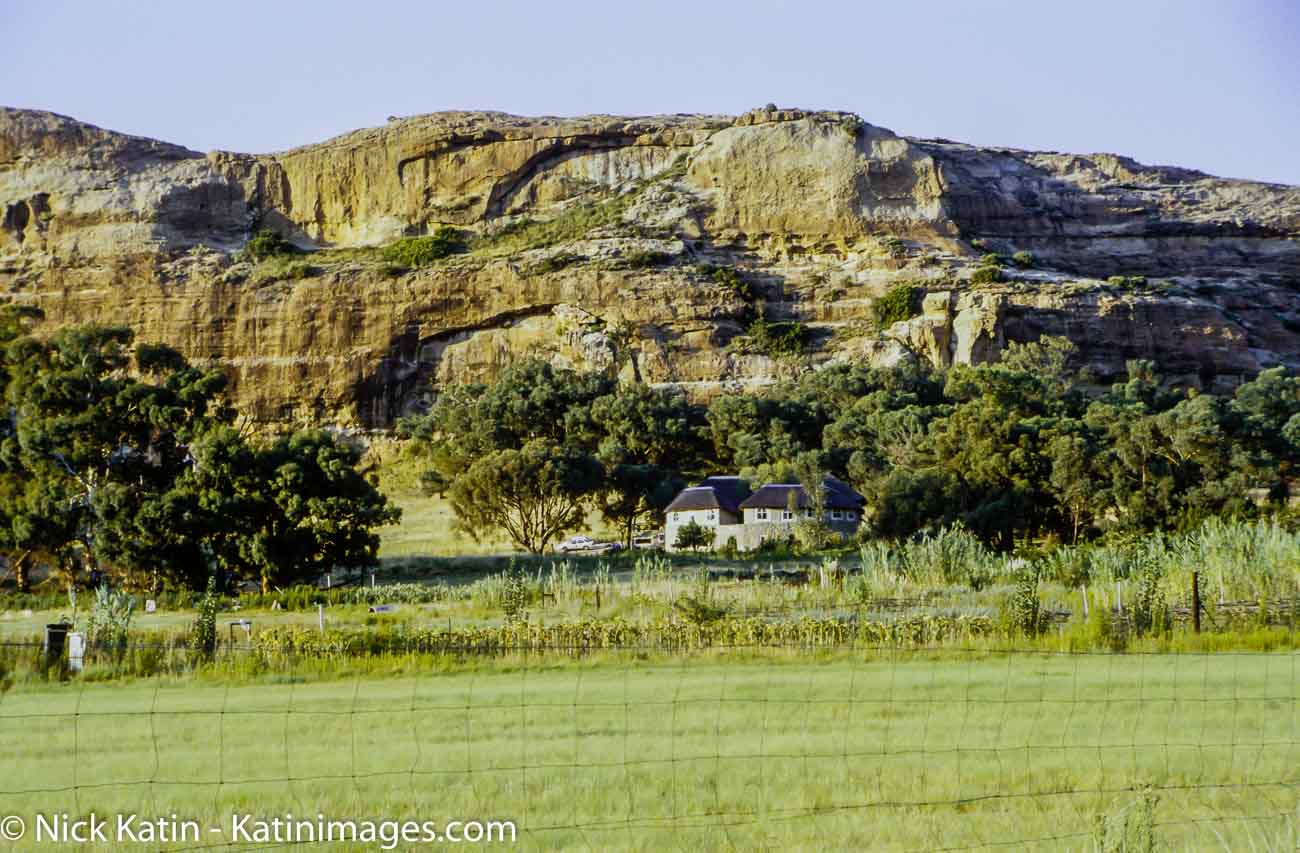
    Some of the scenery found in the Golden Gate National Park in the Drakensberg ranges in Soth Africa
    Some of the scenery found in the Golden Gate National Park in the Drakensberg ranges in South Africa
  • African shoestrings – South Africa Day Eighteen

    Being in Southern Africa we did however see lots of Baboons.
    Let me rephrase that we actually heard them first as they went from rubbish bin to rubbish bin, in the early hours of the morning, scavenging at whatever scraps were to be had. They left crap everywhere and they were still dining on the fruits of their spoils when we got up.
    I noticed that no one made any attempt to ‘sho’ them away, this was apparently for a good reason, “they’re bloody vicious little pricks,” said the South African guy staying in the next hut. “Baboons are a problem all over Southern Africa” he continued “most parks have baboon proof bins to prevent all this mess”.

    He and his wife were up from Durban some 300 kilometres south for a few days and like nearly all white South Africans we came across seemed to know someone in Perth.
    Back in the last days of Apartheid a lot of whites left for Australia and either settled in Sydney or Perth.
    Perth attracted a lot due simply to its proximity to South Africa and with a similar beach life style, it has a lot in common with Durban. In fact there was a saying “will the last one leaving for Perth please turn out the lights”.

    Royal Natal National park is the Drakensberg. Huge jagged peaks form the spectacular and well known “Amphitheatre”. Looking like the bottom row of perfectly level teeth (you know the ones, the actress’s from ‘Days of our Lives’ all have them) with an incisor, Mount Amery (3143 metres and Sentinel (3165 metres, standing at either end, this wall of rock dominates the park. It has a mythical look about it that makes you think that beyond it lies a different world waiting to be discovered.
    Well actually there is, Lesotho!

    Some of the scenery found in the Golden Gate National Park in the Drakensberg ranges in Soth Africa
    Some of the scenery found in the Golden Gate National Park in the Drakensberg ranges in South Africa
  • African shoestrings – Lesotho Day Fifteen

    That tricky river crossing was the final challenge and can you believe it wee stopped for lunch about ten minutes from there!
    We just wanted to get it over and done with!
    David & Clement had been unable to talk to each other as much because of David having to spend a fair amount of time controlling the now impatient and eccentric Black Label. So we figured that they wanted to have a final ‘chat’ before heading home.
    The crossing was actually no big deal going back. This time we were climbing the steeper side of the gorge and it’s a lot more comfortable looking up than down. For me riding a sure-footed and obedient pony made a big difference.

    We got back at around 1.30 pm and despite feeling dirty and dusty we headed for the bar and stayed there for the rest of the afternoon.

    The next day we headed out back to South Africa.

    The road was pretty much the same until we reached Maseru.
    To avoid the city centre we had to travel along the eastern outskirts. Even though we had been assured that there was no danger by almost everyone, this area seemed uncomfortably close to the spot where all the rioting had happened 6 months ago. We passed several buildings that had been gutted by fire or looting and appeared to be sitting there unused and ignored.
    But we never felt threatened by the many people who were going about their business not in the least bit interested in two potentially nervous white tourists.

    What did make us uncomfortable was a lone policeman standing in the road waving us down. You hear lots of stories of corrupt African police officials extorting money from helpless tourists in exchange for not impounding their vehicle, luggage, children or anything else that’s worth them confiscating.
    He examined the tax disc on the front of the car very closely as if it was strange flaw in the windscreen. His face lit up on viewing my Australian drivers licence and said beaming, “Aha, from Australia! Kangaroo!” We laughed with him at this obviously witty and perceptive comment not realising at the time that this was going to be repeated many times by what seems now to be an army of officials, bureaucrats, tour guides, hotel workers and any other smart arse that inadvertently wanted to piss us off!
    He waved us on politely still beaming at his joke.

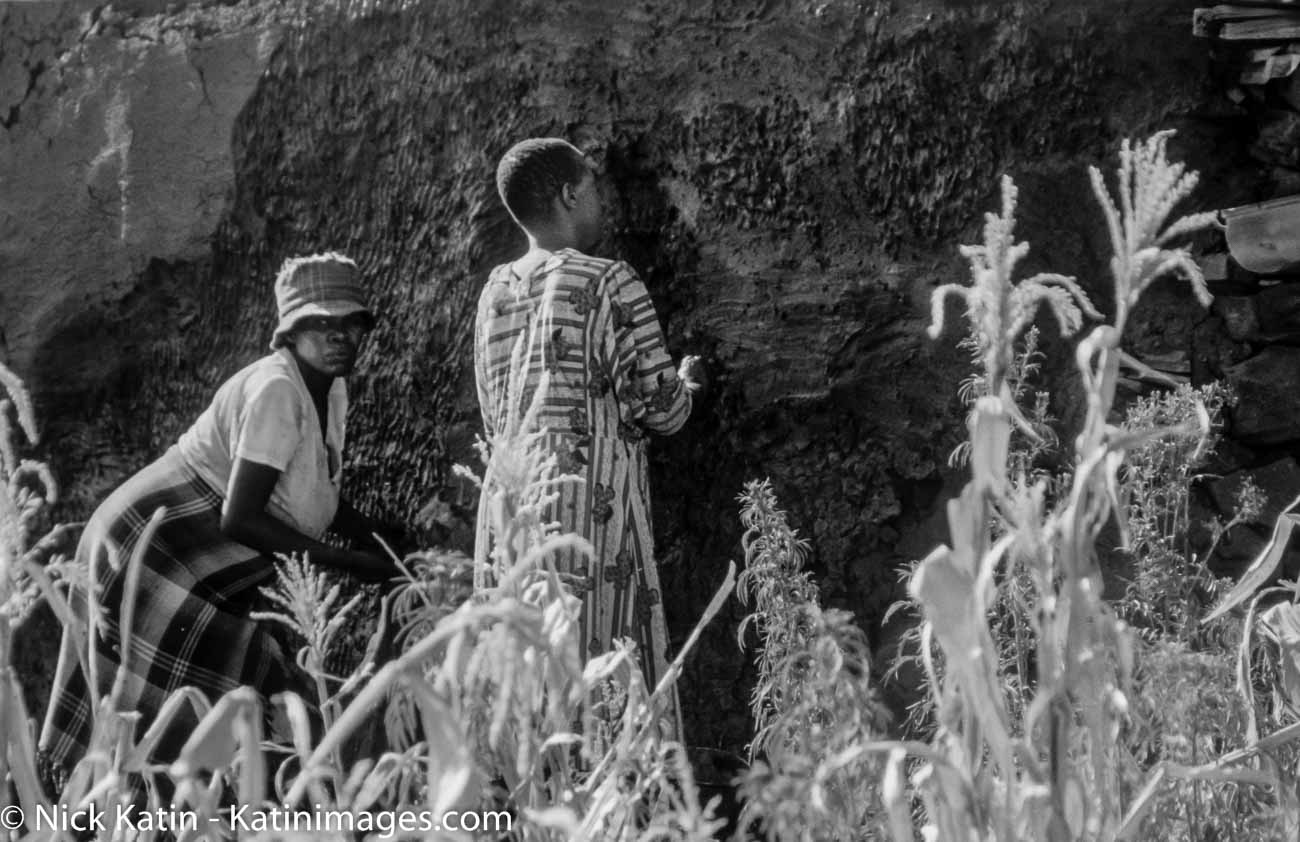
    Women cleaning the outside of a mud hut near Malealea Lesotho
    Women cleaning the outside of a mud hut near Malealea Lesotho
  • African shoestrings – Lesotho Day Thirteen

    David & Clement talked incessantly amongst themselves in SeSotho. To us of course it was rabble of noise punctuated by frequent loud hearty African laughs. What they were talking about was anyone’s guess.
    Normally on these treks, one guide is enough for six people but as we and Olive and Petra had booked separately somehow we had ended up with a guide each. We think it was more to create employment rather than any real need for two guides.
    So I guess these two guys were making use of the opportunity of having a real conversation whilst working, instead of having to continually talk to ‘dumb’ tourists.

    They did stop talking when we came across a store in the middle of nowhere. Not another building or village was to be seen. But what silenced David and Clement were the big mouthfuls of beer they took from the couple of cans of Castle purchased from this place.

    Our destination was the village of Ribaneng, famous for its falls and where our “five star” rondavels awaited us.
    Well I guess almost anywhere can look five star after a day in the saddle.
    Basically it was a mud hat with about ten mattresses on its spartan and dusty floor and a couple of gas rings with a gas bottle. Lighting was five star candles and BYO torches and our toilet was the long drop variety located down the end of a vegetable garden in a small wooden hut.

    The falls itself was almost out of view and was according to Clement an easy two hour return “stroll”.
    Guided by yet another David, we brushed rather uncomfortably through rough vegetation, jumped and hopped from one huge boulder to another and slipping on the many small stepping stones along and around the river.
    It’s at this point that I would like to describe to you a wonder, a creation of nature so beautiful that it brought tears, a spectacular feast for our eyes but I can’t.
    It’s not that it’s indescribable nor that it’s too wonderful for words, well it was just a waterfall and after the struggle to get there it was just not the spectacle that we had hoped for. It was, well, sort of nice, nice and boring.
    And with that we struggled back to camp.

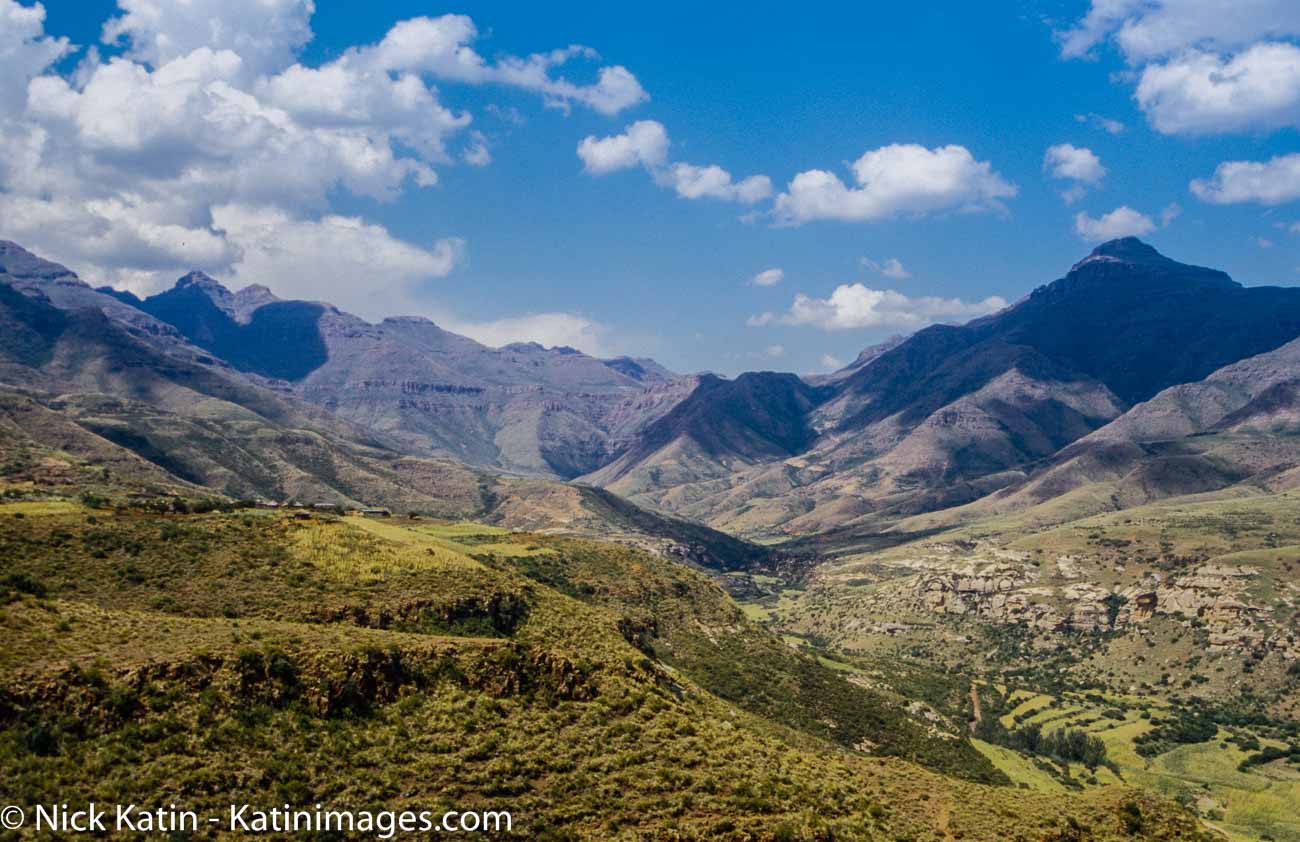
    Maloti Mountains of Lesotho in the early afternoon light.
    Maloti Mountains of Lesotho in the early afternoon light.
  • African shoestrings – Lesotho Day Twelve

    Somehow we made progress until we reached the river crossing about an hour in.
    In fact it wasn’t actually the river crossing that was the problem, it was the steep, narrow, rocky path that zig zaged down the side of a small gorge at an angle that would make you think twice about walking down there, let alone ride a pony, that had me spooked. Black Power stumbled down at her almost standstill pace whilst Black Label wanted to go down at breakneck speed and consequently was forever trying to overtake.
    Well let me tell you there was absolutely no room for overtaking and it took a lot of “wooing” and pulling in the reins to keep him back. Far below I could see Sue and Olive patiently waiting with David. Clement was with us trying to speed up Black Power, slow down Black Label and hold onto the packhorse. Eventually we made it down physically unscathed but mentally frazzled.

    The rest of the journey was a lot easier and I was able to relax a bit and take in the view without fear of my psychopathic pony deciding to crack on to Black Power and take us both down some steep ravine (Clement came up with the idea of keeping Black Power behind us rather in the front).

    The scenery was pretty much the same as we had experienced on our previous days walk. A continuous range of high country surrounding us, it seemed as if it we would have to climb great heights to go forward but somehow that never seemed necessary, there was always a low pass to take us through the mountains.

    There were plenty of villages too. I couldn’t help thinking that the Basotho people lived in a country that has a GDP of US$ 2255.00 per person and yet they appeared to live their lives quite happily. By comparison, Namibia has a GDP of US$8190.00 per person and the USA a GDP of $ 53,000 per person!

    When we passed the villages or just the odd traveller they all said hello and gave us that broad watermelon grin that you just couldn’t help but return. They seemed so content and peaceful! Maybe a good GDP is not as important as economists of the western world would have us believe.

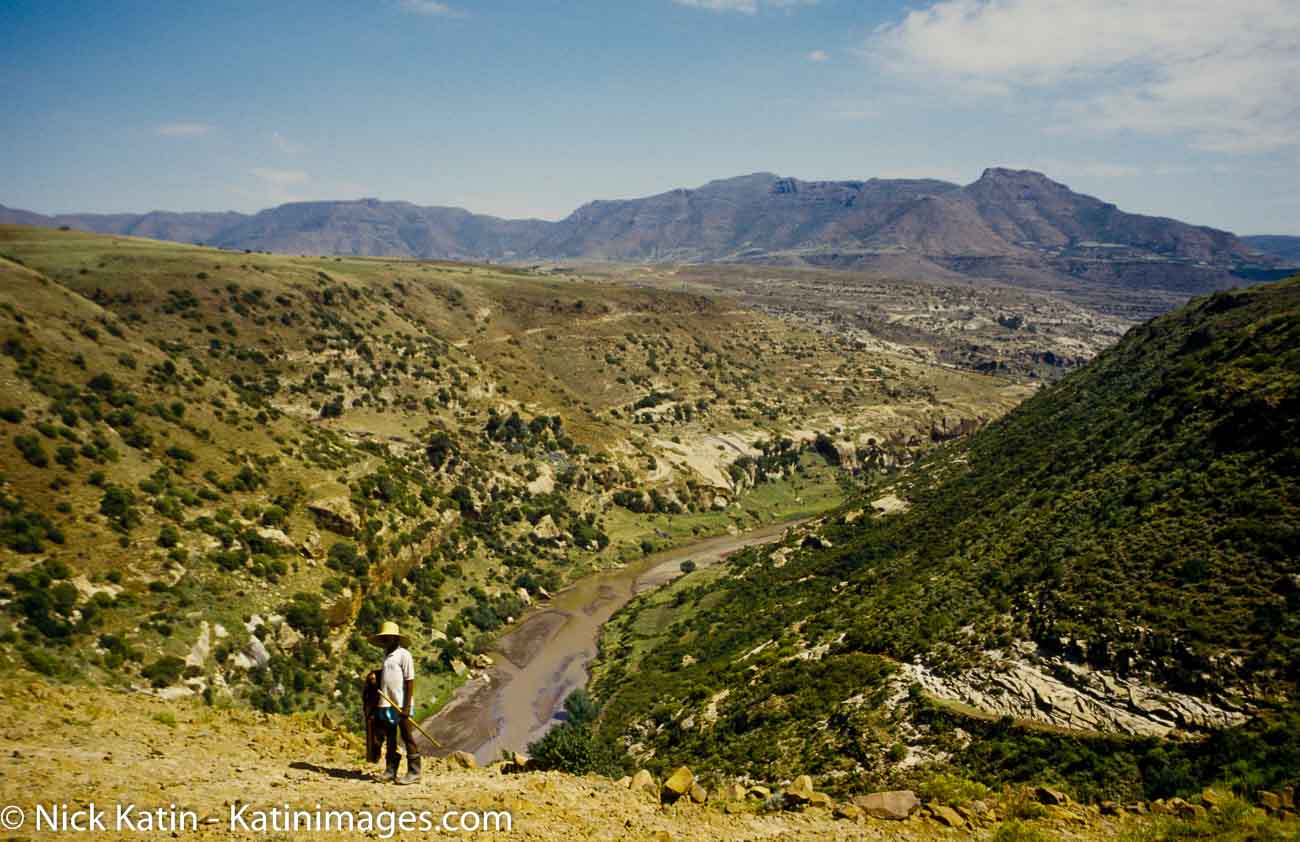
    A sheep herder stands overlooking a gorge in the Maloti Mountains of Lesotho.
    A sheep herder stands overlooking a gorge in the Maloti Mountains of Lesotho.
  • African shoestrings – Lesotho Day Eleven

    The Pony trek itself was something else.
    Now as corny as it sounds, I always get the dude horse.
    I once rode a horse that flatly refused to go anywhere, another time, a horse that would only go in one direction, home, which is fine at the end of a ride but is a bit inconvenient at the beginning!
    The last four legged animal I had ridden was a mule in the Grand Canyon and she was the only one that slipped and stumbled, generally near the edge of a trail where there was not much else between you and the rocky ground some 600 metres below.
    These ponies however are different; they’re Basotho ponies.
    The Basotho pony is the result of cross breeding small Javanese and full sized European Horses. Strong, sure-footed and docile it has been a popular mode of transport for many villagers, particularly in the highlands, since the early nineteenth century and now used for tourists in several places in Lesotho.

    Strong, sure footed and docile were words that seemed heaven sent if only it were true of Black Label, the pony that was selected for me by Mick.
    Sure it was strong but it was also disobedient, frisky and clumsy. My wife, Sue’s pony, Fox was good, as was Olive’s pony. Olive and Petra, two young German girls (well a lot younger than us anyway) were our companions together with two local guides Clement and David (a different one) and a packhorse or is it a packpony?
    Anyway Petra’s pony, Black Power was even worse than mine. Slow, stubborn, disobedient and almost paranoid, if a pony can be such a thing, of having her arse smelt at any opportunity by Black Label. I was bringing up the rear behind Petra and Black Label just couldn’t help himself. Even after Clement changed the order so that Petra was two ponies in front, Black label would make a beeline for Black Power’s rear end. The matter was made even worse by Black Power’s stubborn insistence to go at a speed half that of everyone else.

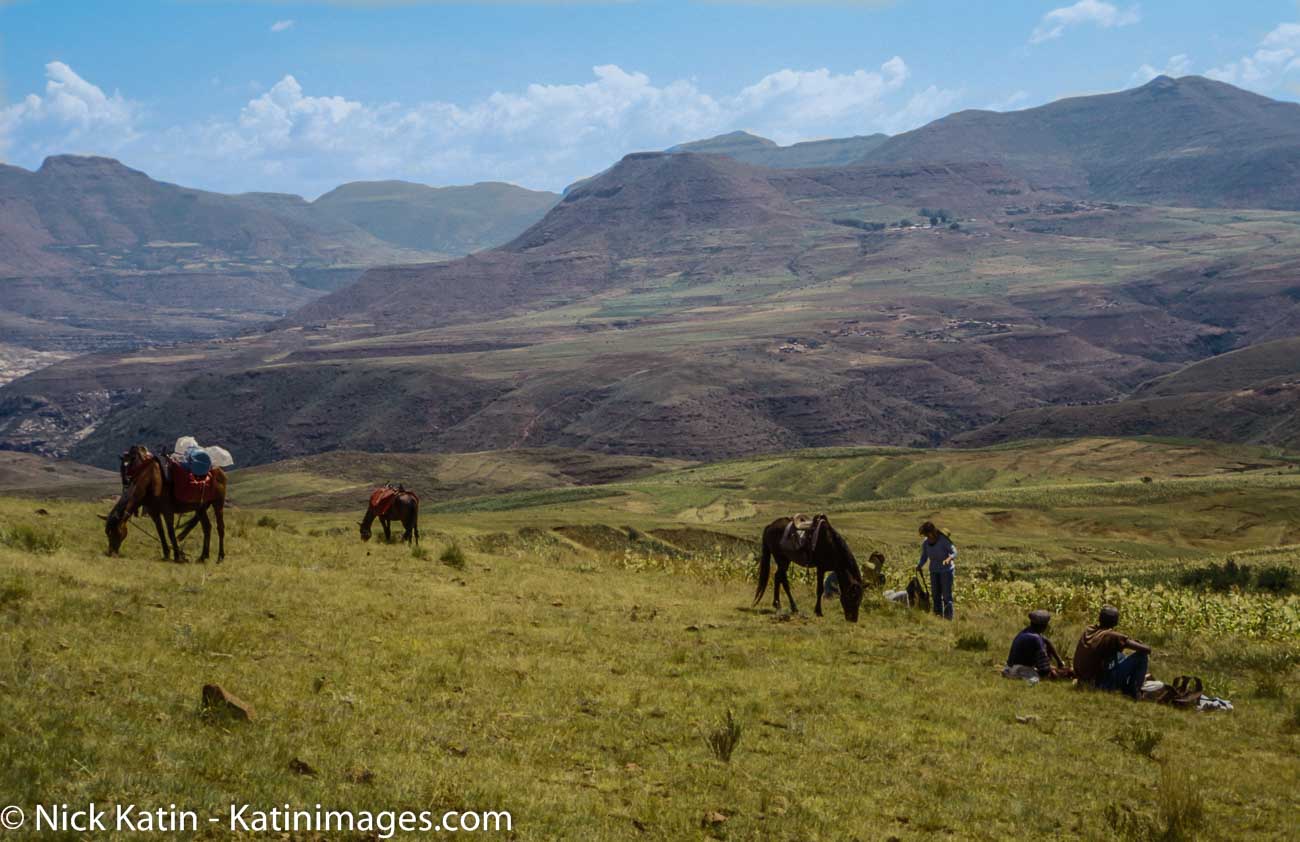
    Ponies and Riders take a break with the backdrop of the Maloti Mountains of Lesotho.
    Ponies and Riders take a break with the backdrop of the Maloti Mountains of Lesotho.
  • African shoestrings – Lesotho Day Nine

    The main reason why we had come to Malealea was to go Pony trekking. Somehow though, Mick had not only talked us into taking an ensuite cabin rather than a lot cheaper Basotho hut but had also persuaded us to wait a day before going Pony trekking. I’m glad he did because that allowed us to walk to the Botsoela waterfall.

    For the measly sum of around A$5.00 we hired a guide, David to take us to the falls. David was probably around 6 foot tall and quite well built and to our surprise, was only twelve years old! He obviously did this often, because towards the end of this four hour jaunt, we had trouble keeping up.

    Malealea village itself was our first taste of the Bastho way of life. Mud huts and houses with small areas of crops in the garden, smoking fires, ladies patching up the mud walls and children approaching us once again with hands outstretched for “sweets”.
    Some of the mud huts had different colour flags flying. This David told us was all to do with beer.
    A white flag meant that beer made from Sorghum had just been brewed. If it was yellow then it was Maize beer.
    Having tried Maize beer before we decided not to pursue any potential tasting.

    This  for the village of Ha Mohlakana, on the way back, was pretty much the same, except it had absolutely priceless views. In fact all along the walk we had difficulty in looking where we were walking. We just couldn’t take our eyes off the almost Tibetan scenery.

    The falls themselves were a bit tame but every cloud has a silver lining. The crystal clear water in a small pool at the base of the falls to dangle was perfect to refresh our aching feet in.

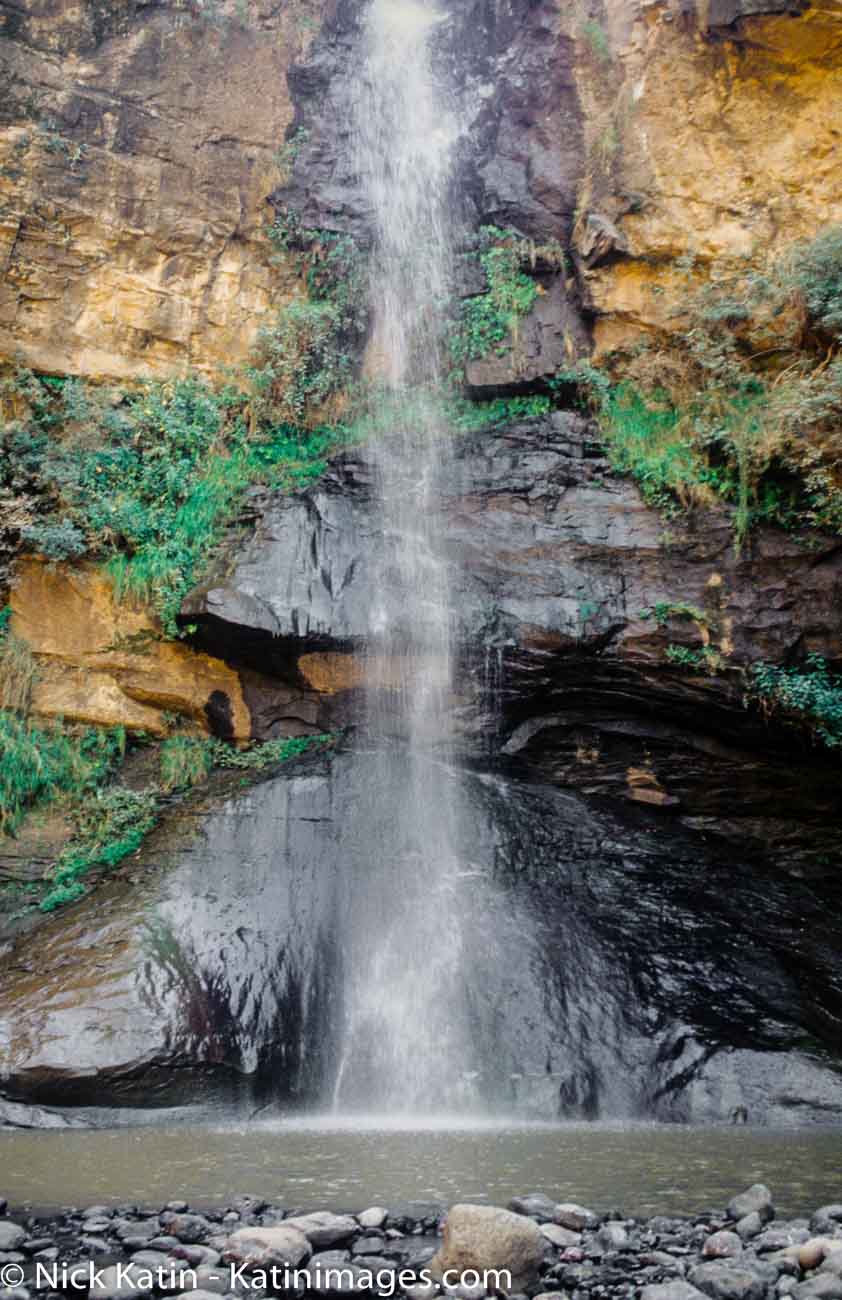
    The Botsoela waterfall near Malealea in Lesotho
    The Botsoela waterfall near Malealea in Lesotho
  • African shoestrings – Lesotho Day Eight

    We decided to celebrate our feeling of freedom at the Lodge bar. Well it was a sort of bar but more like a counter in a small cupboard. We managed to find a couple seats outside with some of the other fellow guests, the odd local ex pat, a few locals from Maseru (the capital, some two hours drive away) and ‘just a few’ American Peace Corp volunteers.

    The Peace Corp boys and girls were a pretty lively and interesting bunch. Four or five of them were based in this area and this was their ‘local’. For all of them local is not the right word, in getting here for their once a week gathering, they have to hitch from as far as 100 kilometres away!

    Overall there are 50 in Lesotho and 6000 worldwide who generally live in the same conditions as the people they have come to help. Often there’s no running water, sewerage and electricity and the living conditions are pretty basic by western standards. Without the immune system of the locals, they have to live with the constant threat of illness or disease. There is usually only one peace Corp volunteer per village or area so contact with other volunteers is reduced to once a week or even month. These guys are all in their early 20’s so it’s tough for them especially at the beginning and they do all admit to some initial culture shock.
    Mind you by volunteer standards they are well compensated with a local monthly allowance of US$125.00 in local currency plus a monthly allowance paid into their bank account at home. If they complete the two-year term they get a plane ticket home via any destination of their choosing plus a substantial bonus.

    Brian and Kim told us that the most frustrating part was the fact that often the locals do not actually want help. “They’re just happy doing what they’ve always been doing. For example a farmer will plough his field or plant his crop the same way his ancestors did regardless of the consequences of erosion or soil salinity. So our job is to try and educate them on why they need to change. It’s not easy!”

    None of this, I might add, stopped them from enjoying a drink or two whilst we there!

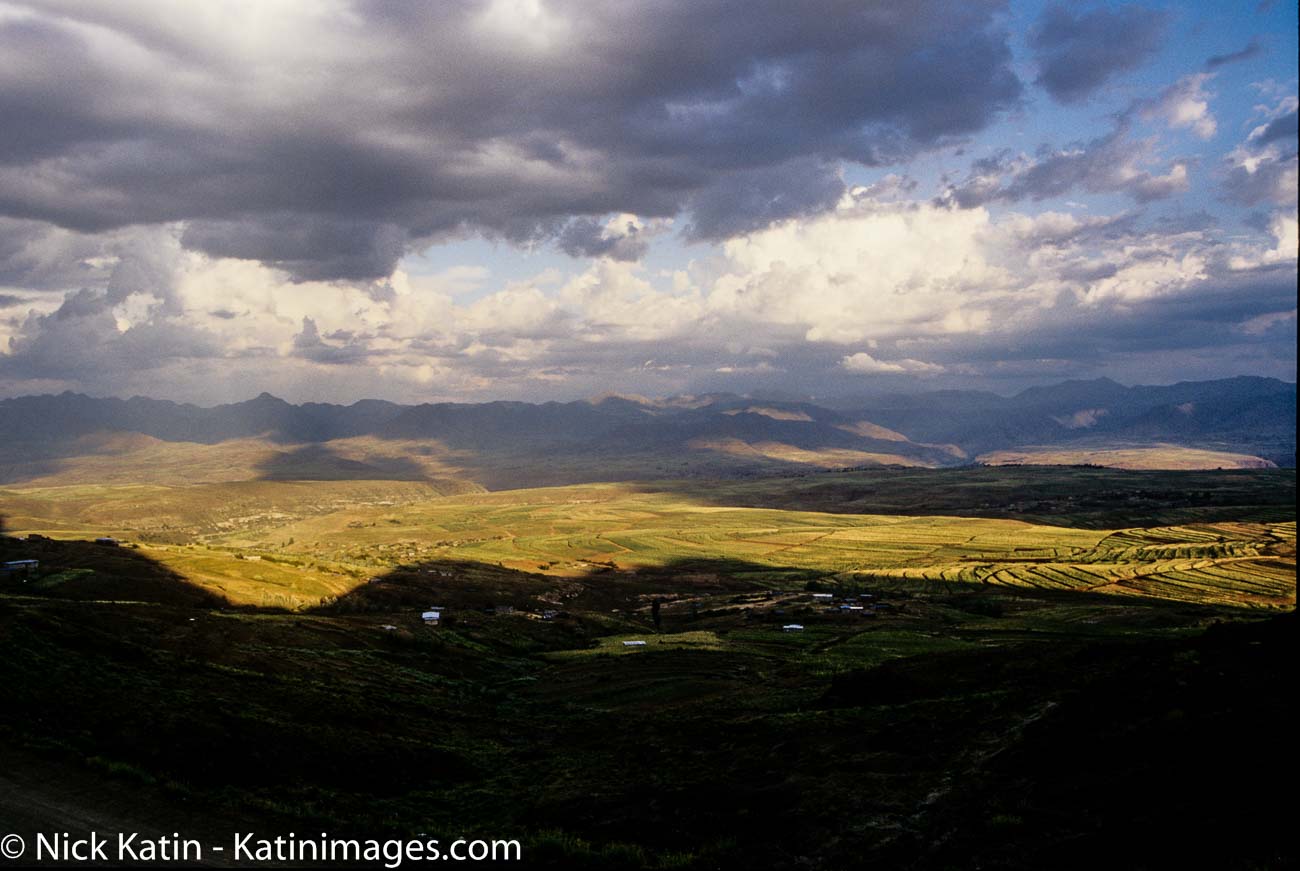
    Maloti Mountains of Lesotho in the late afternoon light.
    Maloti Mountains of Lesotho in the late afternoon light.
  • African shoestrings – Lesotho Day seven

    Malealea Lodge is at the top of a hill right next to Malealea Village. The lodge itself is a collection of chalets, huts, a dorm and a bar/store dotted among Pine trees and areas of brown lawn. Set to one side away from the other buildings, stood a colonial style house that the old man at the gate pointed us towards.
    There we managed to find Mick Jones with his feet up on the veranda overlooking the Malotti. Mick owns and runs Malealea with his wife Di. At the time, Mick stayed all the time at the lodge whilst Di ‘commuted’ to their office in Bloemfontain in South Africa.

    We watched Mick from our chalet veranda striding around and barking instructions at his employees in the local lingo, SeSotho, until the afternoon thunderstorms that had been threatening all afternoon, turned on a show.

    Thunderstorms are a way of life here. Incredibly more people die in Lesotho from lighting strikes than any other single cause. Which is really surprising considering the way they drive! I suppose the bottom line is that a country as poor as Lesotho, it’s one of the world’s poorest, doesn’t have that many cars but does have plenty of people travelling by foot. When you travel by foot in such a mountainous country the risk of getting struck by lighting is relatively high.

    That’s not to say that it’s unsafe to walk around Lesotho, it’s just some care is required during their thunderstorm season in the summer months.

    The spectacle of these thunderstorms is a show not to be missed, especially after dark.

    Watching this show brought home to us that we were actually living our dream. We were away from our home, family and friends travelling the world without a care, except that constant nagging fear of spending too much money. It was a great feeling and a place like this was what it was all about.

    Mother and Boy outside a hut, their home in the mountains of Lesotho
    Mother and Boy outside a hut, their home in the mountains of Lesotho
  • African shoestrings – Lesotho Day six

    Malealea Lodge is set in the quaintly called Valley of Paradise that’s about 2200 metres high.
    To get to it, after travelling on what can only be described as the ‘road from hell’, 13 kilometres of potholes loose rock and shifting gravel, you have to travel through the “Gates of Paradise”.

    This is a pass with such a beautiful vista, that a guy called Mervyn Smith left the words “Wayfarer Pause and Look Upon a Gateway of Paradise” inscribed on a plaque.
    Mervyn also founded the Malealea trading post so I guess you could accuse him of being a little bit one eyed.
    Even so the view is magnificent and gives the feeling that you are entering a secret valley of gentle rolling hills with a dramatic backdrop of mountains and storm clouds, hidden over the centuries by the locals from the mass commercialism of the white man.
    As we stood absorbed by all of this, one of those buses that can only be found in the third world, charged up the hill towards us and came to an abrupt stop amongst it’s own clouds of diesel fumes.
    This was the local bus stop and this vehicle was unloading some of it’s cargo of bags, people, children, chooks, goats and anything else that could hang onto the outside or be crammed into the interior, there were even two guys on the roof!
    Before I had time to point the camera it was off again, incredibly still jammed packed and leaving behind clouds of black smoke and some of the cutest kids that have ever been put on this earth.
    Three of these kids came up to talk us, which we thought was so nice until they stretched out the palm and asked for money or “sweets”.

    Young girl from Lesotho looking for her mother on a remote roadside.
    Young girl from Lesotho looking for her mother on a remote roadside.
  • African shoestrings – South Africa Day four

    At Rustlers Valley Guest Lodge, we met the occupants, neighbours and anyone else who seemed to materialise from time to time (we were the only guests) at dinner that night.
    There was Dale the local naturalist and loved snakes.
    Birthday boy Carl couldn’t believe that I hadn’t heard of some permaculture guru from Australia. I didn’t like to admit that I didn’t even know what permaculture was, let alone have any idea of its personalities!
    Then there was Bill who either had a hard life or he was old enough to have been dancing to Glenn Miller let alone Janis Joplin.
    There were other refugees of the sixties as well but none as dominant as Frick.
    Hippies have always maintained that everyone’s equal and there are no leaders in their ‘gangs’.
    Well in this case Frick was without doubt the leader. He just had that look; I would call it the Charles Manson look but that sounds rather sinister. He had the long ponytail and beard and had a sort of holier than thou sort of presence.
    When he looked at me I wasn’t sure whether he was going to bless me or offer me a joint! In fact he was actually the owner of Rustlers, so I guess he had some sort of commercial seniority.
    Apparently he was a farmer going broke when he decided to build the lodge and change direction. How he became an aging hippie was not explained.
    Rustlers are famous, amongst those that care, for their music festivals. We know this because, after the initial polite conversation, the sole topic was the upcoming Easter festival, apparently a sort of South African mini Woodstock.
    By the time our beds beckoned we knew all about running festivals and have since mercifully forgotten it all.

    An Umbrella Thorn Acacia at sunset on the savannah of South Africa. It's a native to Africa.
    An Umbrella Thorn Acacia at sunset on the savannah of South Africa. It’s a native to Africa.
  • African shoestrings – South Africa Day three

    The women at the tourist information place in Ficksburg told us that this place was considered weird by the locals but she herself thought it was “quite nice”. The Lonely Planet described it as a “dare to be different” sort of a place and gave it such a rap that we had to see it for ourselves
    Rustlers Valley Guest Lodge is not a place that we will ever forget in a hurry. The 15 kilometre potholed dirt track to its door is not easily forgotten, especially the bone jarring last five kilometres or so.
    Now we’re deep in the heart of Free State, formerly Orange Free State. This is Boer country, about as god fearing and conservative as you get. So to find a hippie commune smack bang in the middle is absolutely amazing!
    VW Kombi’s, teepees, suspicious looking patches of vegetation and escapees from the sixties dotted the place. But it was comfortable. The scenery was pretty good too. The Maloti range overlooked us in the west and the plains stretched out to the east with odd line of sandstone hills and grassy slopes here and there. Mostly there actually, because we made the mistake of following the “extensive network of tracks” up and around them until the tracks petered out or were so overgrown that only a machete and a chain saw would have got us further. to be continued………

    Rustlers Valley Lodge in the shadow of the malotti Hills in Free State, South Africa
    Rustlers Valley Lodge in the shadow of the malotti Hills in Free State, South Africa
  • African shoestrings – South Africa Day one

    Last time we flew to South Africa via Qantas we were upgraded to business class. No such luck this time! We were once again mere mortals packed in with our fellow passengers into the Airline industry’s version of the mini.

    Now that’s not to say that travelling economy with Qantas is a hardship. It’s not. In fact I think that they’re terrific. Good service, facilities, food and most importantly an unparalleled safety record makes any long haul flight reasonably comfortable. If that doesn’t get me a free flight nothing will!

    But a long flight is a long flight and quite tiring.

    Some eleven hours and two movies later we arrived at J’burg airport. Once ‘processed’ by the authorities we claimed our bags and moved out into the arrival lounge. We had been to J’burg before and sort of knew what to expect but nonetheless J’burg’s reputation as violent crime capital of the world makes you view everyone with a great deal of suspicion. In fact the biggest danger seemed to be the frustration caused by the ceaseless touting by reps of J’burgs many backpacker hostels. These guys hone in on anyone who looks even faintly potential. I think we got picked because it was such a quiet night and they were getting desperate.

    We managed to eventually find our hotel shuttle, which was driven by a young white guy. I make a point of this because several years ago these ‘menial’ jobs were done by black or coloured people, never by a white person especially a young white person.

    A lioness enjoys the late afternoon sun in Chobe National Park, Botswana
    A lioness enjoys the late afternoon sun in Chobe National Park, Botswana
  • African shoestrings the plan part two

    So with the flights books and with the aid of countless travel guides borrowed from the library, the internet and the scantiest of information from the few African countries tourist offices in Australia we plotted our route.

    We gave ourselves 111 days to travel overland from J’burg to Dar es Salaam, see what we wanted to see and spend only an average US$100 a day, not each, but in total! We would stay in backpackers, youth hostels, cheap hotels and where possible camp. The latter was made a little difficult on account of the fact that we weren’t taking any camping equipment but as they say, there’s more than one way to skin a cat!

    The only things we booked here in Perth were our first nights’ accommodation and ten days car hire in J’burg. There was a very important reason for pre booking both of these. Safety! J’burg is infamous for violent crime; the last thing we wanted to be doing when we arrived was wondering the streets looking for somewhere to stay or looking for a hire car. No, we just wanted to stay one night near the airport, pick up a car and get the hell out of there!

    We booked the car through our travel agent and the accommodation through the Internet. Maybe it’s because of time constraints, security or lack of knowledge but it’s interesting that so many people still use travel agents. We found a cheap motel in the right location for half the cost of what our travel agent quoted.

    An elephant strolling through the scurb at sunset in Etosha national Park, Namibia
    An elephant strolling through the scurb at sunset in Etosha national Park, Namibia
  • Restaurant widow in Matilda Bay Perth

    I guess we all complain about where we live at one time or another. As some of you know i live in Perth Western Australia and like everyone else you become blasé about your surroundings. Matilda Bay is a small bay that is a part of the Swan River and from there you get a great view of the City and river.
    Near the water’s edge is a restaurant, café and a couple of Yacht clubs. In fact, for those yachting aficionados, the famous Royal Perth Yacht Club is one of these. RPYC was the Club that won the America’s cup in 1983 after the New York Yacht club had successfully defended it for 132 years, the longest winning streak in sporting history.
    This image is a bit abstract but you can see the yachts in the reflection.

    Reflections from the restaurant at Matilda Bay part of Perth's Swan River in Western Australia
    Reflections from the restaurant at Matilda Bay part of Perth’s Swan River in Western Australia


    To see a larger image or to see purchase options click on the image