Katin Images Travel Photography

Travel Photos, Travel Photography Tips and Software

Tag: Desert

  • African shoestrings – Namibia Day Seventy five – Windhoek

    In most African towns and cities there are plenty of curio and souvenir shops, a lot of them tacky and often overpriced and Windhoek was no exception, we did however find tucked away in an old renovated warehouse that once housed a brewery, the Namibia crafts centre. This place sold only artifacts and souvenirs made by local Namibian communities and the profits go back into the community. We bought some bits and pieces from the one of the Namibia women’s communities and came away with that warm and fuzzy feeling that comes from knowing that you have helped people who have so much less than you. After all a lot of souvenirs and curios are often mass produced by large wealthy companies and sold in markets and small shops with the pretense that they have been hand made by the seller themselves. In some of the instances, this is achieved by the use of nothing more than slave labour. So it’s good to see that places like the Namibia crafts Centre, are beginning to appear more and more. So to all you future travelers I urge you to seek out these places and buy!

    Out last night at the Cardboard box was spent socialising. We met Andre, our driver for the Botswana tour that started the following day. Andre had only just started as a tour guide and as it turned out he remained with us for the all but the last day of the 6 day tour. A white Namibian he was a nice guy who like all novices made up for a lack of experience with lots of enthusiasm.

    We also met Sharon an attractive girl from somewhere in Queensland who was travelling around southern Africa on her own. Somehow or other an American called Jed (aren’t they all?) got into the conversation. He was a young guy also travelling on his own and was heading south whilst we were heading north so we swapped notes for a time. He of course had done everything and in comparison to us was travelling a lot ‘rougher’. Within ten minutes of the conversation it became pretty obvious that these two were in the process of starting a ‘romantic’ relationship and we were in the way. Sue, of course, spotted this first and tried to drag me away. I wasn’t going until I had extracted as much info as possible from Jed. Eventually we left our two lovebirds and made our way over to a young German bloke who bored us with tales of his travels in Australia.

    We set off at 6.30 am to start our tour of Botswana. Its run by a crowd called Audi camp who are basically logistics experts. They seem to take a bit of a tour here and another one there and make a complete package. I guess we had four components to our trip, the transport to Audi’s main camp Ngepi in Caprivi in the far north of Namibia, the Okavango Delta, Chobe National Park and transport to Livingstone in Zambia. All these components could be purchased separately but as we needed transportation to Zimbabwe (Livingstone is about 10 kilometres from Victoria Falls in Zimbabwe.), it suited our purpose to do it this way.

    We were actually an hour and a half late setting off because Andre had to pick up another traveler, Louise, from the station.

    It’s a long ten and a half hour drive and the most notable point was crossing the ‘red line’ between Grootfontein and Rundu. It’s actually a veterinary control fence. Livestock bred north of this fence are banned from being moved south or being sold overseas in order to prevent any spread of disease to the rich cattle farms of the south. But it’s much more than that. Namibia like most of South Africa is fairly westernised and I suppose could almost be classified as a first world country.

    Except for north of the red line.

    The change is as dramatic as it is sudden. We went from large open spaces punctuated by population centres of varying sizes to a world of traditional and tribal villages that dot the roadside. Clusters of mud and thatch houses, surrounded by reed or bamboo fencing, were populated by cattle, goats and other livestock wandering aimlessly and feeding by the side of the road. Women were gathering wood or water and then returning with their pickings on their head.
    This is the Africa most of us expect to see!

    If you like this then hit “follow” on the side bar
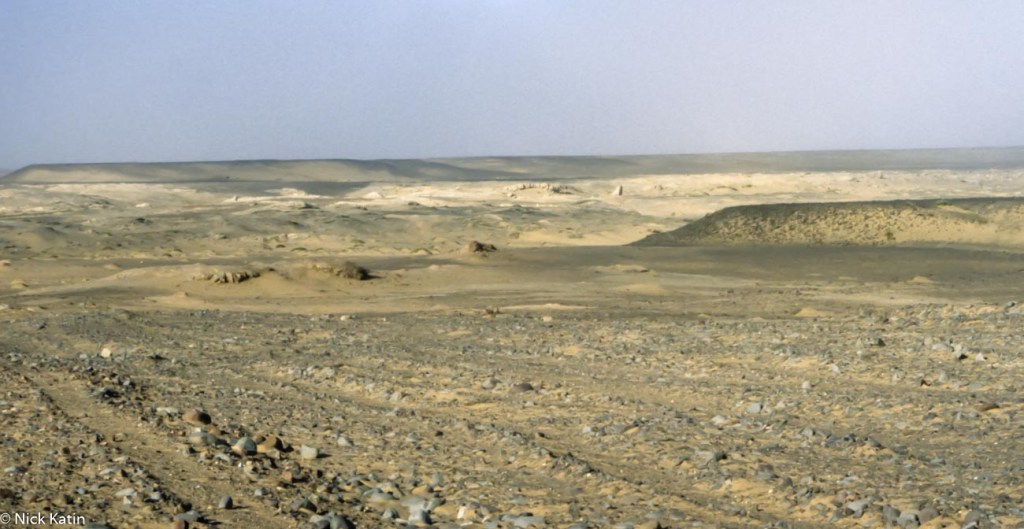
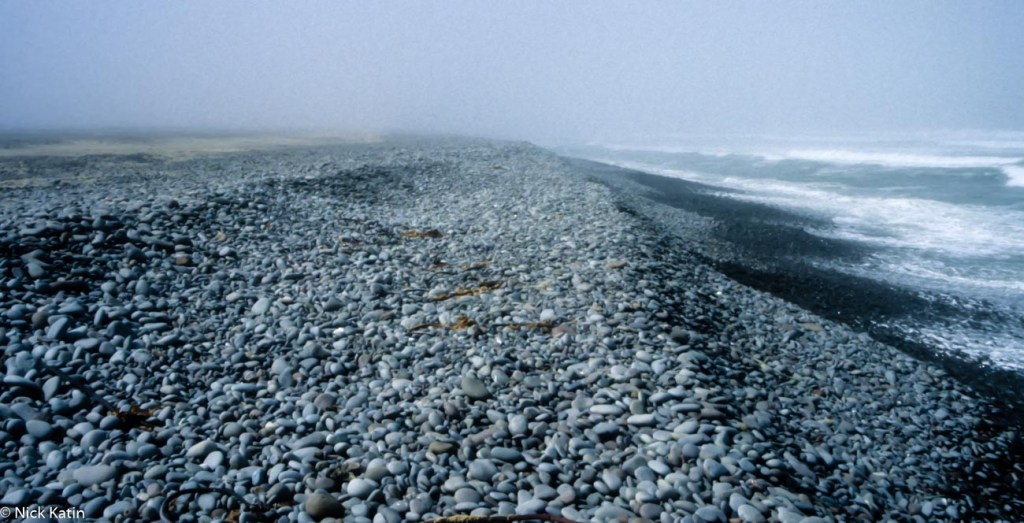
    The inhospitable Skelton Coast in Namibia
    The inhospitable Skelton Coast in Namibia


  • African shoestrings – Namibia Day Seventy four – Windhoek

    Spitkoppe is an attractively shaped mountain on the main drag between Swako and Windhoek (we were now heading back to Windhoek). Its been called the Matterhorn of Africa due to its similarity in shape. Well, maybe but it’s a bit like comparing Fish river Canyon with the Grand Canyon, once you’ve seen the real thing comparisons aren’t helpful.

    What was fascinating was the little community camp ground at the foot of the mountain. Run by the local women’s development corporation, it had a basic bar constructed of stone with a shady pergola attached and some half finished thatched chalets. The toilets were long drops stuck in the middle of the desert with shade cloth doors and hesian or bamboo walls, whilst the showers were similar in construction with gravity fed water. There were even some ‘natural’ camp sites quite away from the rest of the camp, which is why they must have been called ‘natural’; after all if you got up in the middle of the night for a pee only the most conscientious are likely to walk 200 metres to relieve themselves. We were tempted to stay there but decided against it, in order to make some time to our next destination, Gross-Barmen Hot Springs.

    Gross-Barmen was a MET resort and we were a bit concerned that as we hadn’t booked anything, it might be full. Well we shouldn’t have worried, even though it was late in the afternoon and a Sunday there was only one other site in use. We had an ablution block and a kitchen for our own exclusive use for the two nights that we stayed there.

    As the name suggests the main attractions were the baths. There were 2: one to put minerals into your body and the other to cook them out again and leave you looking like a red double decker London bus with skin as creviced as Mount Everest. Wow, that thermal bath was hot!

    These baths, in fact were the only attractions. We had only selected it as was within striking distance of Windhoek and we decided that it was a good place to ‘veg’ for a day.

    Our site was on the edge of the campsite and probably about 500 metres from the staff accommodation. On our second night, the staff decided to have a party, or at least that’s what it sounded like. So from about 10 pm till the early hours of the morning we treated to some popular African music, trouble was that it was all the same and I don’t mean it sounded all the same; it was the same! There was one particular song that was played over and over and over… We actually found out by hearing it again sometime later that it was Sum’Bulala by Brenda a smash hit in Southern Africa.

    We spent the next 3 nights back at the Cardboard Box in Windhoek. Our camping tour through Botswana didn’t start until Friday and as it was Tuesday when we left Gross-Barmen we had to cool our heels for 3 days. Werner came and picked up the hire car and was pretty good about the bill from Hennie. He did however charge us for a small crack in the windscreen and a broken gas light glass, the former happened on the road back from Sossusvlei as a Landcruiser coming in the opposite direction rounded a bend and chucked up most of the loose gravel between us. We really didn’t have a problem with either and I think, in a weird sort of way, we were quite sad to hand back the little Chico that we had become quite attached to.

    Apart from some sojourns into Windhoek we spent most of that time reading and deciding what we were going to do after the tour had finished.

    We spent a couple of hours following the Hofmeyer walk on the outskirts of the city. At least we thought we followed the walk until we came across a sign towards the end, pointing in a different direction. It didn’t matter too much, the point of the walk is too see elevated views of the cityscape and its surrounds and we had achieved that. We finished that off with an indulgence trip to Gathemann’s, a colonial style café famous for its great terraced outdoor area and lots of mouth-watering cakes and pastries. Unfortunately neither the cakes nor the coffee lived up to its reputation and we just had to be content with the activity of people watching from the terrace.

    If you like this then hit “follow” on the side bar

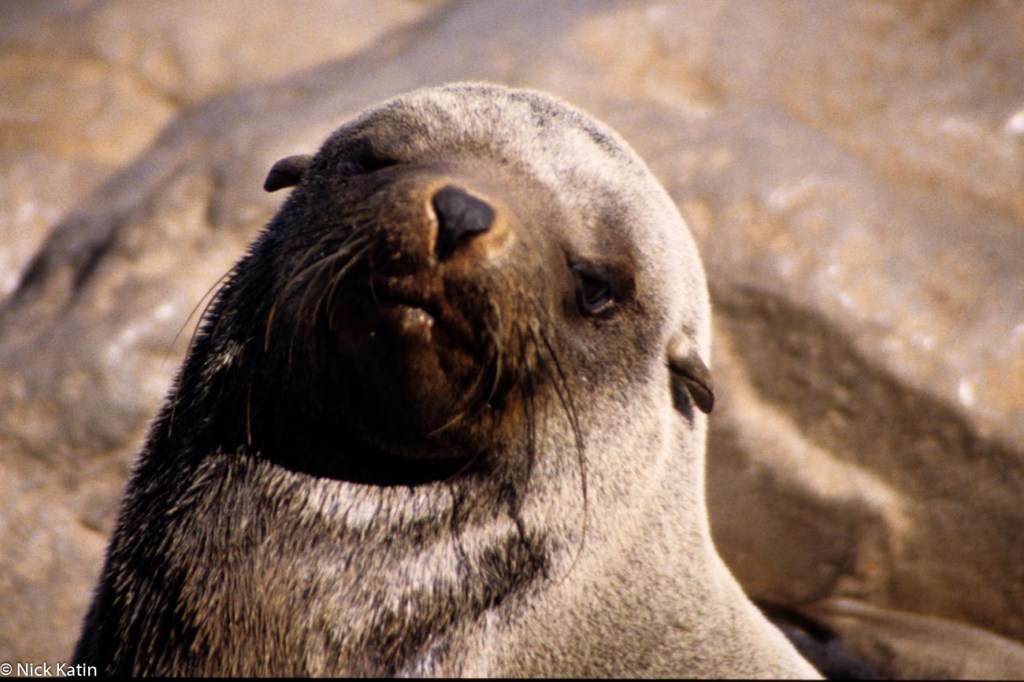
    A Cape Fur Seal at Cape Cross Seal colony in Namibia
    A Cape Fur Seal at Cape Cross Seal colony in Namibia


  • African shoestrings – Namibia Day Seventy Two – Swakopmund

    Our final day in Swako was actually spent in Walvis Bay, a small town, 30 kilometres south. We checked out of our comfy accommodation thinking we would find something in Walvis Bay, a decision we were later to regret.

    This little nondescript town was never actually colonised by the Germans. The British who controlled the Cape colony (South Africa) and laid claim to it in 1878 and didn’t let go of it until 1994, four years after Namibia’s independence. This natural harbour’s popularity is because it’s the only decent port north of Luderitz and south of Luanda in northern Angola and has been a very strategic political, defensive and commercial position to hold.

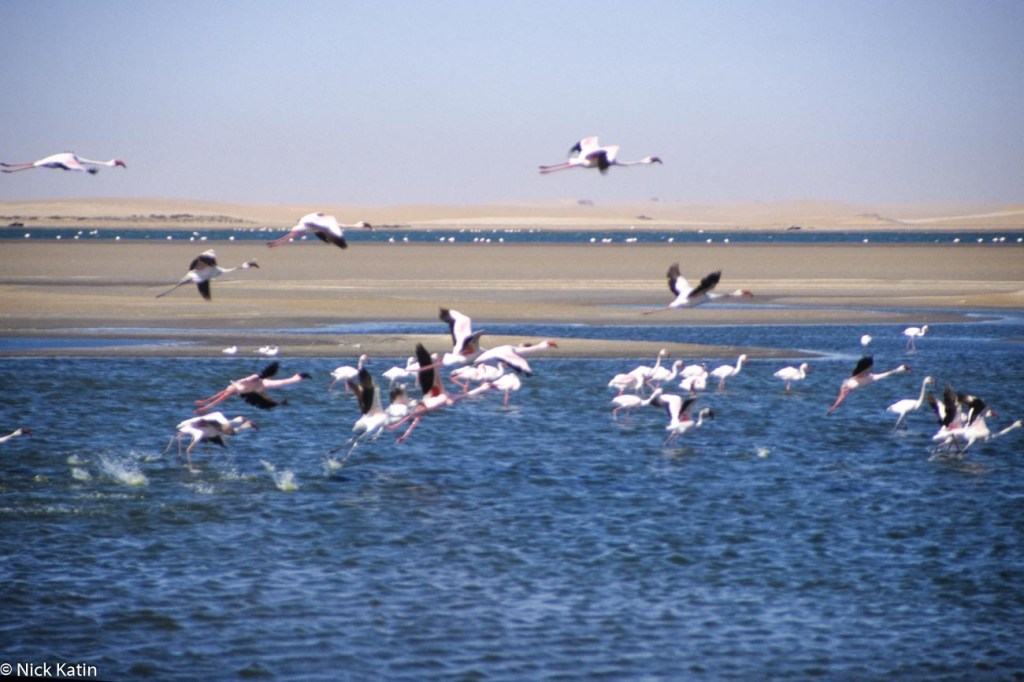
    Now Walvis Bay’s main attractions are its bird life, in particular flamingoes, and Dune 7.

    Dune 7 is large stand-alone sand dune north east of the town that rises above the bleak landscape and overlooks the noisy goods train railway. The locals’ flock to it in their droves to walk, run, sandboard or simply sit at the picnic tables in its shadow eating sandy sandwiches or gritty sausages. The bird life on the other hand is much more interesting. The lagoon just to the south of the town is home to half of southern Africa’s flamingo population plus pelicans, gulls and plovers to name just a few. Close by is the Raft a pub/restaurant housed in a wooden building sitting on stilts over the water.  A couple of beers in there gave us a brief respite from the ever-increasing wind and in a rash moment we decided to return for dinner that night.

    I have to say that it was one of the most amazing dining experiences either of us had ever had. The meal was nice we had some of the local fish species, Kobaljai and Steenbras and it was all pretty good including the service. What stole the show were the flamingos! From where we were sitting we could see the floodlight water and all night there was this constant flow of flamingos walking back and forwards doing their best to imitate the huge walking box robots from the Stars Wars movies. These wonderfully colourful waders gave us a show neither of us will ever forget!

    What is forgettable however is the smelly cramped dog box of a unit we ended up staying in overnight back in Swako. We hadn’t managed to find anything cheap enough in Walvis Bay so we rang a place back in Swako without knowing what it was like. The women who answered the phone said yes it was free that night and the cost was N$100 plus $30.00 for laundry. OK I thought we don’t want any laundry done we’ll take it. What the laundry turned out to be was the cost of washing the bed linen after you had used it, assuming that you hadn’t brought your own. Well after sleeping the night in this matchbox with less facilities than a prison cell and having to listen to her winging about this that and anything else she happened to be an expert on, we told her to get stuffed, politely of course! Needless to say we headed out of there as soon as the sun was up.

    Every town or city has the Café, the place to be seen at and usually has a specialty or two. Swako was no exception. The Café Anton was a trendy, probably in some eyes pretentious, indoor/ outdoor café overlooking the main beach. After such a shitty night we thought we’d treat ourselves to morning tea in the shape of a couple of German pastries and (finally) some good coffee before heading out. No doubt about its popularity, the locals were arriving in droves for both coffee and pastries and breakfast. It was a fitting end to our stay in Swako. It had been the only place in Namibia where we could take time out to get our fix of some western culture.

    If you like this then hit “follow” on the side bar

    Flamingos at Walvis Bay in Namibia
    Flamingos at Walvis Bay in Namibia


  • African shoestrings – Namibia Day Seventy One – Swakopmund

    Everybody (that is mainly the white population) was friendly and seemed to have either German or Afrikaans accents. Wilma our landlady, a white Namibian of German heritage was a third generation Namibian, But she had been brought up to speak German in school and at home and spoke English with a strong German accent.

    Despite our immediate liking for Swako our second day turned out to be quite expensive. We had to send a fax relating to our house to Australia which cost the princely sum of N$31.50. Sue was still not feeling quite right so a trip to the doctor cost N$100 who immediately ordered a blood test (another N$36). Fortunately the blood test cleared Sue of Malaria, which was our main concern. But it didn’t answer the question as to why she was still feeling disorientated. The doc put it down to the Lariam that we were taking. It’s a strong anti malarial drug with a bad reputation for side effects such as disorientation, hallucinations, anxiety and nightmares. The last time we had taken it we had both experienced the latter two but this time I hadn’t experienced any side effects and up until Sue had been sick nor had she.

    We had been quiet happy just to laze around Swako for the couple of days that we were there but as always curiosity got the better of us. Swako is at the edge of the Namib Desert, so we had almost done a full circle on our tour of Namibia. This part of the desert holds a few surprises or so we were led to believe by the Lonely Planet and the Swako tourist office. That was enough for us and we were off having a look. In fact it was more of a ‘so what’ tour rather than a scintillating safari into the desert. I say ‘so what’ because unless you’re a botanist or a historian most of the items on the signposted Welwitschia drive mean very little. The Swako tourist office gave us a handout called “The Welwitschia Plains-a scenic drive” with thirteen numbered stone beacons to watch out for. Each of these beacons are positioned at places of interest along the drive. The first stop was at little cluster of lichen; the next was at a couple of bushes called the Dollar and the Ink. So far we’re yawning and wishing that we had stayed in bed.

    Oxwagon tracks remarkably preserved from decades ago and just as remarkably almost impossible to see were next and followed by something much more interesting, the Swakop valley moonscape. This dark brown and wheat coloured pitted and crated landscape was formed by 1000’s of years of erosion and is very much reminiscent of the moon’s landscape. Not that I’ve been there of course but those who know this sort of things say it is.

    Our interest began to wane again, as more lichen was sign posted. Apparently the lichen of the Namib Desert is the most extensive in the world. I suppose a botanist would find that fascinating but we’re still stifling those yawns. Our interest was rekindled by a much bigger expanse of moonscape. Created this time by a non-existent river cutting it’s way through softer material. Even my imagination was finding it hard to imagine any river flowing through this dry and inhospitable landscape.

    A heap of junk left behind by the South African army in 1915 was considered notable enough to be the next point of interest. Somehow I cannot see how even 85 year old broken bottles and rusting cans are a great tourist attraction!

    The next two beacons are not even worth us getting out of the car. A couple of ridges of Dolerite (what’s that I hear you say, forget it, it’s in the dictionary) were somewhere around.

    Then we had a small patch of vegetation dressed up as picnic spot. Apparently the river that I had trouble picturing earlier actually runs deep underground and in some spots is high enough for some trees and bushes to tap into.

    Speaking of vegetation, the Welwitschia drive is named after a unique ‘tree’ that has also been described as a living fossil. The next and penultimate stops are for these strange looking ‘trees’. They are apparently dwarf trees and are related to pine trees but you would never know that by looking at them. They look like straggly low lying semi tropical palms that have had a bad day. In fact if you saw one anywhere else you wouldn’t even stop to have a second glance. The point of interest is however that they somehow thrive in this hostile environment and are totally unique to the Namib Desert and get this; live for up to 1500 years.

    Our last stop on this spell binding drive was a let down after the Welwitschia. An abandoned iron ore mine from the 1950’s is really nothing but a hole in the ground.

    If you like this then hit “follow” on the side bar

    A Cape Fur Seal at Cape Cross Seal colony in Namibia
    A Cape Fur Seal at Cape Cross Seal colony in Namibia
  • African shoestrings – Namibia Day Seventy – Swakopmund

    Hentiesbaai is another fishing spot but it does have a sort of quaint character, (compared to Terrace Bay everything has character) with a decent looking beach and some ‘beachy’ looking houses with palm trees and lots of liquor shops. Hennie found us a cheap apartment next to his garage and the shopping centre.

    We had the luxury of a TV in this place and as it seemed like years since we had watched any, we just crashed in front of it.

    It was cable TV too except there was nothing much on. Most of it came from South Africa and watching South African TV is most disconcerting. They have this habit of changing languages continuously. We were watching their rugby equivalent of the footy show when the interviewer began to interview a rugby player in English. Problem was we could understand the interviewer’s questions but didn’t have a clue as to how the player answered as he was speaking in Afrikaans. Weird!


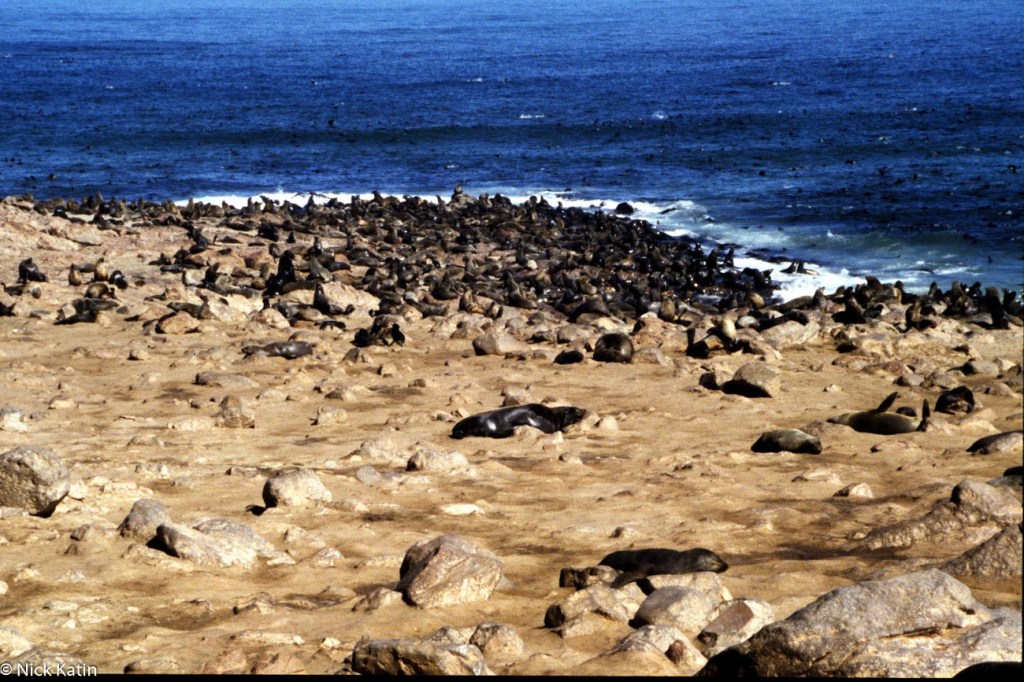
    Cape Cross is smelly. Not just a bit smelly but it stinks. The 100,000 Cape fur seals that call this home really know how to put visitors off. I’ve never seen so many seals! Big ones, little ones, dark ones and grey ones, old and young, male and female, some on the rocks or beach sunbaking, others in the water. Just a huge mass of blubber and seal shit! The Cape fur Seal is distinguished from other seals by the fact it has ears (with all the noise they were making I think they would be better off without them!). They are only found on the West Coast of Southern Africa, as they don’t migrate as a rule. They are quite big in size, the average male weighs around 187 kg but increases its weight to as much as 360 kg at the beginning of the breeding season due to the accumulation of food reserves in the form of blubber. It was for this reason that there are warning signs everywhere not to disturb the seals and cause them to stampede. These huge males can easily crush a small ten kg pup and it’s one of the main causes of the 27% mortality rate.

    Cape Cross itself was named after the cross that the Portuguese Diego Cao, the first European to set foot on the coast of Namibia, erected in honour of the Portuguese king. The original cross is actually in the Berlin museum but there are a couple of replicas erected in the same spot.

    This weird Namibian coastal climate played tricks with us all day. When we left Hentiesbaai in the morning and headed north it was really hot but as soon as we got we got to Cape Cross it cooled down about fifteen degrees. Driving back down through Hentiesbaai it was hot again and then as we approached Swakopmund (or Swako as it’s known by the locals) it cooled right down again

    Swako is a bigger more up market version of Luderitz. It’s a mixture of German, Western and African culture forced together onto the cold Atlantic and carved out of the desert. Its flat featureless topography has been brightened up by some colourful buildings and lots of German Bakerae’s and Bearhaus (bakeries and pubs) on almost every street. Along the promenade there’s these huge date palms on either side of the walkway with houses of varying colours and beach architecture sandwiched between the palms and the beach. German architecturally historic buildings were dotted along most streets in between the many restaurants and trendy curio shops. It felt good to back in western culture for a time. We didn’t camp here either. Why camp when you can stay for in a small, well equipped and centrally positioned self contained unit for N$100 (US$10) per night. Yup! We were going to like ‘Swako’!

    Cape Cross in Namibia is a colony of Cape Fur Seals
    Cape Cross in Namibia is a colony of Cape Fur Seals
  • African shoestrings – Namibia Day Sixty nine – Hentiesbaai

    Terrace Bay is desert, black stone beaches and a grey sick looking ocean that yielded an endless abundance of fish. This is serious stuff! A couple of guys caught 82 fish each one weighting around seven or eight kilos off the beach! I don’t know that much about fishing but I do know that there are few places left in Australia where you could get a catch like that without a boat.

    A few others must have caught a bucketload as well as it was being offered around (cooked that is) by one of the other groups at dinnertime.

    This group was led by the ‘knowitall’ you know the type, there’s one in every gathering or group. Even though they were speaking Afrikaans his body language and actions told us “I know it all and I’m going to tell you”.

    We were in the bar and he and his friends and family walk in and he just took over the bar. Frans, the barman, must hate arseholes like him just walking behind the bar and helping himself simply because they all arrived together and poor old Frans was a bit slow in keeping up.

    Relaxing for a day or so gave Sue a chance to recover, which she did although she still felt off colour. I was hoping that the bracing air and relaxation would clear up my catarrh but that still stuck to me so much so that in frustration I started a course of antibiotics that we had brought with us.

    The Skeleton park is infamous for its shipwrecks that dot the coast after hitting one of the treacherous sand banks and some bright spark thought the name ‘Skeleton’ was appropriate. It was one of these shipwrecks that got us into what we thought at the time was big trouble. Our next destination was Swakopmund some 350 kilometres south on the coast, via the Cape Cross seal colony. Bearing in mind our ‘reluctance’ to leave ‘Terrible’ bay, we set out early to ensure we had time.

    Well we made good time along the salt road to the park gate at Ugab and then turned off to see one of these shipwrecks. The road had another of these heavily corrugated surfaces that have you bouncing around everywhere and just moving forward at more than 30 kilometres an hour was a struggle. Suddenly a buzzer went off and the oil light flashed on the dash. We both said “Shit!” stopped and turned off the engine. Like any part time mechanic, I was quite capable of opening the bonnet and checking the oil. Plenty there! I checked to see if the filter was loose. No that was ok as far as I could tell. Now we’re in a hire car which is less than a year old and still covered by it’s warranty, somehow fiddling with it didn’t seem the right option without authority. After all it’s my credit card imprint they’ve got as a deposit. So we did the right thing and slowly drove back. It didn’t seem to mind if we drove it at 20 kilometres an hour.

    It took forever to get back to Ugab. There’s not a lot at Ugab in fact there’s not even a phone. Fortunately they did have a more modern method of communication than the pigeon, a two-way radio. The gatekeeper radioed the nearest mechanic in Hentiesbaai a small town some 137 kilometres away. His only option in these circumstances was to bring a tow truck.

    All we could do now was wait and wait! Eventually Hennie turned up around 3 hours later which I guess wasn’t too bad. He took a quick look at the car and then we loaded into the back of his truck whilst we both climbed into the front.

    Hennie was born and raised in Namibia and despite being white considered this was as much his country as anyone else. We talked about the fish, the up coming Rugby world cup (Namibia actually had a team entered) and life in general in Hentiesbaai. Hennie told us that there was around 200,000 whites in Namibia and then turned to us and asked “How many blecks ‘ave you goot in yoor ‘ountry?” When I replied that we had about 300,000 aboriginals. He looked at us and said “Thets nothin man, we got 3 million of them!”

    Of course it turned out that there was nothing wrong with the car other than a loose wire on the oil switch in the engine which had somehow shaken loose. It cost N$1235 (US$124.00) to get us picked up from Ugab and I had to break the news to Werner. “We’ve fixed the problem mate” I told Werner on the phone and proceeded to tell him about the oil switch. We had already rang him and told him what had happened and needed permission for Hennie to look at the car which Werner got from Volkswagen. “Thing is, it’s cost N$1235.00 and they want to know how you gonna pay for it?” There was a pause. Somehow I had this picture of Werner looking to the heavens and saying “why me”. Anyway we ended up paying for it on proviso that he would settle with us when we returned the car.

    If you like this then hit “follow” on the side bar
    The inhospitable Skelton Coast in Namibia
    The inhospitable Skelton Coast in Namibia
  • African shoestrings – Namibia Day Sixty – Windhoek

    We got our liquid back in the bar when we got back after cooling the bodies in the cool water of the pool.
    There were three tour guides in there. They were actually running an overlander full of middle-aged Belgium and Dutch tourists. We got chatting and had a bit of banter. One of them was a South African and of course the up and coming Cricket and Rugby union world cups was the main topic of discussion.

    “You know I’ve got a lot of time for you guys, but I’m afraid you’re going to come second in both comps to us mighty Aussies” I bravely predicted. Harmless banter followed and these guys then went on to giving us some great tips and info and where and what to see in Namibia and Zimbabwe where they were also heading.

    One of the things I always desperately miss when we’re away from Australia is the dry laconic wit that is always tinged with a sense of irony. Nobody does it better than we do and often it just doesn’t work with people from other cultures even Anglo-Saxon ones. But on occasion we do strike people who have a similar sense of humour and meeting these guys were one of those times.

    It was time to move on to our next port of call, Etosha National Park, nearly 800 kilometres away. We knew we would never be able to get there in one day, especially with 280 kilometres being on gravel and having a car that struggles at 80 kilometres an hour let alone 100 or 110. We did expect however to get further than Windhoek which was little over half way. …………..but that was not to be.

    The gravel section seemed slower than ever and a puncture slowed us down even more. The irony of this was that it happened only half an hour after chuckling at our overlander friends who had stopped by the side of the road to also change a wheel. We now had the problem of getting the puncture repaired. The overlander drivers had given us the name of a place just near Windhoek but it was closed and a slow search eventually found us a place that seemed to take forever to repair it.

    Another problem was rearing its head, that of cash. We had attempted to get some cash out of several ATM’s before heading out to Namib. For some reason none of them wanted to release any money, so we were now starting to get desperate and the ATM’s still weren’t working. A trip into a bank was necessary, something you try to avoid at all costs. It’s not that the bank tellers are unfriendly, it’s just that African banks are slow, disorganized and very bureaucratic. It usually takes three queues to find the right one, which will always be the longest. When it’s your turn the teller looks at you as if you had asked for the Prime Minister’s bank account number. On this particular occasion I got off lightly at only 40 minutes, which was a good job too as Sue was waiting in the car outside.

    By the time we had restocked our food supplies, we just couldn’t be bothered to travel on. A bed at the Cardboard Box seemed a much better option.

    If you like this then hit “follow” on the side bar

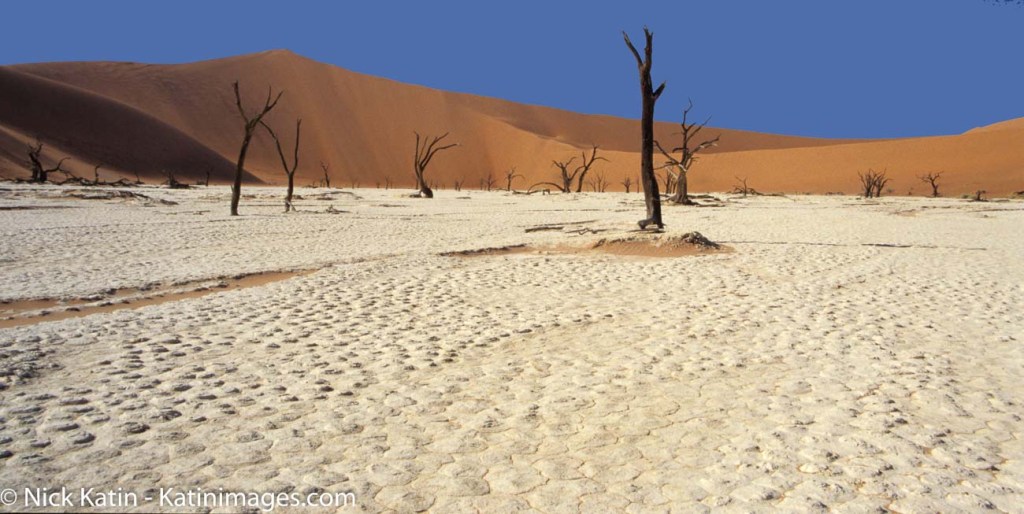
    Deadvlei is a white clay pan located near the more famous salt pan of Sossusvlei, inside the Namib-Naukluft Park in Namibia.
    Deadvlei is a white clay pan located near the more famous salt pan of Sossusvlei, inside the Namib-Naukluft Park in Namibia.


  • African shoestrings – Namibia Day Fifty nine – Namib desert

    Sunup was at 6.30 am and we were first in line at the gate for the 4.45 opening except they actually didn’t open until five. It took one hour to get to within 4 kilometres of Sossusvlei. From here the road is only suitable for 4WD or feet. We only had the latter and it took us a good hour to trudge across the sometimes gravel but mostly sandy track. So after all that we missed the fucking sunrise over Sossusvlei!

    But we there are plenty of other dunes on the way and the sunrise was still pretty good, as was the light as we got to Sossusvlei.
    But it was more than just that.
    Being out there with only the occasional Gemsbok for company (there was another couple, but they gave up after 20 minutes), surrounded by these spectacular shaped dunes changing colour before our very eyes was incredible.
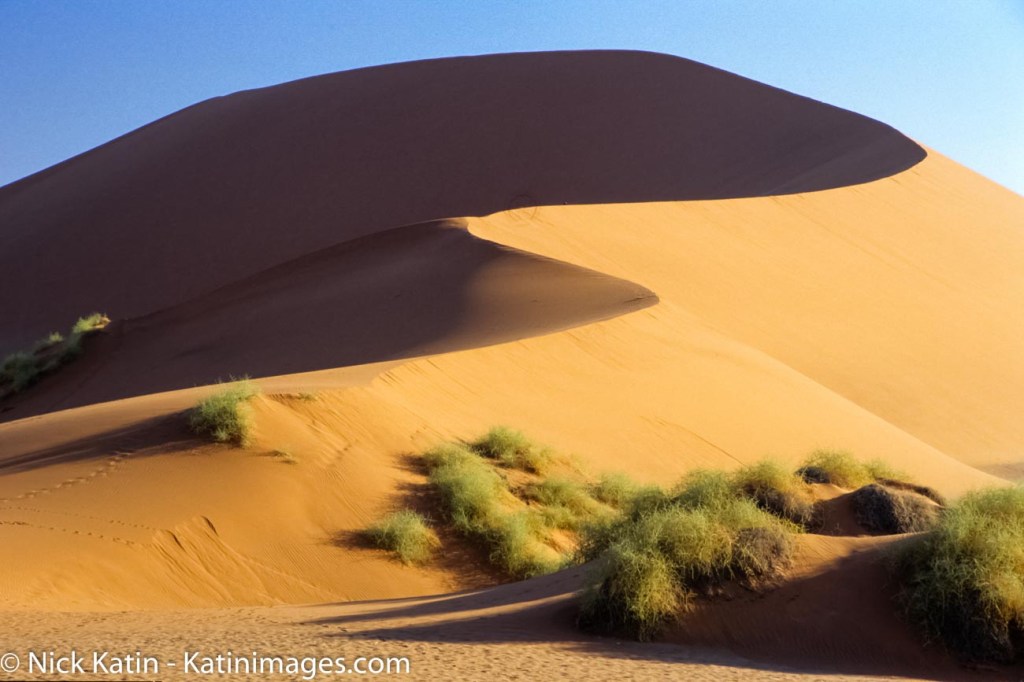
    Sossusvlei itself is without doubt the home of the most dramatic dunes. It has two as a backdrop one of which stands like a giant curly lock of hair, a semicircle with a tail supported by a mountain of red quartz sand grains.
    This is the dune!
    We spent an hour taking photographs, wondering around, eating our breakfast and just enjoying being the only privileged humans in what must be one of the world’s most special places.

    That was until the buses arrive laden with camera carrying, overweight and loud tourists.
    I have absolutely no objection to people seeing the world through a coach window, I believe they’re missing a lot a lot but I respect their choice. What I can’t understand is that insistence that some of them have to touch everything. In this instance they head straight for the dunes and walk along its finely sculptured ridge destroying the moment and changing its shape forever. Not massively of course because the dunes are constantly shifting their sands anyway and I suppose no damage is really being done. ……….But it’s the principle! Being on the dunes cannot be any better than just being there and seeing it untouched and undisturbed by the destructive feet of people who will climb down, get back into their bus and then ask “what’s next” as if it was something to tick off their list of ‘must-see’s in Namibia’.

    We left them to it and walked to Deadvlei a kilometre away.
    Deadvlei was equally as impressive but in a different way. A flat crusty white pan dotted with dead black trees of varying shapes and sizes against a backdrop of the sidewall of a huge dune. No finely sculptured sand shapes here just an impressive mountain range of dunes surrounding this eerie scene. And it was hot too! I set up the tripod and dripped sweat over the camera and the crunchy soil. Probably the first drop of fluid the pan had seen for who knows when.

    We still had the 5 kilometre walk back in this heat. By now there was almost a continual stream of 4WD vehicles and buses following the track. Not one of them stopped to offer a lift!
    Even the occupants of a Landcruiser that got bogged and I offered a hand, drove on past us once free. Back at the car we found out why! There’s a shuttle!! A small bus takes people back and forward to Sossusvlei for N$50(US$5) return or N$30(US$3) one way. No good for sunrise (it doesn’t start until 8) but would have been great for the return. If only we had known we thought, sweat stinging our eyes, our bodies crying out for liquid and legs weak from dragging them across the thick sand.

    If you like this then hit “follow” on the side bar
    Sossusvlei is a salt and clay pan surrounded by high red dunes, located in the southern part of the Namib Desert, in the Namib-Naukluft National Park of Namibia
    Sossusvlei is a salt and clay pan surrounded by high red dunes, located in the southern part of the Namib Desert, in the Namib-Naukluft National Park of Namibia
  • African shoestrings – Namibia Day Fifty eight – Namib desert

    The Desert is inhospitable place when it’s sunny & hot, when it’s raining and windy and still hot it’s pretty much the same. We had a day and a night to kill before our next booked accommodation at Sesriem (I’ll get to that later) so we found an obscure camping ground called Betheseda on the way and put up the tent ready to just relax. Our ‘neighbour’ was a young Uni. student called Jane who looked like she was here to stay for a long time, judging on the permanency of her tent and the number other occupants like dogs, chickens and turkeys who were obviously quite at home in an around her tent.

    I checked out the swimming pool thinking that a swim and a doze by the side would wile away a couple of hours. Unfortunately it was empty.
    Oh well, we’ll just crash by the tent I thought. Well the only thing that crashed was the weather. A thunderstorm came from nowhere and within minutes we were sitting inside the tent hoping our weight would prevent it from taking off and listening to those big drops of rain peppering the canvas walls. Finally we risked leaving the tent when the thunderstorm moved on but now the wind had changed direction and was a hot gusty son of a bitch which made everything dusty and uncomfortable and didn’t ease up until nightfall (at least we got a peaceful night’s sleep).

    One of the disappointing things about budget travelling is the amount of planning you have to do! Having left a career that incorporates planning as an essential tool, I had sort of hoped that we wouldn’t need to do it much. The trouble is if you don’t plan then you could go wrong and miss out on something worth seeing or experiencing or possibly have to wait for another chance which means that you may be in the wrong place to sit around and then get bored and spend money!

    For example we had to plan how much time we spent in Swakopmund so that we can get back to Windhoek to catch the tour to Botswana and get dropped off in Victoria Falls and then we have to decide how much time we spend in Zimbabwe, before getting to Malawi and Tanzania etc etc. But I guess it’s a lot better than having to plan what I’m going to say at the next Sales Meeting about sales for the month, strategies, KPI’s, WCA’s and other ‘exciting’ topics.

    Back on the road again and the rain had left big lakes of water covering the gravel road. We (I say we but it was really me, Sue got out of the car to watch) managed to navigate through two of the three consecutive temporary water holes without mishap. The last one was a bit scary as the car began to slow the deeper it got but ‘Peter Brock’ here was equal to the challenge.

    Sossusvlei is arguably, Namibia’s greatest natural attraction. It’s basically a 32,000 square kilometre area of sand dunes in the Namib Desert. But that doesn’t do it justice. Some of the world’s largest and most spectacular dunes are found here and Sossusvlei is merely the most accessible site. The German word vlei means pan and that is what Sossusvlei is, a huge dry pan set amongst 200 metres high dunes 69 kilometres from the civilization.

    If you like this then hit “follow” on the side bar

    Sossusvlei is a salt and clay pan surrounded by high red dunes, located in the southern part of the Namib Desert, in the Namib-Naukluft National Park of Namibia
    Sossusvlei is a salt and clay pan surrounded by high red dunes, located in the southern part of the Namib Desert, in the Namib-Naukluft National Park of Namibia
  • African shoestrings – Namibia Day Fifty seven – Namib desert

    We had actually booked a campsite for the next day but took a chance that they had a vacancy for that night. That almost backfired when the camp manager said that they were fully booked but then went on to say, “I think we can make a plan”.

    Strange sort of saying that! I had first heard it in South Africa and we sort of guessed it means “we can work it out” or “I think we can do something” etc. Namibia was effectively colonised by South Africa from the end of World War I until 1990 when it gained independence. They were only meant to administer Namibia for a short period until the League of Nations worked out (‘made a plan!!’) what to do with the place. But the South Africans were a stubborn lot and had also become paranoid about National security, so once they took control, they had no intention of leaving in a hurry.
    The South African influence is still pretty strong. Even though English is the official language, Afrikaans is spoken by nearly everyone as a first language and most of the whites that live here are either South African or have South African ancestry.

    So anyway we had now become accustomed to coming across these pseudo South Africans, who, to be fair think of Namibia as their home.

    The campsites in nearly all of these National parks are big enough to take up to eight people, so in this instance even though there was only about ten sites, a couple of them only had two people and we were able to share a site and still have room to spare.

    It was a beautiful shady campsite nestled in a small but deep valley between huge sandstone boulders on one side and a steep rocky bank on the other. It did have a couple of major drawbacks, no electricity even in the ablutions block and no shop or fuel. Can’t really say that the latter really worried us. But as the days were now quite short we ended up showering in the dark, a unique experience not to be missed especially when you drop the soap.

    We were there for one reason; to walk the 17 kilometre Waterkloof trail…… and quite a hike it was. It felt like thirty kilometres!

    Up at sunrise the next morning, we followed the yellow feet (markers) along a riverbed or two for most of the way. You know, riverbeds are often rather tedious and awkward to walk on. They’re usually cluttered with big boulders, rocks and stones and sometimes an occasional metre or two of sand and this was no exception.
    There were some pockets of small clear pools of water populated with a few frogs, crabs and tiny fish. But they died out after a while and then reappeared around 3 or 4 kilometres from the end, bigger and deeper, deep enough in fact to revitalize our weary bodies and aching feet.
    Between these two riverbeds we had actually climbed till we reached and then crossed a flat treeless plain to reach another, though steeper ascent to the trails highest point of 1910 metres. From here there were great views of the surrounding Naukluft Mountains and the desert, despite the increasing cloud cover.

    Now it was time to follow those yellow feet down the mountain which wasn’t as easy as coming up. It was made even harder by two German blokes virtually skipping down the rocky trail past us as we carefully and slowly scrambled our way down. They were a lot younger we told ourselves. This really doesn’t help much, you know! It just confirms that even though you still feel like a 25-year-old, your body is reminding you that you’re not.

    Why is it that the last few kilometres of any hard walk seem like ongoing hell? We think we instinctively know that we are nearing the end and then we torture ourselves by assuming the end is really just around the corner, knowing full well that it’s nowhere near. Finally it really was just around the corner and we trudged back to our tent, cracked open a couple of beers and flopped down exhausted after nearly 8 hours of walking.

    If you like this then hit “follow” on the side bar
    Deadvlei is a white clay pan located near the more famous salt pan of Sossusvlei, inside the Namib-Naukluft Park in Namibia.
    Deadvlei is a white clay pan located near the more famous salt pan of Sossusvlei, inside the Namib-Naukluft Park in Namibia.
  • African shoestrings – Namibia Day Fifty nine – Namib desert

    Civilization is the Sesriem campsite, located on the Namib Naukluft National Park boundary. We had already worked out that if, like all keen photographers, we wanted to see these dunes at sunrise, we had to stay here. Access to the park gate is through the campsite. The park gate opens at 5 am the camp gate two hours later, so stay anywhere else and no sunrise! Of course for those not interested in getting up real early, there’s plenty of choice of accommodation, but they’re all quite a few kilometres from Sesriem let alone Sossusvlei.

    Nothing wrong with Sesriem though. A huge big complex with huge wall lined sites. Each site was luxurious as campsites go with a water tap, a bin, a shady tree, a BBQ and a garden bench. Our site was right at the edge of the place almost in the desert, well actually it’s all in the desert, we just had a closer view. It has a pool, a bar and a shop. The former two came in real handy after our first look at the dunes.

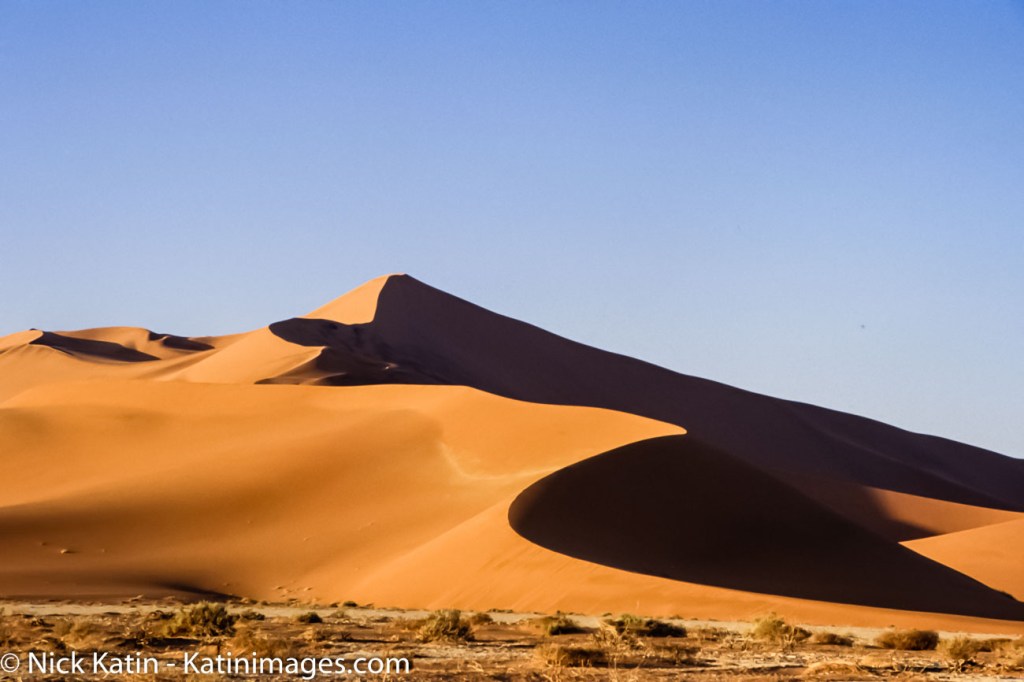
    In the extreme heat of the afternoon when really a siesta underneath a shady tree would have been better we drove down along the white dusty, sandy track. But it was worth it. We didn’t have time to go to Sossuvlei and get back before the park gates shut at Sunset, so we headed for dune 45. Dune 45 is the nearest high dune, which is 45 kilometres from the park gate. It stands almost on it’s own, rising from the flat pan around it, glowing red and brown in the bright sunlight which was rapidly being diffused by the sand laden wind.

    Hiddenvlei, a sort of mini Sossuvlei but hidden by the many dunes behind dune 45 was a 2 kilometre walk away and the trip was notable for the thousands of pinpricks from the grains of sand that were now being propelled at us by the ever increasing gusts. Trying to take photographs was a challenge. Forget the tripod it was all I could do to stand still, let alone the hope the pathetic little thing that we had lugged with us would.

    In some ways it was quite exhilarating, to be there virtually all alone amongst these sandy giants that shift shape in quite short periods of time. Apparently these dunes differ from the their more famous counterparts in the Kalahari and the Sahara in the fact that they are constantly being remodeled by the remorseless wind. Certainly we could see evidence of this before our very eyes as tiny particles of the colourful quartz sand spilled over the crest and down the leeward side. This side is called the slipface for obvious reasons and gives you the classic picture that Hollywood and others have served up as a backdrop for their countless desert blockbusters over the years.

    By the time we got back it was dark and we ready to eat and smooth the sides of our parched throats with a couple of ales from the bar. We didn’t stay around long though. We had to be up at 3.30 am!

    If you like this then hit “follow” on the side bar

    Sossusvlei is a salt and clay pan surrounded by high red dunes, located in the southern part of the Namib Desert, in the Namib-Naukluft National Park of Namibia
    Sossusvlei is a salt and clay pan surrounded by high red dunes, located in the southern part of the Namib Desert, in the Namib-Naukluft National Park of Namibia


  • African shoestrings – Namibia Day Fifty four – Windhoek

    Strangely enough the train actually got into Windhoek at 6.15 am, on time!
    We had managed to sleep a little despite the noise and the fact that my seat leaned to one side and changed on its own accord from recline to upright once in a while.
    That’s the thing about Africa the colonialists had put in all this infrastructure and then pulled out leaving the Africans to maintain it. With few exceptions, Africans are not big on maintenance, so the little jobs are just left until it actually it becomes bigger & then bigger again and a full-scale breakdown occurs.

    We had managed to book a room in the Cardboard Box; a backpackers hostel a couple of kilometres walk from the station. Now it was time to test out these backpacks. With the big ones on our back and the daypacks on our front and feeling like a couple of packhorses, we trudged in the general direction of our destination.
    There were several times in the course of our travels that I wondered what we were doing. And this was one!

    Here we were walking along early in the morning in a strange town with our wardrobes on our back, through who knows what kind of district and being continual ‘honked’ by eager taxi drivers to stay with people younger than our own kids.

    We could be in our comfortable home having breakfast on the patio, or better still asleep in our four star hotel provided for us by Abercrombie & Kent or another equally famous and expensive Tour Company.

    The Cardboard box was open but its ‘reception’ was closed when we got there.
    We dropped our packs and slumped into the usual overused ready to throw out couches and waited.

    This turned out to be the friendliest hostel we had stayed in so far.
    Owned by a couple of local white guys it was run by two girls, Irene & Louise. Irene was Irish and Louise was English and like most of the people who run these places they came here travelling and ended up staying a while.
    The hostel also had a their own travel agent with plenty of info on tours, local attractions and adjoining countries like Botswana, which is where we were headed next. These guys turned out to be pretty handy in organising our next few weeks.

    At home we had we had worked out how we were going to get as far as Windhoek by public transport but had drawn a blank from there to anywhere else in Namibia and then on to Botswana and Zimbabwe. It had become obvious to us that for us to see what we wanted to see in Namibia and then to go to Botswana we would have to either hire a car or join a tour or overlander.

    We ended up doing both.

    Regular backpacker tours run from Windhoek to the Okavango Delta and Chobe National Park in Botswana and then drop you off in Livingstone, Zambia, which is right next to Victoria Falls in Zimbabwe. We didn’t book that right away as we hoped we could find a cheaper tour that maybe spent a bit more time in Botswana but we now knew it was there.

    The next thing we did was get Cardboard Box to organise a cheap hire car and some camping gear whilst we trundled off into the city to organise the next 3 weeks in Namibia.

    If you like this then hit “follow” on the side bar
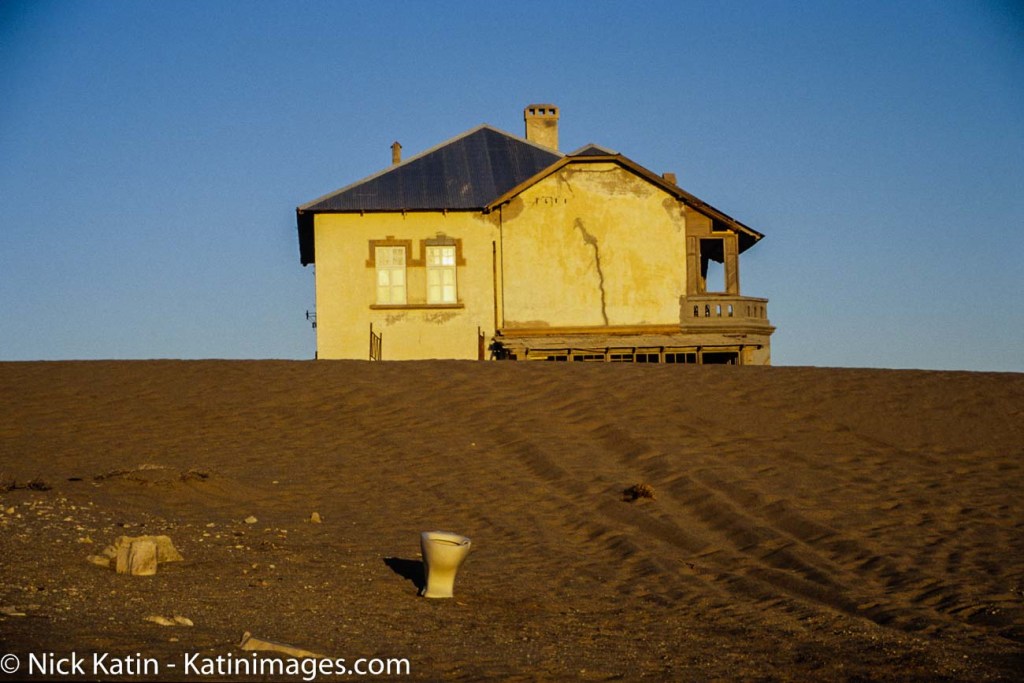
    The ruins of the ghost town of Kolmanskop in the Namib desert in southern Namibia, a few kilometres inland from the port town of Lüderitz
    The ruins of the ghost town of Kolmanskop in the Namib desert in southern Namibia, a few kilometres inland from the port town of Lüderitz
  • African shoestrings – Namibia Day Fifty three – Luderitz

    Diamonds were discovered around Luderitz relatively late in 1908. The Orange River and some of the islands off the coast had yielded some good results from around 1866. A chance discovery by a railway worker sparked off a ‘diamond rush’ and the establishment of Kolmanskop.
    In its heyday it supported a wealthy, mainly German, population of 300 with a hospital, school, bowling alley, theatre and casino. Its only problem had been water that had to be carted from Cape Town. In 1956 the mines were closed and workers were shifted to Oranjemund 200 kilometres south. The town was abandoned and since then has battled to stay afloat in a sea of sand.

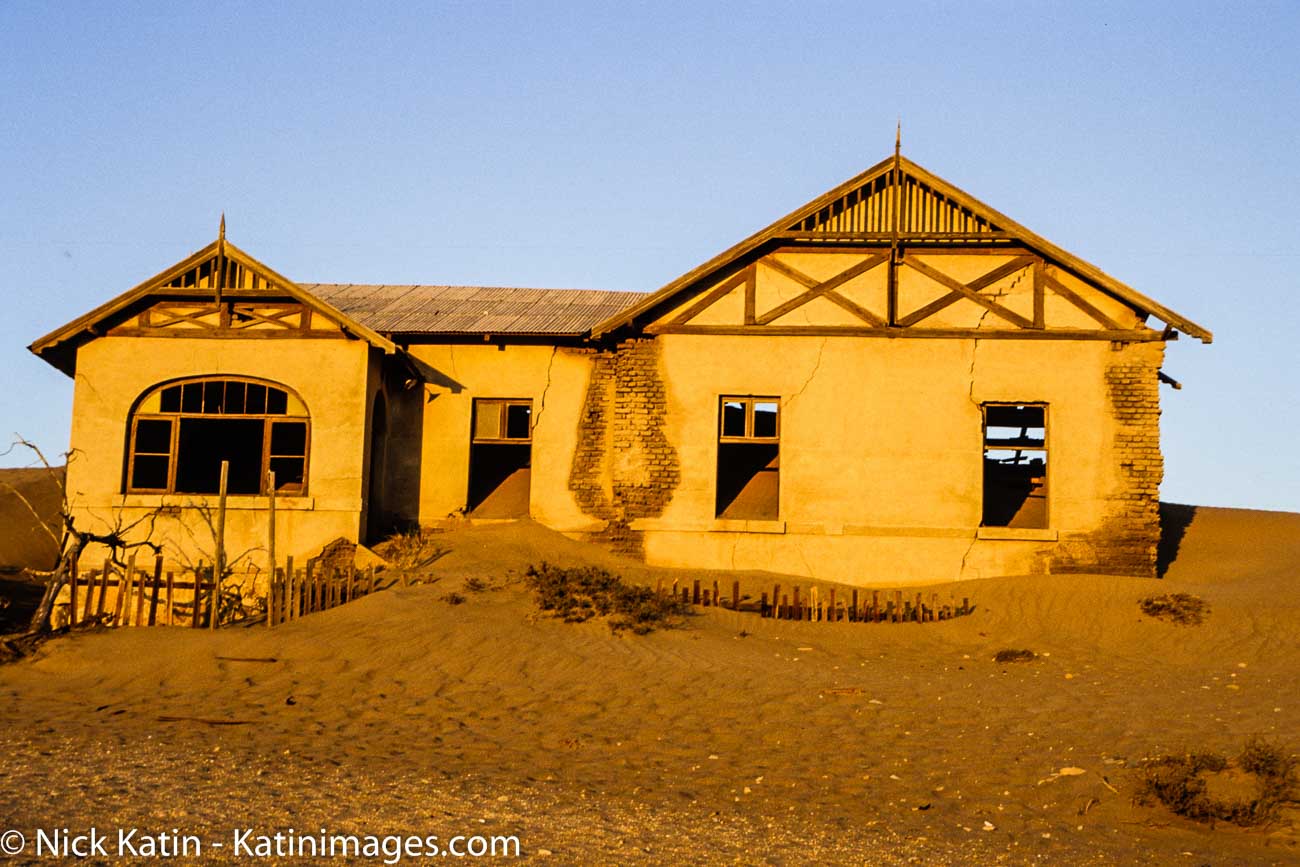
    Some of these old buildings had been partly swallowed by the sand dunes, whilst others still stood proudly above the sand.
    Wondering around, a black and white picture formed in my mind of well dressed people going about their business, men tipping their hats to the ladies, horse drawn carriages or model T fords honking as they passed by friends, butchers, bakers and barbers.

    This image was only partly reinforced by our return later that morning to do the guided tour. What was also reinforced was why the sand had been so successful in claiming some of the town. The wind was painful! Millions of tiny particles of sand stung any bare skin and got into our eyes, ears, and anywhere else there was an opening. The picture I now had was of windblown deserted streets as the town’s residents all stayed inside waiting for these almost daily mini sandstorms to ease.

    The journey back to Keetmanshoop on the bus would have been fairly uneventful had we not spotted the worlds only desert horses, some distance from the highway. These horses somehow survive in this harsh environment without aid except for their only source of water, a man made water hole, installed especially for them. They are feral and what’s even weirder is that nobody knows for sure where they came from originally. There are plenty of theories of shipwrecked, or abandoned German cavalry horses.
    I liked the theory that they were once stud horses from the stock of a Baron who lived in a castle nearby. The thought of a European aristocrat living in this harsh environment and pretending that he was still in lush green Bavaria or wherever is just so typical of European colonisation.

    The bus arrived in Keetmanshoop one hour late, which by African time is actually the equivalent of two hours early! Fortunately that really didn’t impact on us as we still had a two hour plus wait for the overnight train to Windhoek. The train itself left an hour late thanks to a bureaucratic conductor insisting that he checked all tickets at snail like speed as passengers boarded. Had one of his colleagues not intervened and presumably told him in Bantu that he was a stupid prick and to go and do something more useful like tie himself to the rail tracks in front, we would probably still be waiting to board the train.

    We had traveled by train in Africa some 4 years before so we sort of knew what to expect. What we had not experienced on these other journeys but had been told about was the videos. A small TV screen sits above the doorway adjoining the next carriage and blasts out the latest movie at decibel level that makes most rock concerts seem quiet. It wouldn’t have been quite so bad if the movie had been half-decent! This was California Man known as Encino Man in Australia and some other parts of the world. It was absolute crap!

    If you like this then hit “follow” on the side bar

    The ruins of the ghost town of Kolmanskop in the Namib desert in southern Namibia, a few kilometres inland from the port town of Lüderitz
    The ruins of the ghost town of Kolmanskop in the Namib desert in southern Namibia, a few kilometres inland from the port town of Lüderitz
  • African shoestrings – Namibia Day Fifty two – Luderitz

    Luderitz is the arsehole of the world! I’m sorry, I know that there are plenty of people who live there and love the place but I had to say it!
    Someone, somewhere decided that they would put Luderitz about 350 kilometres from anywhere on the way to nowhere and then have the gall to make it sound appealing enough for you to make the effort, only to find that there is actually nothing there!
    Look it’s all very twee having these Bavarian style buildings that house teahouses and pastry shops sandwiched between the desert and the Ocean but if I wanted to see German character I would go to Germany.

    We stayed a couple of nights and managed to keep ourselves busy. The backpackers was quite comfy and more importantly quiet, we virtually had the place to ourselves.

    Most of the ‘attractions’ are spread out away from the town so you either hire a car or go on a tour. We chose the former as the tours weren’t running very frequently and were quite expensive. One tour we did do however was the “West Coast Experience” on the schooner ‘Sedina’. Two hours on a boat, one hour motoring to a desolate spot called Halifax Island and one hour sailing back.

    Actually it wasn’t really that bad, we got to see lots of Cape Fur Seals, Heaviside Dolphins and some really smelly Jackass Penguins plus an old whaling station. But the terrain was so desolate, just sand and rock, no colour, trees or shrubs just a naked bleak landscape. I wondered, shivering in the cold and wet from the continual splashing of seawater, what the suicide rate was here.

    The scenery didn’t change much during our self-drive tour; it just got windier, to the point that just getting out of the car was a challenge. We wanted to walk across the wooden bridge to get a closer look at the Cape Fur Seal colony at Diaz Point but the wind was just too strong! The rock actually got darker and bleaker as we drove around the peninsular that faces Luderitz, if the moon is like this, I don’t want to go there! Even the scattering of a few flamingoes on Agate Beach didn’t raise our spirits. What did though was Kolmanskop!

    Kolmanskop is literally the jewel in the dreary Luderitz crown. A once thriving diamond mining town, now deserted and thanks to a few hardy souls, a tourist attraction.
    It borders the Sperrgeibiet, 20,000 Km2 of desert set aside for diamond mining and a prohibited area. In fact a permit is needed to visit the town. We managed to get a couple of Sunrise to Sunset permits so that we could photograph the town at sunrise.
    Boy! Was that a good decision! At 6.00 am the light was perfect and the buildings literally glowed in the golden light. Even better the wind was non-existent and as the only visitors to this eerie ghost town, we snapped away to our hearts content in comfort.

    If you like this then hit “follow” on the side bar
    The ruins of the ghost town of Kolmanskop in the Namib desert in southern Namibia, a few kilometres inland from the port town of Lüderitz
    The ruins of the ghost town of Kolmanskop in the Namib desert in southern Namibia, a few kilometres inland from the port town of Lüderitz
  • African shoestrings – Namibia Day Fifty one – Keetmanshoop

    Alfred and Bridgett gave us a lift back to Keetmanshoop, where we met up with Riet again in her B&B.
    Because Riet didn’t have to collect us we got a free tour of the only two tourist attractions in Keetmanshoop, the quiver tree forest and Giants castle.

    Giant’s castle is not worth the wear and tear on the word processor.
    The quiver trees though were mildly interesting. Named after the San Bushmen who used the branches to make Quivers for their arrows, they are from the Aloe family and have a highly efficient method of retaining water by having a coating of wax on their leaves and branches. The forest had about 250 of these little oddities (they can grow up to 8 metres) growing out of very inhospitable rocky landscape. Mind you from what we had seen of Namibia so far the whole landscape is pretty inhospitable and pretty bloody hot!

    Riet for some unfathomable reason or other seemed a lot less friendly than she had been when we first met her. Not that she didn’t do the right thing but we sort of had that sense that we were imposing rather than being valued guests. Maybe it was because I snored! Certainly I think she was glad to get rid of us the next morning when she dropped us off at the train station to catch the bus to Luderitz.

    There are trains at this station but not one that was going our way. There used to be a train from Keetmanshoop to Luderitz but that was discontinued and a bus service runs in its place.

    It was a long hot and uneventful ride made uncomfortable by more than just the heat and the dust, I had a nose that wouldn’t stop running, the bus was full and quite cramped and we were permanently on guard watching our bags in the luggage hold. Africa in general has a reputation for making luggage disappear from public transport. Somehow we felt our luggage was a lot more secure in the Intercape Mainliner hold. Every bag was labeled and a steward got out and found your bags for you. On this bus it was chuck it in the hold and get it out yourself.
    This was also the first time we were the only whites. That’s not being racist but it did take us out of our comfort level until we got used to it.

    The landscape was just desert of varying shades of brown from the light rust coloured sandy stretches to the dark brown almost grey lunar landscape with the odd small town carved out of nowhere. At a couple of points the bus actually runs along the still existing rail track and pulls up at the once rail now bus station in places like Aus and Seelhelm. The towns in fact were a welcome distraction from the harsh and fairly flat landscape. Personally I’m more of a train person. When the train pulls into the station I enjoy watching people get off or on or just shuffle around the platform. In this case I was just clutching at straws to ease the boredom and take my mind off the heat and the tap that passed for my nose.

    It’s been said many times before but I’ll say it again: Why is it that we can send a man to the moon, swap organs, eliminate diseases like small pox and genetically create different species of flora and fauna but can’t cure the common cold?

    At around 30 kilometres from Luderitz we felt a significant temperature drop. The coastline of Namibia is severely influenced by the very cold Atlantic Ocean. I say severely because the maximum temperature almost never gets above a 23/24ºC. If there’s not a blanket of sea mist, there’s a cool breeze that often imitates a gale force wind. Surprisingly enough the rainfall is actually lower along the coast than it is 160 kilometres inland. It was a very welcome relief after the heat of the last few days.

    If you like this then hit “follow” on the side bar

    View of a Quiver Tree in Quiver Tree Forest near Keetmanshoop
    View of a Quiver Tree in Quiver Tree Forest near Keetmanshoop