Katin Images Travel Photography

Travel Photos, Travel Photography Tips and Software

Tag: seals

  • African shoestrings – Namibia Day Seventy four – Windhoek

    Spitkoppe is an attractively shaped mountain on the main drag between Swako and Windhoek (we were now heading back to Windhoek). Its been called the Matterhorn of Africa due to its similarity in shape. Well, maybe but it’s a bit like comparing Fish river Canyon with the Grand Canyon, once you’ve seen the real thing comparisons aren’t helpful.

    What was fascinating was the little community camp ground at the foot of the mountain. Run by the local women’s development corporation, it had a basic bar constructed of stone with a shady pergola attached and some half finished thatched chalets. The toilets were long drops stuck in the middle of the desert with shade cloth doors and hesian or bamboo walls, whilst the showers were similar in construction with gravity fed water. There were even some ‘natural’ camp sites quite away from the rest of the camp, which is why they must have been called ‘natural’; after all if you got up in the middle of the night for a pee only the most conscientious are likely to walk 200 metres to relieve themselves. We were tempted to stay there but decided against it, in order to make some time to our next destination, Gross-Barmen Hot Springs.

    Gross-Barmen was a MET resort and we were a bit concerned that as we hadn’t booked anything, it might be full. Well we shouldn’t have worried, even though it was late in the afternoon and a Sunday there was only one other site in use. We had an ablution block and a kitchen for our own exclusive use for the two nights that we stayed there.

    As the name suggests the main attractions were the baths. There were 2: one to put minerals into your body and the other to cook them out again and leave you looking like a red double decker London bus with skin as creviced as Mount Everest. Wow, that thermal bath was hot!

    These baths, in fact were the only attractions. We had only selected it as was within striking distance of Windhoek and we decided that it was a good place to ‘veg’ for a day.

    Our site was on the edge of the campsite and probably about 500 metres from the staff accommodation. On our second night, the staff decided to have a party, or at least that’s what it sounded like. So from about 10 pm till the early hours of the morning we treated to some popular African music, trouble was that it was all the same and I don’t mean it sounded all the same; it was the same! There was one particular song that was played over and over and over… We actually found out by hearing it again sometime later that it was Sum’Bulala by Brenda a smash hit in Southern Africa.

    We spent the next 3 nights back at the Cardboard Box in Windhoek. Our camping tour through Botswana didn’t start until Friday and as it was Tuesday when we left Gross-Barmen we had to cool our heels for 3 days. Werner came and picked up the hire car and was pretty good about the bill from Hennie. He did however charge us for a small crack in the windscreen and a broken gas light glass, the former happened on the road back from Sossusvlei as a Landcruiser coming in the opposite direction rounded a bend and chucked up most of the loose gravel between us. We really didn’t have a problem with either and I think, in a weird sort of way, we were quite sad to hand back the little Chico that we had become quite attached to.

    Apart from some sojourns into Windhoek we spent most of that time reading and deciding what we were going to do after the tour had finished.

    We spent a couple of hours following the Hofmeyer walk on the outskirts of the city. At least we thought we followed the walk until we came across a sign towards the end, pointing in a different direction. It didn’t matter too much, the point of the walk is too see elevated views of the cityscape and its surrounds and we had achieved that. We finished that off with an indulgence trip to Gathemann’s, a colonial style café famous for its great terraced outdoor area and lots of mouth-watering cakes and pastries. Unfortunately neither the cakes nor the coffee lived up to its reputation and we just had to be content with the activity of people watching from the terrace.

    If you like this then hit “follow” on the side bar

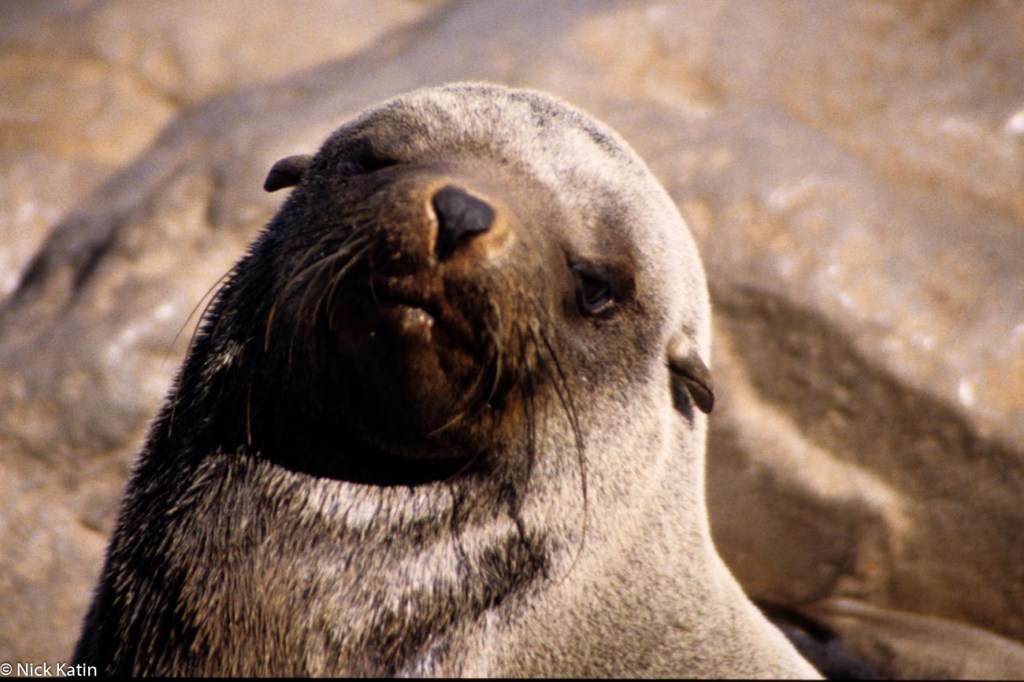
    A Cape Fur Seal at Cape Cross Seal colony in Namibia
    A Cape Fur Seal at Cape Cross Seal colony in Namibia


  • African shoestrings – Namibia Day Seventy One – Swakopmund

    Everybody (that is mainly the white population) was friendly and seemed to have either German or Afrikaans accents. Wilma our landlady, a white Namibian of German heritage was a third generation Namibian, But she had been brought up to speak German in school and at home and spoke English with a strong German accent.

    Despite our immediate liking for Swako our second day turned out to be quite expensive. We had to send a fax relating to our house to Australia which cost the princely sum of N$31.50. Sue was still not feeling quite right so a trip to the doctor cost N$100 who immediately ordered a blood test (another N$36). Fortunately the blood test cleared Sue of Malaria, which was our main concern. But it didn’t answer the question as to why she was still feeling disorientated. The doc put it down to the Lariam that we were taking. It’s a strong anti malarial drug with a bad reputation for side effects such as disorientation, hallucinations, anxiety and nightmares. The last time we had taken it we had both experienced the latter two but this time I hadn’t experienced any side effects and up until Sue had been sick nor had she.

    We had been quiet happy just to laze around Swako for the couple of days that we were there but as always curiosity got the better of us. Swako is at the edge of the Namib Desert, so we had almost done a full circle on our tour of Namibia. This part of the desert holds a few surprises or so we were led to believe by the Lonely Planet and the Swako tourist office. That was enough for us and we were off having a look. In fact it was more of a ‘so what’ tour rather than a scintillating safari into the desert. I say ‘so what’ because unless you’re a botanist or a historian most of the items on the signposted Welwitschia drive mean very little. The Swako tourist office gave us a handout called “The Welwitschia Plains-a scenic drive” with thirteen numbered stone beacons to watch out for. Each of these beacons are positioned at places of interest along the drive. The first stop was at little cluster of lichen; the next was at a couple of bushes called the Dollar and the Ink. So far we’re yawning and wishing that we had stayed in bed.

    Oxwagon tracks remarkably preserved from decades ago and just as remarkably almost impossible to see were next and followed by something much more interesting, the Swakop valley moonscape. This dark brown and wheat coloured pitted and crated landscape was formed by 1000’s of years of erosion and is very much reminiscent of the moon’s landscape. Not that I’ve been there of course but those who know this sort of things say it is.

    Our interest began to wane again, as more lichen was sign posted. Apparently the lichen of the Namib Desert is the most extensive in the world. I suppose a botanist would find that fascinating but we’re still stifling those yawns. Our interest was rekindled by a much bigger expanse of moonscape. Created this time by a non-existent river cutting it’s way through softer material. Even my imagination was finding it hard to imagine any river flowing through this dry and inhospitable landscape.

    A heap of junk left behind by the South African army in 1915 was considered notable enough to be the next point of interest. Somehow I cannot see how even 85 year old broken bottles and rusting cans are a great tourist attraction!

    The next two beacons are not even worth us getting out of the car. A couple of ridges of Dolerite (what’s that I hear you say, forget it, it’s in the dictionary) were somewhere around.

    Then we had a small patch of vegetation dressed up as picnic spot. Apparently the river that I had trouble picturing earlier actually runs deep underground and in some spots is high enough for some trees and bushes to tap into.

    Speaking of vegetation, the Welwitschia drive is named after a unique ‘tree’ that has also been described as a living fossil. The next and penultimate stops are for these strange looking ‘trees’. They are apparently dwarf trees and are related to pine trees but you would never know that by looking at them. They look like straggly low lying semi tropical palms that have had a bad day. In fact if you saw one anywhere else you wouldn’t even stop to have a second glance. The point of interest is however that they somehow thrive in this hostile environment and are totally unique to the Namib Desert and get this; live for up to 1500 years.

    Our last stop on this spell binding drive was a let down after the Welwitschia. An abandoned iron ore mine from the 1950’s is really nothing but a hole in the ground.

    If you like this then hit “follow” on the side bar

    A Cape Fur Seal at Cape Cross Seal colony in Namibia
    A Cape Fur Seal at Cape Cross Seal colony in Namibia
  • African shoestrings – Namibia Day Seventy – Swakopmund

    Hentiesbaai is another fishing spot but it does have a sort of quaint character, (compared to Terrace Bay everything has character) with a decent looking beach and some ‘beachy’ looking houses with palm trees and lots of liquor shops. Hennie found us a cheap apartment next to his garage and the shopping centre.

    We had the luxury of a TV in this place and as it seemed like years since we had watched any, we just crashed in front of it.

    It was cable TV too except there was nothing much on. Most of it came from South Africa and watching South African TV is most disconcerting. They have this habit of changing languages continuously. We were watching their rugby equivalent of the footy show when the interviewer began to interview a rugby player in English. Problem was we could understand the interviewer’s questions but didn’t have a clue as to how the player answered as he was speaking in Afrikaans. Weird!


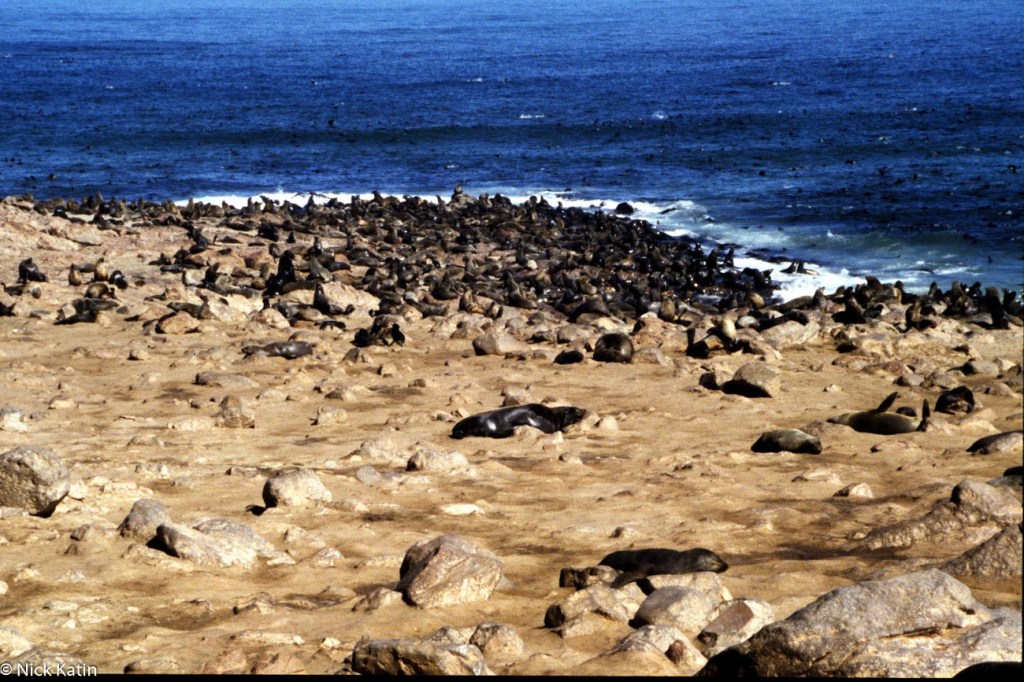
    Cape Cross is smelly. Not just a bit smelly but it stinks. The 100,000 Cape fur seals that call this home really know how to put visitors off. I’ve never seen so many seals! Big ones, little ones, dark ones and grey ones, old and young, male and female, some on the rocks or beach sunbaking, others in the water. Just a huge mass of blubber and seal shit! The Cape fur Seal is distinguished from other seals by the fact it has ears (with all the noise they were making I think they would be better off without them!). They are only found on the West Coast of Southern Africa, as they don’t migrate as a rule. They are quite big in size, the average male weighs around 187 kg but increases its weight to as much as 360 kg at the beginning of the breeding season due to the accumulation of food reserves in the form of blubber. It was for this reason that there are warning signs everywhere not to disturb the seals and cause them to stampede. These huge males can easily crush a small ten kg pup and it’s one of the main causes of the 27% mortality rate.

    Cape Cross itself was named after the cross that the Portuguese Diego Cao, the first European to set foot on the coast of Namibia, erected in honour of the Portuguese king. The original cross is actually in the Berlin museum but there are a couple of replicas erected in the same spot.

    This weird Namibian coastal climate played tricks with us all day. When we left Hentiesbaai in the morning and headed north it was really hot but as soon as we got we got to Cape Cross it cooled down about fifteen degrees. Driving back down through Hentiesbaai it was hot again and then as we approached Swakopmund (or Swako as it’s known by the locals) it cooled right down again

    Swako is a bigger more up market version of Luderitz. It’s a mixture of German, Western and African culture forced together onto the cold Atlantic and carved out of the desert. Its flat featureless topography has been brightened up by some colourful buildings and lots of German Bakerae’s and Bearhaus (bakeries and pubs) on almost every street. Along the promenade there’s these huge date palms on either side of the walkway with houses of varying colours and beach architecture sandwiched between the palms and the beach. German architecturally historic buildings were dotted along most streets in between the many restaurants and trendy curio shops. It felt good to back in western culture for a time. We didn’t camp here either. Why camp when you can stay for in a small, well equipped and centrally positioned self contained unit for N$100 (US$10) per night. Yup! We were going to like ‘Swako’!

    Cape Cross in Namibia is a colony of Cape Fur Seals
    Cape Cross in Namibia is a colony of Cape Fur Seals