Katin Images Travel Photography

Travel Photos, Travel Photography Tips and Software

Tag: Mountains

  • African shoestrings – South Africa Day Twenty-nine

    We left J’burg for Cape Town the next day via a domestic South African airways flight.

    We had been to Cape Town before but we had felt that hadn’t done it justice, so this visit was to ‘see’ the place properly. Last time we had stayed in a pleasant Bed & Breakfast near the city centre. This time we were going to stay in a backpackers of which like J’burg there were many. Expecting to be hassled by their touts at the airport, we hadn’t bothered to book ahead. Guess what? The only touts we saw were for taxis. After a three or four phone calls to different hostels we soon realised why. They were all full!

    It was a long weekend and Cape Town was almost booked. I say almost because eventually we found a backpackers that had a double room and they paid for the shuttle from the airport to take us there, saving us R30 each.
    Unfortunately that was not as much to our advantage as we initially thought, we were now obligated to stay at least one night. The Cat and Moose was we thought at the time about as bad as it gets. The landlady led us to a dingy little room with threadbare carpet, paper thin linen and the sort of musty damp and putrid smell that makes you want to vomit! Worse still we had to walk through a dorm for access and it was across an alleyway from the TV area where a little blonde haired prick full of bullshit (we had met him earlier) had the sound loud enough for people in the next suburb to hear.

    Needless to say we were out of there the next day!

    With the help of the tourist office we found the colourful Observatory guesthouse in a suburb called, you guessed it, Observatory, a trendy uni student area. I say colourful because the rooms all had loud colour schemes and the owner, Andre and his manager, Gregory, were both pretty camp. This sorted added a certain ambience to the place and was cheap, clean, quiet and comfortable. But here’s the rub…..we were no longer within walking distance from the city centre and apparently public transport as we know it, was virtually non existent.
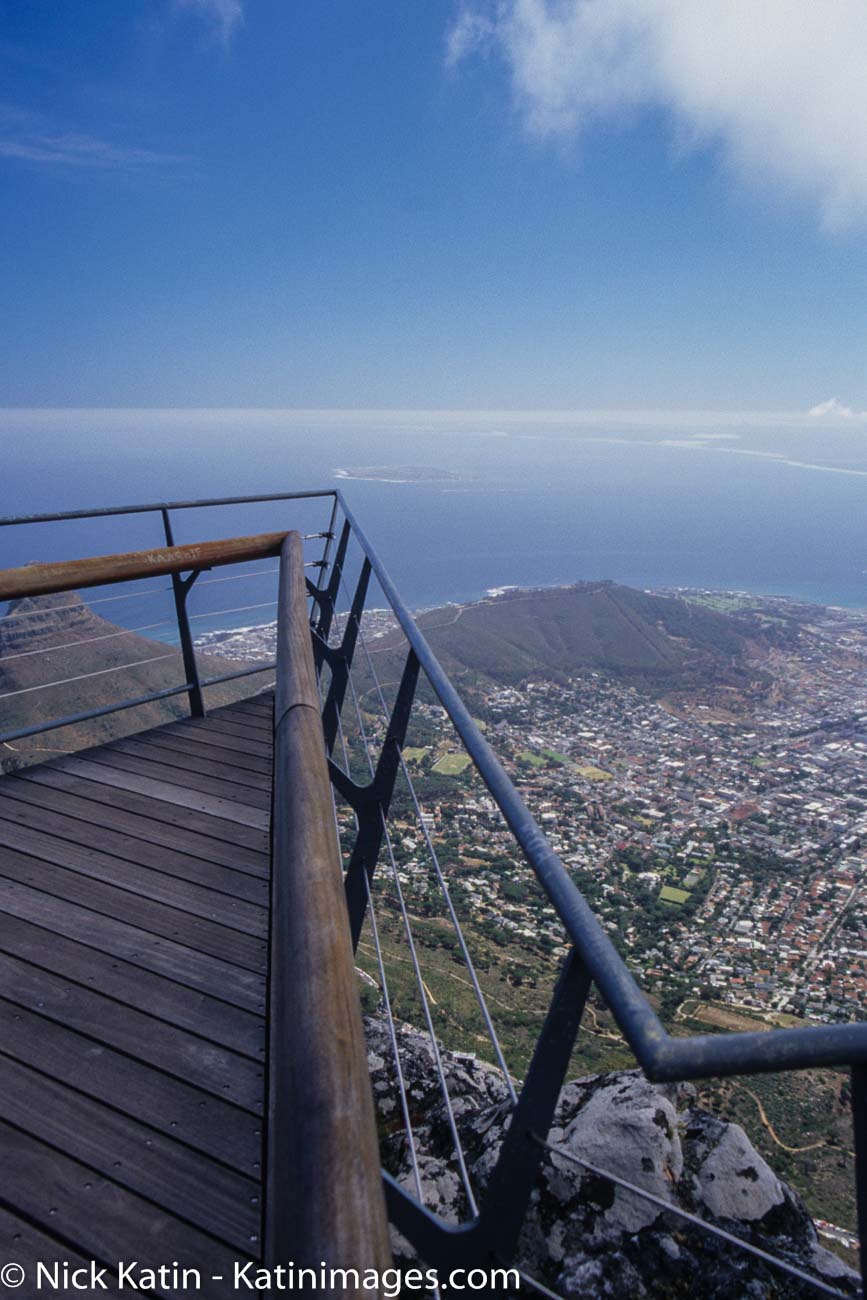
    Cape Town from the Aerial Cableway lookout on Table Mountain .
    Cape Town from the Aerial Cableway lookout on Table Mountain .
  • African shoestrings – Lesotho Day Thirteen

    David & Clement talked incessantly amongst themselves in SeSotho. To us of course it was rabble of noise punctuated by frequent loud hearty African laughs. What they were talking about was anyone’s guess.
    Normally on these treks, one guide is enough for six people but as we and Olive and Petra had booked separately somehow we had ended up with a guide each. We think it was more to create employment rather than any real need for two guides.
    So I guess these two guys were making use of the opportunity of having a real conversation whilst working, instead of having to continually talk to ‘dumb’ tourists.

    They did stop talking when we came across a store in the middle of nowhere. Not another building or village was to be seen. But what silenced David and Clement were the big mouthfuls of beer they took from the couple of cans of Castle purchased from this place.

    Our destination was the village of Ribaneng, famous for its falls and where our “five star” rondavels awaited us.
    Well I guess almost anywhere can look five star after a day in the saddle.
    Basically it was a mud hat with about ten mattresses on its spartan and dusty floor and a couple of gas rings with a gas bottle. Lighting was five star candles and BYO torches and our toilet was the long drop variety located down the end of a vegetable garden in a small wooden hut.

    The falls itself was almost out of view and was according to Clement an easy two hour return “stroll”.
    Guided by yet another David, we brushed rather uncomfortably through rough vegetation, jumped and hopped from one huge boulder to another and slipping on the many small stepping stones along and around the river.
    It’s at this point that I would like to describe to you a wonder, a creation of nature so beautiful that it brought tears, a spectacular feast for our eyes but I can’t.
    It’s not that it’s indescribable nor that it’s too wonderful for words, well it was just a waterfall and after the struggle to get there it was just not the spectacle that we had hoped for. It was, well, sort of nice, nice and boring.
    And with that we struggled back to camp.

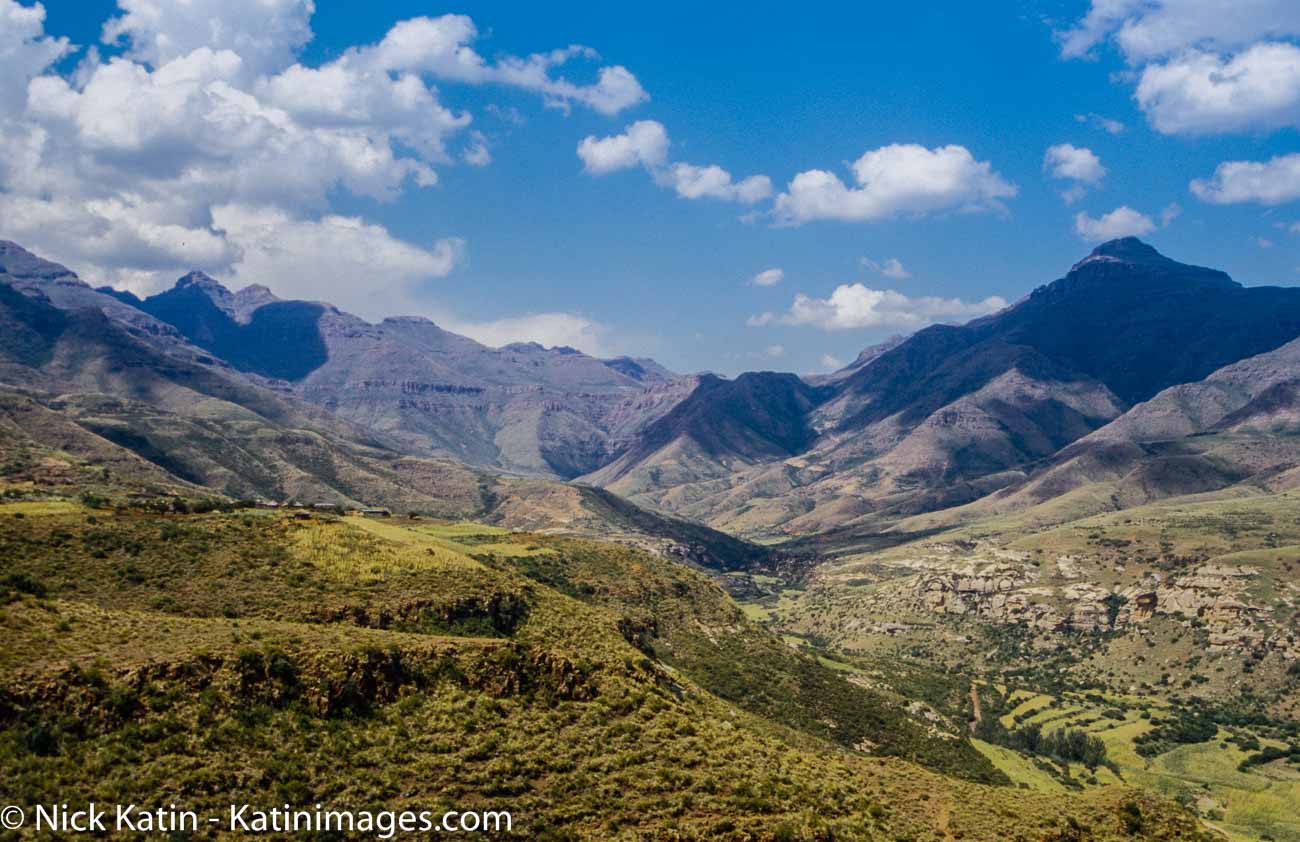
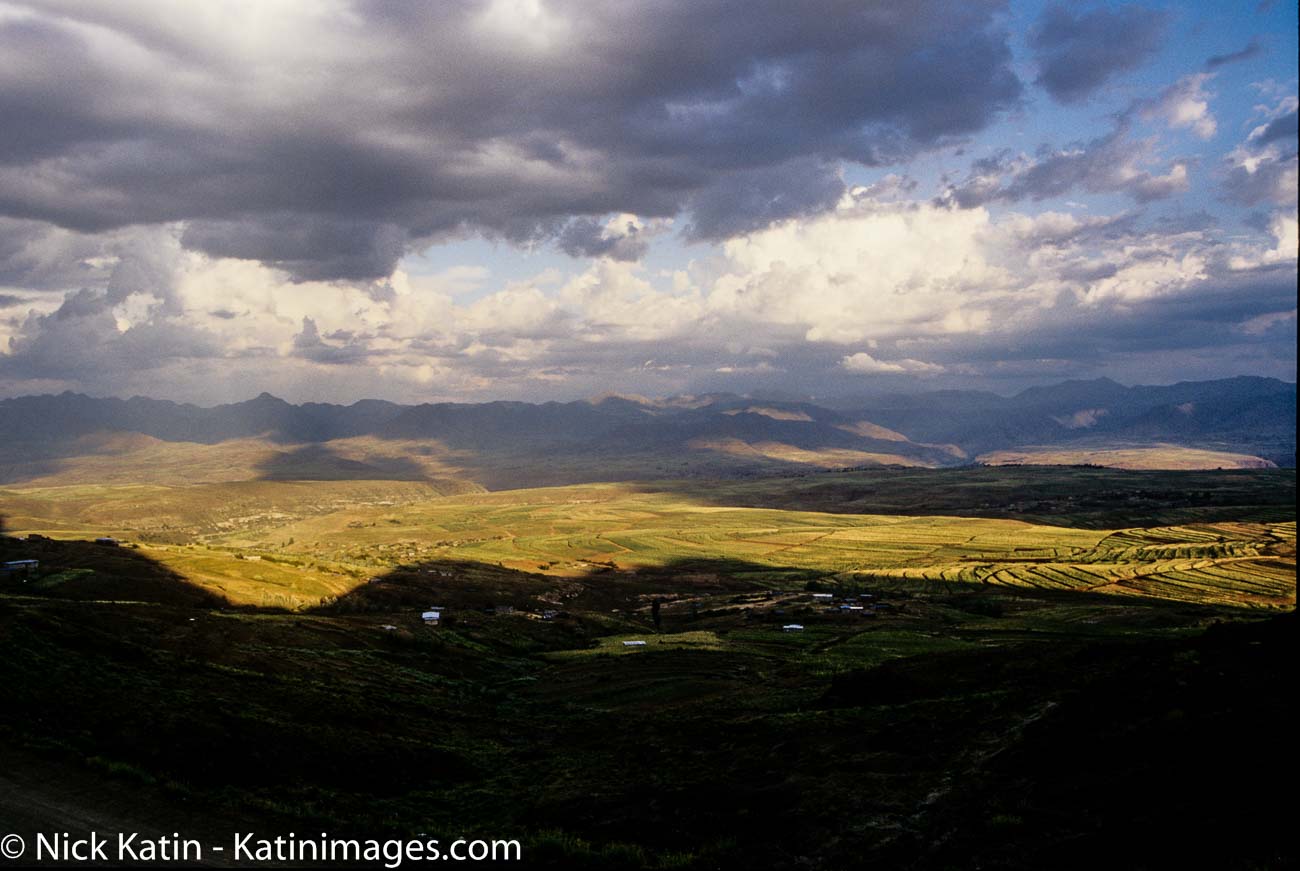
    Maloti Mountains of Lesotho in the early afternoon light.
    Maloti Mountains of Lesotho in the early afternoon light.
  • African shoestrings – Lesotho Day Twelve

    Somehow we made progress until we reached the river crossing about an hour in.
    In fact it wasn’t actually the river crossing that was the problem, it was the steep, narrow, rocky path that zig zaged down the side of a small gorge at an angle that would make you think twice about walking down there, let alone ride a pony, that had me spooked. Black Power stumbled down at her almost standstill pace whilst Black Label wanted to go down at breakneck speed and consequently was forever trying to overtake.
    Well let me tell you there was absolutely no room for overtaking and it took a lot of “wooing” and pulling in the reins to keep him back. Far below I could see Sue and Olive patiently waiting with David. Clement was with us trying to speed up Black Power, slow down Black Label and hold onto the packhorse. Eventually we made it down physically unscathed but mentally frazzled.

    The rest of the journey was a lot easier and I was able to relax a bit and take in the view without fear of my psychopathic pony deciding to crack on to Black Power and take us both down some steep ravine (Clement came up with the idea of keeping Black Power behind us rather in the front).

    The scenery was pretty much the same as we had experienced on our previous days walk. A continuous range of high country surrounding us, it seemed as if it we would have to climb great heights to go forward but somehow that never seemed necessary, there was always a low pass to take us through the mountains.

    There were plenty of villages too. I couldn’t help thinking that the Basotho people lived in a country that has a GDP of US$ 2255.00 per person and yet they appeared to live their lives quite happily. By comparison, Namibia has a GDP of US$8190.00 per person and the USA a GDP of $ 53,000 per person!

    When we passed the villages or just the odd traveller they all said hello and gave us that broad watermelon grin that you just couldn’t help but return. They seemed so content and peaceful! Maybe a good GDP is not as important as economists of the western world would have us believe.

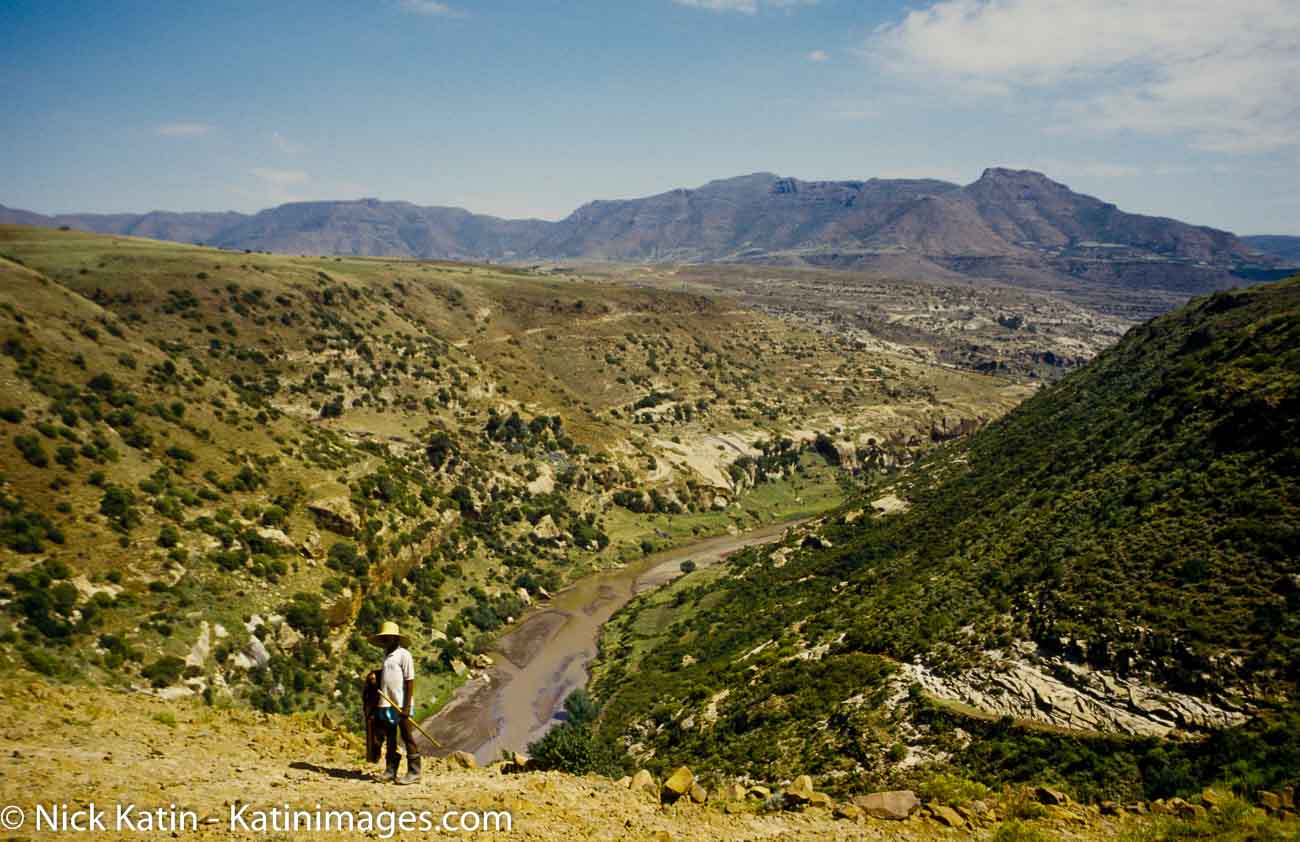
    A sheep herder stands overlooking a gorge in the Maloti Mountains of Lesotho.
    A sheep herder stands overlooking a gorge in the Maloti Mountains of Lesotho.
  • African shoestrings – Lesotho Day Eleven

    The Pony trek itself was something else.
    Now as corny as it sounds, I always get the dude horse.
    I once rode a horse that flatly refused to go anywhere, another time, a horse that would only go in one direction, home, which is fine at the end of a ride but is a bit inconvenient at the beginning!
    The last four legged animal I had ridden was a mule in the Grand Canyon and she was the only one that slipped and stumbled, generally near the edge of a trail where there was not much else between you and the rocky ground some 600 metres below.
    These ponies however are different; they’re Basotho ponies.
    The Basotho pony is the result of cross breeding small Javanese and full sized European Horses. Strong, sure-footed and docile it has been a popular mode of transport for many villagers, particularly in the highlands, since the early nineteenth century and now used for tourists in several places in Lesotho.

    Strong, sure footed and docile were words that seemed heaven sent if only it were true of Black Label, the pony that was selected for me by Mick.
    Sure it was strong but it was also disobedient, frisky and clumsy. My wife, Sue’s pony, Fox was good, as was Olive’s pony. Olive and Petra, two young German girls (well a lot younger than us anyway) were our companions together with two local guides Clement and David (a different one) and a packhorse or is it a packpony?
    Anyway Petra’s pony, Black Power was even worse than mine. Slow, stubborn, disobedient and almost paranoid, if a pony can be such a thing, of having her arse smelt at any opportunity by Black Label. I was bringing up the rear behind Petra and Black Label just couldn’t help himself. Even after Clement changed the order so that Petra was two ponies in front, Black label would make a beeline for Black Power’s rear end. The matter was made even worse by Black Power’s stubborn insistence to go at a speed half that of everyone else.

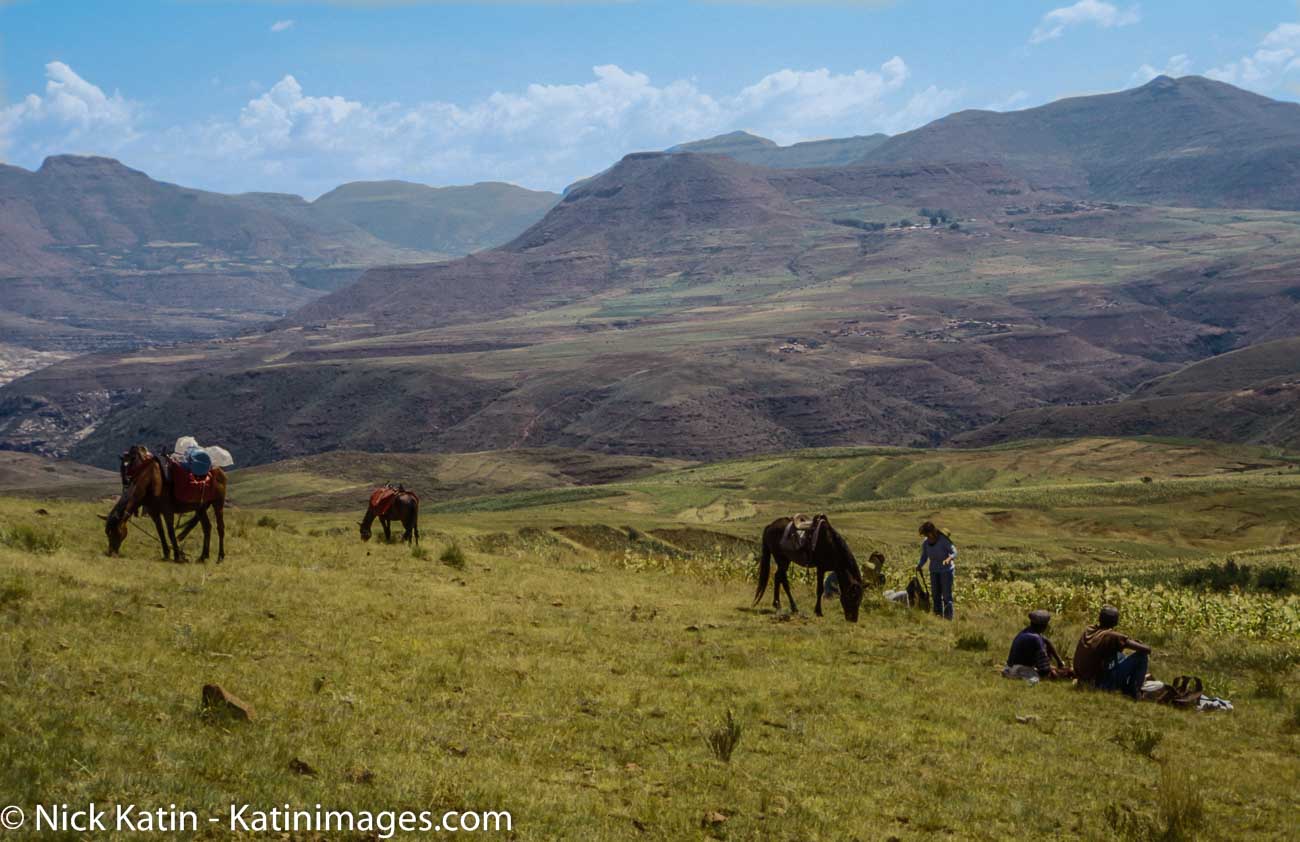
    Ponies and Riders take a break with the backdrop of the Maloti Mountains of Lesotho.
    Ponies and Riders take a break with the backdrop of the Maloti Mountains of Lesotho.
  • African shoestrings – Lesotho Day Nine

    The main reason why we had come to Malealea was to go Pony trekking. Somehow though, Mick had not only talked us into taking an ensuite cabin rather than a lot cheaper Basotho hut but had also persuaded us to wait a day before going Pony trekking. I’m glad he did because that allowed us to walk to the Botsoela waterfall.

    For the measly sum of around A$5.00 we hired a guide, David to take us to the falls. David was probably around 6 foot tall and quite well built and to our surprise, was only twelve years old! He obviously did this often, because towards the end of this four hour jaunt, we had trouble keeping up.

    Malealea village itself was our first taste of the Bastho way of life. Mud huts and houses with small areas of crops in the garden, smoking fires, ladies patching up the mud walls and children approaching us once again with hands outstretched for “sweets”.
    Some of the mud huts had different colour flags flying. This David told us was all to do with beer.
    A white flag meant that beer made from Sorghum had just been brewed. If it was yellow then it was Maize beer.
    Having tried Maize beer before we decided not to pursue any potential tasting.

    This  for the village of Ha Mohlakana, on the way back, was pretty much the same, except it had absolutely priceless views. In fact all along the walk we had difficulty in looking where we were walking. We just couldn’t take our eyes off the almost Tibetan scenery.

    The falls themselves were a bit tame but every cloud has a silver lining. The crystal clear water in a small pool at the base of the falls to dangle was perfect to refresh our aching feet in.

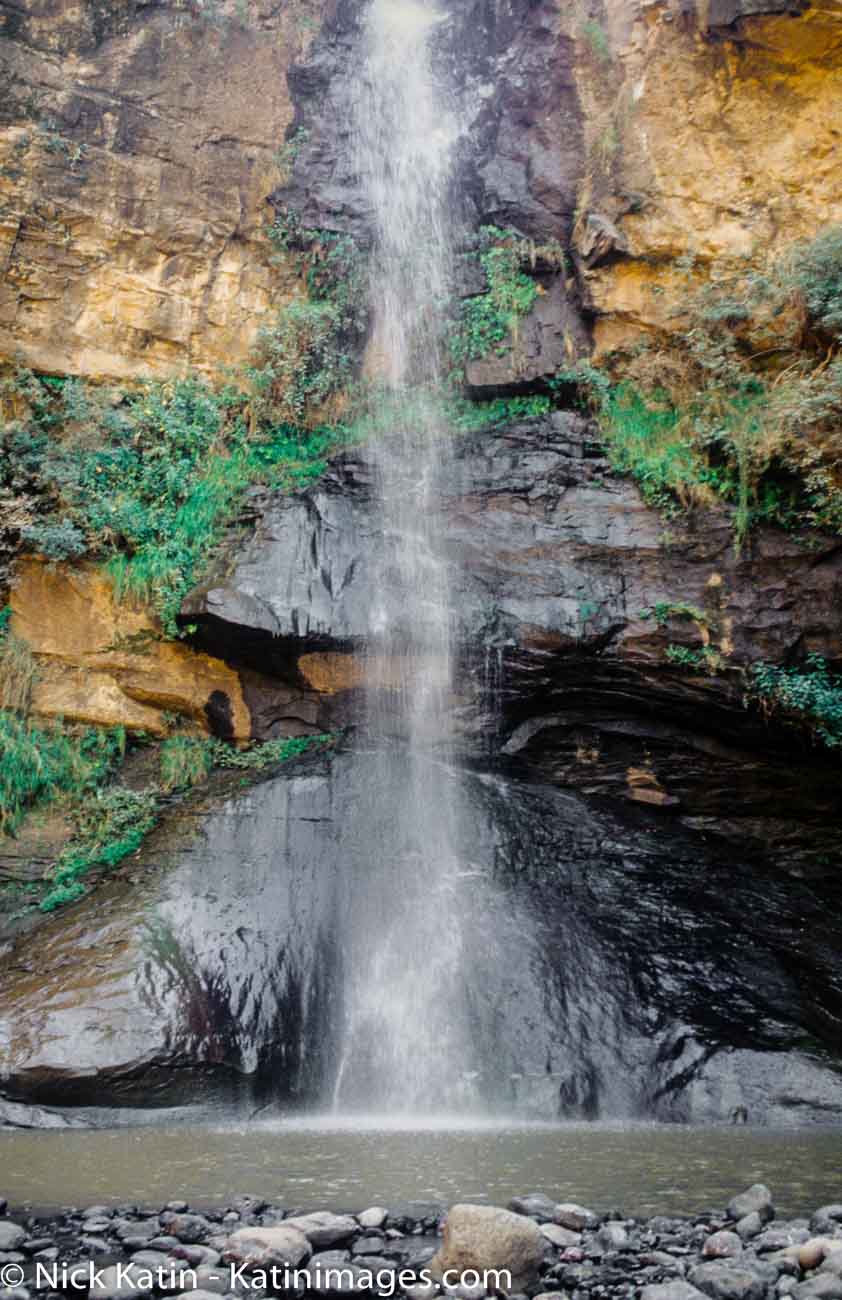
    The Botsoela waterfall near Malealea in Lesotho
    The Botsoela waterfall near Malealea in Lesotho
  • African shoestrings – Lesotho Day Eight

    We decided to celebrate our feeling of freedom at the Lodge bar. Well it was a sort of bar but more like a counter in a small cupboard. We managed to find a couple seats outside with some of the other fellow guests, the odd local ex pat, a few locals from Maseru (the capital, some two hours drive away) and ‘just a few’ American Peace Corp volunteers.

    The Peace Corp boys and girls were a pretty lively and interesting bunch. Four or five of them were based in this area and this was their ‘local’. For all of them local is not the right word, in getting here for their once a week gathering, they have to hitch from as far as 100 kilometres away!

    Overall there are 50 in Lesotho and 6000 worldwide who generally live in the same conditions as the people they have come to help. Often there’s no running water, sewerage and electricity and the living conditions are pretty basic by western standards. Without the immune system of the locals, they have to live with the constant threat of illness or disease. There is usually only one peace Corp volunteer per village or area so contact with other volunteers is reduced to once a week or even month. These guys are all in their early 20’s so it’s tough for them especially at the beginning and they do all admit to some initial culture shock.
    Mind you by volunteer standards they are well compensated with a local monthly allowance of US$125.00 in local currency plus a monthly allowance paid into their bank account at home. If they complete the two-year term they get a plane ticket home via any destination of their choosing plus a substantial bonus.

    Brian and Kim told us that the most frustrating part was the fact that often the locals do not actually want help. “They’re just happy doing what they’ve always been doing. For example a farmer will plough his field or plant his crop the same way his ancestors did regardless of the consequences of erosion or soil salinity. So our job is to try and educate them on why they need to change. It’s not easy!”

    None of this, I might add, stopped them from enjoying a drink or two whilst we there!

    Maloti Mountains of Lesotho in the late afternoon light.
    Maloti Mountains of Lesotho in the late afternoon light.
  • Refuge des Mottets, Vallee des Glaciers, France photo

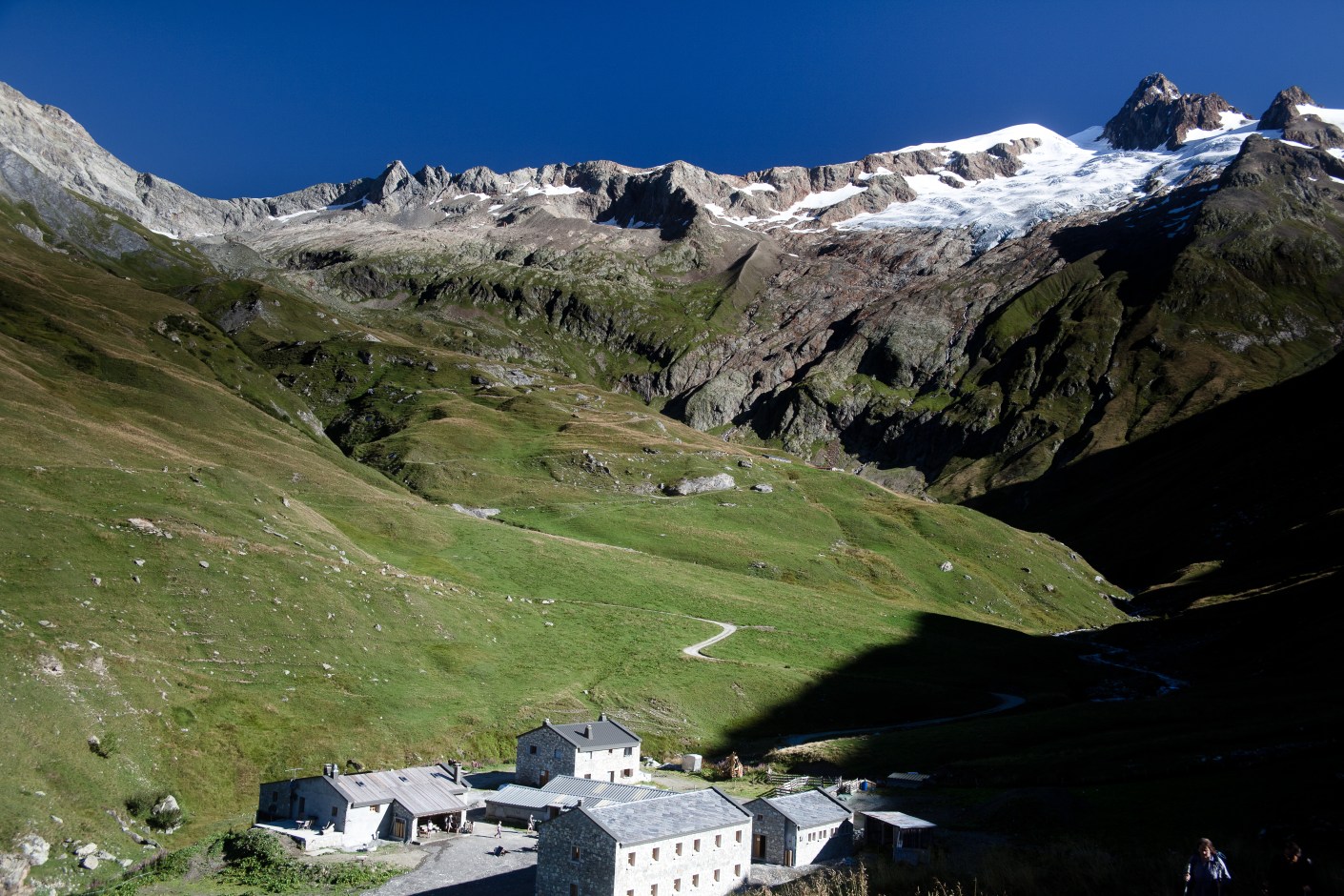
    Back onto the Tour du Mont Blanc trail. The last stop if going anti-clockwise or the first stop if going clockwise in France, is this little spot hidden away in the Vallee des Glaciers. The road stops here and the only way onto Italy is by foot. Depending on which way you go it’s another couple of hours to reach the Col de la Seigne that straddles France and Italy. Once again we were blessed with exceptional weather. 1/80 @ f10 37mm ISO 200

    Refuge des Mottets, Vallee des Glaciers near Les chapieux, France ©2013 Nick Katin
    Refuge des Mottets, Vallee des Glaciers near Les chapieux, France ©2013 Nick Katin

    To buy a print of this photo go to Vallee des Glaciers photo. To licence this photo email or contact us

  • Alp Bovine view near Champex , Switzerland photo

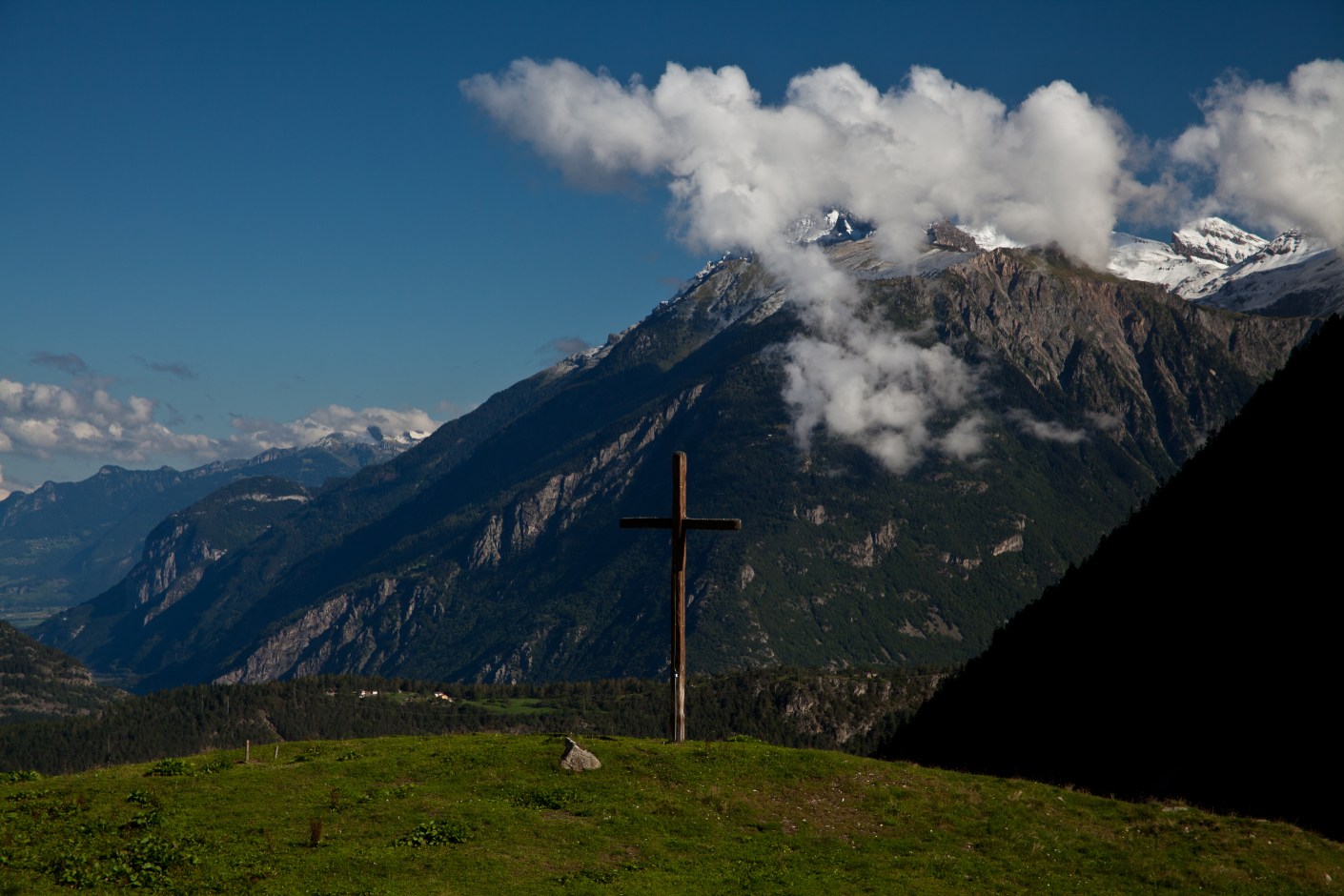
    On the Tour du Mont Blanc there are many places in the remote mountains to stop and have a coffee or tea. Alp Bovine is actually a working dairy farm high above the much busier and industrious Rhone valley. Like everyone else we stopped here for a drink and to soak in the view, not to mention catch our breath after a lengthy climb from Champex. 1/100 f11 85mm ISO 100

    Alp Bovine farm and rest stop is located near Champex , Switzerland © 2010 Nick Katin
    Alp Bovine farm and rest stop is located near Champex , Switzerland © 2010 Nick Katin

    To buy a print of this photo go to Alp Bovine photo. To licence this photo email or contact us

  • Gl de la Lee Blanche in the Italian Alps

    The Tour Du Mont Blanc is a 170 km circular hike around the tallest mountain in the Alps.
    Starting in France the track passes through both the Swiss and the Italian Alps before returning back to France. The spectacularly placed Rifugio Elisabetta is located on the side of the hill next to the GL (Glacier) de lee Blanche. On this particular day the storm clouds were gathering!

    Gl de la Lee Blanche Next to Rifugio Elisabetta, Italy © 2010 Nick Katin
    The Glacier de la Lee Blanche Next to Rifugio Elisabetta, Italy © 2010 Nick Katin