Katin Images Travel Photography

Travel Photos, Travel Photography Tips and Software

Tag: landscape

  • African shoestrings – South Africa Day Fourty two – Kalahari

    Sunday was the day we left Stellenbosch and made our way to Upington. The arrangement was for us meet with the tour group, who go by the rather colonial name of Livingstone Trails, at the Yeho Backpackers in Upington itself. It was now time to brave the local transport system. Up until now we had somehow managed to get from A to B in either a hire car or in the case of J’burg to Cape Town by plane. This trip meant we had to catch the train from Stellenbosch to Cape Town and there catch the Intercape Mainliner, one of the many long distance bus companies that cover South Africa and some its neighbours.

    We had settled comfortably into that semi conscious state experienced by most train travelers until we just started to stop at a place called Bellville. The guy sitting opposite us said “Mister air you going to kip Town, ’cause if you are, you need to be on that train there and it leaves any minute”. He pointed to a train right next to us sitting waiting with the engine running. As he finished and the train came to a stop almost everyone in the train rushed off.

    “Oh shit” Sue and I said collectively.

    We grabbed our bags and followed the masses as they headed down the platform steps into the tunnel, back up again on the next platform and then straight onto the train seconds before it began to pull away. Breathless and sweating I asked the same guy where the train we had been on was going. “Back to Stellenbosch and there isn’t another train to Cape Town for about another hour” he added “It’s a Sunday, man, they always do this on a Sunday” We thanked him appreciatively and found a seat.

    The bus ride was pleasant enough. As it was an overnight trip, we managed to get some sleep in between the hostess; a buxom blonde haired imitation of a German farm girl who we affectionately named ‘Big Bertie’, giving us coffee, rusks and biscuits and the odd stop to swap drivers and hostess. That intrigued me. I certainly don’t begrudge a change of staff for such a long journey (894 kilometres and ten hours) but these guys had a bed tucked away behind the luggage compartment that they had to share. As the first shift driver was quite thin and short I feared for his safety having to sleep next to ‘Big Bertie’. If the bus had to slam on the brakes, she could roll right over and flatten him!

    If you like this then hit “follow” on the side bar
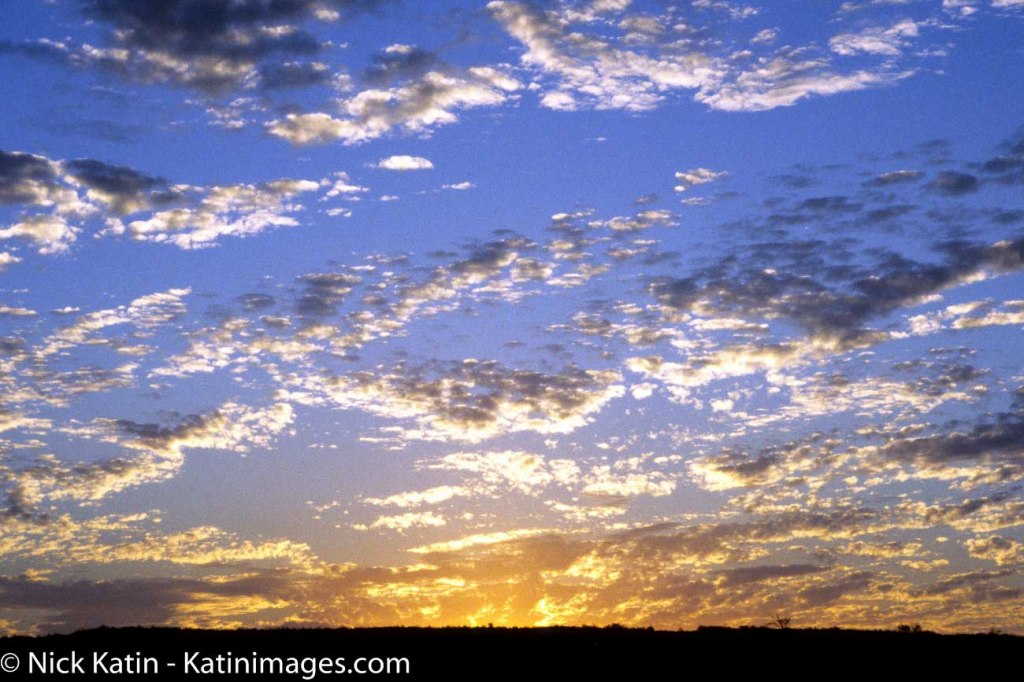
    Sunset over the Kalahari
    Sunset over the Kalahari
  • African shoestrings – South Africa Day Fourty – Stellenbosch

    The following day we ‘jumped ship’ and found a little apartment just out of town.
    Not that there was anything wrong with the Stumble Inn, it was just the noise from the other ‘guests’.
    I’d like to think that we haven’t we’ve lost touch with modern music but the repeated thumping of ‘techno’ music is not the best bedtime music as far as we were concerned.
    A young guy, John also from Perth, who was travelling around on his own, shared this opinion. In staying in the dorm, he was in a worse position than us and was getting fed up with being constantly disturbed as his fellow bedmates stumbled in and out of bed.
    Never really gave that much thought before. As a couple we always got a private room and had drawn a line in sleeping in a dorm. But anyone on their own is pretty well damned if they want privacy. They either pay more than double the cost for a double room (they are often more expensive per person than a dorm) or put up with sleeping in the same room as a load of strangers, have no privacy and in some circumstances be permanently on guard watching their belongings.

    Anyway we had enough of the Stumble Inn, we had lasted two nights, and for just a few more Rand we had a nice cosy little place tagged on onto someone’s house called “Kaveeltjie”. That someone was Gertie an extremely helpful and warm housewife with a couple of youngish kids. She picked us up at the tourist office in town and couldn’t do enough for us.

    One of the fascinating things about South Africa is the white Afrikaners. Most of these are descended from the original Dutch, German and French settlers and have been in South Africa since the seventeenth century. This is different from the whites of British heritage that have only been around since the nineteenth century. That in itself is interesting but what really fascinates me is that when you meet the Afrikaners is their own country they are totally different from your expectations. After all this is a race that is responsible for apartheid. A lot of these expectations are based on the media and those you meet in Australia who have left the country for good.
    Well we found them to be kind, friendly, warm and honest people. You almost get the feeling that they would give their lives for you. A lot of that comes from their strong religious beliefs, but I’ve met plenty of religious people over the years who will hardly acknowledge your existence let alone help you out in tight corner.
    These people also have an amazing attachment to their language, which for most of them is their first language, with English being used only whenever it’s really necessary.
    One particular lady we met on our first visit, actually pitied us for not being able to speak Afrikaans, saying it was such a shame that we were unable to use words that there was no equivalent for in English to describe the world around. At the time I wasn’t that convinced. But the more of these people I met the more I think there must be something in it. So many actually struggle to translate certain words from Afrikaans to English which tends to surprise as their English is usually so fluent.

    Any way Gertie fitted this mould, and was happy to give us a few pointers for our future travels and expeditions.

    If you like this then hit “follow” on the side bar

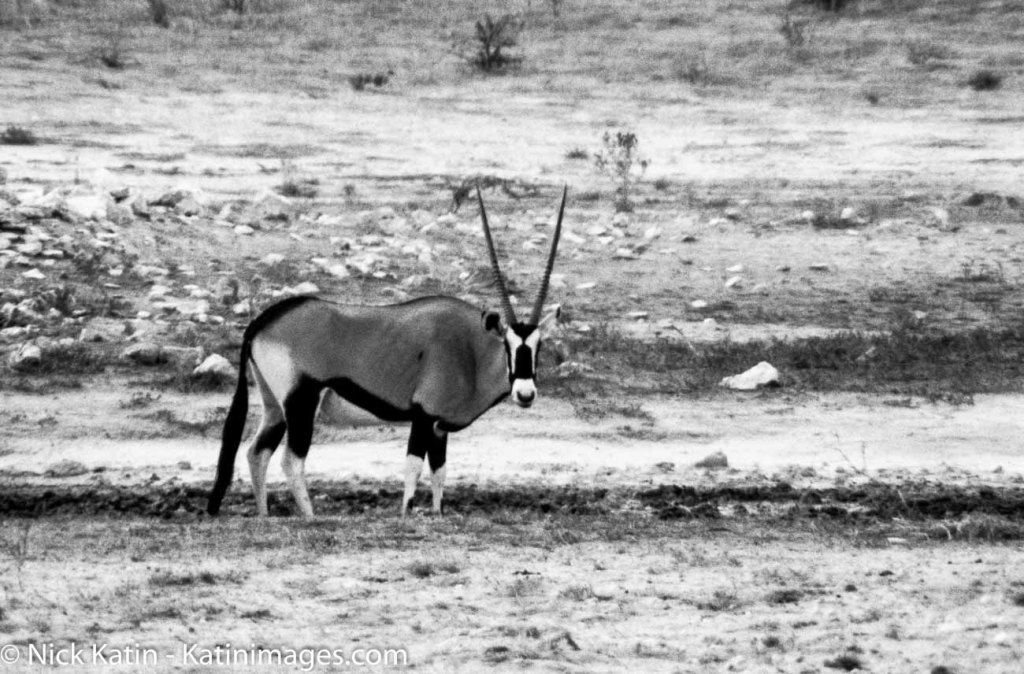
    A Gemsbok in the Kalahari national park in South Africa
    A Gemsbok in the Kalahari national park in South Africa
  • African shoestrings – South Africa Day Thirty-nine – Stellenbosch wine route

    What the Stumble Inn did have and what backpackers all have is plenty of information in the form of a notice board and flyers. The flyers were mostly from other backpackers and other forms of budget accommodation plus the odd restaurant and attraction or tour from all parts of Southern and Eastern Africa.
    We even saw a flyer from a backpackers in England! This is really an excellent idea and a great way to pick up info whilst travelling. Some of the busiest places even have an ‘expert’ who can arrange almost everything for you, but most have people with enough knowledge to book tours and accommodation and guide visitors to local attractions.
    We took advantage of this when we saw an ad on the notice board for a six day camping tour of the Kalahari called the “6 day Kalahari experience”. Neil booked it for us but we still had to wait for confirmation.

    Of course for us the biggest attraction in Stellenbosch was the wine route. This is a route that you follow to 29 different wineries, if you’re up to it!
    We decided to hire push bikes and just visit a few. Selecting the flattest route we enjoyed ourselves riding through the vineyards and stopping off at three different wineries.
    Staff at all these places were friendly, informative and happy to give us some of their time. And even though I am unashamedly biased towards Australian wines, the wines were pretty good too, especially at a place called Jordon.
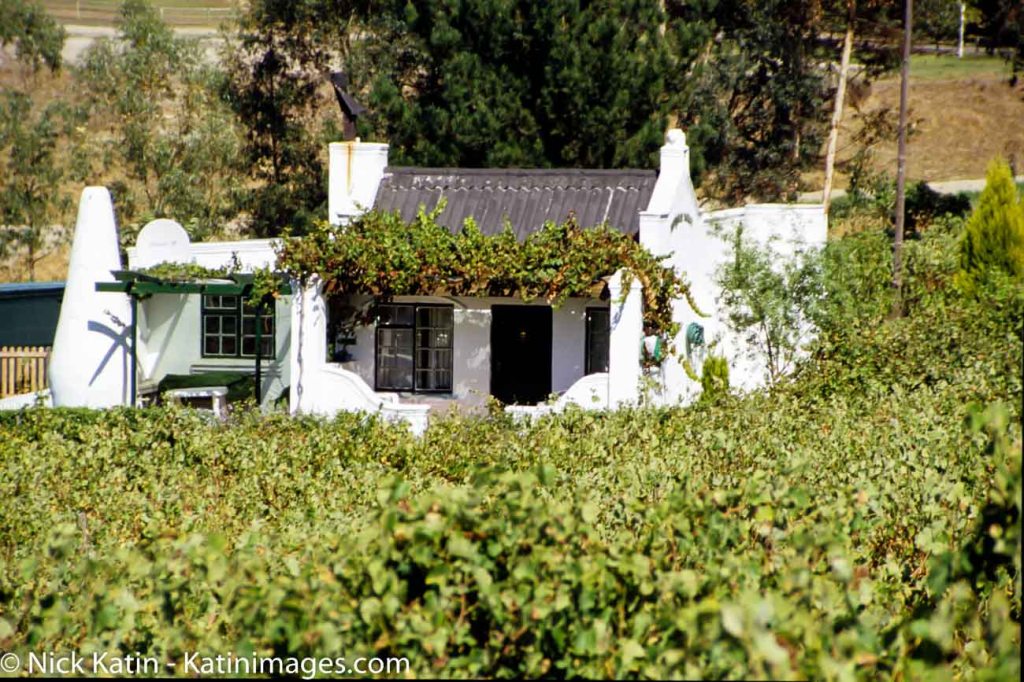
    Most of these wineries had character white washed buildings of the dominant Cape Dutch style with an excellent backdrop of mountains and vines. The fourth and last winery, Spiers, was more like a theme park. Two restaurants, a café, conference and banquet centre, Cheetah Park and a deli from which we bought picnic supplies, made us forget that it was actually a winery. We sat around the lake and ate without a care in the world as we watched families enjoying the park like atmosphere in the warm sunshine.

    All this tranquility and relaxation came to an abrupt end, when we discovered one of the bikes had a puncture. Somehow we had a feeling that a place like this wouldn’t have any facilities to repair punctures for tourists pleasantly warmed by the gentle sipping of wine.
    We rang the Stumble Inn and Neil said he would come and pick up us. He had actually warned us about these giant thorns that are found in the grass. Even though we had been especially careful to avoid riding over grass, one little prick had created another bigger prick in the tyre!

    Well every cloud has a silver lining. Whilst we were waiting we went on the Spiers cellar tour and tasting. Peter, our young host was very entertaining even though he had this annoying habit that’s crept into our society, of saying, “you’re welcome” after being thanked for answering a question.

    We ended up waiting around for a fair bit of time after the tour before Neil picked us up and then charged us for the privilege!

    If you like this then hit “follow” on the side bar
    A small winery near Stellenbosch beneath the Stellenbosch Mountains
    A small winery near Stellenbosch beneath the Stellenbosch Mountains
  • African shoestrings – South Africa Day Thirty-eight – Stellenbosch

    It was time to leave Cape Town, not as we thought at the time forever, but for a few days. We were off to the winelands!

    Stellenbosch has two dominant influences, the wine industry and the local student population that studies at the Afrikaans-language University of Stellenbosch. Fortunately these two influences compliment each other and the result is a trendy, lively place that seems to have avoided the social problems that dogs the rest of South Africa. It’s also the second oldest town in South Africa and hence has many well preserved architectural gems. Gleaming white Dutch Gable buildings interspersed with the odd flat or thatched roof were everywhere.
    We attempted to follow a walk trail that passes the most notable buildings and landmarks. But gave up following it exactly. There were just too many to look at!

    We ended up at the Die Bergkelder a big cooperative winery that owns many labels and small vineyards in the area. They have an interesting but fairly pedestrian tour of the winery and we got to taste some wines from their biggest label Fleur Du Cap. Silly thing was that to taste some other wines, you were directed to the main tasting area, which by the time the tour finished at 4.30 pm, had closed. Obviously they don’t need the business that badly!

    The Stumble Inn is a name that conjures up visions of a quaint little guesthouse with period piece architecture and furniture. Not quite. It’s a converted house of no specific beauty that now serves as a Backpackers, our third! …….We were determined to get the hang of these places.

    Neil, the owner (we think) took one look at us and must have decided that at our age we needed to be in a quiet room away from the living areas. It was pretty much the same, soft beds, hand me down furniture, décor that varied in style, standard and colour. A big back yard was dotted with small tents whose occupants were all in a state of undress and trying hard to be the first to get a melanoma.

    If you like this then hit “follow” on the side bar

    A small winery near Stellenbosch beneath the Stellenbosch Mountains
    A small winery near Stellenbosch beneath the Stellenbosch Mountains
  • African shoestrings – South Africa Day Thirty-seven – Rhodes Memorial Cape Town

    Just up the road from Observatory, we found the Rhodes Memorial. A little gem of a place!

    Cecil John Rhodes, founder of the famous De Beers Diamond Company and British Empire builder had a big influence on the way Southern Africa was carved up politically in the nineteenth century. He was Prime Minister of the Cape Colony from 1890-95 but by then he had already made his fortune through Kimberley Diamond Mines and a huge Gold strike near J’burg.
    He established British Colonial power in Rhodesia (later Zimbabwe), Northern Rhodesia (Zambia) and Bechuanaland (Botswana) to name but a few.
    Mind you he profited personally from these ventures as he established a few more gold mines on the way.

    Strangely enough he’s probably better known for the Rhodes scholarship. Something he established by way of his will devoting most of his wealth to this noble cause. The scholarship even today still sends winners from countries other than Great Britain to study at Oxford University.
    From an Australian point of view the most (in)famous winner was the then beer swilling Bob Hawke, arguably it’s most popular Prime Minister ever.

    Well they’ve built a memorial to this guy (Rhodes, not Hawke) on the slopes of Devil’s Peak. It’s a bit like a mini coliseum, all columns and bronze statues of Lions bordering impressive bluestone granite steps that lead to a bronze bust of Rhodes. Really over the top stuff!

    We found out about this place from a couple of white University students who we chatted to on one of our many minibus trips. We’re harden pro’s now. That same bus was also driven by, much to our surprise, a white guy, so times are definitely changing.

    Actually they said that the little café next to it was worth a visit. In fact it was almost more fascinating than old Rhodes. To coin a phrase “it was just so colonial”. Wicker chairs and small round tables were scattered around the garden.
    Nothing scattered about the young white waiters though, about six of them stood guard at the front of the garden, in their gleaming white shirts and black bow ties, waiting to pounce on unsuspecting prospects. It was the sort of place that had this been England or even Australia, would have made your wallet tremble. But this is South Africa and even our pitiful dollar made it real value for money. Mind you we only had coffee and cake!

    Table Mountain in Cape Town from Robben Island former prison of Nelson Mandela
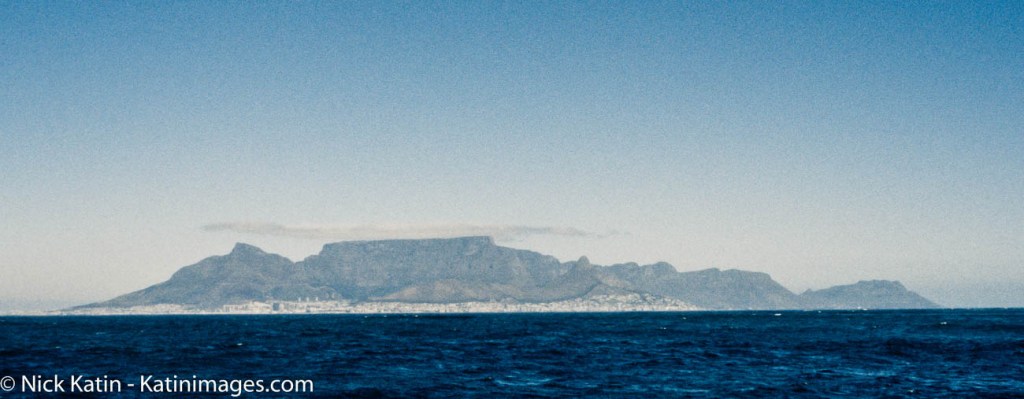
    Table Mountain in Cape Town from Robben Island former prison of Nelson Mandela


  • African shoestrings – South Africa Day Thirty-six – Cape of Good Hope

    We got an even closer look at the Cape the next day after picking up a cheap hire car from the unknown (to us anyway) Atlantic Car Hire. The plan was to explore the peninsula for the day and drop off the car in Stellenbosch, centre of the South Africa’s wine industry and some 40 odd kilometres away and still be within the free 150 kilometre mileage. What we didn’t realise was that drop off and pick up mileage were also included so we ended up having to fork out more money at the end of it than we had budgeted for!

    Nonetheless the Cape Peninsula is a beautiful spot. This is white man country, large two storey houses, apartment blocks and trendy little village’s front onto the white sandy beaches on both sides of the peninsula.
    No black or coloured townships here, just Cappuccino’s, designer labels and more BMW’s and Merc’s.
    Along the western side the famous Chapman’s Peak Drive is up there with the rest of the world’s great scenic drives. Carved into solid rock, this winding 10 kilometres of bitumen has several lookout points to avoid accidents caused by sightseers slowing down to admire the panoramic scenery at every bend. I’m not sure that worked. Cars screech to snail pace as they suddenly realise that they want to stop at the lookout they are in the process of passing!

    Somehow that day we managed to visit the World of Birds and Groot Constania the Southern hemisphere’s oldest winery, follow Chapman’s Peak Drive, tour the windy Cape of Good Hope Nature Reserve and explore the trendy the St. Tropez of South Africa, Clifton.

    We finished up having fish & chips from ‘Fish & Chips at the Rack’ in Hout Bay supposedly “the Capes best Fish and Chips” and then somehow finding our way back to the guesthouse in the dark with an extremely basic map.

    The Cape of Good Cape, a rocky headland on the Atlantic coast of the Cape Peninsula, South Africa.
    The Cape of Good Cape, a rocky headland on the Atlantic coast of the Cape Peninsula, South Africa.


  • African shoestrings – South Africa Day Thirty-five – Table Mountain Cape Town

    In our previous visit to Cape Town we had taken the cable car to the top of the 1000 metre Table Mountain (and back down again).
    This time, we promised ourselves, we would walk to the top and catch the cable car down. Today was a public holiday and even minibuses would be few and far between so we had to brave another of Andre’s lectures as he very kindly gave us a lift into the city.

    From there it was just a short walk to the main track that winds up the Platteklip gorge the easiest way up from the that side of the mountain.
    There are two very distinct features about Table Mountain, the fact that from a distance it appears to have as the name suggests a completely flat top and it’s “tablecloth”. The tablecloth is cloud that regularly rolls in and covers the top for anything like a few minutes to the rest of the week. This phenomenon usually happens around mid- morning so we wanted to ensure that we got up there early enough to see the 360° views.
    Last time we got to the top we had about 5 minutes before our vision was reduced to about 5 metres. This time we hadn’t even got up to the top before it rolled in, reducing visibility to a few metres and slowing our already slow progress.

    The track was a winding trail that zig zagged awkwardly and was strewn with large boulders and obviously designed for mountain goats. Worse still we had the challenge of having to clamber around hundreds of people all with the same idea. Now we had to pick our way through damp mist and poor visibility. Being as I said a public holiday, the last thing was I would have expected would to be find teenage school groups. But there hundreds of the little shits who, as well as some adults, seemed oblivious to the fact that there was actually a trail with lots of signs asking us to keep to it.

    But the gods did smile on us as we approached the top, the ‘tablecloth’ disappeared as quickly as it had appeared and we were able to spend a good hour and a bit admiring the great views. Table Mountain is at the end or the beginning of a small range called the twelve apostles that travel south and reduce in size at the beginning of the Cape Peninsula. It had cleared enough for us to see the famous Cape of Good Hope some 70 kilometres away at the end of the peninsula.

    Cape Town from Table Mountain
    Cape Town from Table Mountain
  • African shoestrings – South Africa Day Thirty-three – Robben Island Cape Town

    Another pretty interesting guy whom unfortunately we didn’t get around to meet was Nelson Mandela. We did however get to meet someone who served time with him on Robben island a small former prison island 11 kilometres north west of Cape Town.

    Eugene was his name and he served seven years on Robben Island for his part in a student anti-apartheid demonstration in 1983. He was still there but this time as a guide.

    Mandela spent twenty-six years as a political prisoner there and certainly in the earlier years had to overcome some pretty harsh treatment to survive.
    In the 1960’s they were only allowed one visit of 30 minutes and one heavily censored letter every six months.
    For around thirteen years Mandela and others were made to work with picks and shovels in a lime quarry where the heat and blinding glare in summer could eventually kill or blind.

    In the 1980’s the authorities eventually softened under international pressure and stopped hard labour, allowing education of selected subjects to university level.

    The prison itself however is not what you expect. The layout is pretty similar to any other high security prison found in the western world, you know, small cells, high walls, a cramped exercise yard and barbed wire everywhere. For effect life size cardboard cut outs of past prison guards are strategically placed around the prison corridor and yards. These guys are pretty lifelike, at first glance I wondered what this guy in the uniform with a gun was guarding! From what Eugene was saying I was glad that they were only cardboard, their reputation as cruel and harsh was apparently well justified. Beatings and other acts of violence were all in a day’s work. And yet the main gate to the prison gives no hint to these brutal facts. Written above it in Afrikaans is “ONS DIEN MET TROTS” that means “We serve with pride”.

    The known history of the island dates back some 400 years and has been used as a fishing base, a whaling station, a hospital, a mental asylum, a civilian prison, a military base, a political prison and now finally a museum.
    It’s as a museum that it seeks to be as Mandela puts it “a symbol of the victory of the human spirit over political oppression; and for reconciliation over enforced division.”

    The island itself has little natural beauty to mention although it does have the odd gemsbok and springbok around and the views of Cape Town and its spectacular Table mountain backdrop are worth the admission price alone.

    Table Mountain in Cape Town from Robben Island former prison of Nelson Mandela
    Table Mountain in Cape Town from Robben Island former prison of Nelson Mandela
  • African shoestrings – South Africa Day Thirty-one – Cape Muslim quarter Cape Town

    You know Cape Town is really a very beautiful place. It’s up there with the likes of Sydney, Rio de Janeiro and San Francisco as places of natural beauty. With the Atlantic Ocean on its western and northern sides and the brooding presence of Cradle Mountain to the south, it’s in a great location.
    Of course location doesn’t mean that the city itself is necessarily a great place to be.
    I suppose on a scale of one to ten I would rate it around five or six. It’s much like any other New World city, lots of people going about their daily business, with the usual social problems like homelessness fairly evident in the form of beggars and glue sniffing street kids.
    It does have of course quite a history, being first settled in 1652 by the Dutch. And they have managed to retain a lot of the Architecture that sprung up in the first 200 years or so. Unfortunately most of it is quite boring!

    We did a walk tour to explore some of these ‘attractions’ and the only attractive buildings were the Dutch Cape SA museum and the president’s house.
    What was fascinating was the Cape Muslim Quarter. It’s mainly inhabited by descendants of slaves or political prisoners from the Dutch East Indies and you’ve guessed it, they are mostly Muslim. Here we found cobbled streets, mosques and flat roofed colourful houses. We also found that there was no one there, well at least no other tourists! This made us quite uncomfortable, after all, most guidebooks advise you not to go into deserted areas as this makes you a mugging potential. Personally I didn’t think we had anything to worry about but I was still grateful to enter the relative safety of the Bo-Kaap museum a building furnished as a nineteenth century Muslim home where we finally found two other tourists, looking equally as nervous.

    Needless to say we survived the rest of the Cape Muslim quarter and found our way to ‘the Company Gardens’ six hectares of botanical gardens that were originally Jan van Riebeecks vegetable garden planted soon after the first settlement. Jan van Riebeeck, for those of you who don’t know, lead the initial settlement back in 1652 and from all accounts was instrumental, in his time there, in establishing the Cape colony against all odds.

    Dutch Reformed Church, in Franschhoek, South Africa
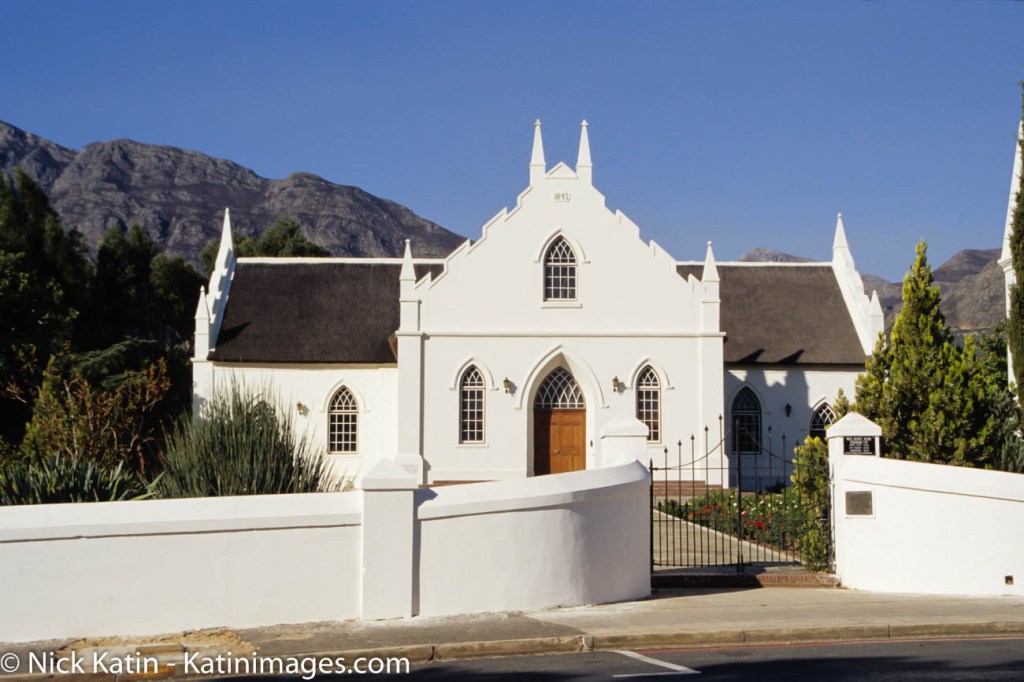
    Dutch Reformed Church, in Franschhoek, South Africa
  • African shoestrings – South Africa Day Twenty-nine

    We left J’burg for Cape Town the next day via a domestic South African airways flight.

    We had been to Cape Town before but we had felt that hadn’t done it justice, so this visit was to ‘see’ the place properly. Last time we had stayed in a pleasant Bed & Breakfast near the city centre. This time we were going to stay in a backpackers of which like J’burg there were many. Expecting to be hassled by their touts at the airport, we hadn’t bothered to book ahead. Guess what? The only touts we saw were for taxis. After a three or four phone calls to different hostels we soon realised why. They were all full!

    It was a long weekend and Cape Town was almost booked. I say almost because eventually we found a backpackers that had a double room and they paid for the shuttle from the airport to take us there, saving us R30 each.
    Unfortunately that was not as much to our advantage as we initially thought, we were now obligated to stay at least one night. The Cat and Moose was we thought at the time about as bad as it gets. The landlady led us to a dingy little room with threadbare carpet, paper thin linen and the sort of musty damp and putrid smell that makes you want to vomit! Worse still we had to walk through a dorm for access and it was across an alleyway from the TV area where a little blonde haired prick full of bullshit (we had met him earlier) had the sound loud enough for people in the next suburb to hear.

    Needless to say we were out of there the next day!

    With the help of the tourist office we found the colourful Observatory guesthouse in a suburb called, you guessed it, Observatory, a trendy uni student area. I say colourful because the rooms all had loud colour schemes and the owner, Andre and his manager, Gregory, were both pretty camp. This sorted added a certain ambience to the place and was cheap, clean, quiet and comfortable. But here’s the rub…..we were no longer within walking distance from the city centre and apparently public transport as we know it, was virtually non existent.

    Cape Town from the Aerial Cableway lookout on Table Mountain .
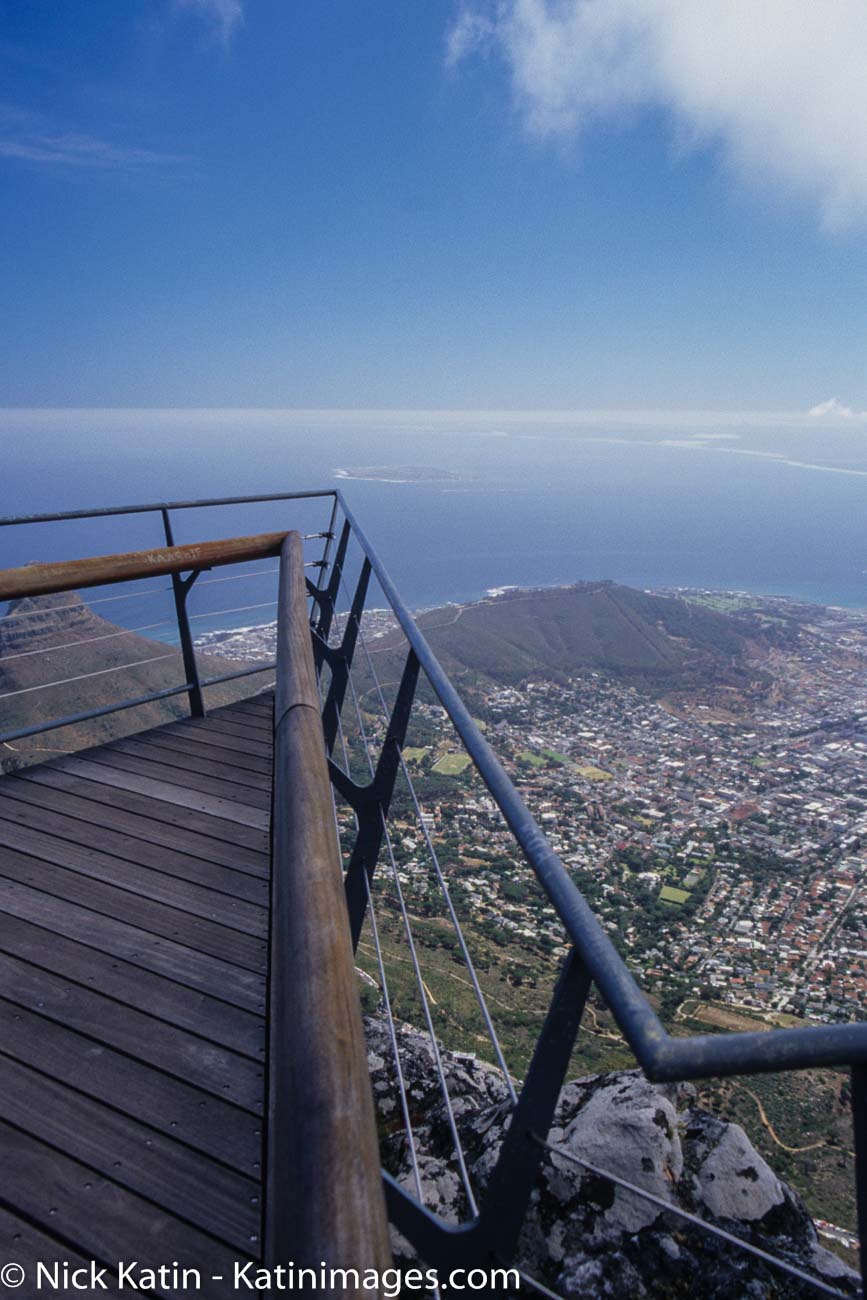
    Cape Town from the Aerial Cableway lookout on Table Mountain .
  • African shoestrings – South Africa Day Twenty-four

    It was as the guy from Budget was driving away that a rather worrying thought crossed my mind.
    What if he wasn’t a Budget employee and had just easily hoisted a car from two unsuspecting and naïve tourists! The fact that he was standing in the Budget car park with a Budget jacket might mean nothing; that could have been part of the ‘sting’. I decided that I would take an aggressive approach if it turned out I was not paranoid.

    “Why let a car thief stand in your car park with your uniform on was going to be my approach”, I was going to take it up to them!

    I was awoken from my absurd fantasy by more of these backpacker hostel touts ceaselessly badgered us to stay in their hostels.Apparently since the end of apartheid in 1994 there have been numerous hostels sprouting up in the more popular tourist spots especially J’burg and Cape Town.
    I don’t how many there are in J’burg but It appeared that each one had a tout at the airport.

    As it happened we had booked a night in the ‘Airport backpackers’ before flying to Cape Town on our freebie flight.
    This was our first experience of a backpackers and we had been strangely comforted by the fact that the female voice on the other end of the phone had been Aussie when we booked a few days before.
    So when Gerard picked us up at the airport in old beaten up VW golf and proceeded to apologise for the damp in our room, dropping the price of the room by 20%, our comfort was soon replaced by some trepidation.
    This was heightened by the fact that we had to wait whilst Gerard seem to spend rather a long time getting it ready before allowing us to move in.

    Actually our room wasn’t that bad, the only pieces of furniture were a soft, uneven bed and a rickety wardrobe. The smell of damp caused by a leaking shower next door was just about tolerable.

    Lying at the southern end of the central Drakensberg Giant’s Castle, which gets its name from the outline of the peaks and escarpment that combine to resemble the profile of a sleeping giant, is essentially a grassy plateau that nestles among the deep valleys of this part of the Drakensberg.
    Lying at the southern end of the central Drakensberg Giant’s Castle, which gets its name from the outline of the peaks and escarpment that combine to resemble the profile of a sleeping giant, is essentially a grassy plateau that nestles among the deep valleys of this part of the Drakensberg.
  • African shoestrings – South Africa Day Twenty-three

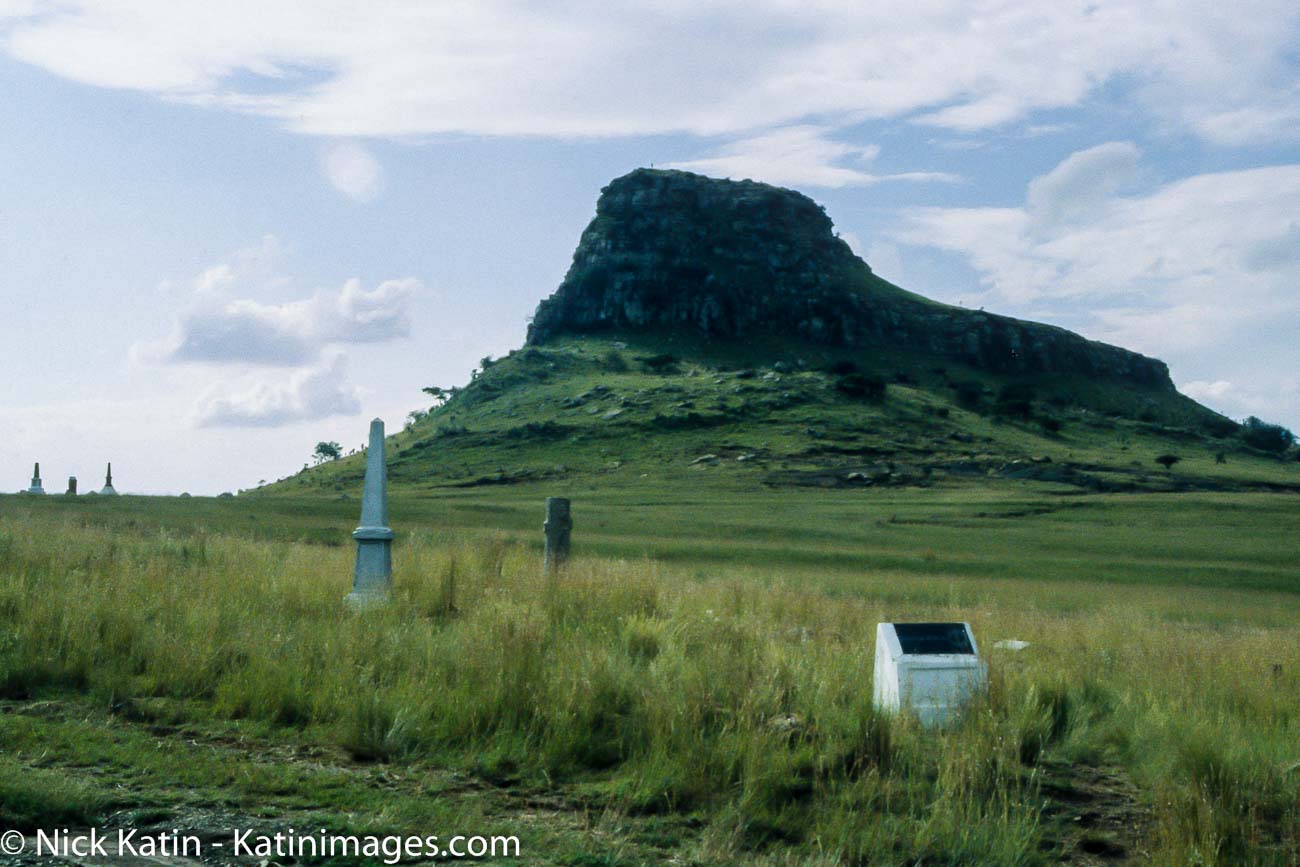
    We found the Isandlwana battlefield quite eerie and moving. Monuments and unmarked graves in the form of stone cairns (piles of small rocks and stones for anyone that doesn’t know what a cairn is) dot the base of the hill, marking spots where they believe certain events or deaths took place.
    There is a memorial to the Zulu dead but somehow we didn’t really get the feeling that the local Zulu population hold this site as sacred, cattle and rustlers just strolled across the field without any reverence to the memorials around them.

    For those history buffs I didn’t mention the other two wars that were fought in this area, namely the first war of independence and the Anglo Boer war.
    Both of these wars were fought between the British and the Afrikaners or Boers and eventually led to the British having complete control of South Africa, despite a crushing defeat in the former.
    It was in the Anglo Boer war that the first ever concentration camps were used, this time by the British, who imprisoned Boer women and children 26,000 of whom died in the camps.

    Ironically the Boers regained control of South Africa, this time peacefully, through the ballot box in 1910 and only relinquished it in 1994, again through the ballot box in the country’s first multi racial election.

    At this stage we were still 360 Km’s from J’burg and had to drop the hire car back to the airport the next morning. So after staying the night in rondavel on a rather strange property called Carla Mai we headed out early to J’burg.

    Now you most of you who’ve ever hired cars would know that you are meant to return them with a full tank. At J’burg airport this was a hassle! We had tried unsuccessfully to find one close to the airport and thought there’s bound to be one there. Do you think we could find one! ………..No!

    After circling, getting lost and losing our sense of direction, we gave up and somehow managed to find the Budget car park and office. There they have stewards who guide you to a parking spot and one of these guys very obligingly jumped in the car and took us to the nearest fuel station 30 seconds away! Following this he dropped us off at the international terminal and took the car back to Budget.

    Lying at the southern end of the central Drakensberg Giant’s Castle, which gets its name from the outline of the peaks and escarpment that combine to resemble the profile of a sleeping giant, is essentially a grassy plateau that nestles among the deep valleys of this part of the Drakensberg.
    Lying at the southern end of the central Drakensberg Giant’s Castle, which gets its name from the outline of the peaks and escarpment that combine to resemble the profile of a sleeping giant, is essentially a grassy plateau that nestles among the deep valleys of this part of the Drakensberg.
  • African shoestrings – South Africa Day Twenty-two

    In the middle to the end of nineteenth century a large group of Afrikaners, (descendants of the original, mainly Dutch, French and German settlers) trekked their way their way from the Cape after the British took control of the Cape colony. This was called the Great Trek.
    When they got to Natal they found the Zulu’s here and after trying to negotiate for some land ended up fighting them.

    Now the British were also there and they had already claimed the land but started to feel threatened by a build up in Zulu numbers, eventually, you’ve guessed it, another war, called unimaginatively the Anglo-Zulu war, broke out.
    Two famous battles were fought in this war, Isandlwana and Rorke’s drift.

    Four years ago we stayed in Dundee and visited both the local Talana museum, a resource of information and displays about all the battles and events of these wars, and the scene of Rorke’s drift. The heroic effort by 139 British soldiers to hold off 4000 Zulu’s was immortalised by the movie Zulu. It starred Michael Caine and Stanley Baker and we loved it, henceforth our desire to see the real thing! It’s one of those places that requires a lot of imagination.
    None of the original buildings are there and the grassland that was there at the time has been overrun by scrub due to years of overgrazing. But the museum, available literature and markers that are dotted around go some way towards transporting you back into time.

    Now the whole reason for us coming back to this area was to see the other Battlefield, Isandlwana.
    What happened at this hill a few hours before the Battle of Rorke’s Drift was horrific. I won’t bore you with the complex maneuvers that took place beforehand except to say in summary that the British had issued an ultimatum demanding this, that and the other, which the Zulu’s ignored, triggering off a British invasion of Zululand. The British centre force accidentally stumbled on the main Zulu force at Isandlwana, which spoilt the Zulu’s plan for a surprise attack. So they attacked anyway and in two hours 20,000 men surrounded the British and annihilated 1400 of the 1800 British soldiers. Some of the survivors found their way to Rourke’s Drift and helped fortify the position together with the small force that had been left there to guard a river crossing and supplies.

    The Isandlwana battlefield where the Zulus destroyed 80% of the British forces in Kwazulu-Natal in South Africa
    The Isandlwana battlefield where the Zulus destroyed 80% of the British forces in Kwazulu-Natal in South Africa
  • African shoestrings – South Africa Day Twenty-one

    What Giant’s castle is really known for is its 5000 Bushmen Rock Paintings and the twelve species of Antelope and from our experience it’s a lot easier to see the former than the latter. With one of the park rangers we went to Main cave, one of the two sites open for viewing. He pointed out and interpreted a lot of the paintings that date from early man through to as recent as one hundred years ago, just before the bushman left this area forever.

    From Main Cave we followed the River walk alongside the quaintly named two Dassie Stream. Dassies are small animals that resemble giant hamsters and are about the size of a large domestic cat and seem to be everywhere in Southern Africa. Somebody with a fertile imagination spread a story about their closest relative being an Elephant!

    Back to the pub at White Mountain lodge. We got talking to Peter, a young white teacher there with a school group. He actually was one of the few that wasn’t thinking of leaving South Africa despite the fact that educational standards for all students were slipping fast due to a chronic lack of funds. Peter had relations in Australia and had been to Perth so he knew the alternatives. I wondered as we talked whether he would change his mind if/or when he has kids.

    South Africa is a land of undeniable natural beauty, it has the mountains, beaches, gorges and desert, it also has an abundance of wildlife, plus of course a fascinating cocktail of cultures. But one of its greatest attractions is its colourful history.

    In an area centered around the quiet farming town of Dundee in the province of Kwazulu-Natal, lies the Battlefield Route. This self guided tour takes in attractions historical events and obviously battles in this pretty part of the country. It was here that incredibly four wars were fought in the middle to the end of nineteenth century. More on that next week

    Lying at the southern end of the central Drakensberg Giant’s Castle, which gets its name from the outline of the peaks and escarpment that combine to resemble the profile of a sleeping giant, is essentially a grassy plateau that nestles among the deep valleys of this part of the Drakensberg.
    Lying at the southern end of the central Drakensberg Giant’s Castle, which gets its name from the outline of the peaks and escarpment that combine to resemble the profile of a sleeping giant, is essentially a grassy plateau that nestles among the deep valleys of this part of the Drakensberg.
  • African shoestrings – South Africa Day Twenty

    The accommodation at Royal Natal was more than we wanted to pay so we took our chances on the road.
    Peering through the gloom we knocked on several doors of motels and B & B’s all of which were full!
    Eventually we managed to find a huge chalet at a rather sterile Drakensville Resort. This place was a holiday village full of suburban fibro homes and unfriendly people. I felt like we were back in the 50’s in one of those American suburbs that are the scene for a horror or serial killer movie but without the pumpkins.

    This was definitely a white man holiday camp! There was not at a black face to be seen!
    What was to been seen however were little weevils in the bag of rice we bought at the shop there. Either added for flavour or it had been on the shelf for a while we took it back and ended up with another bag which guess what, also had weevils.
    We gave up trying to cook a rice dish went to bed and left early the next morning.

    By contrast White mountain lodge is a quaint resort with white thatched roof cottages and cabins overlooking a large lake with lots of physical activities like canoeing and walking and less strenuous ones like the pub to keep guests occupied. Needless to say the latter was were we ended up that night after spending the day at Giant’s castle game reserve.

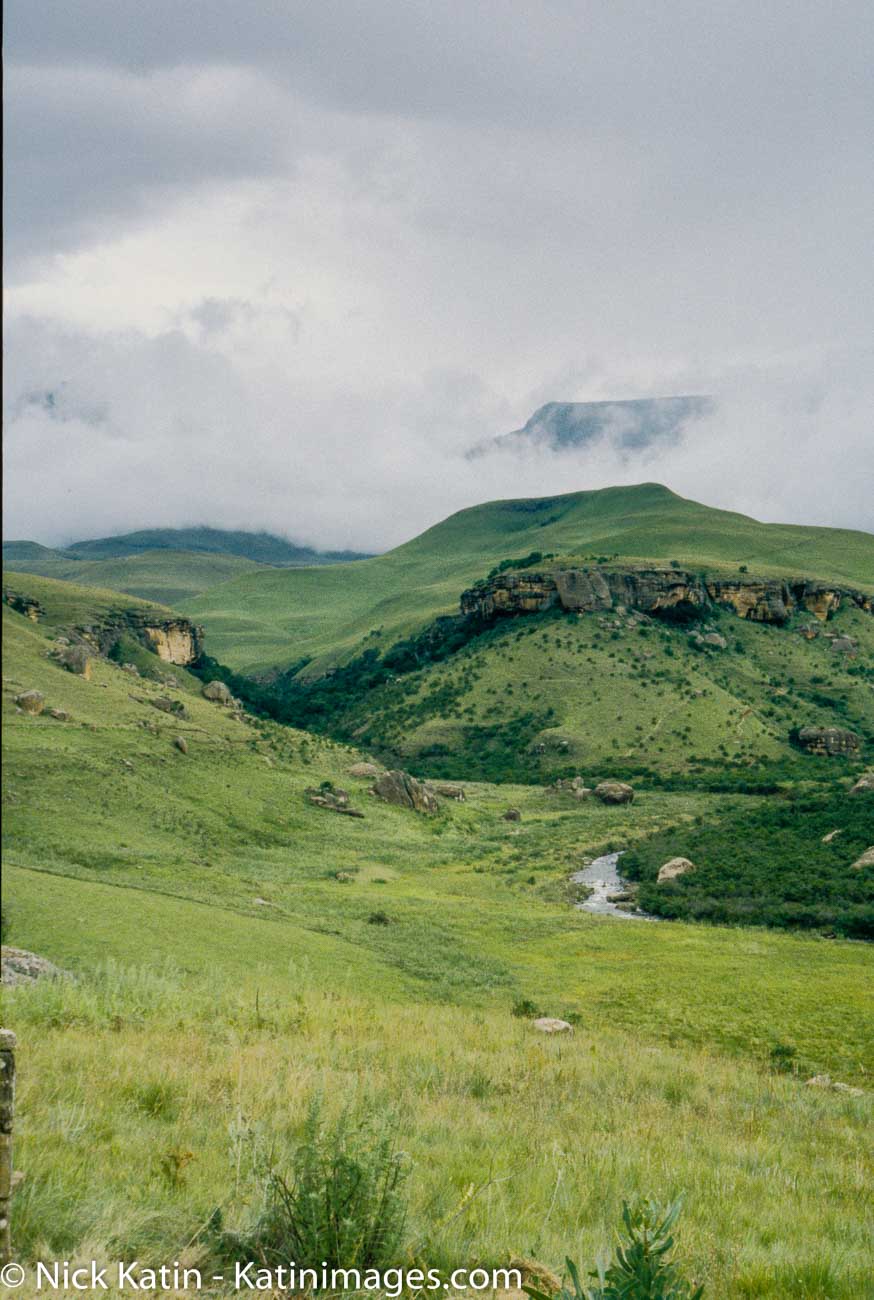
    Named after one of the highest peaks in the park, this is real high country with the highest mountain in the Drakensberg, the 3409 metre Injasuti Dome, located here. It’s not as spectacular as Royal Natal but it is quite awe inspiring. Huge perfectly curved peaks of various sizes covered in grassland dominate the landscape, particularly at the eastern and southern borders of the park. Down in the valleys the landscape is covered in walking tracks and fast flowing rivers.

    Lying at the southern end of the central Drakensberg Giant’s Castle, which gets its name from the outline of the peaks and escarpment that combine to resemble the profile of a sleeping giant, is essentially a grassy plateau that nestles among the deep valleys of this part of the Drakensberg.
    Lying at the southern end of the central Drakensberg Giant’s Castle, which gets its name from the outline of the peaks and escarpment that combine to resemble the profile of a sleeping giant, is essentially a grassy plateau that nestles among the deep valleys of this part of the Drakensberg.