Katin Images Travel Photography

Travel Photos, Travel Photography Tips and Software

Tag: etosha

  • African shoestrings – Namibia Day Sixty four – Waterberg Plateau Park

    Our destination was the Bernabe de la Bat Resort in the Waterberg Plateau Park  (which sounds a lot more romantic than it is) some 300 kilometres south. We planned to see a couple of sights on the way, Lake Otijikoto and the Hobo Meteorite. Lake Otijikioto is one of the only two natural lakes in Namibia.
    This important fact didn’t really make it any more interesting. It’s just a collapsed limestone cavern that later filled with water and the only things of interest was its aqua blue colour and the fact that at its deepest (estimated to be 55 metres) lived some rusting ammunition and artillery. In 1915 the Germans were retreating from the South Africans and decided that dumping their weaponry into the lake to prevent those nasty South Africans having it was a master stroke.

    At least the lake was just off the main road.
    Not so the Hobo Meteorite! According to the Lonely Planet it was about 25 kilometres west of Grootfontein, which was 63 kilometres east of Otavi making it 38 kilometres from Otavi and a 76 kilometre round trip for us as we passed through Otavi.
    Easy! Well no, it was not! In fact the turn off, which was extremely hard to find, is a 76 kilometre round trip but the Meteorite itself was a 160 kilometre round trip!
    I guess we could have accepted that had this great artifact from the sky been a sight that would change our lives or at least been mildly interesting. It looks just like a rock (its mostly iron) partially buried in the ground with a little bit of landscaping to make it look pretty. Sure there was some interesting information on a board nearby but nothing we couldn’t have looked up on the internet.
    “So what did you expect?” I hear. I’m not sure but it was a long way to go for a lump of iron. If it had been green kryponite that glowed and changed colour, or throbbed like something from Star Trek, I would have been happy. But this thing just looked like something that had been found in another part of the country and brought here to make some extra cash and piss tourists like me off!

    The Bernabe de la Bat ‘Resort’ is nestled in the shadow of the 50 by 16 kilometre sandstone Waterberg plateau that stands around 150 metres high.
    The campsites were sheer luxury, grass. We hadn’t had grass since Daan Viljoen. No dust to find its way into your sleeping bag at night or blow into the tent by day. It was terrific.
    We actually spent the afternoon of our only full day there cleaning the dust out of the car. Considering how small it was, it seemed to hold an awful lot of sand.

    In Australia a big proportion of retirees, buy a caravan and do the round trip around Australia, sometimes for months, sometimes for years. In South Africa they head North to Zimbabwe, Zambia, Botswana and Namibia. Namibia is generally favourite amongst those from the Cape Town area. Here at Waterberg, we met three couples up from the ‘Cape’ travelling in convey. They were extremely friendly and helpful (even hanging up our washing whilst we were out walking).

    Speaking of walking we followed the only decent length walk trail, outside of the couple of long distance trails, in the park to a spot called mountain view at the top of the plateau. It was not a long climb but it gave us a bit of a workout after the day of driving we had the day before. The views at the top were certainly worth it, we could see for miles across the scrubby plains interrupted by the odd decaying sandstone hill but probably the best view was of the plateau rim with its sheer sided red, orange and green rock and vegetation.

    If you like this then hit “follow” on the side bar
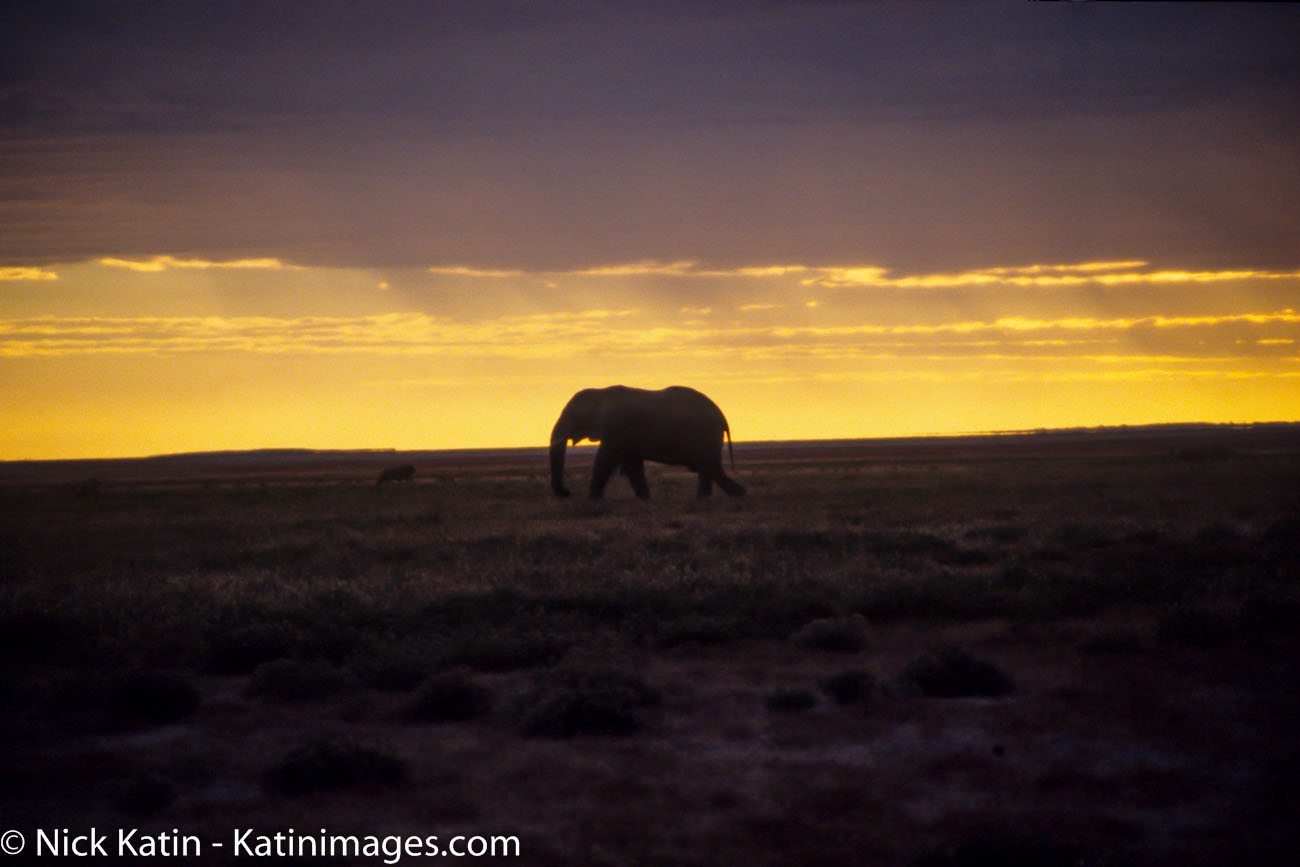
    An elephant strolling through the scurb at sunset in Etosha national Park, Namibia
    An elephant strolling through the scurb at sunset in Etosha national Park, Namibia


  • African shoestrings – Namibia Day Sixty three – Etosha NP

    We now on our way to Halali, the next rest camp that was 70 kilometres away, which should only have taken us around hour but this place was teeming with animals. Every waterhole had an abundance so we didn’t end up getting there until after midday some 4 hours later!
    This wildlife viewing slows you down!
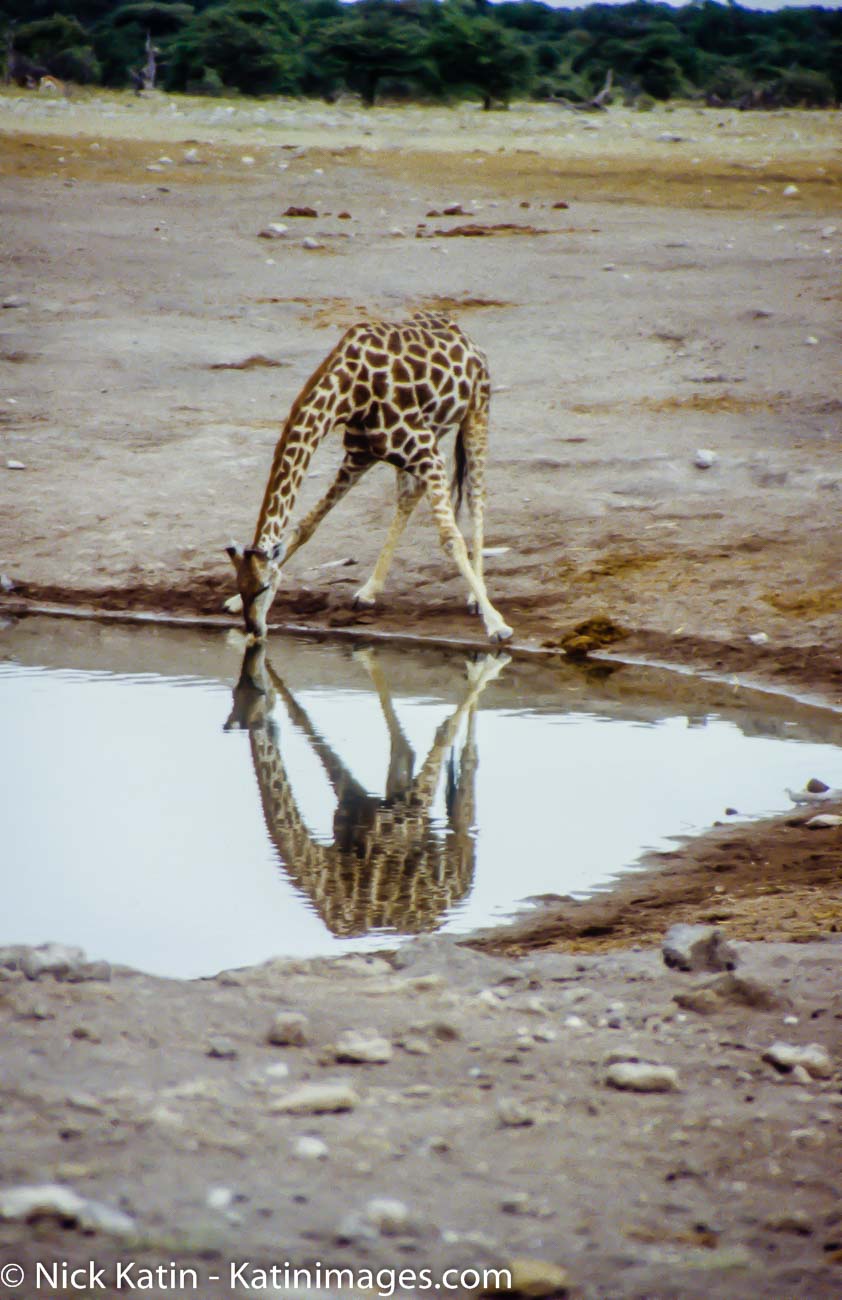
    But how can you hurry when a big herd of elephants turn up at waterhole that you’ve been watching for a few minutes or two or three giraffes bend over, legs splayed, to have a drink.

    At Halali we were back to camping after the dubious luxury of a chalet at Okaukuejo. It was fine, a bit dusty but there weren’t many other happy campers, so it was quite quiet.
    That was until an overlander with at least 20 people hanging off it parked next to us. Needless to say we didn’t get much sleep that night.

    Halali also had its own waterhole and that evening we saw a three black rhino again. We tried to work out whether it was the same three we had seen at Okaukuejo the previous evening. It seemed almost impossible that three rhino (one was a baby) would walk 70 kilometres in a day but who knows! As they lapped away at the water, a lioness and a couple of hyena appeared. They didn’t hang around long! One of the rhino continually went for them so that eventually they got the hint that they weren’t welcome to join the rhino family for a drink.

    Our morning game drive yielded more lions again. How boring! There were three males strolling down to Salvadora waterhole obviously thirsty and possibly hungry. We hung around for a while but they just found a shady tree and slept.
    Lions actually sleep or rest for around twenty-one hours a day, leaving just three hours to hunt and eat. It’s a little known fact that they actually have a very low kill hit rate but one decent kill can last them for almost a week. Of course these three guys probably weren’t thinking too much about actually hunting that’s a predominately female occupation. They actually looked like they were having a boy’s day out, a bit of strutting and a few drinks and whole lot of sleep.

    We had the same distracting problem getting to Namutoni the last of the rest camps in the afternoon, which again is 70 kilometres away.  Elephant, giraffe, gemsbok, etc all appeared from time to time at different water holes.

    Namutoni is home to the rather out of place Namutoni fort; a relic of German colonial days. Built in 1899 as an outpost for troops to control the Owambo people, it’s now tourist accommodation. In 1904 seven soldiers faced the impossible task of defending it against 500 warriors, needless to say they didn’t succeed.

    Namutoni had its own waterhole but for some reason it’s not as popular with the animals as the others at Okaukuejo and Halali, even though it’s a lot more picturesque. Still we couldn’t really complain we had seen a cheetah close up and fifteen giraffe on our late afternoon game drive earlier.

    It was time to leave Etosha. It really was an experience and great value for money in comparison to some of the other game parks in Africa. US$22.00 per day for a chalet and US$13.00 per day for a camp site including all the game viewing you can cram in during daylight hours is pretty good. Especially when generally speaking there’s so much game around.

    If you like this then hit “follow” on the side bar

    A giraffe takes time out to have a drink at a watehole in Etosha National Park in Namibia
    A giraffe takes time out to have a drink at a watehole in Etosha National Park in Namibia
  • African shoestrings – Namibia Day Sixty two – Etosha NP

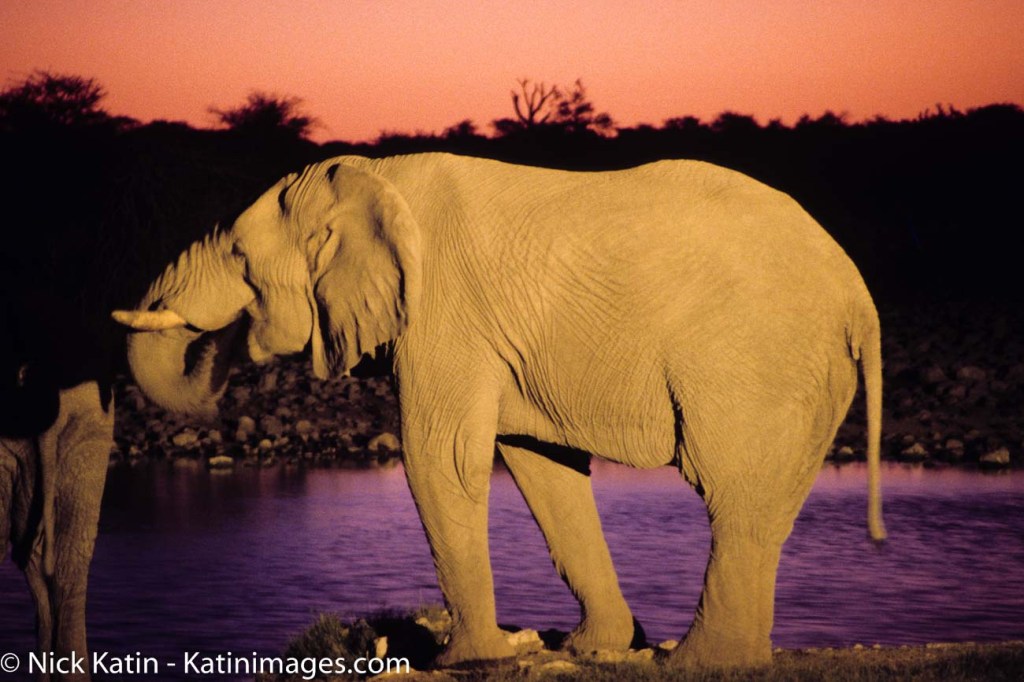
    Back at the camp we found a couple of seats by the illuminated camp water hole and waited for the show to start. As darkness came so did a herd of thirsty Elephants. They drank like there was no tomorrow. We thought that they would suck the water hole dry. But suddenly they all stopped and led by the boss bull all fifteen including five babies, trooped off, like a scene from Jungle Book, into the under growth and out of our sight.

    Later that night we were really privileged. Three black rhino sauntered down for a drink. Why were we privileged? Well the black rhino is probably the most famous endangered species in Africa. Due, mainly to poaching, there are a little over 3000 left after having a population of 60000 in 1970. It’s not my place to explain the mechanics of why these powerful beasts are exterminated ruthlessly for their horn so that the ‘misguided’ population of some Asian nations can use it for medicinal and aphrodisiac purposes. Nor is it my place to explain why the Yemeni insist that they must have daggers made of rhino horn.
    Suffice to say that due to both of these stupid ignorant beliefs a few ruthless businessmen make a fortune out of having a beautiful animal virtually wiped out from the surface of this planet and that sucks!

    Black rhino are also one of the ‘big five’. These five were the most prized ‘scalps’ by game hunters and if you think that’s just a relic of the past, then think again, there’s still plenty of opportunities on private land for game hunters to shoot defenseless animals for ‘sport’.

    Now the ‘big five’ are sought after for the best viewing. The other four are lion, leopard, buffalo and elephant and on that particular day we had seen three of them.
    For those of you thinking of game viewing in Africa, don’t knock yourself trying to see this group of animals. There is plenty of other wildlife to be seen that are just as enjoyable to watch. Game viewing is not a serious of ticks on a ‘to see checklist’ but an opportunity to watch Mother Nature at it’s wildest best.
    Anyway that’s enough winging and preaching for now.

    The next morning there was wildlife everywhere!………….. Giraffe, zebra, hyena, red hartebeest, impala and kudu to name just a few and then on then way back a huge bull elephant just ambling across the road just a few metres in front of us. It occurred to us at the same time that elephants have been known to charge if spooked, if this baby had turned on us this little ‘Chico’ would have been scrap metal within seconds.
    Needless to say I had the gear stick in reverse and the handbrake off, just as a precaution!

    The afternoon yielded different results. We went back to Okondeka hoping to see the same pride of lions. They were missing in action but what we did see was a male lion sitting in the shade of a thorny acacia tree, you know the ones, the trees that are shaped like an umbrella and are in almost every African sunset shot found in the glossy travel brochures.
    We didn’t realise that he was injured until he got up and strolled or rather limped away. We managed to follow him to his destination, a carcass that probably a few hours a go was live Zebra, going about his business of chewing a few blades of grass, before being brutally murdered for Monsieur lion’s dinner. Somehow the lion must have got injured during the kill, but that didn’t stop him chewing away and at the same time growling at the vultures and jackals who anxious to share the spoils.
    It was quite fascinating to watch. I felt like we were watching a discovery channel show!

    If you like this then hit “follow” on the side bar
    An elephant drinking at dusk at a camp waterhole in Etosha NP in Namibia
    An elephant drinking at dusk at a camp waterhole in Etosha NP in Namibia


  • African shoestrings – Namibia Day Sixty one – Etosha NP

    Before we left home the idea of picking up some casual work in Southern Africa had appealed. We emailed several lodges in Namibia and Botswana with no luck. However some of these lodges were quite helpful and invited us to drop in when we were in the area, hoping, of course, that we would stay as guests.

    One of these lodges was Camp Setenghi, who had an office in Outjo, the last decent sized town before Etosha. Wayne and Ilvia were genuinely friendly and interested in what we were doing and more than happy to offer advice with no strings attached. They still had no work and in fact warned us that it was illegal to work in Namibia without a work visa and that could lead to some unscrupulous employees taking advantage and basically ripping you off.

    We had actually already dismissed the idea of working in Africa. One of the pitfalls of middle age ‘backpacking’ is the fact that you are often parents as well. In our case our grown up sons were both working in London and we hadn’t seen either of them for quite a while. Working would have delayed any reunion, so it seemed a better idea to simply work for longer in England, where there appeared to be plenty of work and where we had no work visa issues.

    Etosha National Park is 22,000 square kilometres of animals!
    It doesn’t have the same international profile as Botswana’s Okavango Delta and Chobe, Kenya’s Maasai Mara or Tanzania’s Serengeti but it does have an abundance of wildlife that rivals any of it’s more famous counterparts.
    The name Etosha means ‘great white place’ after its main feature the mostly dry Etosha pan that is roughly 120 kilometres long and 72 kilometres wide and dominates the Park in area. Game viewing revolves mainly around the many natural and manmade waterholes that dot the southern edge of the pan. That’s not to say that game can’t be seen elsewhere, it’s just they’re the most likely spots.

    We stayed in a small chalet in Okaukuejo, the first rest camp. Each camp has a waterhole of it’s own and we were disappointed that our chalet with it’s hospital towels and décor wasn’t closer to it. But we soon forgot that and concentrated on the business of wildlife viewing.

    One of the beauties of Etosha is that it’s easy to self-game drive even in the little ‘Chico’. The roads are mostly gravel but are pretty firm so a 4WD is not required. As soon as we got settled in, we were off in search of wildlife.

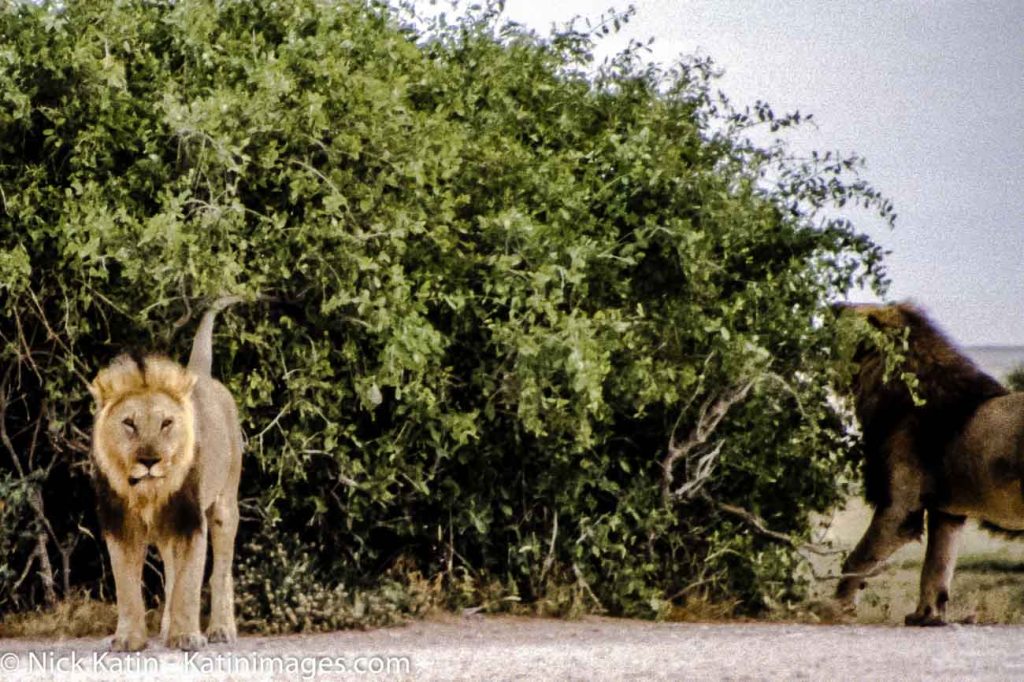
    At the Okondelia waterhole there was an abundance. Zebra, Wildebeest, Gemsbok, Springbok, Jackals and the pièce de résistance, Lions, everyone’s favourite. We spotted one going for a kill and suddenly there were another seven, two females, one male and four young males, strolling down from the hill behind us towards the water hole to our front. Amazingly they just ambled around the five or six vehicles, that were all clambering for the perfect possie and photo, as if they weren’t there. One of them, a young male, got within 2 metres of the car and Sue nearly dropped the camera out of the window in her excitement.

    What incredible looking beasts they are, finely tuned, aerodynamically designed and perfectly shaped, they are nature at it’s handsomest. You can go to the best zoo’s in the world and see them up close but nothing beats seeing them on their own turf. In a zoo they are just a caged animal, here free to roam they are Lions! They have that spring to their step and sparkle in their eye. This is who they are!

    They all met up at the water hole for I suppose a bit of a sundowner. It was a great start marred only by some dickhead in a red Chico moving his car around to get a better shot at one of the other young males close to his car and frightening him in the process. He should have been dragged out of the car and literally thrown to the lions for dinner by the rest of us, who felt honoured enough just to sit still and experience mother nature at it’s best.

    If you like this then hit “follow” on the side bar

    Two lions hanging out together at Etosha National park in Namibia
    Two lions hanging out together at Etosha National park in Namibia
  • African shoestrings the plan part two

    So with the flights books and with the aid of countless travel guides borrowed from the library, the internet and the scantiest of information from the few African countries tourist offices in Australia we plotted our route.

    We gave ourselves 111 days to travel overland from J’burg to Dar es Salaam, see what we wanted to see and spend only an average US$100 a day, not each, but in total! We would stay in backpackers, youth hostels, cheap hotels and where possible camp. The latter was made a little difficult on account of the fact that we weren’t taking any camping equipment but as they say, there’s more than one way to skin a cat!

    The only things we booked here in Perth were our first nights’ accommodation and ten days car hire in J’burg. There was a very important reason for pre booking both of these. Safety! J’burg is infamous for violent crime; the last thing we wanted to be doing when we arrived was wondering the streets looking for somewhere to stay or looking for a hire car. No, we just wanted to stay one night near the airport, pick up a car and get the hell out of there!

    We booked the car through our travel agent and the accommodation through the Internet. Maybe it’s because of time constraints, security or lack of knowledge but it’s interesting that so many people still use travel agents. We found a cheap motel in the right location for half the cost of what our travel agent quoted.

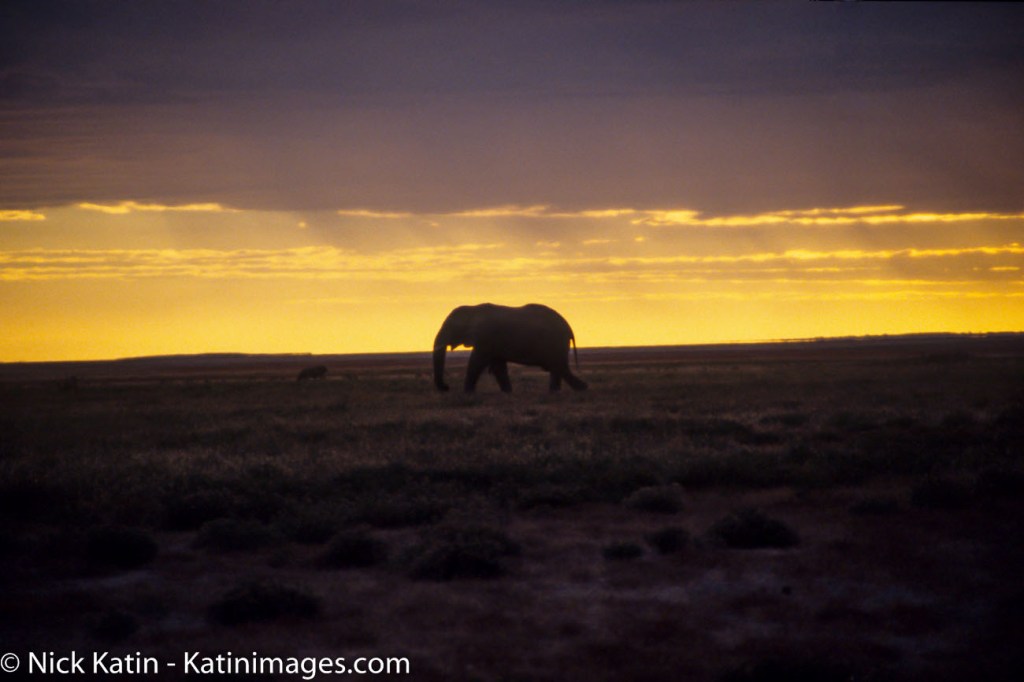
    An elephant strolling through the scurb at sunset in Etosha national Park, Namibia
    An elephant strolling through the scurb at sunset in Etosha national Park, Namibia