Katin Images Travel Photography

Travel Photos, Travel Photography Tips and Software

Tag: education

  • Here’s why it’s about Time you took your own Stock Photos.

    Here’s why it’s about Time you took your own Stock Photos.

    I Know, you’re happy using other people’s stock photos – And that’s fine.
    However, your business is unique and it deserves unique content to grow and scale.
    I’m not saying that you need great photos to be successful, you may have other advantages or skills that can offset that.
    But we are an image driven society and without originality a business will struggle to stand out from the crowd.
    You can read more on this topic here.
    By the way I’m not the only one to hold this opinion read these articles as well:

    The tyranny of stock photos

    Stock Photography Sucks! Let’s Do Something about It!

    11 Ways Photos Harm Ecommerce Conversions

    Say No to Stock Photography and Create Authentic Photos

    So let me ask you this:

    • Are you fed up with wasting your time searching for stock photos for your business?
    • Have you used a stock photo, only to see it being used elsewhere by another business, even a competitor?
    • Do you always find yourself saying “Oh if only I had a photo of X”?
    • Have you had a photo taken on your behalf that you submitted to your ad agency or printer only for them to charge you to rework or even retake it because they don’t think it’s up to scratch?
    • Have you paid a photographer to take some photos for your business only to be unhappy with the ‘finished article’?

    If you answered “yes” to even one of these questions, then read on.

    Because despite everything you read to the contrary you can learn to take some great photos consistently to impress and attract customers.

    Stock photo of spanish shoe shop

    So what’s the advantages:

    Well you can

    • Spend time creating your own and be in charge of your own destiny.

    Taking photos (and videos) for business marketing is different. Not harder or easier but different.

    The eye should be looking to make your product or service as attractive as possible sometimes in an obvious way, other times in a subliminal or subtle way.

    Stock photo of library in Melbourne

    • Make unique photos that you own the copyright to

    It always amazes me how little is understood about just the basics of copyright
    When a photographer conducts a shoot for any business (or wedding or portrait session or any other third party) they keep the copyright. What that can mean is that unless you have a watertight contract with them, that they are prepared to sign (and then the price will increase) they can resell that photo to another business or alternatively a stock agency who can then sell it on.

    Read more on this here

    • Take photos of what you think will help move your business forward

    As I said before you know your business and it’s not the same as other businesses. It’s unique and only you know the sort of photo that you want to represent your business.

    And then you will

    • Stop paying for services that delay your campaigns

    There are some great photographers out there who will no doubt give you exactly what you want. But they are expensive and often hard to book. Getting a less expensive job will save you money but it can cost you if the quality and/or service is substandard.

    • Stop settling for someone else’s interpretation on what photos you need.

    Photographers, stock agencies and marketing agencies are all just interpreting what they think you want.
    Earn yourself the freedom to choose what you want.

    Now I know some you will say:

    1 I don’t have time – well how much time do you spend on searching for stock photography now?
    More on this here.

    2 I don’t have the money to spend on photo education – Look I get that you want to run your business on the smell of an oily rag. I’m in business too.
    But sometimes you have to pay for something that’s going to take your business forward and will give you potentially a big ongoing return on investment.
    More on this here

    3 I don’t have a decent camera – Assuming you have a camera that works then you have a ‘decent’ camera.
    The idea that you need a certain quality of camera to take great photos is simply not true.
    Check out an article on this here.

    4 I can’t learn photography because ………. (fill in the blank) – Well there might be a reason that I can’t think of where this is true but if you can run a business or hold down a challenging job then you will be surprised how quickly and easily you can learn.

    Shop front

    To summarise

    You own or run a business and you want it to succeed.
    Well you can’t do that by buying, or downloading for free, photos that only vaguely represent what your business is about.
    You have a unique offering and therefore all your marketing needs to be unique and that includes photos.

    You can achieve this by taking your own photos and
    1 Save time and money on searching for photos.
    2 Save money by not having to pay for a photographer who may not give you want you need.

    Taking you own photo means learning the basics and building on that.

    Have I convinced you?

    If so, I’d like to suggest you sign up to, not only get notified of future updates, but also get some exclusive content that won’t be available on this site.
    If you’ve been here before and haven’t already signed up, then what are you waiting for?
    Either way you can sign up at these places and get a checklist or guide for your trouble: 

    Camera Features Guide

    Eleven easy ways to help you take your own stock photography

    Aperture Priority Checklist

    Product Photography Checklist

    Alternatively pop your email in the box below.

    Any questions then please contact me here and please say hello at these places:

    FacebookTwitterInstagramLinkedIn:

    And feel free to share this to your social media of choice


  • 5 Ways to Eliminate Camera Shake

    5 Ways to Eliminate Camera Shake

    How many times have you looked at those beautiful images only to realise on closer inspection there’s a slight blurriness about it. It’s just not as crisp and clear as it should be.

    That’s called softness and is usually caused by Camera shake.


    Like most cities in the USA, Anchorage has a big fourth of July parade. This one was in 2012
    He’s a bit soft! (Probably wouldn’t tell him that!)


    https://katinimages.smugmug.com/Travel/Independence-Day/i-WnMvsVN/A
    That’s better! (Fourth of July parade.)

    In my last post How to hold a camera correctly on this topic, I went through the best ways to hold a camera to try and reduce camera shake. Now lets’ look at 5 other ways in order you can help eliminate camera shake


    1 Use a fast shutter speed


    Typically, Camera Shake is caused by the shutter speed being too low.

    Selecting the correct shutter speed can be a challenge. On most cameras, you can select the shutter speed and a rule of thumb, depending on the camera is the focal lens x 1.5 or 2 = the shutter speed.

    So, if you have a focal length of 100mm then you will need a minimum shutter speed of 1/160; a 200mm focal length would be 320 etc. etc…
    Now on some compacts and a lot of Smartphone cameras you can’t adjust the Shutter speed so the next best thing is to either adjust the exposure compensation or the ISO.
    If you are going to shoot a lot of images at low light, then experiment so you know how your camera performs.


    2 Use image stabilisation


    Many years ago, I met a photographer who was taking clear and sharp images of wildlife at dusk without a tripod. That was my first introduction to image stabilisation.
    Basically it compensates for camera shake caused by slow shutter speeds.

    Initially they were only available on the lens but nowadays most cameras have it inbuilt. So now you don’t have to worry about what lens to use.
    Having it inbuilt also means that most cameras have options and settings that can give flexibility.

    Smartphone cameras also have them built in but usually only have the option to turn it on or off.

    Just a little warning – some manufacturers advise you to turn off stabilisation if using a tripod.

    An image stabiliser only goes so far. At the end of the day if the shutter speed is too low for the conditions then it won’t help.


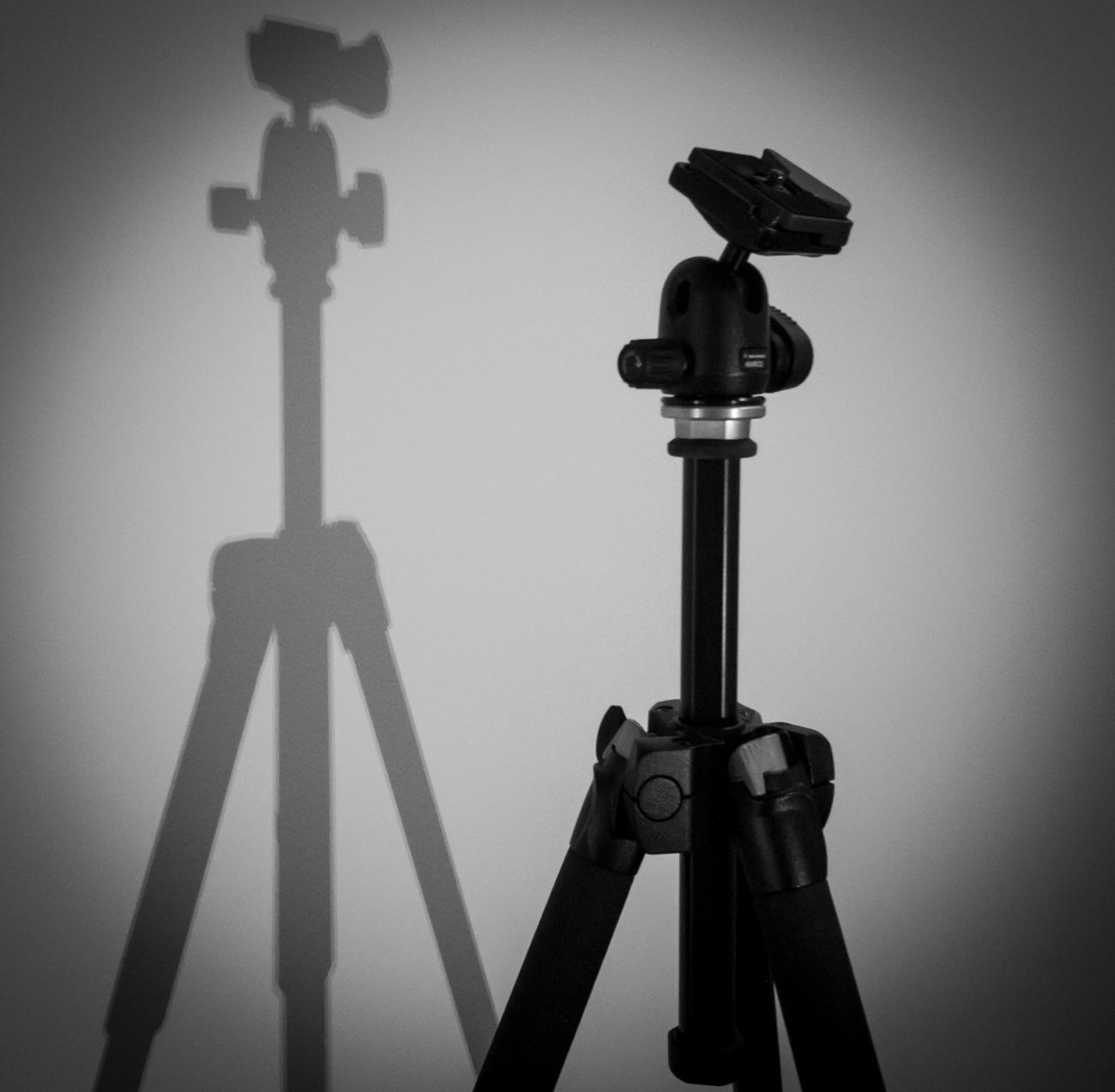
    3  Use a tripod


    This one is obvious. After all, if you don’t have to hold it then it’s not likely to move. Right?
    Well yes and no and I’ll explain in the next tip but for now putting a camera on a tripod is always going to be better than hand holding.

    Nowadays there are lots of different tripods out there. Some are designed for different applications and cameras.

    For a mirrorless, compact or DSLR cameras there is a few considerations such as the weight, ease of use and sturdiness.
    And it also depends on the use. As an example, I have 3 tripods, a studio tripod that never leaves the ‘studio’ a heavy duty one that I use for assignments and a lightweight one which I take travelling or on assignments where weight is an issue.

    For smartphone cameras, there are also a lot of choices but they are usually chosen on convenience. I use the Joby Grip Tight Micro Stand, a great little find that has a mini stand. It can also be fitted to a standard tripod head.


    4 Use the timer


    The other main reason for camera shake is the shutter button action. When you press down on the shutter button the camera moves. Even if you are gentle it still moves. Of course, if you have a fast-enough shutter speed then it’s not a problem but if you are shooting in low light then it will create vibration which equals camera shake

    Another option is to use the timer. In all seriousness, you wouldn’t use the timer if you were hand holding. The idea is to use it when on a tripod or if you have the camera mounted on something sturdy.

    Most cameras have 2 or 3 timer settings. Use the lowest unless there’s some reason you need time like taking a self-portrait. After all, 2 seconds is not a lot of time to get into position.


    5 Use a remote


    For the same reason as the previous point (5) using a remote will take that that heavy human press out of the equation.
    There are a lot of types of remotes out there.
    From the old-school release cable for a DSLR to using a smartphone app to trigger your mirrorless camera to using a Bluetooth remote trigger for your smartphone.

    Choose the one that is right for you or choose a couple for different applications.


    Did you understand all that? I’m happy to clarify anything you’re not sure of.

    Just post in the comments section below. Don’t be shy.

    While you are at it why not subscribe for future updates below.

    You’ll get my free guide “Eleven easy ways to improve your marketing photography”.

  • 20 easy ways to find time to learn photography (or anything else!)

    20 easy ways to find time to learn photography (or anything else!)

    I often hear the complaint of “I don’t have time to learn how to take better pictures of my product or service”

    Of course we live in a busy world where there are lots to things to grab our attention and pull us this way and that.
    I’m no different.
    It’s easy to be distracted by the emails, texts, people, facebook, twitter, I can go on and on.
    It much easier to do something that is going to give instant gratification than work on something that doesn’t give you that instant hit of achievement
    So over the years I’ve learned several techniques which allow me the time to do what I need and should do.
    I’ll share them with you today:

    1. Develop a ritual:

    I have a plan mapped out every day of the week that begins when I awake and finishes when I go to sleep.

    For instance, I stretch for 10 minutes at 5.50AM then exercise at 6.00AM. The exercise varies according to the day for example Mondays and Wednesdays are days I go for a run.

    From 2.30 – 3.15PM I make at least 10 phone calls that are likely to lead to promotion or sales of my business

    1. Establishing the best use of your time.

    Ask yourself on a regular basis, even hourly:
    “is what I’m doing now the best use of my time”
    “Is this going to lead to me achieving my goals”.

    1. Establish yearly goals

    Most of us have a to do list. A to do list are your mini goals for the day and more often than not we over estimate what we can get done in a day.

    What we also do is underestimate is what we can do in a year.

    Start first with your goals for the year and then work backwards.
    Then you can define what you should be doing on a daily basis and set up your ritual (see no 1)

    1. Turn off all notifications

    There are notifications everywhere these days, on your phone, your PC or Mac, your tablet, watch etc.
    Turn off any notifications that tell you that have mail, text, messenger, skype etc.

    There are always notifications you need like calendar and maybe reminders for your next client phone call. But in the main the rest can be turned off.

    Start by putting your phone on silent for half an hour at first, then an hour, then as long as you your business will allow. You’ll actually be surprised that no one missed you.

    1. To do lists

    There’s a theory that’s gaining momentum about the little old to do list.
    Basically you shouldn’t use a daily list but have a continual list. Having a daily to do list just exerts extra pressure and the reality is that most of us never tick off everything on there. So items you didn’t get around to, roll over to the next day and then the next day and the next day and so on.

    Better to have permanent list that gets added and subtracted to and then schedule time to do this in your calendar.

    1. Calendar scheduling

    Speaking of scheduling there’s a saying what doesn’t get scheduled gets doesn’t get done. You could turn that around and say whatever get scheduled gets done. But you get the point. Whichever calendar you use whether it be Google, Outlook or Apple you can easily schedule time to do certain tasks, if not all of them and add reminders.

    1. Unsubscribe, do, delete or delegate

    We spend so much time in our inbox these days. There are countless apps and theories on how to manage your inbox. Trouble is working them out is almost as much work as it to actually process your inbox.

    It’s easier to either unsubscribe, delete, delegate or just do it.

    In getting things done by David Allen, he advocates only acting on an email if it it’s going to take a small amount of time

    Anything more and if you’ve decided it still needs action by you, then decide when.

    1. Use a Voice Recorder or Smartphone App to take notes on the go

    Inspiration often comes from outside the workplace, so make a habit of recording your ideas whenever they pop into your head.

    I use a voice recorder and a note-taking app on my phone, and carry around a notepad

    1. Research on your Phone during downtime

    Use your smartphone to research when you find yourself waiting around.

    That might be waiting in shopping lines, riding public transport, or anywhere else you find yourself waiting

    1. Audiobooks and Podcasts

    Audiobooks and podcasts that help your business and your professional development are great to listen to whilst travelling.

    Extra tip: Try speeding it up to 1.3-1.5. Our brains are capable of handling speech at faster speed than normal speed.

    1. The 80/20 Principle

    Also known as the Pareto Principle, the 80/20 principle is the idea that 80% of your output will come from 20% of your effort. Start by eliminating or delegating non-essential tasks that don’t impact results.

    The more you focus on things that will affect your business, the more you’ll get done with less effort.

    1. Delegate

    If someone else can do a task 80% as well as you can, and you don’t have time to do it yourself, consider handing it off to another team member.

    1. Hiring Help

    Don’t have time to do everything yourself? Consider hiring freelance help if you can.

    1. The Pomodoro Technique

    Try using the Pomodoro technique throughout your workday.

    It’s a productivity method where you work in 25-minute bursts, separated by 5-minute break periods.

    There’s a free app available called, surprisingly, “Pomodoro”

    1. Don’t multitasking

    Studies show you’ll get much more done, faster if you focus on one task at a time rather than try to multi-task.

    1. Checklists

    Create task checklists to keep yourself on track for your projects. Checklists are an effective tool for getting things done. And it feels good to check them off as done.

    1. Never start a meeting without an agenda

    Meetings are a pet hate of mine! Plan your meetings and set timers. Never go into a meeting without an agenda or a goal that the meeting is going to help achieve.

    1. Only Use Tools That Show Real Benefits

    With the many tools and software services that are available, we often end up with non-productive tools. Get rid of them! That saves time and money all in one fell swoop.

    1. Take On Your Toughest Task First Thing In The Morning

    Do your most IMPORTANT task first thing in the morning, to free up mental space to take on the rest of your day.

    1. Sleep

      Asleep on the job
      Asleep on the job

    Get a good night’s sleep. Some say 7-8 hours per night. The more you get the more you’ll get done and with less effort, if you’re well rested. Working when you are tired leads to less energy as the day progresses.

    There’s many more but I’d really like to hear from you any additional tips or tricks that you have.

    You may be using some of the above but have adapted it for your own use. Great! Please share what you do.

    So please leave your comments in the box below.

    While you are at it why not subscribe for future updates here.
    You’ll get my free guide “Eleven easy ways to improve your marketing photography”.