

Tag: Door
-
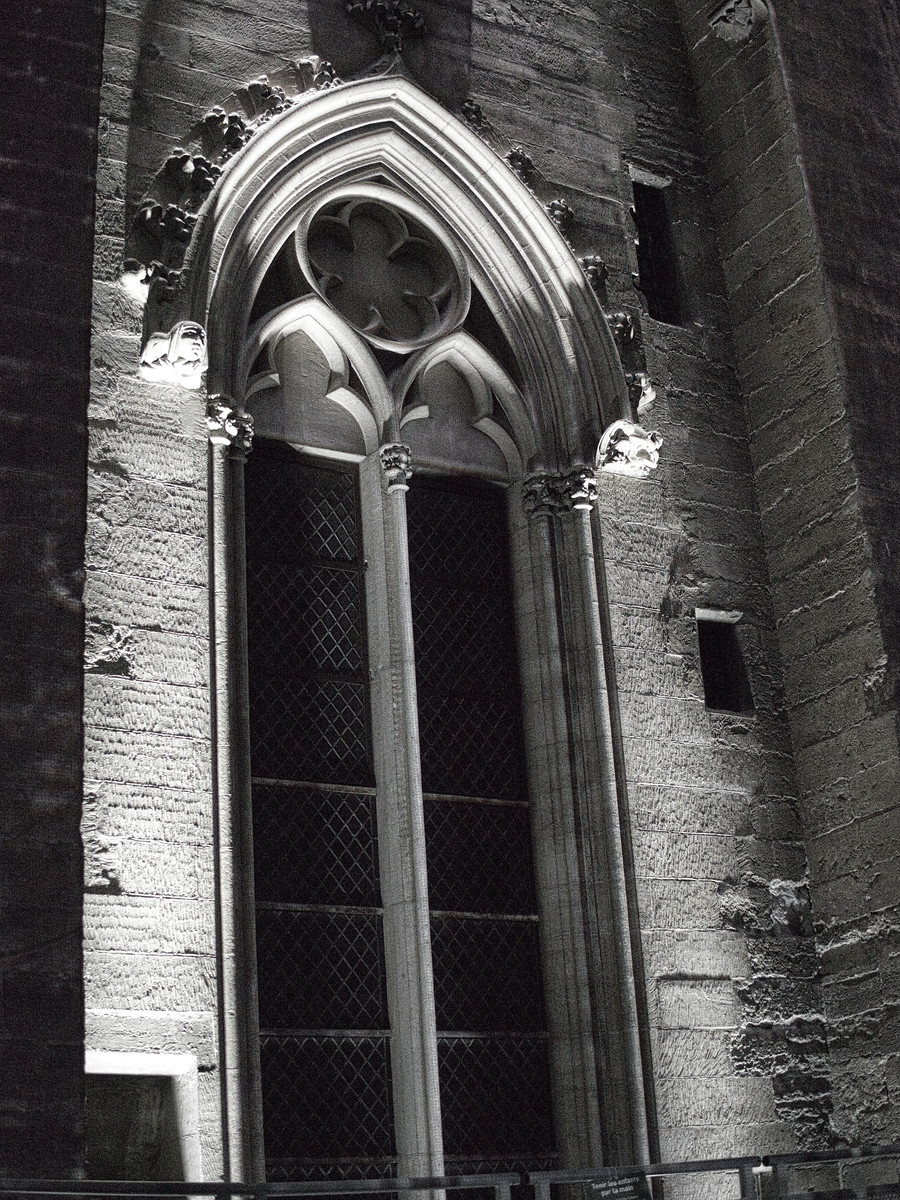
The door to the Metropolitan Basilica

One of the doors to the Metropolitan Basilca, Our Lady of the Doms, Avignon. Click on the image for a larger view -
African shoestrings – Tanzania Day One Hundred and Ten Zanzibar
We awoke the next morning, still shell-shocked after the events of the last 24 hours; our next challenge to catch the boat to Zanzibar.
First however we had to change some money. The hotel didn’t accept travelers cheque’s or US$ or change money and the nearest bank didn’t change travelers cheque’s either. So leaving Sue behind (she was just about ‘Africared’ out) to relax at the hotel, I went off to find a Bureau De Change or a real bank.
What a place Dar es Salaam is! Every street was buzzing with people of all walks of life, market stalls and shops lined the streets and footpaths. This is where the Middle East meets Africa with a small remnant of European colonialism thrown in. The peddlers were remorseless as they called out to me from everywhere.
In Malawi we had struck up a conversation with a Kiwi (New Zealander) who had just traveled through Tanzania and he had nothing but scorn for the Tanzanians who he had said “hassled us from the time we had entered the country to the time we left”. We had already struck their continual harassing in Mbeya and on our previous visit here. But this seemed different. It was light hearted and a lot less intense and added to the feel of exhilaration as I walked through this city of life.
Eventually I found a small Indian bureau de change, who tried to interest me in his cousin’s trinket shop down the road. My usual answer is “sorry, no money” but when you’ve just changed a wad, it somehow didn’t seem so convincing. “Sorry I’m in a hurry,” I just said. Expected some persistence, I was saved by another customer and he muttered something about having a good day.With the aid of Namur a very protective taxi driver who picked us up at the hotel, we managed to purchase tickets for the next fast ‘cat’ to Zanzibar down at the wharf. As the boat wasn’t due for two hours we got Namur to drop us off at the Sheraton. We were in dire need of a bit of western culture. We were tired and just had enough of travelling in ‘local’ fashion and decide to book a flight back from Zanzibar to Dar and thus avoid the struggle across town to get to the airport.
Sitting relaxing at the café there restored some of our energy and by the time Namur picked us up we were once again ready to brave yet another challenge of travel.
As it happened there was no real challenge apart from hogging one of the seats next to us with our bags on quite a full boat.
The Sea Star was comfortable and we had a smooth journey across the Zanzibar channel. Of course it would be, after all it was built in Fremantle, Western Australia.
Zanzibar was already an important centre for trade between Africa, the Middle East, and India by the time it was visited by the Portuguese at the end of the fifteenth century. Seeing the opportunity for a trading post the Portuguese took control in 1503. Arabs from Oman ousted the Portuguese in 1698 and the island developed into a major slaving centre. After several years of political maneuverings between Britain, Germany and France plus a sustained effort to stop the slave trade that revolved around Zanzibar, the British made Zanzibar a protectorate in 1890. Some 83 years of British rule albeit through the Sultanate was ended when independence was granted. This was immediately followed by a violent revolution and the Sultan was overthrown and exiled. In 1964 Zanzibar was merged with the now also independent Tanganyika to form Tanzania.
With such a checkered history dominated by peoples from other parts of Africa and the Middle East it’s not surprising to find that the people of Zanzibar are of different stock. The largest population is that of the Swahili, which as with the rest of Tanzania is spoken widely. But these people have a Persian and Arab ancestry as well as black African. The rest of the population is made up of more recent Arab immigrants, descendants of African freed slaves, Indians, Pakistanis and the usual sprinkling of Europeans working mainly in the tourist industry or employed as teachers, doctors or engineers.
Maybe it’s because of its differences that, even though Zanzibar is part of Tanzania, we still had to pass through customs and immigration after disembarking. On the other side of customs are the hotel touts like lions waiting for their prey, they watch you carefully and when you are within striking distance they pounce.
” I know veely good hotel. Good price, good shower, big big room”
They all seem to say one after the other as we walked single mindedly through their group.
We already had our accommodation booked at the Malindi Guesthouse, just a short walk away. Oozing with character this white washed square building with dark wood shuttered windows had a pretty as a picture enclosed centre courtyard and a maze of passages leading to the rooms. Our first room was a large cool white room with a concrete floor, large wardrobe, colonial furnishings and to our surprise an en suite bathroom. I say first because after the first night they moved us to the room we should have had which was a smaller version with single beds and no bathroom. Apparently they had double booked the first night and that was the only room available.
In Zanzibar the main tourist activity apart from the obvious ones of eating and drinking is to wonder the tiny streets of stone town and find a new wonder around every corner.
Looking at a map of Stone Town you would think that it was a map of a maze. The bulk of it is hemmed in by a triangle of main roads that despite their narrow width supports road traffic. Leading from these main roads are a myriad of miniature streets some of which can only really be described as narrow paths that wind their way through tall buildings. Unlike a maze these alleyways lead somewhere and eventually any walker will find themselves back out of the tangled web of houses, restaurants and curio shops or in a square that houses a Mosque or Palace in the middle of an alleyway.
Like many of the other African towns of our travels, many of the buildings were derelict. Wooden balconies and shutters overhung the alleyways in a state of disrepair and stray cats played amongst rubble and rubbish at the rear of some of the buildings. But through it all, the place had charm and oozed character.
Of course it’s not all about exploring alleyways. The House of Wonders is one of the largest buildings in Zanzibar. A once proud ceremonial Palace is now just a run-down shadow of its former glory, housing the National Museum. Its marble floors, huge carved doors and two old Portuguese cannons are the only things worth going there for. Another museum is the Palace museum dedicated to the Zanzibar sultans and their history. Most of the exhibits were items of furniture including a few thrones, beds and even the sultan’s water closet.
What was fascinating was the room devoted to Princess Salme, daughter of the Sultan Said. Her remarkable story started in 1859 when as a fifteen-year-old, dominated by laws that prevented her from having contact with any males other than her father and brother, she helped one of her older brothers escape after an unsuccessful attempt at overthrowing his older brother Sultan Majid. Rejected by her family, she began, as she grew older to socialise with a lot of the Europeans in Zanzibar. One of them Heinrich Reute did the unspeakable and got her pregnant, necessitating in her fleeing Zanzibar to prevent bringing shame on her family. An immediate wave of anti-European feeling on the island brought a British warship to Zanzibar just in case of reprisals.
She married Heinrich soon after and they had three children before (and this is the rub) he was tragically killed in a tram accident. They had only been married three years.
Unwelcome in her home country, Salme stayed in Germany and after a brief stay in Syria she died in Germany in 1924.
Footnote:
Get more traffic to your blog! Let me help you take, edit and publish your images now by signing up here to get “Eleven easy ways to improve your marketing photography”
A free guide on how to start improving your images to help you take control of your marketing.
That link again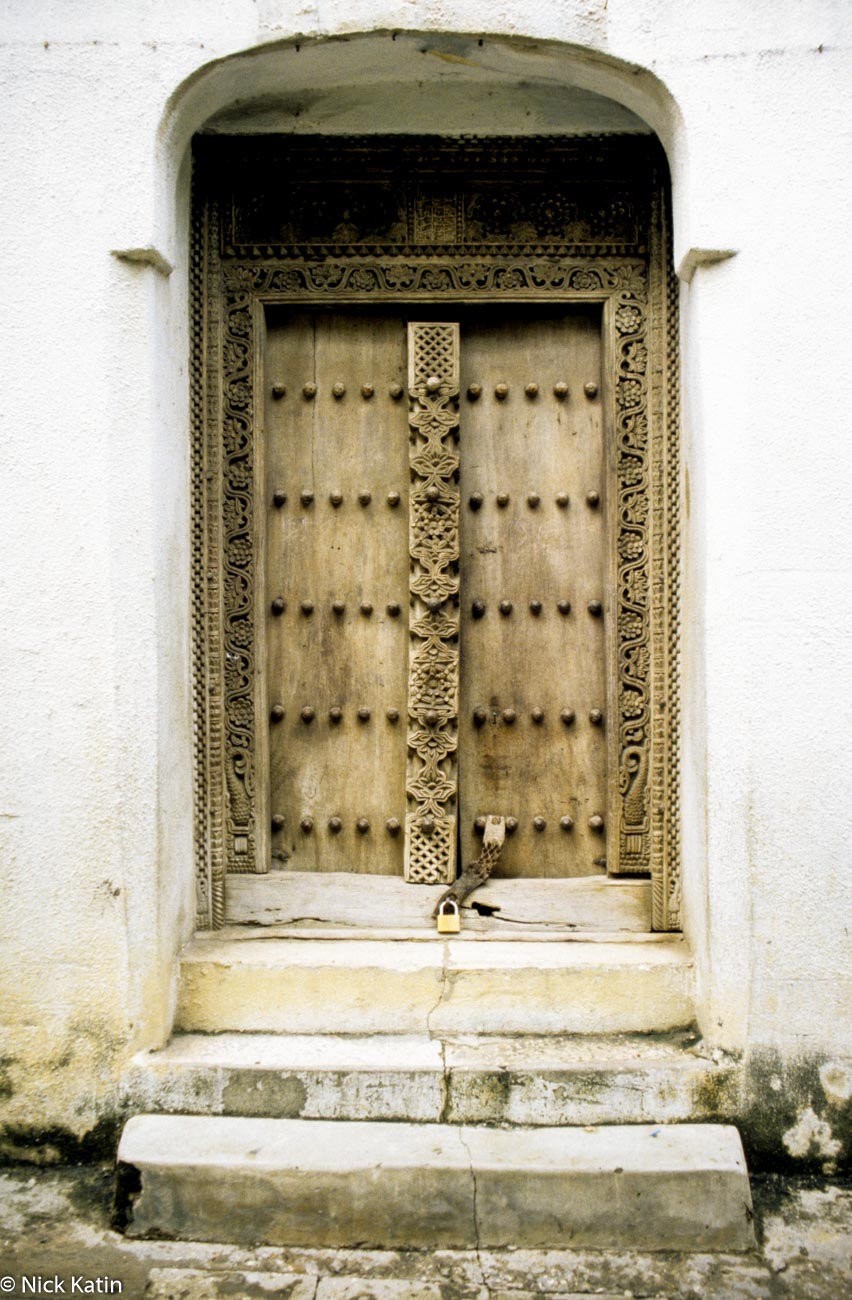
A typical wooden door in Zanzibar town, Tanzania Share this:
-
Granada and the Alhambra
Granada is located in the province of Andalusia in southern Spain. It is at the foot of the picturesque Sierra Nevada Mountains. Granada has a deep Islamic history. Muslim forces took over from the Visigoths in 711 and ruled until well into the 15th century and built a large palace which overlooks the city.
The Alhambra is the most famous site of Granada. The palace and its gardens show the Islamic influence. The detailed arched doorways and tiled walls are typical of Muslim architecture. The gardens and reflecting pools show the Muslim influence.
Besides being a historical city, Granada is a lot of fun. It is one of the hippest and festive cities in Andalusia, with a free-tapas culture, innovative bars, tiny flamenco holes and thumping club scene. There are some great festivals in Granada, like Semana Santa (Holy Week), where many streets are closed down to cars. You can walk around and see religious processions. Many parties are held in the street and flamenco dancing is seen everywhere.
Don’t forget to get your free magazine subscription from Zinio. To claim visit zinio choose a magazine title and send me your first and last name and email address and if you want, send me your website address via the contact page or email. For more info go to Zino competition.
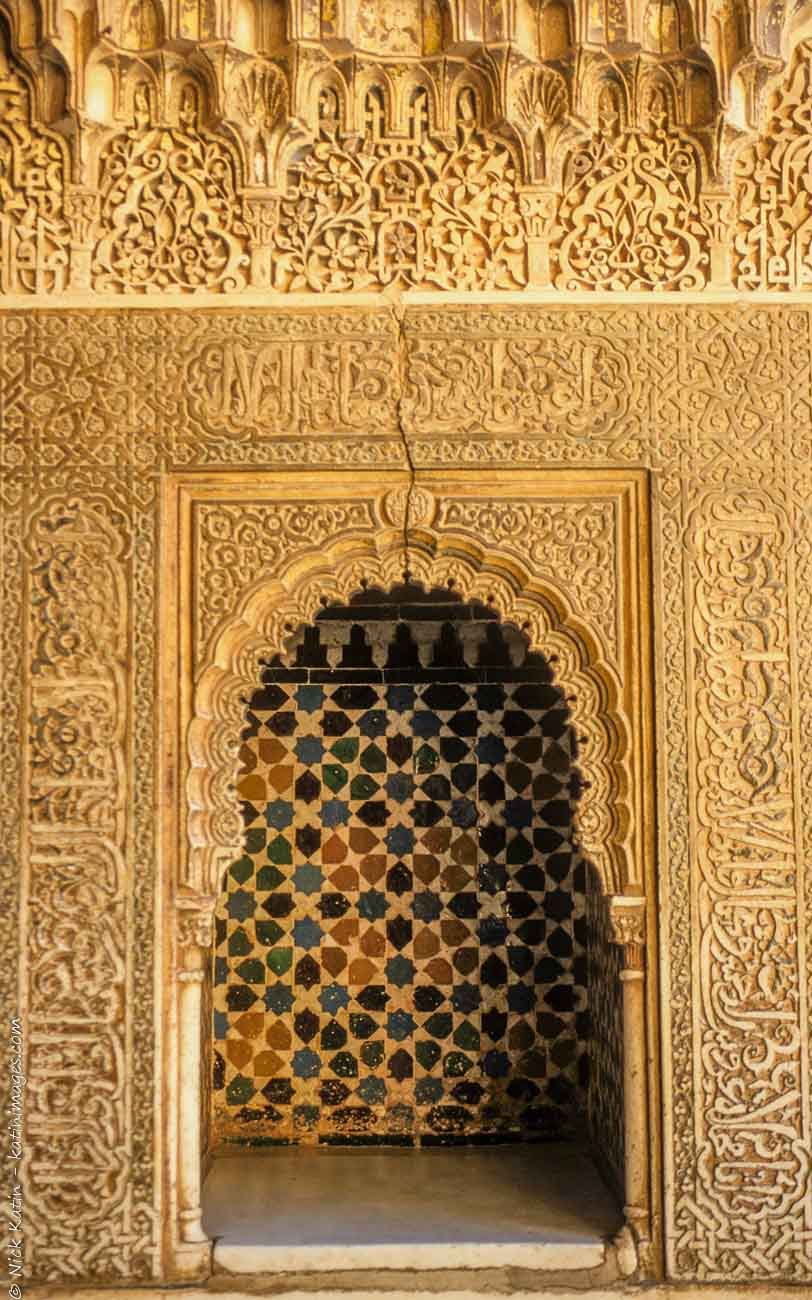
One of the beautifully crafted decorated door ways in the 13th century Alhambra Palace in Granada Spain Share this:
-
A cat on a step on the Greek isle of Thirasia
Of the idyllic Greek Islands everyone knows Santorini and yeah, its bloody beautiful! In fact watch this space for some images of this famous island. Across the Caldera is the little island of Thirasia which is usually a 1/2 day excursion from Santorini. It’s how Santorini probably was before the rich, the famous and the tourists discovered it. No more than a couple of hundred people live here. It has a small harbour, a couple of small villages and pretty church, lots of steep steps, pebble beaches and this cat!
By the way a caldera is a volcanic feature created by a volcanic eruption. In this case Thirasia, Santorini and a couple of smaller islands are all that’s left of a much larger Island after a volcanic eruption.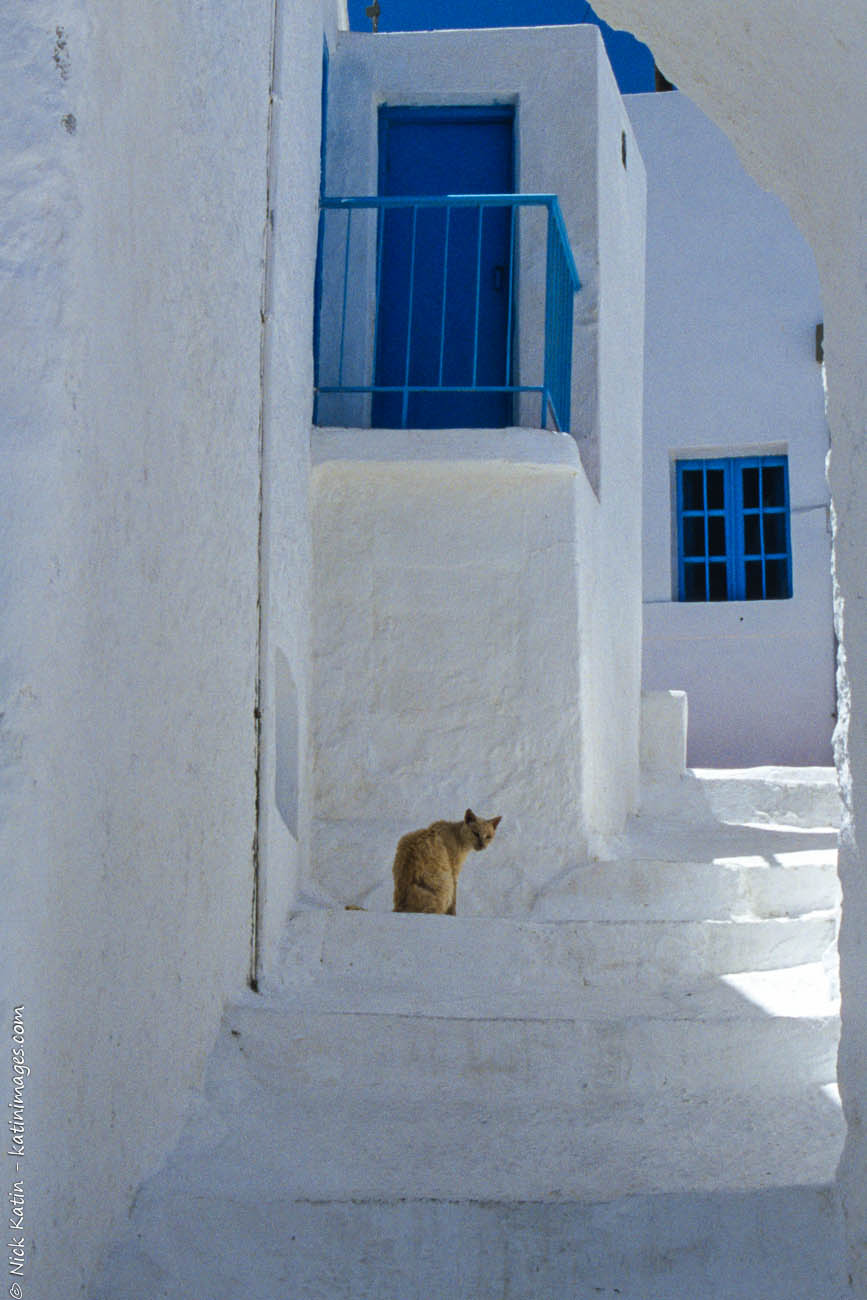
A whitewashed street in Thirasia near Santorini one of the famous Greek Islands Share this:
-
Reflection of the Alhambra in Granada
The 13th Century Alhambra in Granada in Spain is a absolute delight. The Islamic architecture is very intricate and stunning and a visit can wile away hours as you explore the different palaces. These same palaces were built for last Muslim emirs in Spain and the buildings are quadrangular in plan, with all the rooms opening on to a central court. Some, as shown below, have a small decorative reflective pool. The name Alhambra comes from the Arabic al-qala’a al-hamra (the Red Castle). Interestingly the first palace on the site was built by Samuel Ha-Nagid, the Jewish grand vizier of one of Granada’s Zirid sultans.
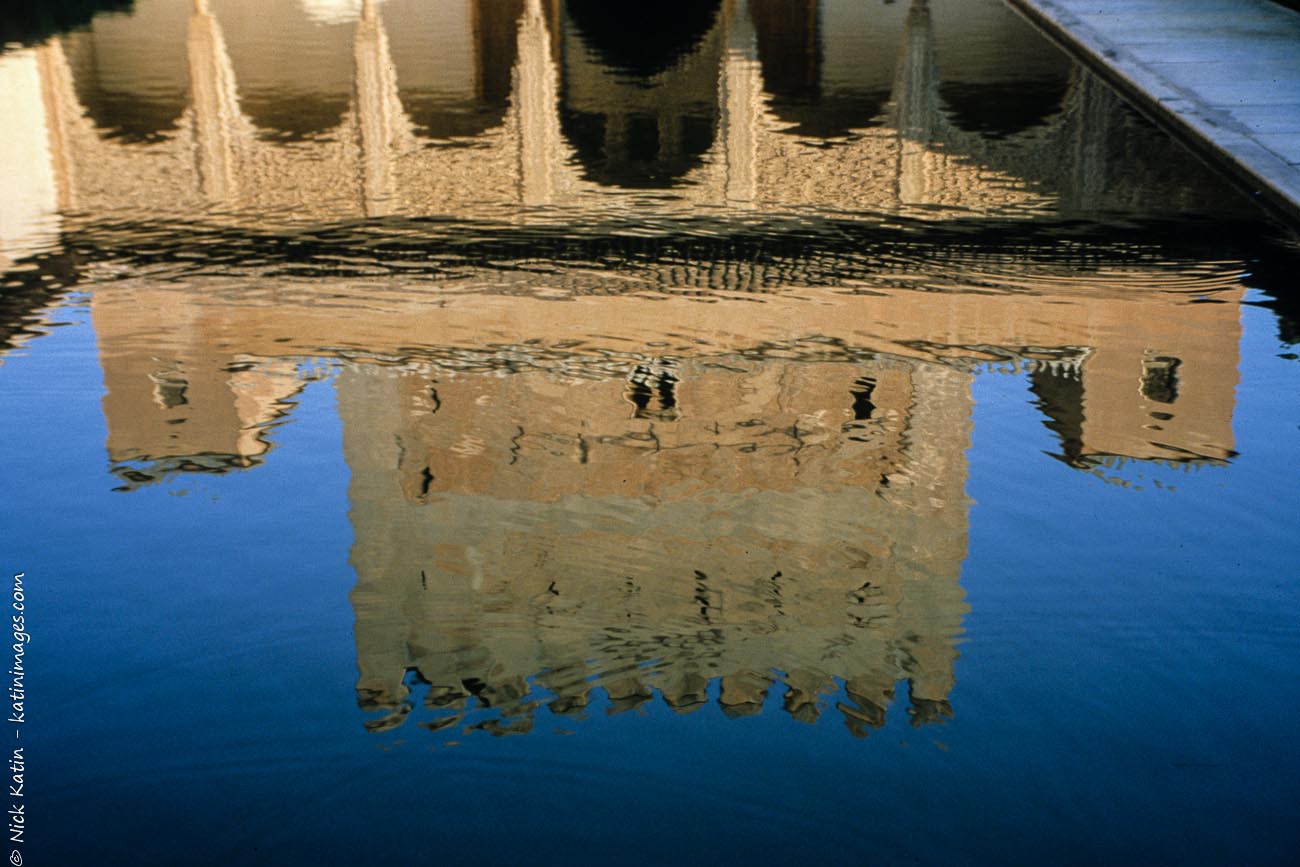
The reflection of one of the beautifully crafted decorated buildings in the 13th century Alhambra Palace in Granada Spain Share this:
-
Canyon Road Santa Fe door photo
Slightly to the South East of downtown Santa Fe is Canyon Road, a street with wall to wall art galleries. There are over 100 places to view and purchase art in this area with most of them along Canyon Road. Most of the buildings were or still are houses built in the Pueblo style and some date back to the 1750’s. In fact it didn’t become a magnet for artists until the early 20th century. From the photographers standpoint these ‘Peublo’ style houses are colourful and ooze character. The most attractive parts are the doors and windows and this one was one of many. 1/320 @ f4.5 60mm ISO 100
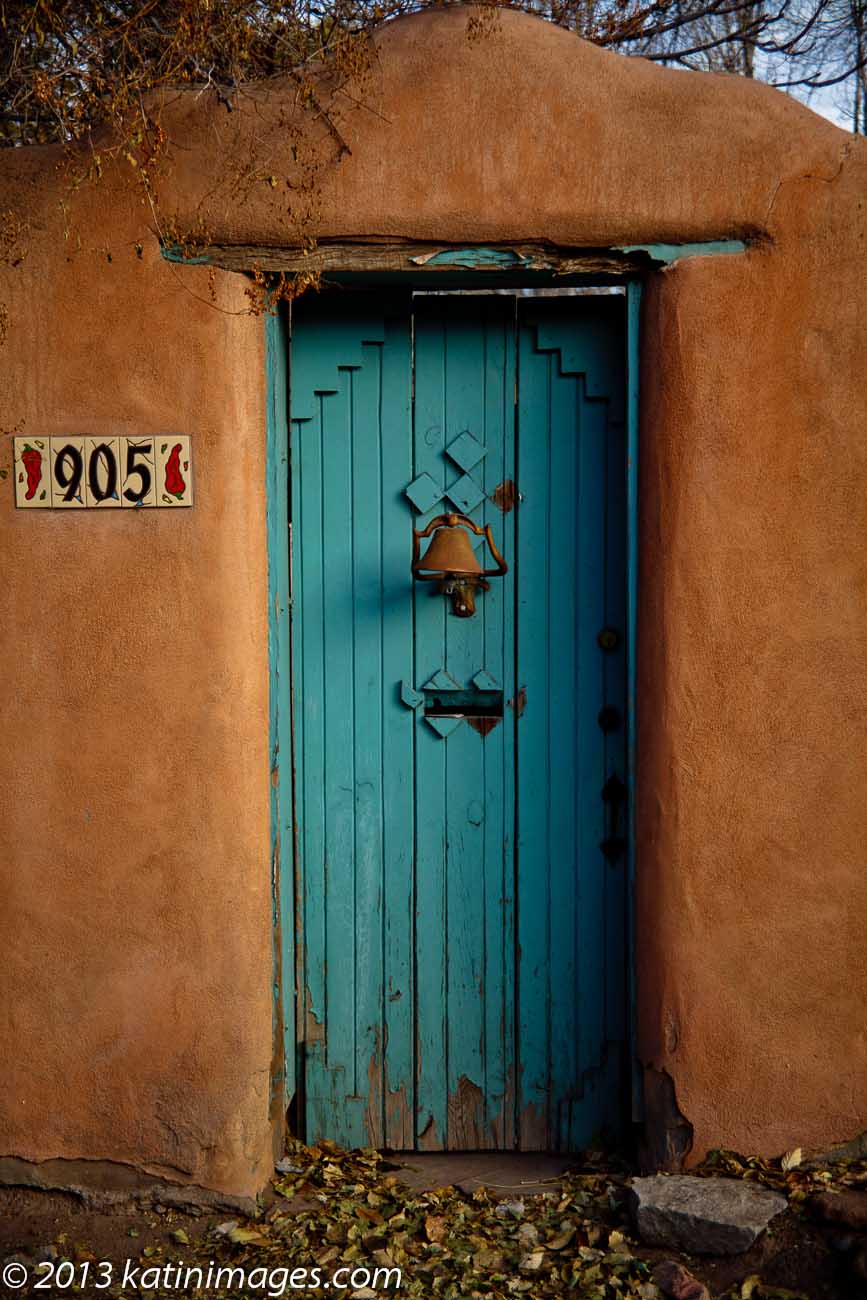
A Doorway in the Canyon Road art district of Santa Fe, New Mexico, USA Want to put this on your wall then go to Sante Fe doorway photo. To licence or share this photo email or contact us
Share this:


 Katin Images Travel Photography