Katin Images Travel Photography

Travel Photos, Travel Photography Tips and Software

Tag: cape town

  • African shoestrings – South Africa Day Thirty-seven – Rhodes Memorial Cape Town

    Just up the road from Observatory, we found the Rhodes Memorial. A little gem of a place!

    Cecil John Rhodes, founder of the famous De Beers Diamond Company and British Empire builder had a big influence on the way Southern Africa was carved up politically in the nineteenth century. He was Prime Minister of the Cape Colony from 1890-95 but by then he had already made his fortune through Kimberley Diamond Mines and a huge Gold strike near J’burg.
    He established British Colonial power in Rhodesia (later Zimbabwe), Northern Rhodesia (Zambia) and Bechuanaland (Botswana) to name but a few.
    Mind you he profited personally from these ventures as he established a few more gold mines on the way.

    Strangely enough he’s probably better known for the Rhodes scholarship. Something he established by way of his will devoting most of his wealth to this noble cause. The scholarship even today still sends winners from countries other than Great Britain to study at Oxford University.
    From an Australian point of view the most (in)famous winner was the then beer swilling Bob Hawke, arguably it’s most popular Prime Minister ever.

    Well they’ve built a memorial to this guy (Rhodes, not Hawke) on the slopes of Devil’s Peak. It’s a bit like a mini coliseum, all columns and bronze statues of Lions bordering impressive bluestone granite steps that lead to a bronze bust of Rhodes. Really over the top stuff!

    We found out about this place from a couple of white University students who we chatted to on one of our many minibus trips. We’re harden pro’s now. That same bus was also driven by, much to our surprise, a white guy, so times are definitely changing.

    Actually they said that the little café next to it was worth a visit. In fact it was almost more fascinating than old Rhodes. To coin a phrase “it was just so colonial”. Wicker chairs and small round tables were scattered around the garden.
    Nothing scattered about the young white waiters though, about six of them stood guard at the front of the garden, in their gleaming white shirts and black bow ties, waiting to pounce on unsuspecting prospects. It was the sort of place that had this been England or even Australia, would have made your wallet tremble. But this is South Africa and even our pitiful dollar made it real value for money. Mind you we only had coffee and cake!
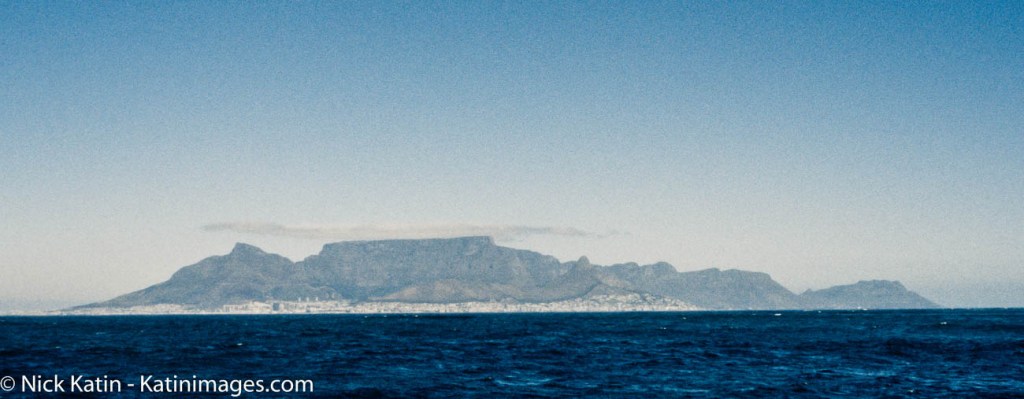
    Table Mountain in Cape Town from Robben Island former prison of Nelson Mandela
    Table Mountain in Cape Town from Robben Island former prison of Nelson Mandela


  • African shoestrings – South Africa Day Thirty-five – Table Mountain Cape Town

    In our previous visit to Cape Town we had taken the cable car to the top of the 1000 metre Table Mountain (and back down again).
    This time, we promised ourselves, we would walk to the top and catch the cable car down. Today was a public holiday and even minibuses would be few and far between so we had to brave another of Andre’s lectures as he very kindly gave us a lift into the city.

    From there it was just a short walk to the main track that winds up the Platteklip gorge the easiest way up from the that side of the mountain.
    There are two very distinct features about Table Mountain, the fact that from a distance it appears to have as the name suggests a completely flat top and it’s “tablecloth”. The tablecloth is cloud that regularly rolls in and covers the top for anything like a few minutes to the rest of the week. This phenomenon usually happens around mid- morning so we wanted to ensure that we got up there early enough to see the 360° views.
    Last time we got to the top we had about 5 minutes before our vision was reduced to about 5 metres. This time we hadn’t even got up to the top before it rolled in, reducing visibility to a few metres and slowing our already slow progress.

    The track was a winding trail that zig zagged awkwardly and was strewn with large boulders and obviously designed for mountain goats. Worse still we had the challenge of having to clamber around hundreds of people all with the same idea. Now we had to pick our way through damp mist and poor visibility. Being as I said a public holiday, the last thing was I would have expected would to be find teenage school groups. But there hundreds of the little shits who, as well as some adults, seemed oblivious to the fact that there was actually a trail with lots of signs asking us to keep to it.

    But the gods did smile on us as we approached the top, the ‘tablecloth’ disappeared as quickly as it had appeared and we were able to spend a good hour and a bit admiring the great views. Table Mountain is at the end or the beginning of a small range called the twelve apostles that travel south and reduce in size at the beginning of the Cape Peninsula. It had cleared enough for us to see the famous Cape of Good Hope some 70 kilometres away at the end of the peninsula.

    Cape Town from Table Mountain
    Cape Town from Table Mountain
  • African shoestrings – South Africa Day Thirty-four – Cape Town

    Table Mountain was next on our agenda but that was tomorrow’s challenge in the meantime we had to get back and eat!

    Largely because of its multiculturalism Cape Town is considered the gastronomic capital of Southern Africa. There are lotss of restaurants and cafes of all descriptions and price tags.

    In Observatory there were several with lip licking menus in which we could have quite happily whiled away a couple of hours.
    Andre in one of his monologues had recommended “A moment of madness” a darkly lit tiny and intimate two storey restaurant with a unique sort of smokers lounge and a small skinny black skinned waiter we nicknamed ‘lurk’ after the Adams family character. He had this way of plodding up and down the creaky stairs and then pausing to catch his breath that just cracked us up.
    Sue’s first order had been a salad of some description and he plodded downstairs to the kitchen with our order. A few minutes later he plodded back up to tell us that she couldn’t have that as they didn’t have any. Sue reordered and off he went reappearing later with the dish that Sue had first ordered but minus our cutlery.
    With a sigh he trudged down stairs and back up, …….. pause for breath… with our cutlery but no napkins, another sigh, another plod down and then up, …. ..pause… and we were happy. In fact we were so happy we were almost in hysterics and waited till he disappeared back down stairs again before falling off our chairs laughing and then using the nicely pressed napkins to wipe our eyes.
    The food from what I remember was pretty good, (I think we had fish of some description) the atmosphere with Louis Armstrong in the background was great but Lurk stole the show.

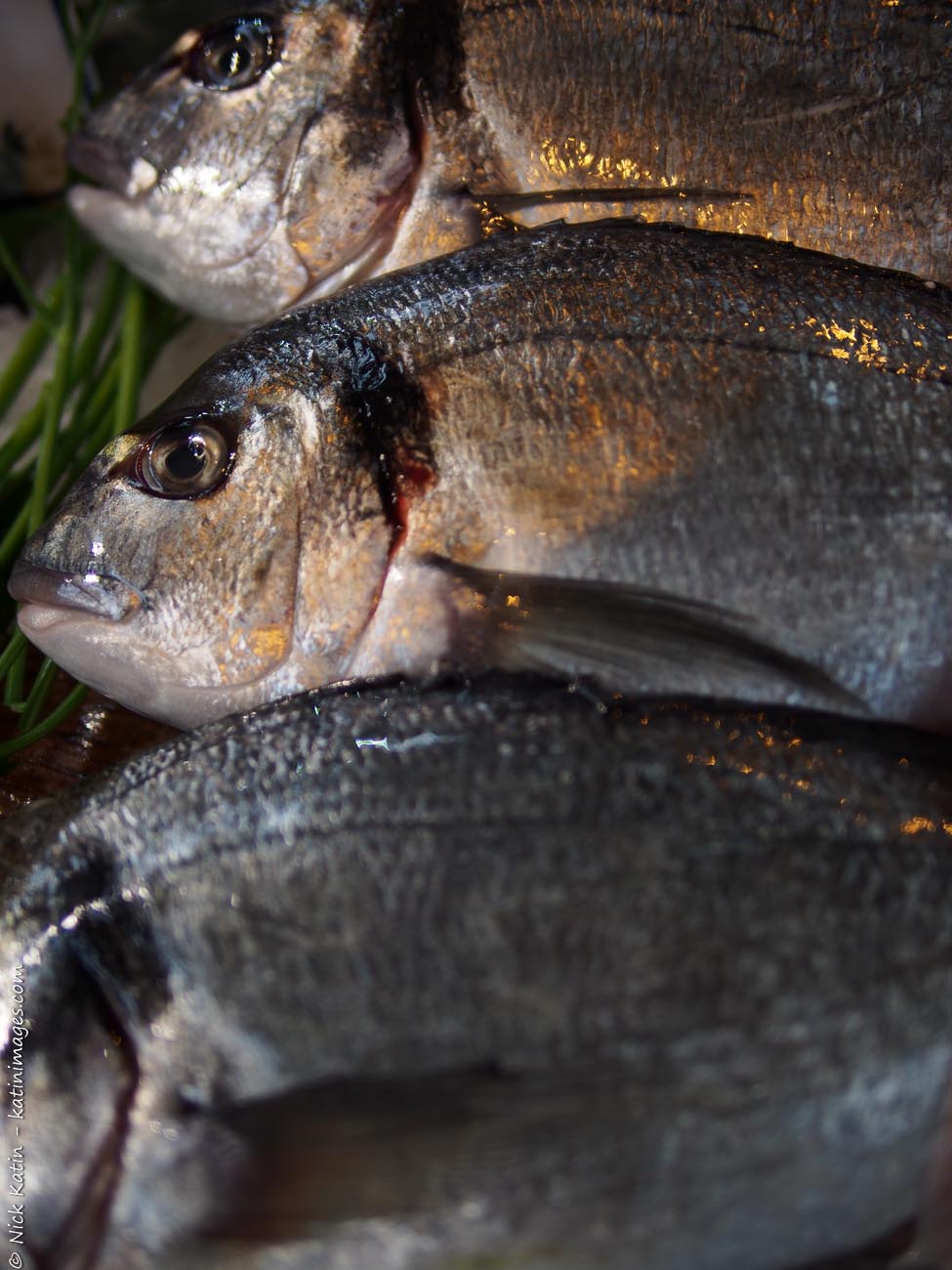
    Fish at one of London's famous markets, Borough Markets which is devoted entirely to food.
    Fish
  • African shoestrings – South Africa Day Thirty-three – Robben Island Cape Town

    Another pretty interesting guy whom unfortunately we didn’t get around to meet was Nelson Mandela. We did however get to meet someone who served time with him on Robben island a small former prison island 11 kilometres north west of Cape Town.

    Eugene was his name and he served seven years on Robben Island for his part in a student anti-apartheid demonstration in 1983. He was still there but this time as a guide.

    Mandela spent twenty-six years as a political prisoner there and certainly in the earlier years had to overcome some pretty harsh treatment to survive.
    In the 1960’s they were only allowed one visit of 30 minutes and one heavily censored letter every six months.
    For around thirteen years Mandela and others were made to work with picks and shovels in a lime quarry where the heat and blinding glare in summer could eventually kill or blind.

    In the 1980’s the authorities eventually softened under international pressure and stopped hard labour, allowing education of selected subjects to university level.

    The prison itself however is not what you expect. The layout is pretty similar to any other high security prison found in the western world, you know, small cells, high walls, a cramped exercise yard and barbed wire everywhere. For effect life size cardboard cut outs of past prison guards are strategically placed around the prison corridor and yards. These guys are pretty lifelike, at first glance I wondered what this guy in the uniform with a gun was guarding! From what Eugene was saying I was glad that they were only cardboard, their reputation as cruel and harsh was apparently well justified. Beatings and other acts of violence were all in a day’s work. And yet the main gate to the prison gives no hint to these brutal facts. Written above it in Afrikaans is “ONS DIEN MET TROTS” that means “We serve with pride”.

    The known history of the island dates back some 400 years and has been used as a fishing base, a whaling station, a hospital, a mental asylum, a civilian prison, a military base, a political prison and now finally a museum.
    It’s as a museum that it seeks to be as Mandela puts it “a symbol of the victory of the human spirit over political oppression; and for reconciliation over enforced division.”

    The island itself has little natural beauty to mention although it does have the odd gemsbok and springbok around and the views of Cape Town and its spectacular Table mountain backdrop are worth the admission price alone.

    Table Mountain in Cape Town from Robben Island former prison of Nelson Mandela
    Table Mountain in Cape Town from Robben Island former prison of Nelson Mandela
  • African shoestrings – South Africa Day Twenty-nine

    We left J’burg for Cape Town the next day via a domestic South African airways flight.

    We had been to Cape Town before but we had felt that hadn’t done it justice, so this visit was to ‘see’ the place properly. Last time we had stayed in a pleasant Bed & Breakfast near the city centre. This time we were going to stay in a backpackers of which like J’burg there were many. Expecting to be hassled by their touts at the airport, we hadn’t bothered to book ahead. Guess what? The only touts we saw were for taxis. After a three or four phone calls to different hostels we soon realised why. They were all full!

    It was a long weekend and Cape Town was almost booked. I say almost because eventually we found a backpackers that had a double room and they paid for the shuttle from the airport to take us there, saving us R30 each.
    Unfortunately that was not as much to our advantage as we initially thought, we were now obligated to stay at least one night. The Cat and Moose was we thought at the time about as bad as it gets. The landlady led us to a dingy little room with threadbare carpet, paper thin linen and the sort of musty damp and putrid smell that makes you want to vomit! Worse still we had to walk through a dorm for access and it was across an alleyway from the TV area where a little blonde haired prick full of bullshit (we had met him earlier) had the sound loud enough for people in the next suburb to hear.

    Needless to say we were out of there the next day!

    With the help of the tourist office we found the colourful Observatory guesthouse in a suburb called, you guessed it, Observatory, a trendy uni student area. I say colourful because the rooms all had loud colour schemes and the owner, Andre and his manager, Gregory, were both pretty camp. This sorted added a certain ambience to the place and was cheap, clean, quiet and comfortable. But here’s the rub…..we were no longer within walking distance from the city centre and apparently public transport as we know it, was virtually non existent.

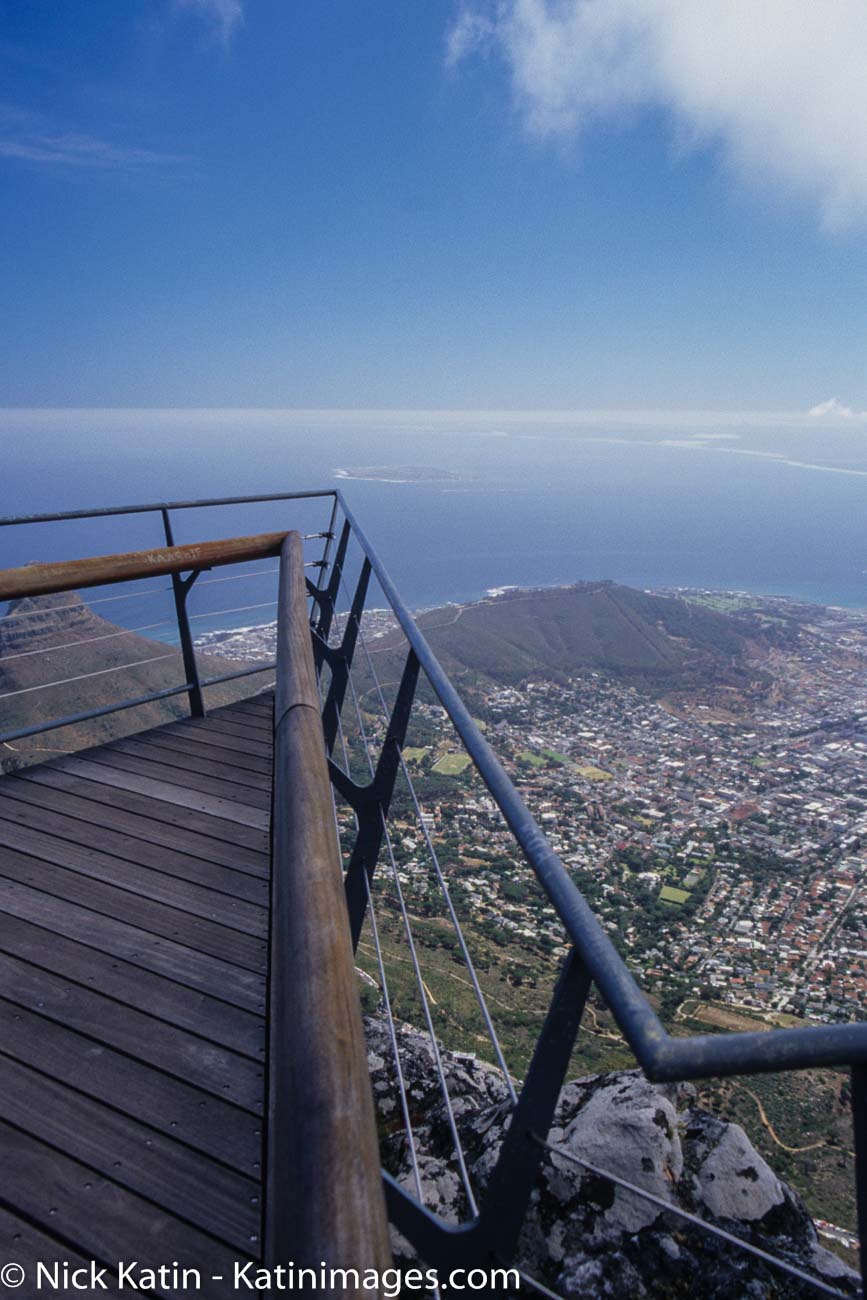
    Cape Town from the Aerial Cableway lookout on Table Mountain .
    Cape Town from the Aerial Cableway lookout on Table Mountain .