Katin Images Travel Photography

Travel Photos, Travel Photography Tips and Software

Tag: animal

  • African shoestrings – Namibia Day Fifty six – Namib desert

    Dan Viljoen is a good place for hiking or even just casual walking. We sauntered along the 3 kilometre Wag-n-Bietjie trail to the Stengal Dam enjoying the twittering of birds and the gentle breeze and then at the dam watching a lone wildebeest and a family of warthogs go about their business.
    The park has plenty of game, none of which are at all dangerous. On the game drive we did after the walk, we spotted Mountain Zebra’s, Gemsbok, Springbok, Red Hartebeest, Kudu and two Wildebeest standing on a cliff edge with a backdrop of Windhoek in the distance.
    Coming from a country such as Australia where the wildlife is on the whole small in size and nocturnal in nature, it’s mind-blowing how much wildlife you can see on this continent. Even more mind-blowing is the thought of how much more there must have been before the arrival of Europeans, who brought hunting and poaching and the destruction of the animal’s habitat. Fortunately most African governments have recognised that preservation of these magnificent beasts is important not only to the environment but also to tourism and have set aside large areas for them to roam freely and safely.

    The Rooibes trail we followed the next morning was around 6 kilometres longer and was a good little hike through green hills covered in scrub brush and small acacia trees with panoramic views across to Windhoek before following a river bed. The final couple of kilometres let it down; taking us through a neglected part of the park that was overgrown and speckled with dumped used tyres. We’ve encountered several good walks in the past that have been spoilt by the last stretch. Its almost as if the track designer lost interest two thirds of the way and just ordered the trail builders to find the quickest and most convenient way back. Still it was a good walk and once again we saw plenty of wildlife.

    I managed to get hold of Werner, the car hire owner ,so that we could do something about the gaslight that wouldn’t work. We met him back in Windhoek at the Maerua shopping centre, Windhoek’s and probably Namibia’s biggest. We swapped lights did a bit of food shopping and headed out to our next destination, the Naukluft Camp in the Namib Naukluft National Park.

    The road to Rehobeth was 100 kilometres of flat bitumen and even in our little toy car we could get up a head of steam. What slowed us down considerably was the 130 kilometres of gravel road to Naukluft. We had, to be fair, been warned. Werner had told us to keep the windows closed to prevent dust getting in but driving in mid 30’s heat without air conditioning and no fresh air was just too much. From hereon in we knew that most of the roads we needed to use would be gravel so we had to get used it and if that meant driving with the windows down and sharing the car with grit, well too bad! So by the time we got to Naukluft we were just a little hot and dusty.

    If you like this then hit “follow” on the side bar
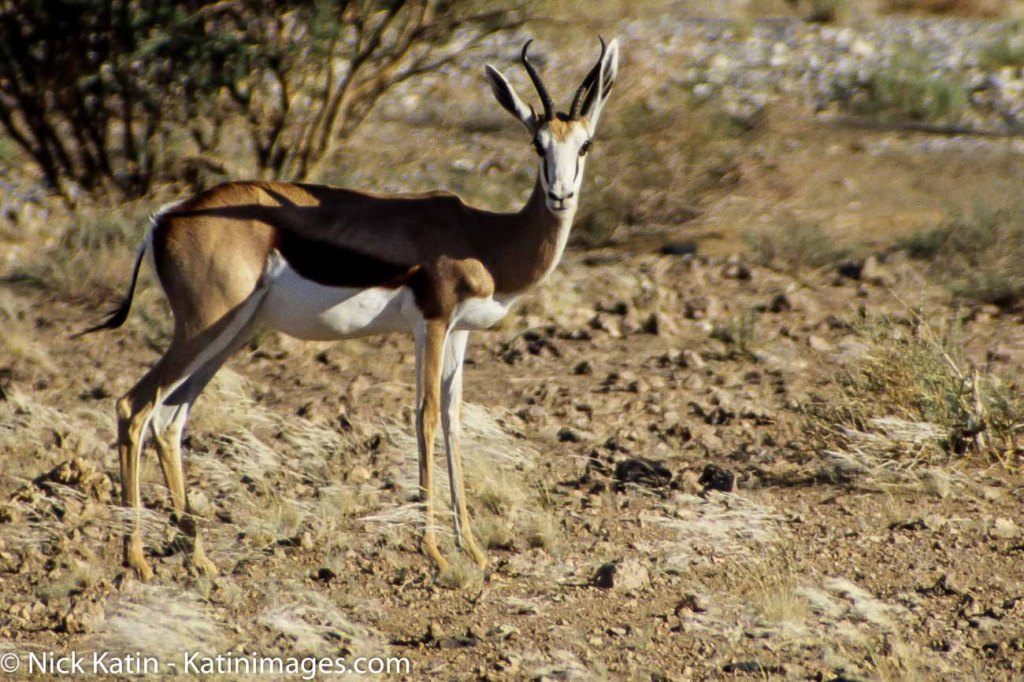
    It is extremely fast and can reach speeds of 100 km/h and can leap 4m through the air. The common name "springbok" comes from the Afrikaans and Dutch words spring = jump and bok = male antelope or goat.
    It is extremely fast and can reach speeds of 100 km/h and can leap 4m through the air. The common name “springbok” comes from the Afrikaans and Dutch words spring = jump and bok = male antelope or goat.
  • African shoestrings – Namibia Day Fifty five – Windhoek

    We had to organize the next three weeks because 90% of the attractions are in the National Parks, so unless you are on a tour you have to book in advance any accommodation with the Ministry of Environment & Tourism (MET) who manage the parks. There is of course plenty of private accommodation outside of these parks but the majority of these are expensive lodges close by or hotels, B&B’s and municipal camping grounds further afield.

    The MET office was located in the centre of Windhoek and the moment you enter the office you have that initial despairing feeling of hopelessness as African bureaucracy oozes from every desk, wall and official.

    We had the feeling that this could take all day.

    In the end it took about an hour and the guy behind the counter was really helpful and patient as we shuffled and reshuffled to try and fit in with their vacancies. “We’re not world class yet” he said “but we are getting there slowly, so we please be patient with us” …………this guy was good!

    Windhoek is pleasant enough, plenty of shops and the odd restaurant but strangely enough not many travel agencies that deal with budget trips to Botswana. We had been warned that it was probably not a good idea to wander around at night, so what do we do? Yes you’ve guessed it, walked back in darkness after a lengthy stint at the supermarket stocking up!

    Our hire car was a little Chico, again.

    I cannot stress the word ‘little’ enough. With all the camping gear, an additional mandatory spare wheel and our bags, it was touch and go whether we could actually get in ourselves. The biggest components were the two foam mattresses and a canvas tent similar to the one we had used in the Kalahari. On the back seat was a box full of camping gear like a single burner stove, gas bottle, cooking utensils etc. A sign that said in English and Bantu “Warning. Snake in Box” was stuck on both the side rear windows. I asked Werner, the Namibia Car Hire owner, manager and probably only employee, what that was about.

    “The blacks are afraid of snakes, so they’ll think twice about breaking into the car” Nobody was that thick I thought at the time. And sure enough a few days later as I filled up the car at a service station a couple of “blacks” were standing near the car laughing and pointing at the sign.

    Daan Viljoen Game Park was our first stop in this eighteen day self drive tour. It’s about 25 kilometres from Windhoek and it’s quite a peaceful place. Well it was when we first set up camp! But as is often the case a group of campers turned up and parked a few spots along deciding that we would all enjoy their ‘ghetto blaster’ playing rap and techno music as much as they would. Having just had to clean the tent of sand and dust, we weren’t impressed. Add that to the fact that the gas light jet was blocked (I nearly started a fire trying to get it to light) and we were really off to great start.

    If you like this then hit “follow” on the side bar

    A Wilderbest overlooks Windhoek, Nambia's capital
    A Wilderbest overlooks Windhoek, Nambia’s capital
  • African shoestrings – South Africa Day Fourty seven – Kalahari

    On that subject, of food, these tours feed you well. Whether it is a budget tour like ours or a five star tour, the tour companies must drum into the tour leaders that the guests must eat. I can just hear them now “Never mind the spectacular scenery or the animals, the object here is for the tourists to eat at least three big meals a day, and if possible morning and afternoon tea and equally as important on time!”

    On one tour we did in Kenya the 4WD got bogged in sand in Lake Nakuru and despite our protestations our guide insisted that we get a lift with a passing vehicle so that we wouldn’t be late for lunch. It was a long lunch because he turned up 6 hours later, covered in mud from head to toe. We would have much rather stayed and given him a hand.
    In Uganda on a Gorilla safari we had a guide called Charles. Charles had a small straw picnic hamper that he spent a great deal of time arranging and rearranging after use so that all the crockery would fit in a certain way. Watching him go through this ritual for the first time it, was merely amusing, by the time we had our last morning or afternoon tea it was all we could do to prevent ourselves from breaking into absolute hysterics, as he fastidiously and obsessively arranged everything first one way then another until satisfied and then sighed, contented with his final arrangement. What didn’t occur to him was that we could have quite happily saved him all this pain and skipped morning and afternoon tea!

    Strangely enough most tourists remember the food they have on these trips more than the experience they had! How often do you hear “Oh and the food was wonderful/crap”
    Maybe the tour operators have a point!

    We had some unwanted visitors that night. Jackals, like the baboons in Golden Gate come in darkness and scavenge anything they can get at. We weren’t affected but a group of school kids who were sleeping under the stars had a torrid time as the jackals ran off with all their stuff and scattered it around the camp or worse took it into the bush.

    The next day was our last of the tour and that meant heading back to Upington, 160 kilometres away, 60 on gravel, slowly at first so that we could search for any game. But once again it appeared that the script had been ignored. We were all now thoroughly depressed and ready to give up.

    Suddenly by the side of the road Roland exclaimed “Lion”. Sure enough right by the roadside lay two male lions asleep under a small but shady tree. The lions of the Kalahari are meant to be amongst the biggest in Africa and sure enough after seeing them up close, I can see why. They were big! They didn’t really entertain us apart from one of them standing up, moving 5 metres and plonking himself down again with a heavy thud before going back to sleep. But we didn’t care we had finished on a high and all of us had a bit of a smile on the dusty journey back to Upington.
    Mind you I think Rolands smile was more one of relief than joy. He had, at the beginning, dangerously bragged about how much game we would see in the park and felt personally responsible for any success or failure. Not that he should have done. Game watching is a bit like trying to win at the races; you can study the form but in the end it’s pretty much out of your control.

    If you like this then hit “follow” on the side bar

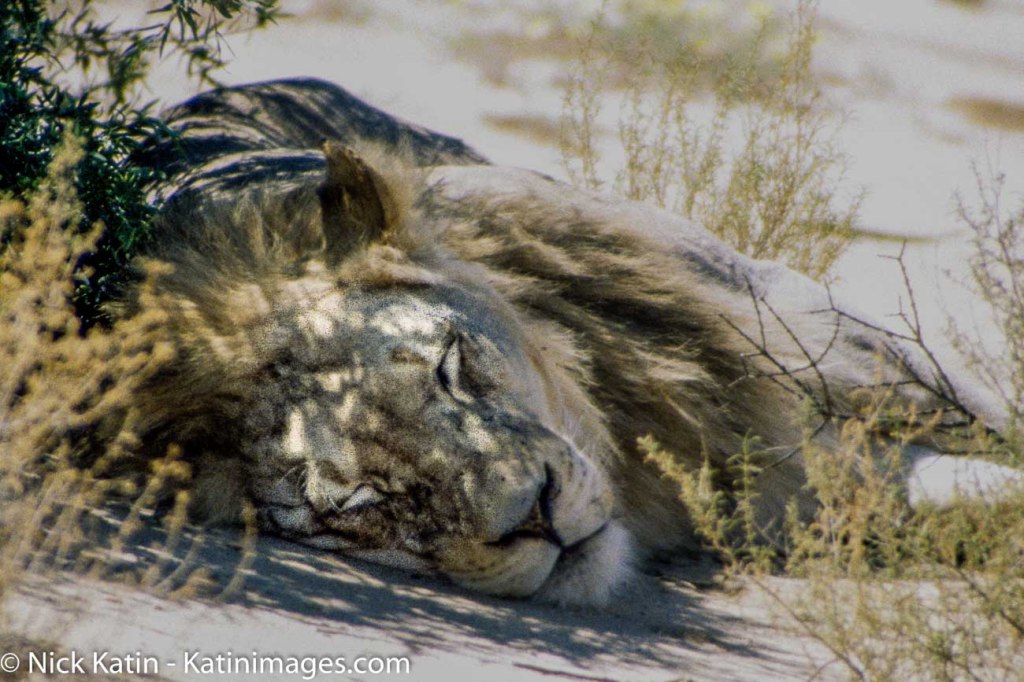
    A lion sleeps in the shade of an acacia tree in the Kalahari national park on the border of South Africa and Botswana
    A lion sleeps in the shade of an acacia tree in the Kalahari national park on the border of South Africa and Botswana
  • African shoestrings – South Africa Day Fourty six – Kalahari

    A night drive is a game drive, obviously, in the dark; well it was really in twilight as we set off just before sundown. The idea is to see lots of animals big and small as they cruised around in the coolness of dusk and then stop for a sundowner in the middle of nowhere. As it got darker so our reliance on the two spotlights grew and of course the obvious happened one of them blew. So the ten of us on the drive all had to squint into the dark to spot anything.
    We did actually see quite a few animals. But of course we didn’t see any of the more popular ones like lions, cheetah’s etc.

    Back at the camp we ate one of Roland’s culinary masterpieces under the light of plastic drink bottle covered candles.
    Now was the time for that beer as we got to know each other better.
    Simon & Hannah had just left school and were doing a bit of travelling before starting University in England. Alex, was visiting rellies in J’burg and I got the impression that they had shunted her onto this tour to get her out of their hair, she certainly was a little temperamental. Michelle was the quiet one. She had finished her Peace Corp stint in northern South Africa and this was her last days in Africa. Despite her quietness and the fact that she was American she had a great sense of humour. Well I think she did, she laughed at all my jokes.

    The tour kept rolling on, our next stop was the camp at Mata Mata, 127 kilometres north on a gravel road. The idea was to take it slow, have brekkie and lunch on the road and do a game drive at the same time.

    Well we saw heaps!

    Cheetahs and lions in the distance, black backed jackals, cape foxes, steenbok, gemsbok, wildebeest, springbok (these last our all from the antelope family) and the quaintly named long legged big bird, kori bustard.

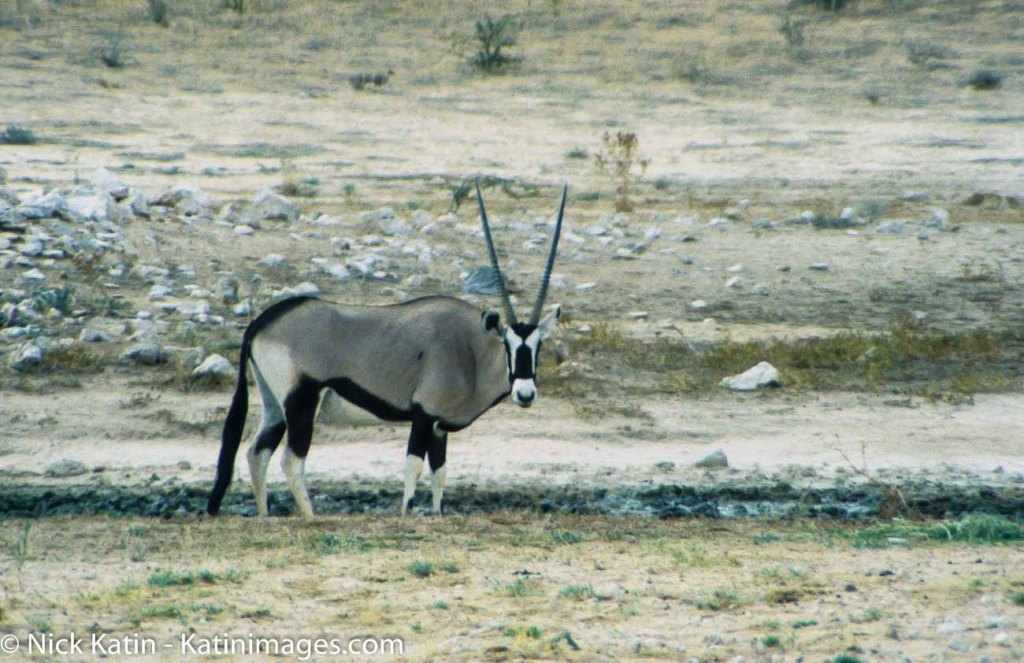
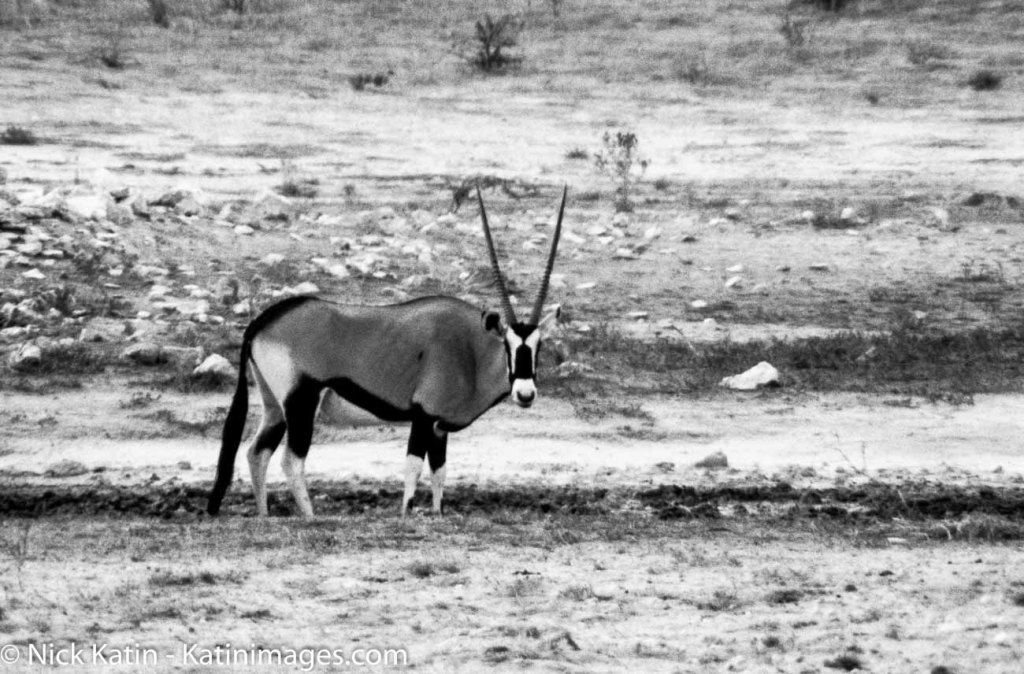
    The park was named after the Gemsbok, being quite common in the Kalahari. It’s a big animal at around 1.2 metres tall with striking fawn grey flanks, black legs and tail and metre high pointed horns. In my humble opinion, this is the most beautiful of all the antelope species found in Africa.

    The next day was pretty much the same format, as we drove on to Nossob, the last of the three camps, except the little critters must’ve sent out the message via the desert telegraph to hide when ever we came on the scene, because we saw virtually nothing.

    Nossob like Mata Mata was more basic than Twee Rivierien, but it did have an animal hide. Once again the animals didn’t read their scripts properly and forgot to come and see us. So we had to gain our entertainment from Roland who was busy being his industrious superhuman self. He was cooking spag bowl and fixing three punctures all at the same time. That night he told us stories of rangers cutting off their limbs to save their own lives after a predator attack in the bush. How he caught tick bite fever and was hospitalised for 9 weeks and how he had just recovered from a bout of Malaria which was really bad that year and had resulted in many deaths in central and eastern parts of South Africa. I think he has the philosophy of “never bugger up a good story for the facts”.

    Fortunately he told us these stories after we ate!

    If you like this then hit “follow” on the side bar

    A Gemsbok in the Kalahari national park
    A Gemsbok in the Kalahari national park
  • African shoestrings – South Africa Day Fourty – Stellenbosch

    The following day we ‘jumped ship’ and found a little apartment just out of town.
    Not that there was anything wrong with the Stumble Inn, it was just the noise from the other ‘guests’.
    I’d like to think that we haven’t we’ve lost touch with modern music but the repeated thumping of ‘techno’ music is not the best bedtime music as far as we were concerned.
    A young guy, John also from Perth, who was travelling around on his own, shared this opinion. In staying in the dorm, he was in a worse position than us and was getting fed up with being constantly disturbed as his fellow bedmates stumbled in and out of bed.
    Never really gave that much thought before. As a couple we always got a private room and had drawn a line in sleeping in a dorm. But anyone on their own is pretty well damned if they want privacy. They either pay more than double the cost for a double room (they are often more expensive per person than a dorm) or put up with sleeping in the same room as a load of strangers, have no privacy and in some circumstances be permanently on guard watching their belongings.

    Anyway we had enough of the Stumble Inn, we had lasted two nights, and for just a few more Rand we had a nice cosy little place tagged on onto someone’s house called “Kaveeltjie”. That someone was Gertie an extremely helpful and warm housewife with a couple of youngish kids. She picked us up at the tourist office in town and couldn’t do enough for us.

    One of the fascinating things about South Africa is the white Afrikaners. Most of these are descended from the original Dutch, German and French settlers and have been in South Africa since the seventeenth century. This is different from the whites of British heritage that have only been around since the nineteenth century. That in itself is interesting but what really fascinates me is that when you meet the Afrikaners is their own country they are totally different from your expectations. After all this is a race that is responsible for apartheid. A lot of these expectations are based on the media and those you meet in Australia who have left the country for good.
    Well we found them to be kind, friendly, warm and honest people. You almost get the feeling that they would give their lives for you. A lot of that comes from their strong religious beliefs, but I’ve met plenty of religious people over the years who will hardly acknowledge your existence let alone help you out in tight corner.
    These people also have an amazing attachment to their language, which for most of them is their first language, with English being used only whenever it’s really necessary.
    One particular lady we met on our first visit, actually pitied us for not being able to speak Afrikaans, saying it was such a shame that we were unable to use words that there was no equivalent for in English to describe the world around. At the time I wasn’t that convinced. But the more of these people I met the more I think there must be something in it. So many actually struggle to translate certain words from Afrikaans to English which tends to surprise as their English is usually so fluent.

    Any way Gertie fitted this mould, and was happy to give us a few pointers for our future travels and expeditions.

    If you like this then hit “follow” on the side bar
    A Gemsbok in the Kalahari national park in South Africa
    A Gemsbok in the Kalahari national park in South Africa
  • African shoestrings – South Africa Day Thirty-two – Cape Town

    Back in the guest house we learned what we had suspected that morning, Andre was a ‘know it all’ who liked to give you the benefit of his wisdom and experience in as many words as possible regardless of whether you asked for it or not.
    In fact listening to him politely, trying hard to stifle an epidemic of yawns wasn’t a shared duty as Sue somehow seemed to have a good reason to go to our room and would leave me stranded and bombarded by all this trivia, opinions and ‘expertise’.
    What did make us both chuckle was Andre’s insistence on stating “and that’s all there is to it” after every statement or monologue. After hearing it so many bloody times I can’t believe that we actually took this up as a catch cry as for the rest of our travels through Africa. We must have been brainwashed! For the life of me I cannot remember anything else that Andre said; but I do remember the fact that 90% of Andre’s commentaries were about the New South Africa.

    Henry on the other hand was far more interesting!
    Henry was a twenty-one year old black Student from Zambia studying at Cape Town University, South Africa’s and probably Africa’s best university and he was lodging at the guest house. Tall, lanky with tight cropped hair like so many of his generation, he was articulate and extremely mature for his age and spoke with some knowledge of the world today.

    That’s what’s so good about travelling, you meant the most interesting people in sometimes the most unexpected surroundings.

    We chatted to this guy in the kitchen as we both prepared our evening meals. He told us of his home near Lusaka in Zambia and how when he drove there from Cape Town, a journey of over 2000 kilometres, he could almost smell it as he crossed the border and first spots the Zambezi escarpment with now only 150 kilometres to go.
    His father was, we gathered an important government official and they wanted for little, except a university of quality close by, hence the 4000 kilometre round trip every time he went home.

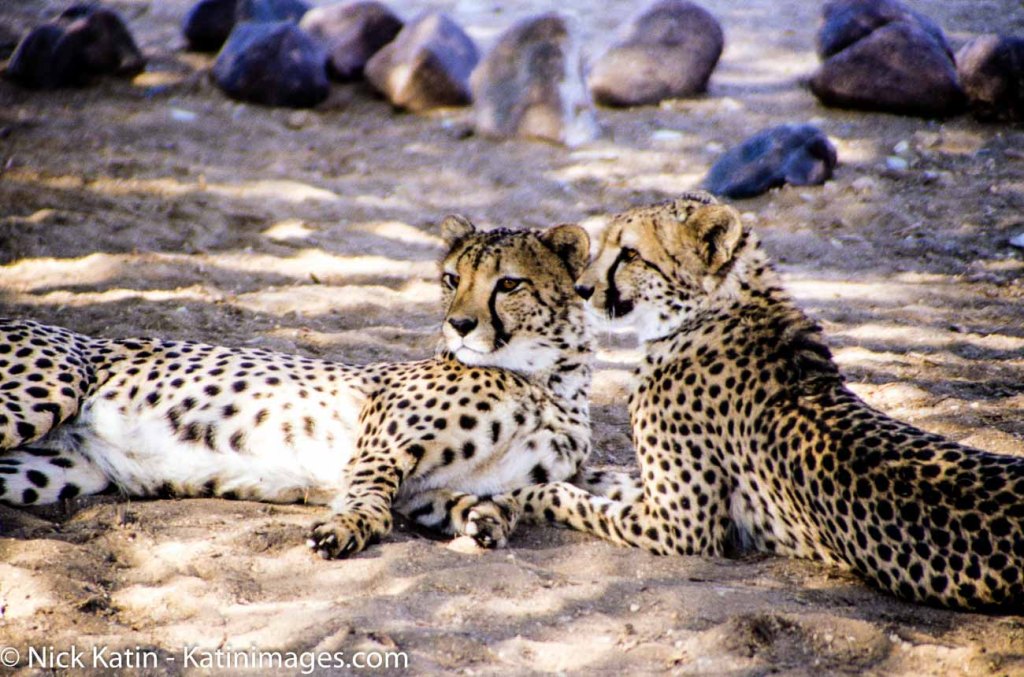
    Two cheetahs watch pensively in the Cheetah Outreach Project in South Africa
    Two cheetahs watch pensively in the Cheetah Outreach Project in South Africa
  • African shoestrings – South Africa Day Twenty-six

    The main reason that we had elected to stay in J’burg the extra night was to see Soweto.

    Soweto you say! Why would anyone want to see such a notoriously dangerous place?

    Well, most tourists visiting South Africa regardless of budget have minimal contact with black South Africans. Very few get to visit black townships or satellite towns because of their reputation or lack of opportunity.
    Hotels and all levels of accommodation, tour companies and other tourist facilities are still in the main, owned and run by white South Africans and generally black South Africans tend to keep their distance particularly from white tourists.
    Not surprisingly Soweto has had the biggest media coverage and for most represents South Africa at its worse. It has in reality, been a war zone ever since that fateful day in June 1976 when many black students were killed by police in a march against the use of the Afrikaans language in black schools.
    So to see such an infamous place is to observe black South Africa.

    Of course we were not stupid enough to go in on our own. Soweto is now a tourist attraction, so there are a number of tours that are run chiefly by black South Africans.

    Like most people I expected to see squalor and poverty on a large scale and it stopped me in my tracks to see that parts of Soweto were just like any other middle class suburb in the world. Nic Mbewe, our guide and Padwana his driver lived all their lives in Soweto and as he explained “There are basically three types of housing in Soweto, upper for the educated with good jobs who are moving out because they can, middle for those with jobs and the poor end of town for those who have nothing”.
    To be contuined………

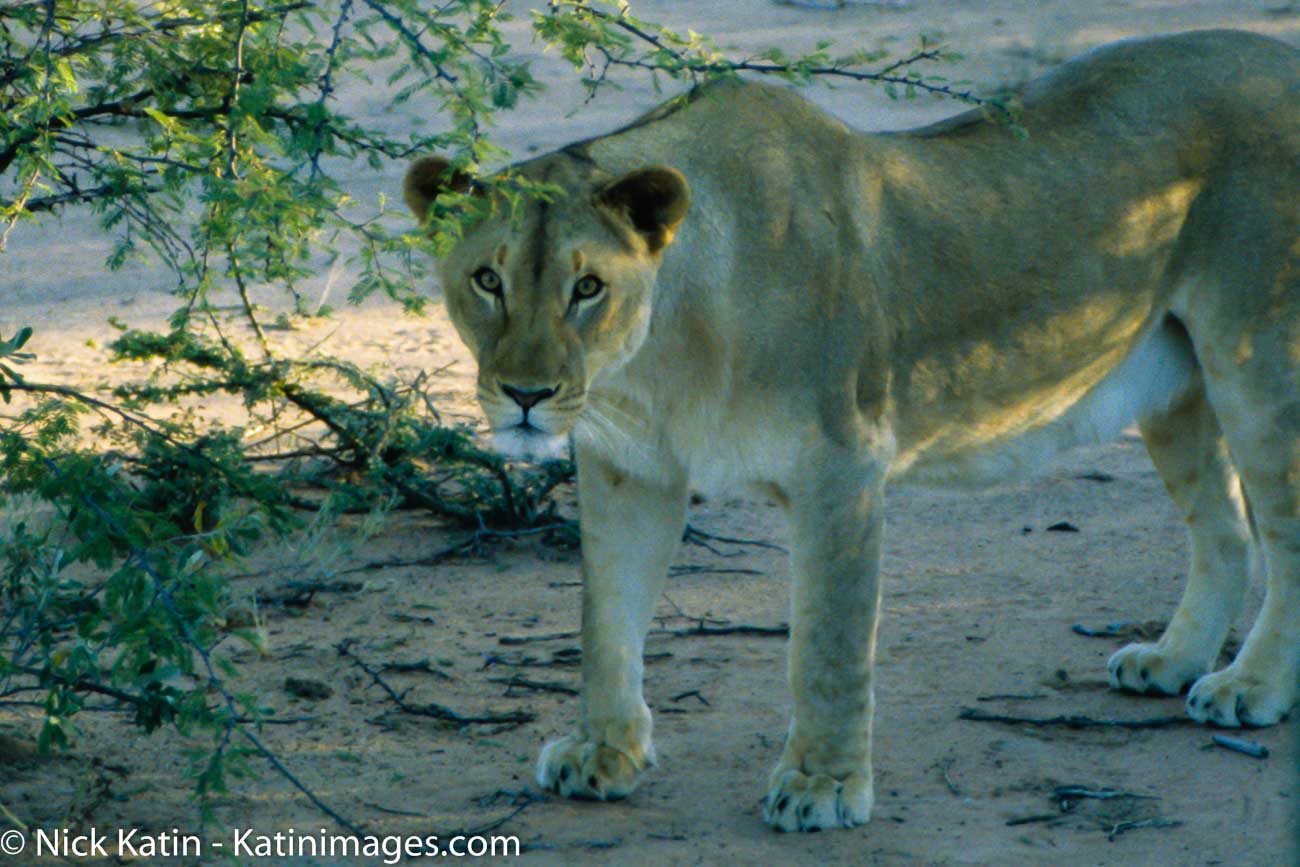
    A lioness underneath bush peers at it's potential prey in Namibia
    A lioness underneath bush peers at it’s potential prey in Namibia
  • African shoestrings – South Africa Day Twenty-five

    The hostel itself was an old large rambling single storey house with hand me down furniture spread haphazardly around the place,………… lounge chairs, torn dining chairs and card tables that had all seen better days and a large garden.
    Sounds all right doesn’t it? Well I did miss out one important fact. It backed onto the runway. It didn’t take too many jumbo jets to fly over to work out why it was called the Airport backpackers!
    Gerard was actually the owner and due to his Aussie manager being away, the manager as well.
    A white South African in his late 30’s or so, Gerard just likes to drink and talk and without doubt is a wealth of information on travel in Africa.
    Mind you, as Gerard’s bar was outside in the garden, conversations were often interrupted by the take off or landing of 747 or something similar. The noise was deafening initially until strangely enough you got used to it.
    What fascinated me more were the clientele; an Israeli couple who were not together, so they kept saying anyway, helping Gerard in slow motion; two Scottish girls who spent the day sun-baking and were never far from each others side; a Sri Lankan family, who never left the place and seemed to spend all their time cooking and washing and finally a Norwegian man in his late sixties with a much younger Thai wife, who just seemed to hover all the time in the background.
    The last couple had houses in both Norway and Thailand and he was a retired engineer, the last person you would be expecting to backpack around Africa.
    They were waiting to catch the ‘Baz’ bus to Victoria Falls in Zimbabwe. Now the Baz bus is one of those innovations born from the principle, necessity is the mother of invention. Clearly aimed at the backpacker market it’s a hop on hop off bus that runs between J’burg and Cape Town with several side routes and of course it’s relatively cheap. We toyed with the idea of using it ourselves except for one important detail, it didn’t go anywhere we were going!

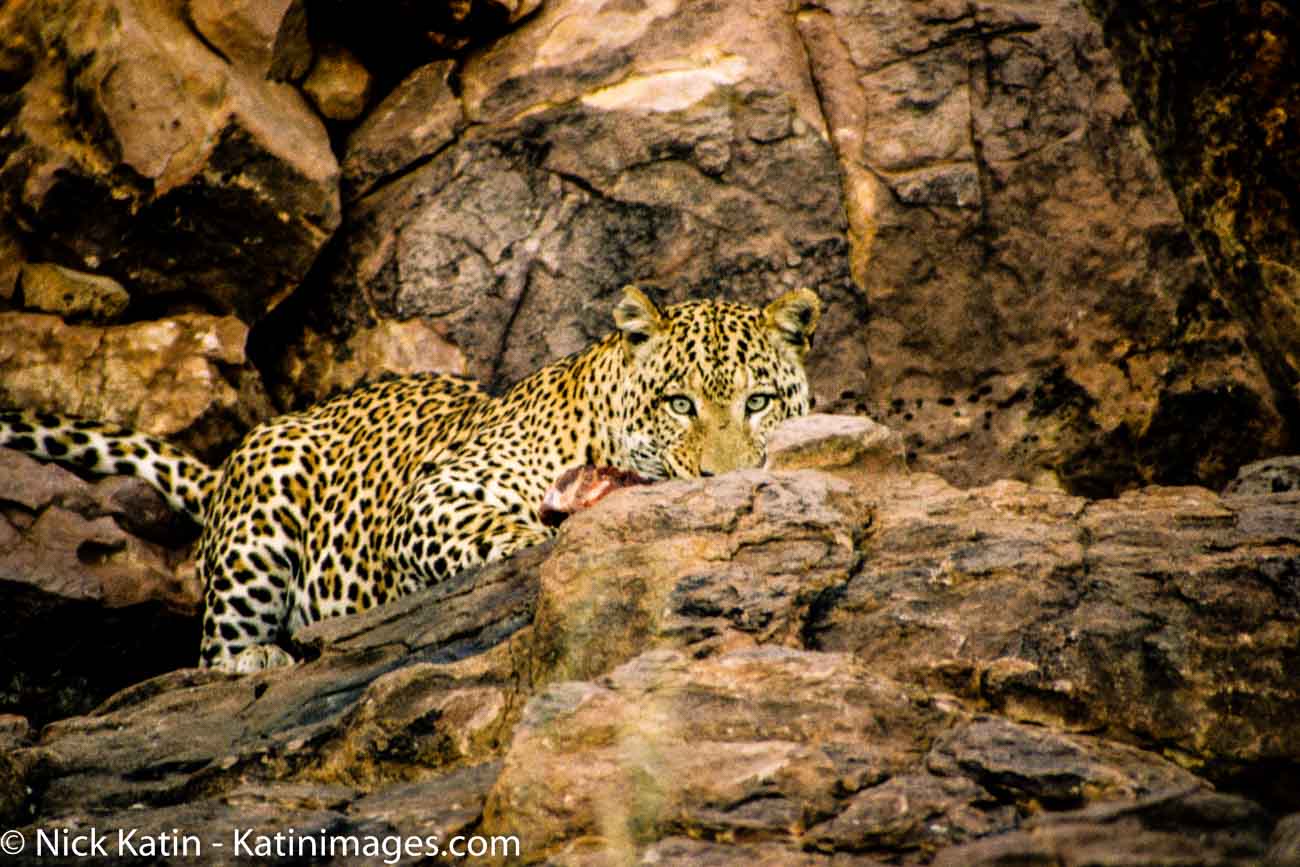
    A leopard eats it's prey amongst the rocks in Central Namibia
    A leopard eats it’s prey amongst the rocks in Central Namibia
  • African shoestrings – South Africa Day one

    Last time we flew to South Africa via Qantas we were upgraded to business class. No such luck this time! We were once again mere mortals packed in with our fellow passengers into the Airline industry’s version of the mini.

    Now that’s not to say that travelling economy with Qantas is a hardship. It’s not. In fact I think that they’re terrific. Good service, facilities, food and most importantly an unparalleled safety record makes any long haul flight reasonably comfortable. If that doesn’t get me a free flight nothing will!

    But a long flight is a long flight and quite tiring.

    Some eleven hours and two movies later we arrived at J’burg airport. Once ‘processed’ by the authorities we claimed our bags and moved out into the arrival lounge. We had been to J’burg before and sort of knew what to expect but nonetheless J’burg’s reputation as violent crime capital of the world makes you view everyone with a great deal of suspicion. In fact the biggest danger seemed to be the frustration caused by the ceaseless touting by reps of J’burgs many backpacker hostels. These guys hone in on anyone who looks even faintly potential. I think we got picked because it was such a quiet night and they were getting desperate.

    We managed to eventually find our hotel shuttle, which was driven by a young white guy. I make a point of this because several years ago these ‘menial’ jobs were done by black or coloured people, never by a white person especially a young white person.

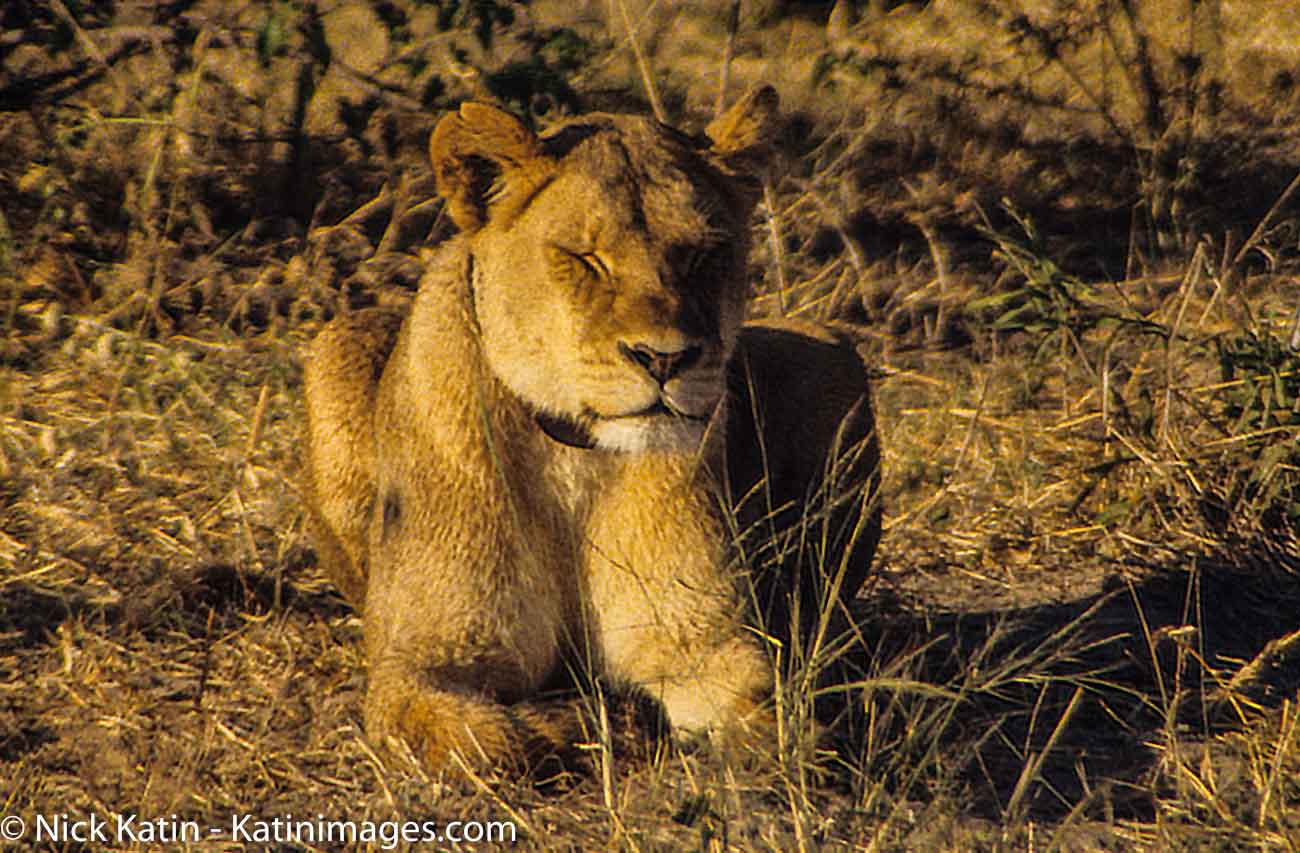
    A lioness enjoys the late afternoon sun in Chobe National Park, Botswana
    A lioness enjoys the late afternoon sun in Chobe National Park, Botswana
  • African shoestrings the plan part two

    So with the flights books and with the aid of countless travel guides borrowed from the library, the internet and the scantiest of information from the few African countries tourist offices in Australia we plotted our route.

    We gave ourselves 111 days to travel overland from J’burg to Dar es Salaam, see what we wanted to see and spend only an average US$100 a day, not each, but in total! We would stay in backpackers, youth hostels, cheap hotels and where possible camp. The latter was made a little difficult on account of the fact that we weren’t taking any camping equipment but as they say, there’s more than one way to skin a cat!

    The only things we booked here in Perth were our first nights’ accommodation and ten days car hire in J’burg. There was a very important reason for pre booking both of these. Safety! J’burg is infamous for violent crime; the last thing we wanted to be doing when we arrived was wondering the streets looking for somewhere to stay or looking for a hire car. No, we just wanted to stay one night near the airport, pick up a car and get the hell out of there!

    We booked the car through our travel agent and the accommodation through the Internet. Maybe it’s because of time constraints, security or lack of knowledge but it’s interesting that so many people still use travel agents. We found a cheap motel in the right location for half the cost of what our travel agent quoted.

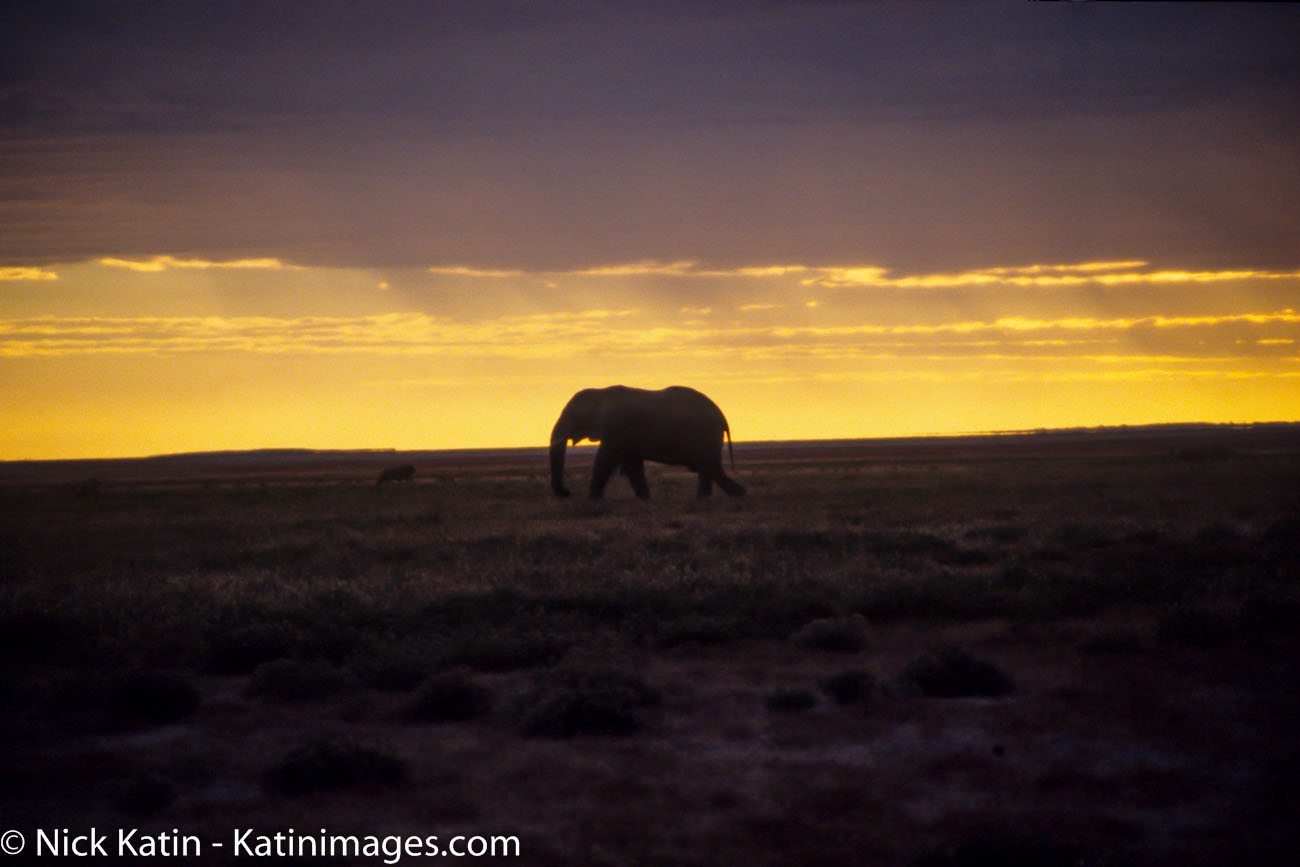
    An elephant strolling through the scurb at sunset in Etosha national Park, Namibia
    An elephant strolling through the scurb at sunset in Etosha national Park, Namibia
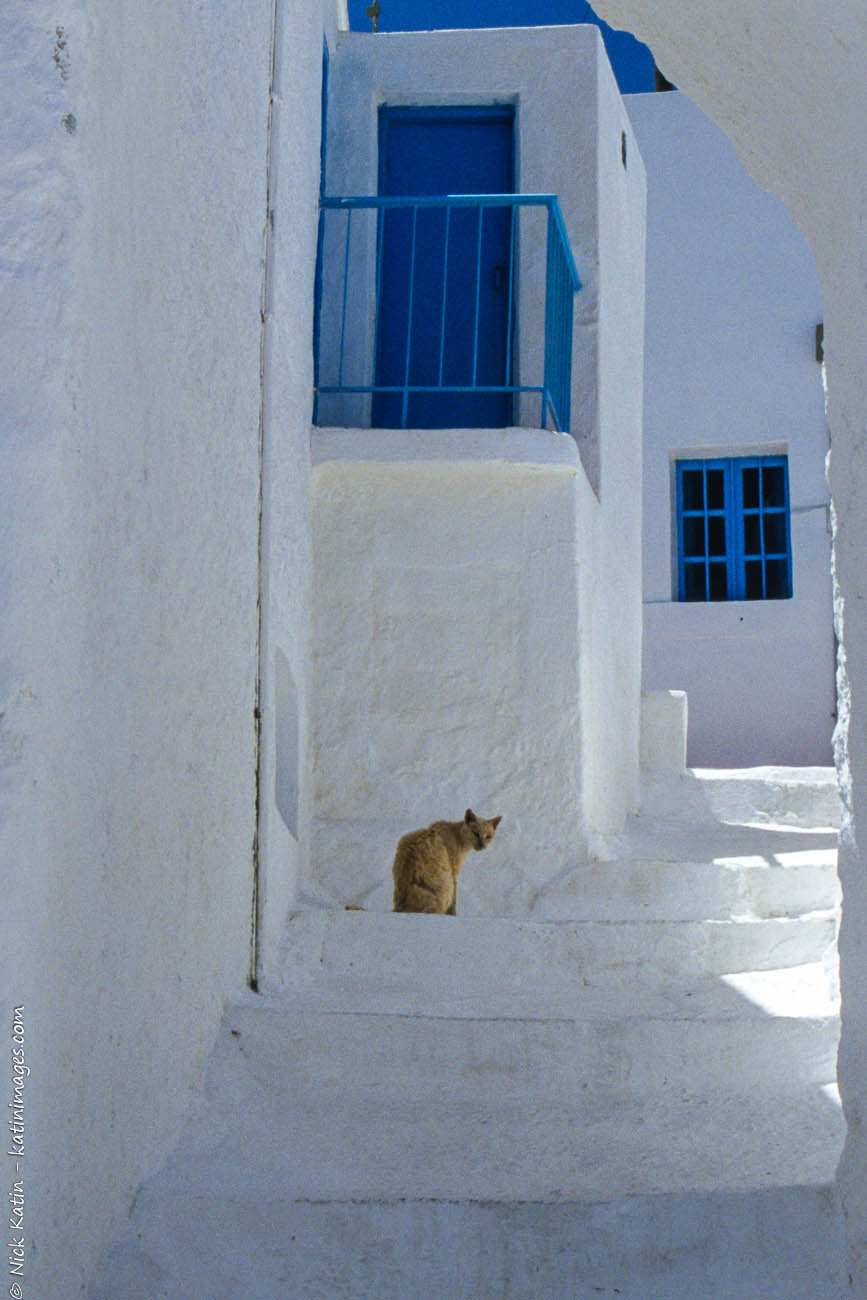
  • A cat on a step on the Greek isle of Thirasia

    Of the idyllic Greek Islands everyone knows Santorini and yeah, its bloody beautiful! In fact watch this space for some images of this famous island. Across the Caldera is the little island of Thirasia which is usually a 1/2 day excursion from Santorini. It’s how Santorini probably was before the rich, the famous and the tourists discovered it. No more than a couple of hundred people live here. It has a small harbour, a couple of small villages and pretty church, lots of steep steps, pebble beaches and this cat!
    By the way a caldera is a volcanic feature created by a volcanic eruption. In this case Thirasia, Santorini and a couple of smaller islands are all that’s left of a much larger Island after a volcanic eruption.

    A whitewashed street in Thirasia near Santorini one of the famous Greek Islands
    A whitewashed street in Thirasia near Santorini one of the famous Greek Islands
  • Photo tip no 2

    This is a contentious one! Turn off your flash! Unless you can control the power and the way it falls on the subject, inevitably the results you get tend to be cold and often washed out. I see so many people taking pictures outdoors with the auto flash on. In these cases unless you have the subject within a few metres, its a waste of time and power and can detract from the overall scene. So instead of having the flash on as a default, have it off as a default. All cameras including compacts and smartphone have this option. That’s not to say you shouldn’t use it from time to time but more as a last resort. How to overcome low light – that’s the next tip.

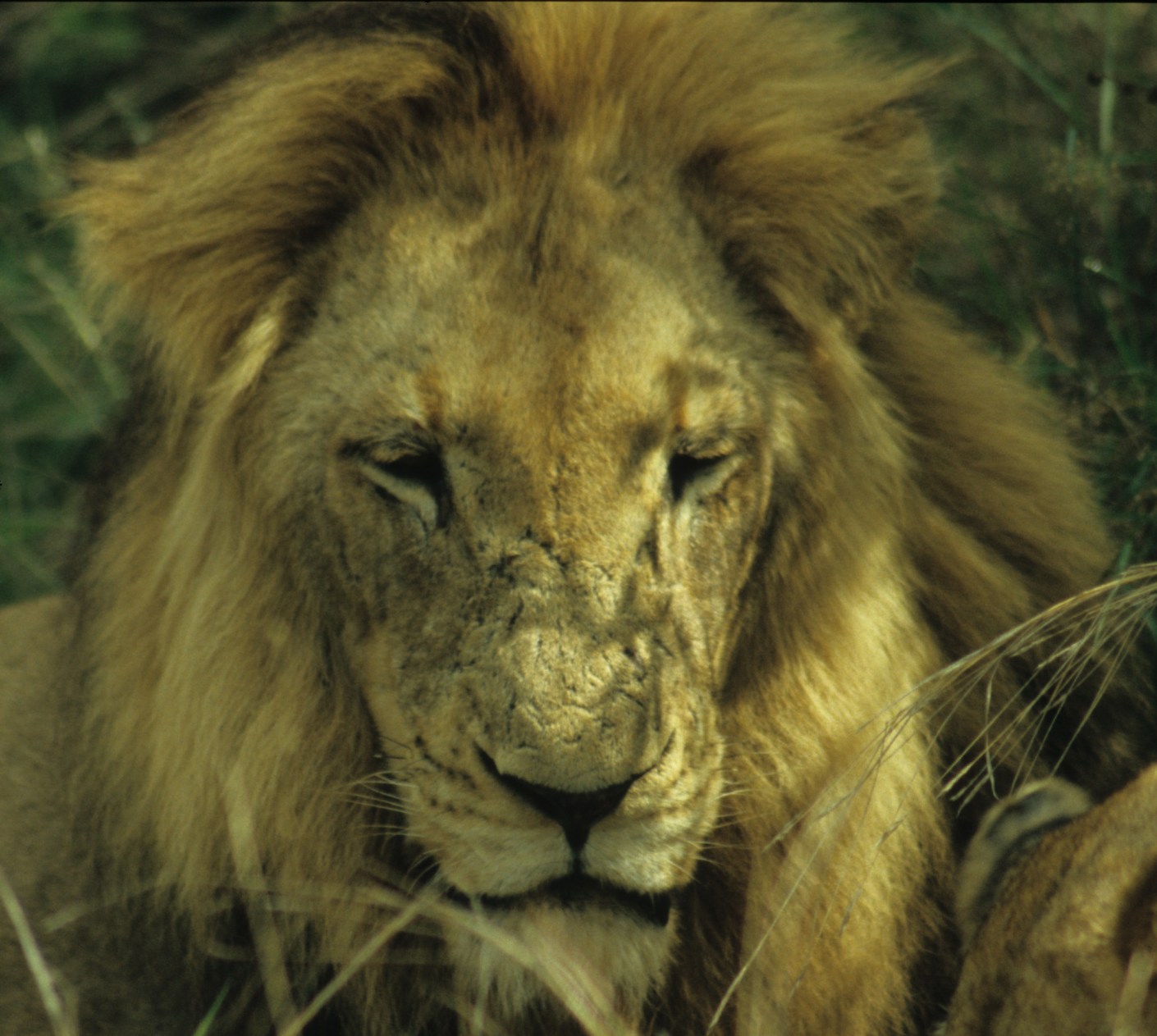
    Lion in Kruger National Park South Africa ©2013 Nick Katin
    Lion in Kruger National Park South Africa ©2013 Nick Katin

     To buy a print or licence this photo email or contact us