Katin Images Travel Photography

Travel Photos, Travel Photography Tips and Software

Tag: Women

  • African shoestrings – Namibia Day Sixty eight – Terrace Bay

    It didn’t start well. We had to cut short the tour of the rock paintings, as Sue was once again sick. What we did see (or what I saw) of it was fascinating. Some of the works are engravings that date back over 6000 years and appear to be still as clear as the day they were created. Fortunately Sue had the presence of mind not to leave a remnant of her stomach over any of them. Somehow I don’t think she enjoyed it one single bit.

    We had no choice but to press on. Sue had been sick twice now and I was starting to get concerned, but civilisation was now closer at Terrace Bay. The state of the roads didn’t help either. The road back to the main ‘drag’ was full of potholes and those irritating corrugations that leave you still stammering for hours.

    The road to Skeleton Coast was marginally better. There were less potholes but still plenty of corrugations and loose stones that had us slipping and sliding from time to time. It was slow going and bloody hot! Sue began to perk up the closer we got as she slowly recovered much to my relief. She had slept most of the way but really hadn’t missed much.

    The Skeleton Coast is as inhospitable as it comes. A waterless terrain of grey sand dunes and gravel plains for as far as the eye can see greeted us as we entered the park at the Springbokwater gate. I was amazed to actually see someone at the gate. The smiling gatekeeper with his house surrounded by a little patch of grass, an oasis continually under pressure from the relentless marching sand. He checked our passes and waved with a big grin on his face as we passed through. Did he know something we didn’t?

    The coastline of Namibia is an enigma. A desert that stops right at the waters edge. Certainly there are other examples of similar coastlines elsewhere. Our own North West of Australia is very inhospitable but at least it has some vegetation and even trees at the equivalent latitude. The difference is the temperature of the ocean. The Atlantic in this part of the world is bloody cold, consequently it just doesn’t create enough moisture to make it rain so this area averages less than 50mm (2″) per year! What the cold ocean does do however is keep the temperature down. Just as we experienced in Luderitz the temperature drops sharply at about 100 kilometres inland from the coast. Particularly when a southerly breeze is blowing (as it does most of the time) and covers the coast with a cool layer of fog. We went from a hot, dusty environment to a cool, almost cold, misty but still dusty environment in almost seconds. It was like walking into an air-conditioned shopping centre after having spent time walking in 35-degree heat. The change was that dramatic!


    There are many places that we have visited over the years that have not been what we expected and we have sometimes asked ourselves briefly “what are we doing here?” Terrace Bay is one of those places that begged the question continuously.

    It’s a small basic resort sandwiched between the ocean and the desert 3 million miles from anywhere and full of white South African and Namibian leisure fisherman all jabbering away in Afrikaans. We got chatting to a group from Paarl in South Africa and they even asked us what we were doing there. “Therre’s nothing ‘ere but fish” one of them said. It did have a restaurant where you have to eat, as full board is obligatory, a bar and a small shop with very little. The accommodation was reasonably comfortable. A few fibro semi detached huts with rather sparse self-contained rooms were dotted around the place.

    Fortunately we only had two nights here. We spent the rest of the day and the next day, relaxing, reading, sleeping and for a brief time, exploring.

    If you like this then hit “follow” on the side bar
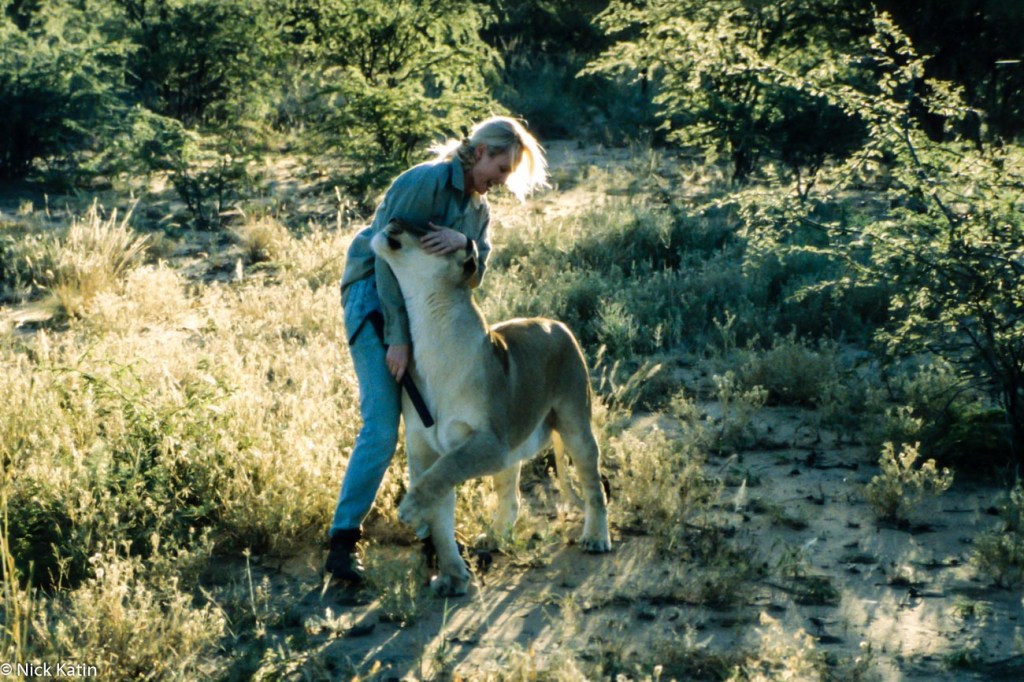
    Playing with a female Lion at Okinjima in Namibia.
    Playing with a female Lion at Okinjima in Namibia.
  • African shoestrings – Namibia Day Sixty seven – Twyfelfontein

    We got back to the resort in enough time to have another shower (our third) before dinner. Dinner brought us kudu steaks again and again it was the texture that put me off confirming after this second ‘chew’ that the kudu is safe from me in the future. Unfortunately there were no other choices so it was that or go hungry! Nonetheless the remainder of the food was good and really became secondary to the conversation we were having with a South African couple and a couple of journalists from Zambia who now live in New York. We were enjoying the conversation so much that it was almost an inconvenient interruption to be called to the night hide to see a porcupine munch on another slab of meat left there to attract him.

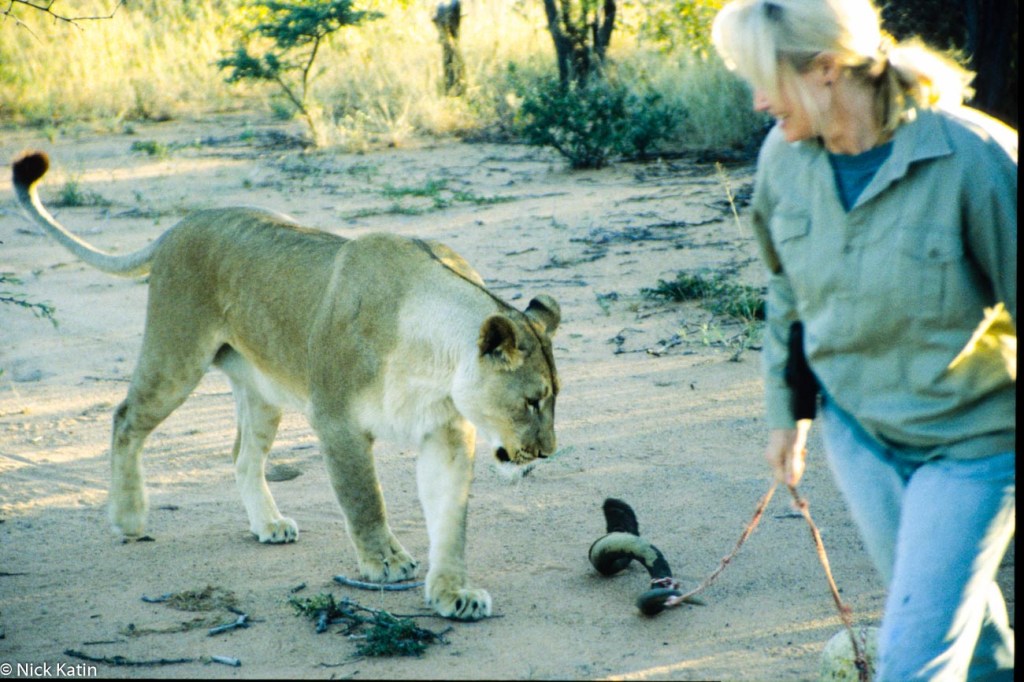
    It was all go the next morning. Up at 6 and into the huge long grassed paddock that was the lion’s enclosure, on the back of an open safari truck. These three lions (one female, Tess and two males, Matata and Tyson) were rescued from brainless people who kept and mistreated them in captivity. Even though they were now part of the family, it was intended that they would be relocated back out into the wild. Watching Donna and Roselea Hanssen play with them, I wondered whether how that could ever be. These animals were domesticated and appeared to me to be just big playful pussycats and then I remembered Guy’s story yesterday and made sure that I stayed well within the safety of the truck.

    Our final ‘activity’ was a guided bushmen walk trail. Chris our guide (who I noticed showed a healthy respect for the lions in the way he held on tightly to his rifle) took us on a track littered with bushmen artifacts, ‘home comforts’ and tools.

    It was interesting without being riveting. The bushmen like many other traditional peoples had no concept of ‘waste’. Everything had a use. A small animal would provide not only food but also pelts for warmth, fat for cooking and skin for shelter. It’s a principle that appears to be have lost over the centuries by Europeans.

    Back to the lodge and we only had a few minutes to vacate our room before Brunch (they like you out of the rooms by 9 am) which we enjoyed under the watchful gaze of the resident warthog.

    On the drive out Sue was feeling pretty crook and we hadn’t got far when I had to stop whilst Sue got rid of the contents of her stomach. From then on she slept whilst I drove onwards to Terrace Bay in the Skeleton Coast Park, some 380 kilometres away, in the blazing heat of the desert.

    As half of the road was gravel, there was no way we were going to make it in a day so our overnight stay was near Twyfelfontein where some of the finest rock art in Africa is found.

    Not so fine was the Abu-Huab Camp. Another dust hole masquerading as a ‘rustic and natural desert camp” in the middle of nowhere. Once again we had to put up with dust and sand blowing into every crevice and orifice. Sue was still crook and lay most of the time in the tent and I still had the remnants (in the form of catarrh and dry throat) of the cold I had caught nearly 3 weeks ago at Fish River Canyon.

    We were back down to the realities of independent budget travelling with a bump. No comfy bed in a dustless air-conditioned room for us that night. As darkness descended Sue gradually regained some strength to sit outside whilst I eat and we actually began to enjoy relaxing under the gaze of the millions of stars that lit the night sky with their pinpricks of light scattered in and around the milky way. That was until Sue almost put her foot on a scorpion, which could have put us right in the ‘shit’. Somehow this wasn’t the sort of place where emergency medical treatment would have been easy to find. That was enough for us, our beds were calling. Hopefully tomorrow would bring a better day.

    Playing with a female Lion at Okinjima in Namibia.
    Playing with a female Lion at Okinjima in Namibia.
  • African shoestrings – Lesotho Day Fifteen

    That tricky river crossing was the final challenge and can you believe it wee stopped for lunch about ten minutes from there!
    We just wanted to get it over and done with!
    David & Clement had been unable to talk to each other as much because of David having to spend a fair amount of time controlling the now impatient and eccentric Black Label. So we figured that they wanted to have a final ‘chat’ before heading home.
    The crossing was actually no big deal going back. This time we were climbing the steeper side of the gorge and it’s a lot more comfortable looking up than down. For me riding a sure-footed and obedient pony made a big difference.

    We got back at around 1.30 pm and despite feeling dirty and dusty we headed for the bar and stayed there for the rest of the afternoon.

    The next day we headed out back to South Africa.

    The road was pretty much the same until we reached Maseru.
    To avoid the city centre we had to travel along the eastern outskirts. Even though we had been assured that there was no danger by almost everyone, this area seemed uncomfortably close to the spot where all the rioting had happened 6 months ago. We passed several buildings that had been gutted by fire or looting and appeared to be sitting there unused and ignored.
    But we never felt threatened by the many people who were going about their business not in the least bit interested in two potentially nervous white tourists.

    What did make us uncomfortable was a lone policeman standing in the road waving us down. You hear lots of stories of corrupt African police officials extorting money from helpless tourists in exchange for not impounding their vehicle, luggage, children or anything else that’s worth them confiscating.
    He examined the tax disc on the front of the car very closely as if it was strange flaw in the windscreen. His face lit up on viewing my Australian drivers licence and said beaming, “Aha, from Australia! Kangaroo!” We laughed with him at this obviously witty and perceptive comment not realising at the time that this was going to be repeated many times by what seems now to be an army of officials, bureaucrats, tour guides, hotel workers and any other smart arse that inadvertently wanted to piss us off!
    He waved us on politely still beaming at his joke.

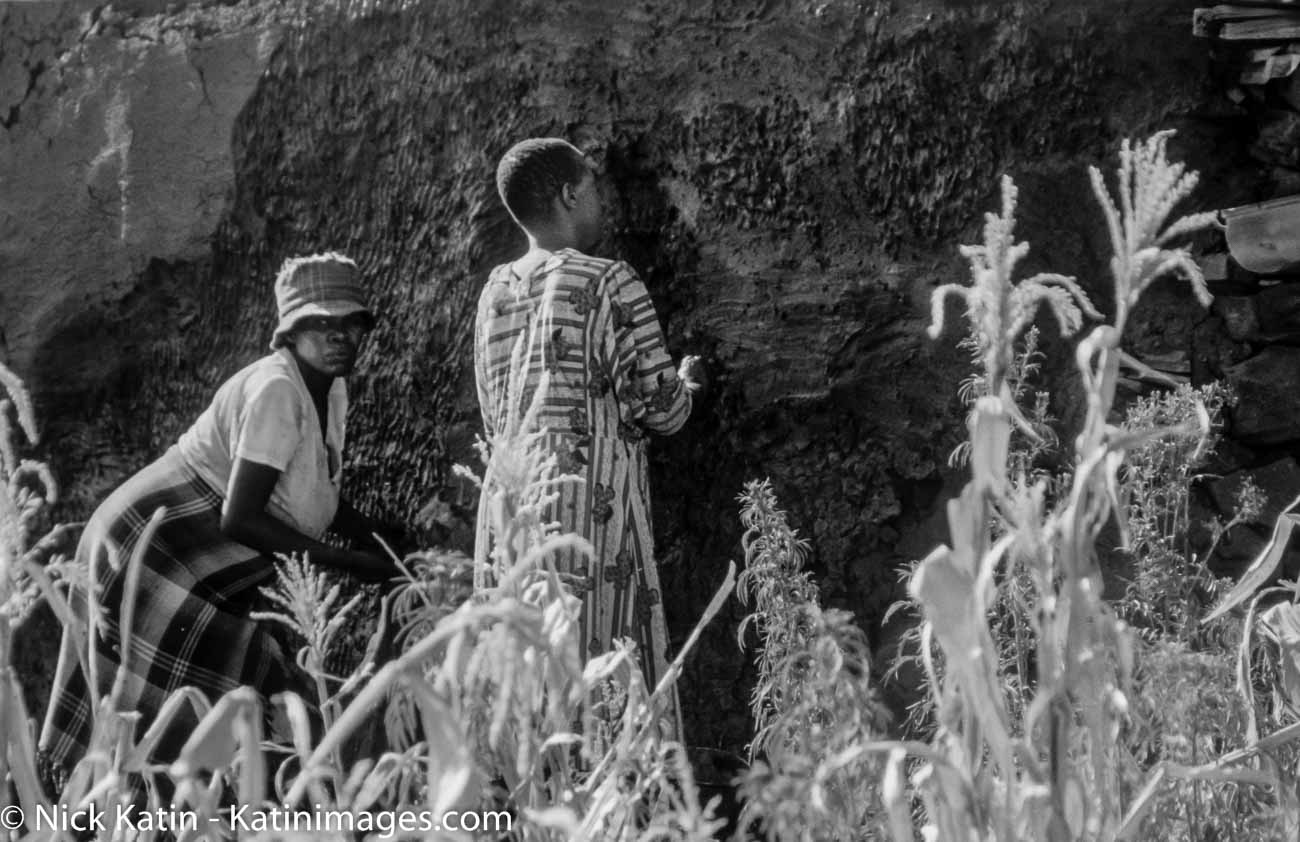
    Women cleaning the outside of a mud hut near Malealea Lesotho
    Women cleaning the outside of a mud hut near Malealea Lesotho
  • African shoestrings – Lesotho Day seven

    Malealea Lodge is at the top of a hill right next to Malealea Village. The lodge itself is a collection of chalets, huts, a dorm and a bar/store dotted among Pine trees and areas of brown lawn. Set to one side away from the other buildings, stood a colonial style house that the old man at the gate pointed us towards.
    There we managed to find Mick Jones with his feet up on the veranda overlooking the Malotti. Mick owns and runs Malealea with his wife Di. At the time, Mick stayed all the time at the lodge whilst Di ‘commuted’ to their office in Bloemfontain in South Africa.

    We watched Mick from our chalet veranda striding around and barking instructions at his employees in the local lingo, SeSotho, until the afternoon thunderstorms that had been threatening all afternoon, turned on a show.

    Thunderstorms are a way of life here. Incredibly more people die in Lesotho from lighting strikes than any other single cause. Which is really surprising considering the way they drive! I suppose the bottom line is that a country as poor as Lesotho, it’s one of the world’s poorest, doesn’t have that many cars but does have plenty of people travelling by foot. When you travel by foot in such a mountainous country the risk of getting struck by lighting is relatively high.

    That’s not to say that it’s unsafe to walk around Lesotho, it’s just some care is required during their thunderstorm season in the summer months.

    The spectacle of these thunderstorms is a show not to be missed, especially after dark.

    Watching this show brought home to us that we were actually living our dream. We were away from our home, family and friends travelling the world without a care, except that constant nagging fear of spending too much money. It was a great feeling and a place like this was what it was all about.

    Mother and Boy outside a hut, their home in the mountains of Lesotho
    Mother and Boy outside a hut, their home in the mountains of Lesotho
  • The travel photographer FAQ’s: How do I get good shots of the locals?

    How do I get good shots of the locals?
    Good question. It really depends on where you are and what shot you are after. Begin with making sure that your camera is ready for an immediate click! This is essential. Nothing worse than loosing a shot because you weren’t prepared. So lens cap off, camera on and the right settings in place, usually a wide aperture i.e small f stop. If you are after candid shots of people just going about their business then a reasonable size zoom lens is handy and usually if you are far enough away you probably won’t need to ask permission. If you are going to try and get close up then it really is courteous to ask permission and then you may need to have a chat to make them feel comfortable. The trouble then is that they will pose which is often not what you want.I take an initial shot of them posing and then continue chatting and taking pictures which tends to yield more relaxed portraits. Beware of cultural sensitivities – in some countries there’s a believe that you are taking away a part of their soul.

    Old women at the Ranipauwa market. Ranipauwa Nepal is also called Muktinath after the sacred site nearby and close to the Tibet border.
    Old women at the Ranipauwa market. Ranipauwa Nepal is also called Muktinath after the sacred site nearby and close to the Tibet border.
  • Jogger in King’s Park Perth photo

    Kings Park in my home town Perth, at over 400 hectares or 1000 acres, is the biggest inner city park in the world. Situated on Mount Eliza it overlooks the Perth CBD and is one of the biggest tourist attractions in Western Australia thanks to its diversity of attractions, beauty and activities. It’s also very popular with walkers, cyclists and joggers. This is one of the many joggers thrashing their hearts all in the name of health, that I snapped running past me in quite dim light just after a touch of rain.

    Jogger at Dusk in Kings Park Perth the biggest inner city park in the world and is very popular with joggers. This area overlooks the Perth CBD.
    Jogger at Dusk in Kings Park Perth the biggest inner city park in the world and is very popular with joggers. This area overlooks the Perth CBD.


    Want to put this on your wall then go to King’s Park Perth photo. To licence or share this photo email or contact us


  • Travel different Murano and Burano two

    Burano, Venice Colourful canal houses in Burano © 2010 Nick Katin
    Burano, Venice Colourful canal houses in Burano © 2010 Nick Katin

    Arguably the prettiest palace in Venice’s lagoon, Burano is known for its lace industry and the colourful houses that line the streets and canals. Legend has it that the fishermen in days gone by wanted to see their houses from afar as they returned after a hard day’s trawl.
    A walk along the streets will reveal a few shops that have their own seamstress producing intricate lace. But beware Chinese imitations are creeping in.
    The day we were there was perfect but we must have also hit washing day! Washing dangled from lines drawn across alleys, streets, window to window, TV aerial to chimneys, anywhere that a make shift washing line could be installed.

    Lacemaker Burano, Venice © 2010 Nick Katin
    Lacemaker Burano, Venice © 2010 Nick Katin