Katin Images Travel Photography

Travel Photos, Travel Photography Tips and Software

Tag: waterhole

  • African shoestrings – Zimbabwe Day Ninety-Three Masvingo Zimbabwe

    The next day was one of those days. Our early morning game drive yielded very little wildlife. It was our last opportunity to see wildlife in Hwange as we then commenced the 630 kilometre journey to Masvingo in the southeast. On the way out we flagged down by a ranger who asked us to drop off a couple of youngsters at the main road. No problem we thought. Except when we got to the main road they didn’t have a clue as to where they were. We obviously couldn’t leave them there and drive away with a clear conscience, so we ended up taking them into the actual town of Hwange 10 kilometres in the opposite direction, where they lived. This must have distracted me because it wasn’t until we had traveled a fair distance towards Bulawayo that we realised that we did not have as much fuel as I had thought. We found much to our dismay that there was not a single open petrol station between Hwange and Bulawayo. We were now sweating on whether we would have enough to reach Bulawayo. We did of course but as soon as I turned the key to drive off after gratefully refueling, you’ve guessed it, nothing happened. The battery lead had again come adrift. After again some basic repairs we were back on the road still sweating but these time about the battery lead. Worse still it was now getting late and that meant driving in the dark.

    So what, you say!……………… Well, driving in the dark in somewhere like Zimbabwe is a challenge. Firstly, once out of the cities and major towns there is very little street lighting. Secondly, there are lots of pedestrians on the road who are not easily visible as they mostly wear dark clothing and are obviously black skinned. Lastly, the other vehicles on the road had at best, blinding headlights and at worst none at all but most seemed to have only one headlight working which meant that it was impossible to tell whether the vehicle coming in the opposite direction was either a motorbike or a car on the wrong side of the road!

    Our intention had been to book a night at a place called Clovelly Lodge in Masvingo on our way. Do you think we could find a pay phone that worked? No! It wasn’t until we reached Masvingo itself that we managed to ring them, find out if they still had a room free and get directions. Needless to say we got there somewhat stressed and it didn’t help that we were immediately pushed into the dining room where dinner was now being served up (it was full board).

    Clovelly was run by Bruce and Iris an elderly English couple who basically felt that the current situation in Zimbabwe was becoming intolerable for any whites to stay. At the same time they were trapped. Their assets and money were now worth very little outside of the country and that made it very hard for them to leave. Now of course with all the recent publicity of white farms being hijacked by black war veterans, I often think of people like Bruce and Iris and wonder of they ever found a way out.

    By this time we had verbally booked a Canoe safari on the Zambezi to start in a few days time, so it was with great interest that we listened to a couple of German guys who were also staying there. They had just finished that same trip and had cut short their stay in Africa to fly home on account of one of them being badly bruised down one side of his body. Apparently they had been sleeping in their tent when a hippo trampled right over the top of the tent and poor old Klaus. Peter on the other hand slept through the whole thing and didn’t realise what had happened until the next morning when he awoke to see his mate writhing in pain and the tent collapsed and torn down one side. “What the fuck were you doing last night?” he had asked.

    We later found out that hippos have their own paths from land to water and if by chance you happen to be between a hippo and water on one of these trails then he (or she) is not going to politely side step around you. That is apparently what happened to these guys. Fortunately for us they had used a different safari company so we could hopefully presume that there was little chance of that happening to us.

    Now there was a reason we were in Masvingo. The town itself is just one of those typical small towns that can be found almost anywhere else with wide streets crisscrossing in the style of towns and cities established in the late nineteenth century. Its only real claim to fame is the general consensus that it was the first white settlement in Zimbabwe but that is not, in today’s political climate, much of a tourist attraction. What we were there for was not actually in Masvingo but 25 kilometres south. The Great Zimbabwe National Monument is one of Southern Africa’s greatest historical ruins.

    If you like this then hit “follow” on the side bar

    Two hippos grazing by the side of the Zambezi River in Zimbabwe
    Two hippos grazing by the side of the Zambezi River in Zimbabwe


  • African shoestrings – Zimbabwe Day Ninety-One Hwange

    Main camp is’ as the name suggests’ the centre of Hwange. It has most of the facilities, accommodation and the National Park office. It was here that we had to check in and try and organise our spare night.

    The female official was not exactly helpful. “Yus we cun give you anuther lodge for dat night” After establishing that meant we had to change lodge I asked whether we could stay in the same lodge instead of changing. “Noo. Thaat is noot possible” There was no point in pursuing the issue further she wasn’t going to be any more helpful and that was that. She wouldn’t even give us the key to our first lodge until 2 pm. ‘Rules are rules’ in African government.

    We consoled ourselves with a beer in the rather tired Waterbucks head and then attempted to find a picnic spot.

    The road we took was so bad that we gave up after a while but then came face to face with a herd of elephants that came perilous close to the car. Hwange has one of the largest populations of elephants in the world at around 30,000 and most of them seem to be crossing the road right in front of us.

    You know sometimes I can’t help myself, I just had to get a little bit closer to get that ‘great’ shot. It began to occur to me that we might be a little too close when one of the elephants turned and looked us rather menacingly and made to charge us. That was it, I was in reverse and began to move backwards so fast that the elephant was impressed enough to change his mind and went back to his herd. These guys are to be taken very seriously!

    The lodge was quite comfortable if somewhat (like everything else) rundown. It was completely self contained with a bedroom, kitchen, bathroom and lounge. It even had a braai and a shady veranda. Better still we had a cleaner who came in to make the beds and do the dishes. But the best thing was that it was so cheap. US$4 per night! At that price rundown or not it was a bargain.

    Hwange covers 14,600 square kilometres of hot, dry and dusty scrub interspersed with clumps of umbrella acacia trees and dotted with a few waterholes. It’s at these waterholes that most of the wildlife congregate, so most of us just drive from waterhole to waterhole looking for the most exciting wildlife we can find.
    It’s sort of strange how we can become blasé so quickly about the wildlife that we do see. Everyone wants to see the big cats and rhinos.
    At Nyamandhlovu (Nya to its visitors) Pan there is a platform where visitors get out of their car and sit for a while. Here we saw almost everything we had seen before wildebeest, kudu, giraffe and even elephants and still we wanted more.

    We visited this spot again the next day but had to return back to camp when I noticed a nail in one of the tyres. Repairing and replacing tyres was a big enough business in Hwange to justify having a permanent workshop there, so getting it fixed was not a problem.
    In the afternoon we returned to Nya and after an hour or so we got back into the car, turned the key and got nothing but a click. Now picture the scene we’re in the middle of an African wildlife park where the only time you can get out of the car is to quickly climb onto the platform and we’ve broken down. My first reaction was to get out of the car to have lift the bonnet. My second reaction when Sue pointed out that I could be risking my life in doing this was panic and then I got out of the car and lifted the bonnet but with my attention very much on the landscape around me rather than the slumbering piece of metal below me.

    Fortunately there was an armed guard who we hadn’t seen nearby and he made his presence known by coming over and without a word just stood guard close to the car. The problem was the battery lead had come loose from the terminal connection and with my limited tool kit and my great versatility as a mechanic, I had it up and running in no time.

    Back at main camp we washed down a ‘coldie’. Actually it wasn’t a beer but a gin and tonic. Gin was so cheap at US$1.00 for half a bottle that we thought we could save a little bit of money. Trouble was a gin and tonic without ice was like having a warm beer, it just wasn’t the same so that idea was abandoned after while and we went back to beer which at least we could have cold and was still only around US$0.80 each.

    That afternoon we went on a guided walk to the nearby Sedina Pan and back. Douglas our guide had good sense of humour and led us through the bush to the pan where we sat and watched in the hide for a while. Whilst peering through slot in the hide Douglas pointed towards one end of the pan. “What dooo yoou see my friend?”

    “What should I be seeing?’ I replied thinking that there was a lion or something equally as interesting.

    “Oh I don’t know. My eyes are not sooo goood”

    What was the point in having a guide whose “eyes are not so good”? We were relying on him to spot those animals that us mere tourists never spot!

    The other two other couples on the walk were from France and USA. I’ve come to the conclusion that yanks who go overseas must all have training before they leave because they all seem act the same way. Once again they wore the obligatory designer label safari gear, were loud and this time had a video camera that they talked to. That was irritating. We would be watching quietly for some wildlife when behind me would come the murmur “heere we ‘re watching quietly for some anemals in Seedona Paan” I’m sure whoever watched that video was bored shitless! I shushed him and neither of them spoke to us again until the end of the walk.
    Later we saw both couples having dinner together in the Waterbuck restaurant ignoring us as we walked past. Some people are just so petty!

    As it turned out Douglas didn’t actually need his eyes. On the way back we walked across a grassy plain full of zebra, wildebeest, jackals, baboon, giraffe and incredibly two kudu having a scrap within a couple of metres of us.

    If you like this then hit “follow” on the side bar

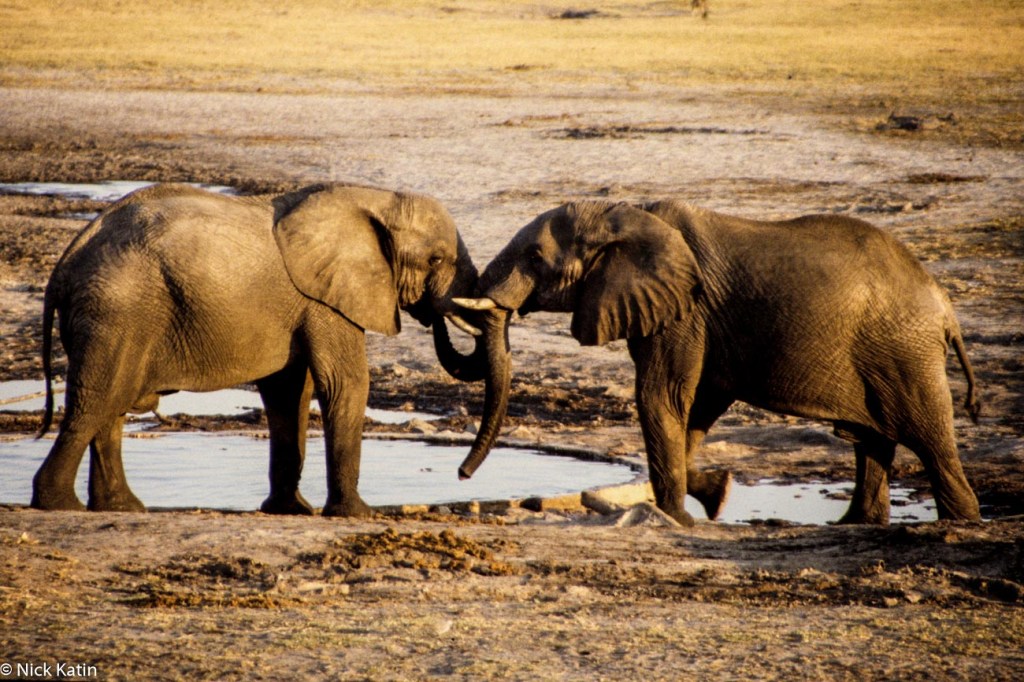
    Two elephants mixing it up at a Hwange NP waterhole in Zimbabwe
    Two elephants mixing it up at a Hwange NP waterhole in Zimbabwe


  • African shoestrings – Namibia Day Sixty three – Etosha NP

    We now on our way to Halali, the next rest camp that was 70 kilometres away, which should only have taken us around hour but this place was teeming with animals. Every waterhole had an abundance so we didn’t end up getting there until after midday some 4 hours later!
    This wildlife viewing slows you down!
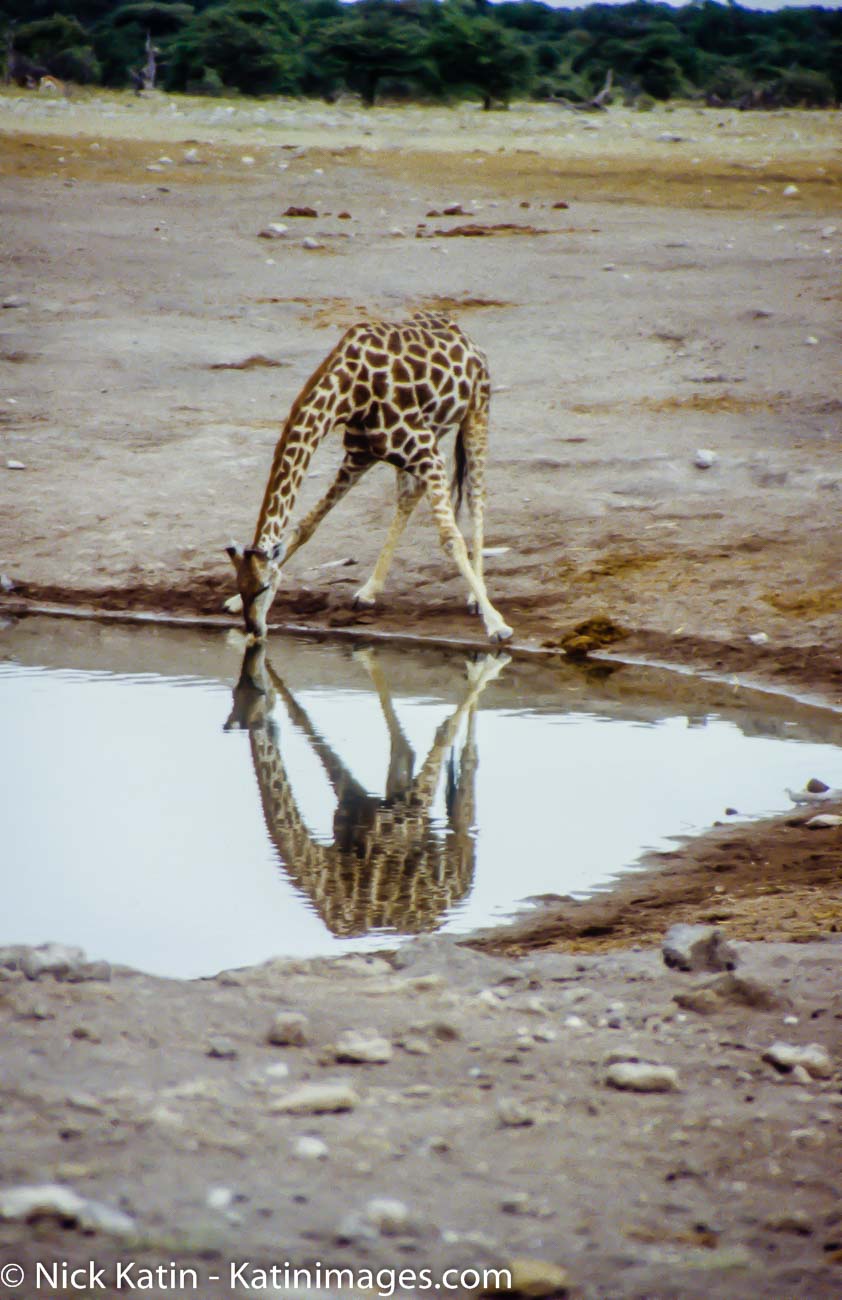
    But how can you hurry when a big herd of elephants turn up at waterhole that you’ve been watching for a few minutes or two or three giraffes bend over, legs splayed, to have a drink.

    At Halali we were back to camping after the dubious luxury of a chalet at Okaukuejo. It was fine, a bit dusty but there weren’t many other happy campers, so it was quite quiet.
    That was until an overlander with at least 20 people hanging off it parked next to us. Needless to say we didn’t get much sleep that night.

    Halali also had its own waterhole and that evening we saw a three black rhino again. We tried to work out whether it was the same three we had seen at Okaukuejo the previous evening. It seemed almost impossible that three rhino (one was a baby) would walk 70 kilometres in a day but who knows! As they lapped away at the water, a lioness and a couple of hyena appeared. They didn’t hang around long! One of the rhino continually went for them so that eventually they got the hint that they weren’t welcome to join the rhino family for a drink.

    Our morning game drive yielded more lions again. How boring! There were three males strolling down to Salvadora waterhole obviously thirsty and possibly hungry. We hung around for a while but they just found a shady tree and slept.
    Lions actually sleep or rest for around twenty-one hours a day, leaving just three hours to hunt and eat. It’s a little known fact that they actually have a very low kill hit rate but one decent kill can last them for almost a week. Of course these three guys probably weren’t thinking too much about actually hunting that’s a predominately female occupation. They actually looked like they were having a boy’s day out, a bit of strutting and a few drinks and whole lot of sleep.

    We had the same distracting problem getting to Namutoni the last of the rest camps in the afternoon, which again is 70 kilometres away.  Elephant, giraffe, gemsbok, etc all appeared from time to time at different water holes.

    Namutoni is home to the rather out of place Namutoni fort; a relic of German colonial days. Built in 1899 as an outpost for troops to control the Owambo people, it’s now tourist accommodation. In 1904 seven soldiers faced the impossible task of defending it against 500 warriors, needless to say they didn’t succeed.

    Namutoni had its own waterhole but for some reason it’s not as popular with the animals as the others at Okaukuejo and Halali, even though it’s a lot more picturesque. Still we couldn’t really complain we had seen a cheetah close up and fifteen giraffe on our late afternoon game drive earlier.

    It was time to leave Etosha. It really was an experience and great value for money in comparison to some of the other game parks in Africa. US$22.00 per day for a chalet and US$13.00 per day for a camp site including all the game viewing you can cram in during daylight hours is pretty good. Especially when generally speaking there’s so much game around.

    If you like this then hit “follow” on the side bar
    A giraffe takes time out to have a drink at a watehole in Etosha National Park in Namibia
    A giraffe takes time out to have a drink at a watehole in Etosha National Park in Namibia
  • African shoestrings – Namibia Day Sixty two – Etosha NP

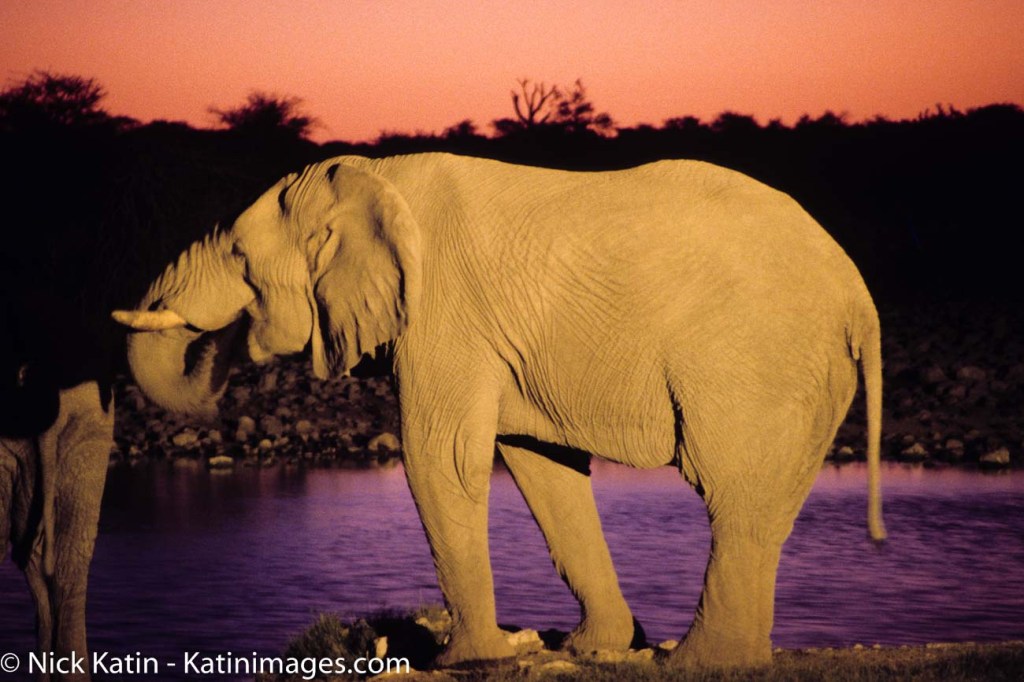
    Back at the camp we found a couple of seats by the illuminated camp water hole and waited for the show to start. As darkness came so did a herd of thirsty Elephants. They drank like there was no tomorrow. We thought that they would suck the water hole dry. But suddenly they all stopped and led by the boss bull all fifteen including five babies, trooped off, like a scene from Jungle Book, into the under growth and out of our sight.

    Later that night we were really privileged. Three black rhino sauntered down for a drink. Why were we privileged? Well the black rhino is probably the most famous endangered species in Africa. Due, mainly to poaching, there are a little over 3000 left after having a population of 60000 in 1970. It’s not my place to explain the mechanics of why these powerful beasts are exterminated ruthlessly for their horn so that the ‘misguided’ population of some Asian nations can use it for medicinal and aphrodisiac purposes. Nor is it my place to explain why the Yemeni insist that they must have daggers made of rhino horn.
    Suffice to say that due to both of these stupid ignorant beliefs a few ruthless businessmen make a fortune out of having a beautiful animal virtually wiped out from the surface of this planet and that sucks!

    Black rhino are also one of the ‘big five’. These five were the most prized ‘scalps’ by game hunters and if you think that’s just a relic of the past, then think again, there’s still plenty of opportunities on private land for game hunters to shoot defenseless animals for ‘sport’.

    Now the ‘big five’ are sought after for the best viewing. The other four are lion, leopard, buffalo and elephant and on that particular day we had seen three of them.
    For those of you thinking of game viewing in Africa, don’t knock yourself trying to see this group of animals. There is plenty of other wildlife to be seen that are just as enjoyable to watch. Game viewing is not a serious of ticks on a ‘to see checklist’ but an opportunity to watch Mother Nature at it’s wildest best.
    Anyway that’s enough winging and preaching for now.

    The next morning there was wildlife everywhere!………….. Giraffe, zebra, hyena, red hartebeest, impala and kudu to name just a few and then on then way back a huge bull elephant just ambling across the road just a few metres in front of us. It occurred to us at the same time that elephants have been known to charge if spooked, if this baby had turned on us this little ‘Chico’ would have been scrap metal within seconds.
    Needless to say I had the gear stick in reverse and the handbrake off, just as a precaution!

    The afternoon yielded different results. We went back to Okondeka hoping to see the same pride of lions. They were missing in action but what we did see was a male lion sitting in the shade of a thorny acacia tree, you know the ones, the trees that are shaped like an umbrella and are in almost every African sunset shot found in the glossy travel brochures.
    We didn’t realise that he was injured until he got up and strolled or rather limped away. We managed to follow him to his destination, a carcass that probably a few hours a go was live Zebra, going about his business of chewing a few blades of grass, before being brutally murdered for Monsieur lion’s dinner. Somehow the lion must have got injured during the kill, but that didn’t stop him chewing away and at the same time growling at the vultures and jackals who anxious to share the spoils.
    It was quite fascinating to watch. I felt like we were watching a discovery channel show!

    If you like this then hit “follow” on the side bar

    An elephant drinking at dusk at a camp waterhole in Etosha NP in Namibia
    An elephant drinking at dusk at a camp waterhole in Etosha NP in Namibia