Katin Images Travel Photography

Travel Photos, Travel Photography Tips and Software

Tag: Okinjima

  • African shoestrings – Namibia Day Sixty eight – Terrace Bay

    It didn’t start well. We had to cut short the tour of the rock paintings, as Sue was once again sick. What we did see (or what I saw) of it was fascinating. Some of the works are engravings that date back over 6000 years and appear to be still as clear as the day they were created. Fortunately Sue had the presence of mind not to leave a remnant of her stomach over any of them. Somehow I don’t think she enjoyed it one single bit.

    We had no choice but to press on. Sue had been sick twice now and I was starting to get concerned, but civilisation was now closer at Terrace Bay. The state of the roads didn’t help either. The road back to the main ‘drag’ was full of potholes and those irritating corrugations that leave you still stammering for hours.

    The road to Skeleton Coast was marginally better. There were less potholes but still plenty of corrugations and loose stones that had us slipping and sliding from time to time. It was slow going and bloody hot! Sue began to perk up the closer we got as she slowly recovered much to my relief. She had slept most of the way but really hadn’t missed much.

    The Skeleton Coast is as inhospitable as it comes. A waterless terrain of grey sand dunes and gravel plains for as far as the eye can see greeted us as we entered the park at the Springbokwater gate. I was amazed to actually see someone at the gate. The smiling gatekeeper with his house surrounded by a little patch of grass, an oasis continually under pressure from the relentless marching sand. He checked our passes and waved with a big grin on his face as we passed through. Did he know something we didn’t?

    The coastline of Namibia is an enigma. A desert that stops right at the waters edge. Certainly there are other examples of similar coastlines elsewhere. Our own North West of Australia is very inhospitable but at least it has some vegetation and even trees at the equivalent latitude. The difference is the temperature of the ocean. The Atlantic in this part of the world is bloody cold, consequently it just doesn’t create enough moisture to make it rain so this area averages less than 50mm (2″) per year! What the cold ocean does do however is keep the temperature down. Just as we experienced in Luderitz the temperature drops sharply at about 100 kilometres inland from the coast. Particularly when a southerly breeze is blowing (as it does most of the time) and covers the coast with a cool layer of fog. We went from a hot, dusty environment to a cool, almost cold, misty but still dusty environment in almost seconds. It was like walking into an air-conditioned shopping centre after having spent time walking in 35-degree heat. The change was that dramatic!


    There are many places that we have visited over the years that have not been what we expected and we have sometimes asked ourselves briefly “what are we doing here?” Terrace Bay is one of those places that begged the question continuously.

    It’s a small basic resort sandwiched between the ocean and the desert 3 million miles from anywhere and full of white South African and Namibian leisure fisherman all jabbering away in Afrikaans. We got chatting to a group from Paarl in South Africa and they even asked us what we were doing there. “Therre’s nothing ‘ere but fish” one of them said. It did have a restaurant where you have to eat, as full board is obligatory, a bar and a small shop with very little. The accommodation was reasonably comfortable. A few fibro semi detached huts with rather sparse self-contained rooms were dotted around the place.

    Fortunately we only had two nights here. We spent the rest of the day and the next day, relaxing, reading, sleeping and for a brief time, exploring.

    If you like this then hit “follow” on the side bar
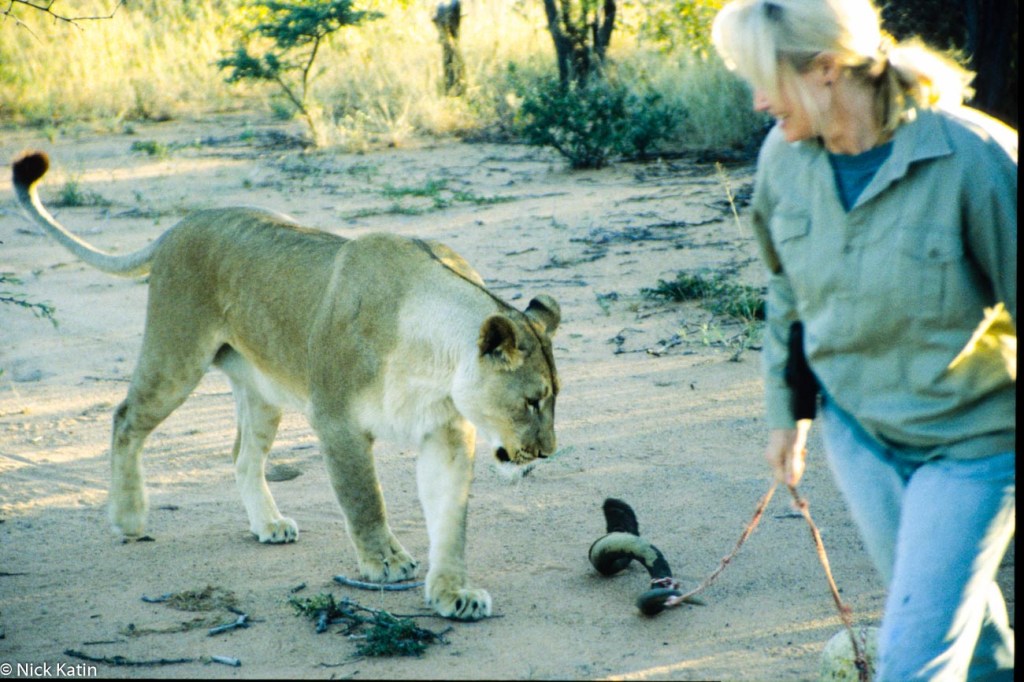
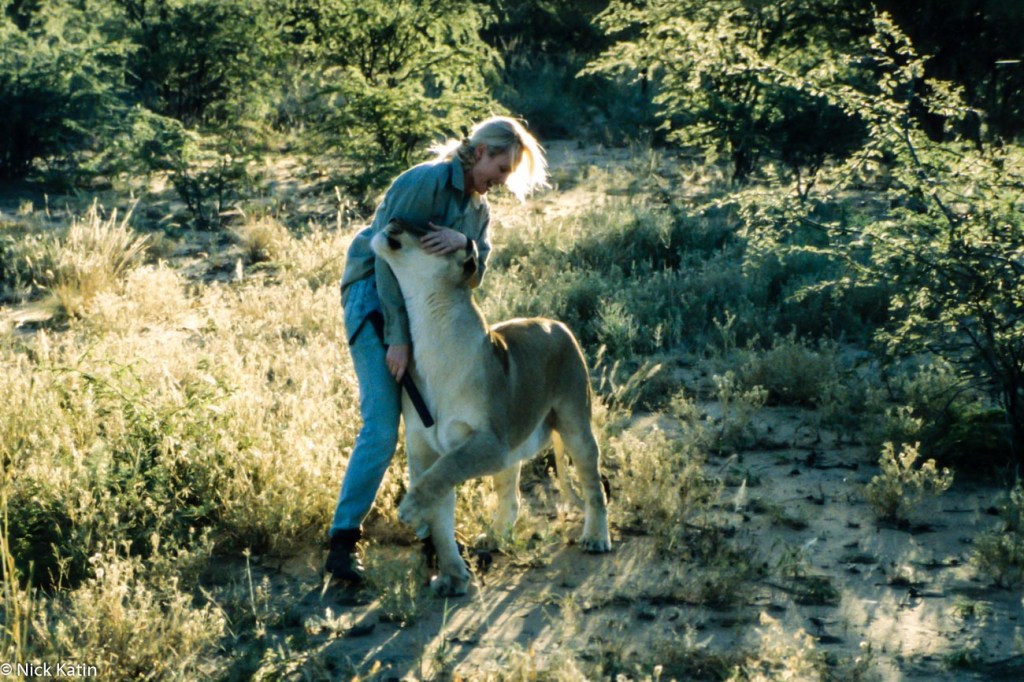
    Playing with a female Lion at Okinjima in Namibia.
    Playing with a female Lion at Okinjima in Namibia.
  • African shoestrings – Namibia Day Sixty seven – Twyfelfontein

    We got back to the resort in enough time to have another shower (our third) before dinner. Dinner brought us kudu steaks again and again it was the texture that put me off confirming after this second ‘chew’ that the kudu is safe from me in the future. Unfortunately there were no other choices so it was that or go hungry! Nonetheless the remainder of the food was good and really became secondary to the conversation we were having with a South African couple and a couple of journalists from Zambia who now live in New York. We were enjoying the conversation so much that it was almost an inconvenient interruption to be called to the night hide to see a porcupine munch on another slab of meat left there to attract him.

    It was all go the next morning. Up at 6 and into the huge long grassed paddock that was the lion’s enclosure, on the back of an open safari truck. These three lions (one female, Tess and two males, Matata and Tyson) were rescued from brainless people who kept and mistreated them in captivity. Even though they were now part of the family, it was intended that they would be relocated back out into the wild. Watching Donna and Roselea Hanssen play with them, I wondered whether how that could ever be. These animals were domesticated and appeared to me to be just big playful pussycats and then I remembered Guy’s story yesterday and made sure that I stayed well within the safety of the truck.

    Our final ‘activity’ was a guided bushmen walk trail. Chris our guide (who I noticed showed a healthy respect for the lions in the way he held on tightly to his rifle) took us on a track littered with bushmen artifacts, ‘home comforts’ and tools.

    It was interesting without being riveting. The bushmen like many other traditional peoples had no concept of ‘waste’. Everything had a use. A small animal would provide not only food but also pelts for warmth, fat for cooking and skin for shelter. It’s a principle that appears to be have lost over the centuries by Europeans.

    Back to the lodge and we only had a few minutes to vacate our room before Brunch (they like you out of the rooms by 9 am) which we enjoyed under the watchful gaze of the resident warthog.

    On the drive out Sue was feeling pretty crook and we hadn’t got far when I had to stop whilst Sue got rid of the contents of her stomach. From then on she slept whilst I drove onwards to Terrace Bay in the Skeleton Coast Park, some 380 kilometres away, in the blazing heat of the desert.

    As half of the road was gravel, there was no way we were going to make it in a day so our overnight stay was near Twyfelfontein where some of the finest rock art in Africa is found.

    Not so fine was the Abu-Huab Camp. Another dust hole masquerading as a ‘rustic and natural desert camp” in the middle of nowhere. Once again we had to put up with dust and sand blowing into every crevice and orifice. Sue was still crook and lay most of the time in the tent and I still had the remnants (in the form of catarrh and dry throat) of the cold I had caught nearly 3 weeks ago at Fish River Canyon.

    We were back down to the realities of independent budget travelling with a bump. No comfy bed in a dustless air-conditioned room for us that night. As darkness descended Sue gradually regained some strength to sit outside whilst I eat and we actually began to enjoy relaxing under the gaze of the millions of stars that lit the night sky with their pinpricks of light scattered in and around the milky way. That was until Sue almost put her foot on a scorpion, which could have put us right in the ‘shit’. Somehow this wasn’t the sort of place where emergency medical treatment would have been easy to find. That was enough for us, our beds were calling. Hopefully tomorrow would bring a better day.

    Playing with a female Lion at Okinjima in Namibia.
    Playing with a female Lion at Okinjima in Namibia.
  • African shoestrings – Namibia Day Sixty six – Okinjima

    It is estimated that there are 2500 cheetahs, a quarter of the world’s population, roaming rural Namibia, that is outside of the national parks. And that’s where all the problems lie. The farms are ideal for cheetahs and leopards (the other big cat that Africat specialises in). In the National Parks and game reserves both these predators are in competition with larger predators like lions. On the farms there is no such competition. Unfortunately they can’t tell the difference between small game and small farm animals like calves, sheep or goats which upsets the farmer just enough for him to set traps or go hunting! That’s where Africat come in.

    Straight after heating up the shutter in our cameras and blistering our shutter finger, we were whisked off in open top 4WD vehicles to the leopard hide. There we all sat in a small marquee whilst Guy one of the guides chats about Africat.

    “When a farmer kills or captures a cheetah or a leopard it often leads to making the problem worse.” He began “when a predator holds a territory it will chase out any intruding predators. Once its removed other predators will move in and often divide up the territory, so instead of having just one animal to deal with the farmer ends up two or three times as many. What we do is to try and educate the farmers to manage their livestock better so that losses are minimised and both can live together. Of course we often meet resistance and in those cases we just ask the farmer not to kill the cats but just capture them and release them to us so that we can release them back into the wild away from that farm.”

    He also told us that there were several cheetahs and leopards roaming wild on this farm and hopefully a number of leopards will visit the hide this afternoon. It occurred to me that we appeared to be in an unfenced area and wouldn’t there be the chance that the leopards might find us more attractive than the slabs of meat. Dumb question Nick!

    “Big cats will only really attack a human if the cat is cornered, injured or senses that we are vulnerable”. Guy said “If it’s got a much easier alternative then it will always go for that. Of course it also associates humans with guns and that also acts as a pretty big deterrent”

    I asked him what happened to his heavily bandaged foot that he couldn’t walk on without the aid of crutch.

    “Oh that, this happened in the lion enclosure”

    There was a complete silence. Sensing this, Guy went on. “Chris (the other guide) and I went in to see the lions and during our work I stepped backwards from the lion and caught my foot on a rock and fell spraining my ankle. As I said these big cats sense when we are vulnerable and in this case she began to make a move towards me. Fortunately Chris was there and herded her off before she actually attacked.” He smiled “So she didn’t really attack me. I just didn’t take enough care, something that when you’re dealing with these animals could cost a life”.

    “Aren’t we seeing these lions in the morning?” I whispered to Sue, who ignored me.

    With a degree of caution we are fed into the small hide and watch as the guides leave meat in conspicuous places on the elevated rocky terrain immediately in front of us. It was getting towards sunset so the light was that golden colour which bathed the rocks in almost perfect light. Within a few minutes a leopard appeared followed a few minutes later by another to chew on the slabs of meat and then disappear. For the next hour there was a regular pattern of first one then the other appearing and then disappearing.

    The hide was totally closed in except for a long thin viewing open window that made us feel like we were so close. In fact it was a zoo in reverse we were the ones imprisoned for our safety whilst the animals roamed around us. At one time one of the leopards looked straight at us and darted off after someone dropped their lens onto the small shelf we were all leaning on. Apart from that the only sound was that of camera shutters as we all strived to get that perfect leopard shot. I couldn’t help feel that this was all a bit contrived even though the leopards are free to roam anywhere they want and are native to the area. But I’m not complaining leopards are one of the most elusive animals to view in Africa and to see them up close and for so long, is an experience not to be missed.

    I like leopards! They are such magnificent beasts, like the shark they appear to be the perfect hunting machine with their muscular shaped body, long tail and strong stature.

    If you like this then hit “follow” on the side bar

    A leopard eats it's prey amongst the rocks in Central Namibia
    A leopard eats it’s prey amongst the rocks in Central Namibia
  • African shoestrings – Namibia Day Sixty five – Okinjima

    Apart from a recreational park, Waterberg is also a breeding ground for some endangered animals. Animals like rhino, sable antelope and roan are protected on the plateau by its proximity to the terrain around it. We took a guided game drive in one of the two open topped 4WD’s that run daily. I mention the word open because a sudden downpour followed by persistent rain soaked us through to the skin. To add insult to injury the animals were hiding from us, probably wisely sheltering from the rain. We did manage to see one lonesome sable antelope briefly but that was it.

    Back in our tent we dried off and thought how nice it would be to sit in a nice cosy hotel room in front of a log fire. Of course we knew that the following night we would be doing something similar at Okinjima.

    I think I might have mentioned that of the two of us Sue is without doubt the animal lover. I love to see them in their natural environment and I can watch them for hours with a camera in my hands but I do not have the same love and concern for their welfare that Sue has. Somehow or rather she heard about the Africat Foundation, a non-profit organisation involved in the conservation and protection on Namibia’s cats. And I don’t mean pussycats!

    Their home is a place called Okinjima guest farm, a 50 kilometre drive from Waterberg. If you are reading this with the idea that it’s gonna be cheap on account of it being in this blog. Think again! At US$165.00 per night per person it cost almost as much as the twelve nights accommodation we had booked with the MET! But the cost was for full board and activities, so the only thing we had to pay for was alcohol.

    This was our treat! We would stay just the one night but make sure we were there spot on check in time and leave spot on check out time. We were going to get our moneys worth! The first thing we did after checking in was to have a swim and then a shower in the privacy of our own room. It’s a funny thing about having a shower. You get used to having to use communal showers and on the whole they had been pretty good, lots of hot water, reasonable flow and quite clean. But you get tired of undressing and dressing (the latter usually in a pool of water) in a matchbox. A shower feels so much better knowing that you can have it at your pace and leisurely get dry and dressed.

    The resort itself is a small area of terraced thatched units with the main building, a huge open thatched rondavel close by. Elsewhere there’s a swimming pool, a huge bird/animal hide and a patch of lawn between the main building and the rooms.

    We had lunch at 1pm and then returned for coffee and cake just before 3.

    It was just after my second helping of cake (I told you I was gonna get my money’s worth) that the action started. Three of the owners, Lisa, Donna and Rosalea brought out three cheetahs and feed them on the lawn. Click, click, click went our camera and those of the other guests as these women cuddled, stroked, feed and talked with these cheetahs. With the exception of one idiot, we all kept a respectable distance. I had never been this close to a wild animal of this stature before, every time I had seen cheetah I had the protection of a car body or wire fence between me and these beautiful beasts. The one idiot attempted to stroke one of them as if it were a domestic cat. I’m not sure who was quicker Lisa or the cheetah! The cheetah swiveled its head menacingly whilst Lisa dashed over and reprimanded the idiot and at the same time had the cheetah under control. These cheetahs were in fact quite tame they had all been rescued from hardship and then reared on the farm and were part of the family.

    If you like this then hit “follow” on the side bar
    A Cheetah on the lawn at Okinjima camp in Namibia
    A Cheetah on the lawn at Okinjima camp in Namibia