Katin Images Travel Photography

Travel Photos, Travel Photography Tips and Software

Tag: marsh

  • African shoestrings – Zambia Day Eighty Six Victoria Falls

    Apart from the shopping and of course the many energetic activities associated with the falls itself (like bungy jumping, white water rafting, absailing etc) there is one that takes you back to a long gone era of British colonialism; afternoon tea on the terrace of the Victoria Falls hotel. This colonial style building had for years been the centre for Europeans up until independence. It was here that local white farmers, townsfolk and well off visitors would gather for spot of ‘tiffin’. Certainly it has lost none of its atmosphere even if it has its colonial clientele. Nowadays well off tourists (mostly Americans) stay in its well-appointed and stylish rooms and budget tourists like us frequent it for afternoon or morning tea and if really feeling extravagant, dinner. Of course it does have prime position overlooking the Zambezi gorge just downstream from the falls.

    I couldn’t help imagining, as we ate our cucumber and smoked salmon triangular bite sized sandwiches, men and women in hats, striped jackets and full length full dresses playing croquet or just lazing around on the expansive and immaculate back lawn. Black waiters dressed in black trousers and white dinner jackets, hovered at our beck and call and delivered the three tier silver tray full of sandwiches, scones, finger cakes and on the side the obligatory tea. It was wonderful even though I don’t like cucumber or tea and cheap at an all you can eat price of US$4 each.

    Across the other side of the hotel is the train station, another relic of the Edwardian past. We had to catch a train here to Bulawayo the next day and we thought it a good idea to book. We had wanted to book a first class coupe, which sleeps just two but had to settle for a second class that sleeps three. Not a big issue we thought at the time. The train left at 5 pm the next day so we had 24 hours left in Vic. Falls.

    Despite the number of tourists that increase as the years go by there is still plenty of wildlife in and around Vic Falls. On our last visit we twice come across wild elephants whilst walking and cycling just outside of town and had also seen a family crossing the Zambezi upstream from the falls. This time round we saw plenty of elephants on a night time game drive and then the following morning we actually rode on some as well!

    Elephant riding is an experience not to missed. The Elephant camp is in a location too remote to find ourselves, so we were picked up and taken there early in the morning and given tea (again) and biscuits just in case we couldn’t survive a couple of hours without sustenance.
    Richard our tour leader introduced us to the elephants as their riders put them through a series of exercises. Fortunately we didn’t need to follow suit! Next it was time to jump on and that’s easy. A platform has been erected just for this purpose.
    Settling in behind the rider (they very wisely team novices like us with riders who really know what they’re doing) I thought how well cushioned the saddles are. Now I always thought that elephants were big heavy brutes that destroy everything in their path as they move around.
    Well that myth was destroyed within the first five minutes of riding! Incredibly they just glide through the bush effortlessly and quietly leaving no trace behind them. Apparently it’s the muscles in their feet that move around to cope with the weight displacement. So it’s just a steady swaying movement as we followed Richard who was on foot and carrying a rifle with both hands behind his neck. The rifle is for our protection just in case a lion or leopard gets too near. Even though he’s never had to use it yet he still believes it’s better to be on the safe side and that sounded like a pretty good practice to me.

    Richard was one of those “boy’s own” characters that seem so commonplace in the ex British colonial Africa. A tall, solidly built, good looking young man he spoke with that sort of cultured Zimbabwean English accent that’s also very close to the accent spoken by South Africans of British ancestry. He would have been born and brought up during Zimbabwe’s war of independence and most likely, as with so many others of his generation who stayed and toughed it out, he was taught how to fire a gun before he could read.

    My elephant was called Manna and my rider was Sopi. Sopi was quite chatty and told me that they had eight elephants in all. They use them in rotation and were purchased for Z$500 from a nearby park that were about cull these beautiful beasts. Most of them are males; it seems that their temperament is more suited to this type of work than females. Elephants live for around 60 – 70 years and during this time they will wear out four sets of teeth. After having seen them eat at the end of the ride I’m not surprised, they chew as if their lives depend on it which in fact I suppose is true. It’s partially because of their feeding habits that the ride is only one and a half hour long. Apparently they get rather anxious and twitchy when they get hungry so it’s wise to keep it short and let us off before hunger gets the better of them.

    The ride actually finished at a secluded spot where we also got fed but not until we helped the riders feed them. Both Sue and I bravely put our hands into our respective elephants mouths with some special feed which was their treat for being good little steeds (the feed not our hands). It actually wasn’t the hand I feared for the most, it was suffocation; their breath is terrible! But not quite bad enough to put me off my bacon and eggs!

    If you like this then hit “follow” on the side bar

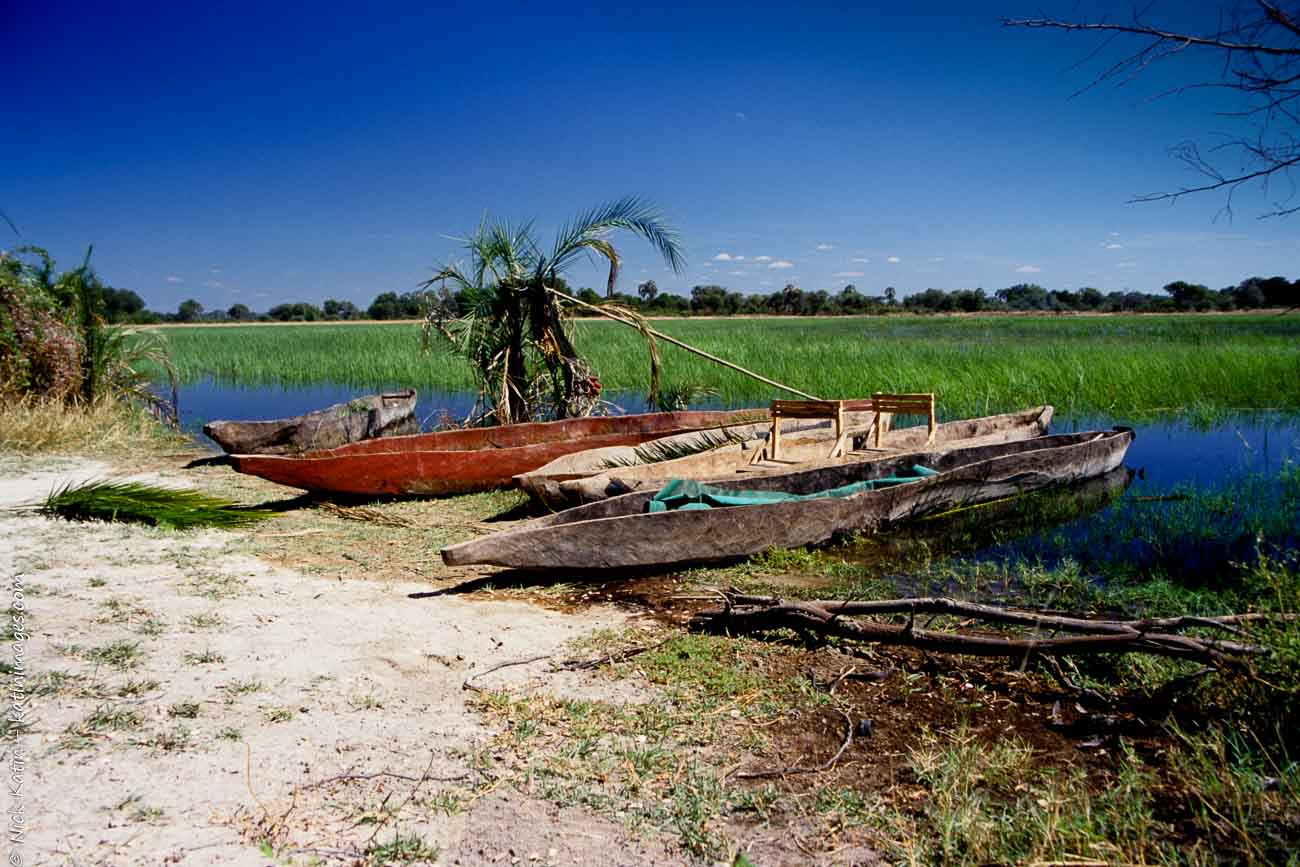
    Dug out canoes at the Okavango delta in Botswana
    Dug out canoes at the Okavango delta in Botswana


  • African shoestrings – Botswana Day Seventy-Eight to Eighty Okavango

    The Delta itself reminded me of a vast flooded field with pockets of dirt that support large trees and palms. It actually consists of a maze of meandering channels, with dense masses of papyrus and other aquatic plants; many shallow, water-filled basins; and numerous islands, or elevated wooded areas that remain dry during flooding. The delta normally covers about 16,000 square kilometres, but this year the rains had been good and it was at its highest level for many years, which translated into covering a larger area than average.

    PT our Polar seemed to be the number one man when the number one man, who was a lot older than the other polars, didn’t go out, which was often. Our first experience of riding in the Mokoro was on the way to the next camp on a nameless island near Qokoqere, deep in the heart of the delta.

    In no time at all we reached the new camp. This time there are no facilities whatsoever, just a hole in the ground for a toilet and the water of the delta for washing. Once we had set up camp again we went back out in the Mokoro and stopped on an adjoining island. PT took us all for a walk and told us of how his people use the trees and plants, what animals and birds are around and the danger of crocs and hippos. Because the water was so high most of the animals had moved away to higher ground so all we saw apart from the odd croc were some Letchwe, a small water antelope that kept their distance.

    After lunch we went for a swim, well some of us brave enough did. It’s a bit scary knowing that we were in the same territory as a croc or hippo but we were assured that this particular spot was croc and hippo free. I did notice however that a couple of the polars were continually scouring the water for any gatecrashers.

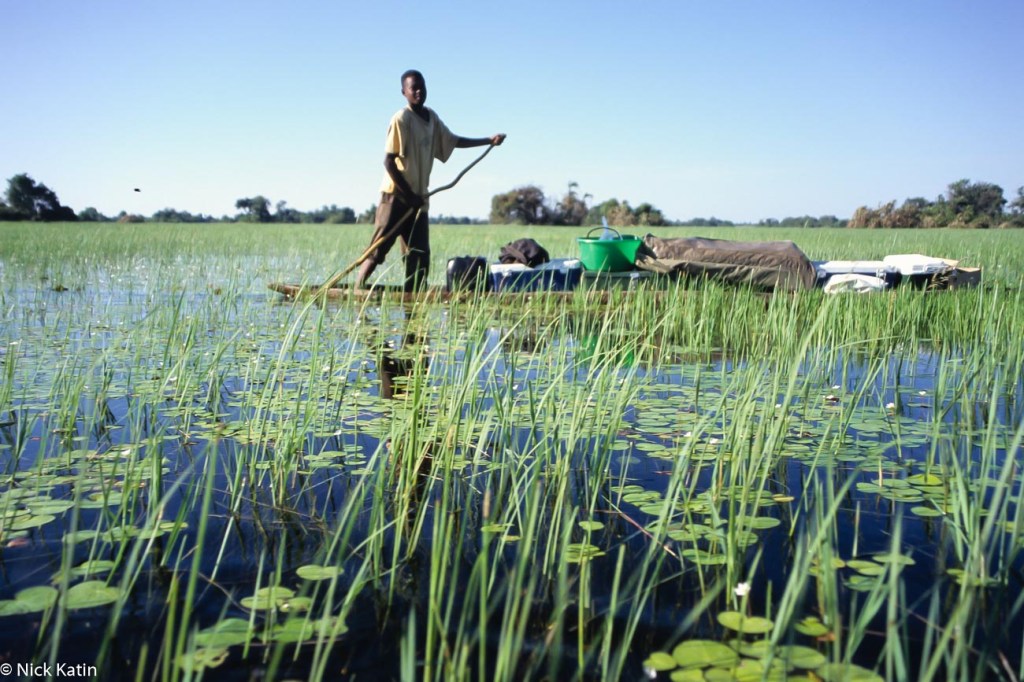
    For the next three days we had a set pattern, up early and out on the Mokoro, back for lunch, back out again after a siesta and the heat of the day to return at sunset. Travelling by Mokoro is a restful and mostly relaxing way to travel (apart from the odd pampas grass brushing our face and the zillions of insects). It just glides through the calm, crystal clear water without any noise, just a gentle splash of the pole as it too moves through the water pushing us on past the papyrus and water lilies that are dotted almost everywhere. Apart from the pole the only other noise is that of the polars chatting and laughing amongst themselves and the odd motor boat disturbing the serenity. We seemed to drift here and there in this water labyrinth, sometimes getting out for a walk or a swim or (as if we needed it) a rest.

    Occasionally these guys would get a bee in their bonnet about finding a particular bird or animal that we had been discussing the night before. We spent three hours one morning looking for Pel’s fishing owl and finally found one hiding in a densely leafed tree on a remote island. Then we spent the same afternoon searching for a Sititunga another antelope that was so rare and extremely shy that we never actually found one!

    Evenings were spent chatting and talking whilst waving away the persistent mosquitoes. These mosquitoes were not, we were assured, the malaria carrying variety, not that it mattered because the insect repellant that we used was capable of killing small animals at twenty paces.

    Andre and Annie did their very best to make us all comfortable and served us up basic but excellent fare.

    As I said before we were, apart from Klaus and Hilda, the oldest of the group by some years. The other four were all Uni. students taking time out and we became all reasonably friendly except for the ‘oldies’ who seemed to keep themselves aloof. Mind you they were only with us on the delta so I guess it probably wasn’t essential that they get to know us. It might have been though the fact that none of us had khaki safari suits and they felt the odd ones out.

    If you like this then hit “follow” on the side bar

    Polers on the makoros (canoe) in the Okavango delta, Botswana
    Polers on the makoros (canoe) in the Okavango delta, Botswana


  • African shoestrings – Botswana Day Seventy-Seven Okavango

    Whether it’s because of the high fees they charge tourists or their natural resources of diamonds, copper and nickel, all of which are mined extensively, Botswana is a relatively wealthy country. It has one of the fast growing economies in the world and its GDP per capita is the highest on the African continent outside of South Africa. None of this was apparent in Shakawe where we stopped to buy ice and other supplies. Dusty run down buildings and shacks were everywhere as were dusty rundown vehicles. Even the townsfolk looked a bit dusty and rundown and seemed to just wander or sit around fairly aimlessly.

    At Supopa we were meant to have two motor boats waiting for us but this is Africa and things don’t often run to plan, so we had to wait an hour or so before being guided onto one of them and our baggage loaded onto the other. About an hour into the three and a half hour journey our boat began to cough and splutter a few times and the second boat, now some distance away, returned to take some of the human baggage and hence lighten its load. We eventually made it to our destination, an island in the delta near the village of Jao, which we could just see from the distance.

    This campsite was in the process of being constructed by a few locals and another bloke from Audi, Brendan and was supposedly near completion but you could have fooled me. But it was just about habitable.

    By now there was ten in our group; Louise (a Pom), who had traveled with us from Windhoek, John and Ann (more Poms), Elizabeth (a yank), Klaus and Ingrid (Germans) and our guides Andre and his more experienced sister Anna. So the night was spent getting to know each other around the campfire. Of course with a South African there as well (Brendan) the topic of conversation never strayed far from Rugby Union and Cricket although we did have a friendly argument about the Southern Cross.

    To Australians and New Zealanders the Southern Cross is an important part of our psyche, it’s on our both our flags, is used extensively in official and commercial advertising and most of us know roughly where it is. But it’s by no means unique to Australia and New Zealand. It can be seen almost anywhere in the Southern Hemisphere all the year round and it’s pretty distinctive. Now I can understand people from the Northern hemisphere not knowing anything about it they can only see at certain times of the year low in the sky plus of course places like England are lucky to see any of the night sky. But Brendan, a budding tour guide, was under the woeful misapprehension that it couldn’t be seen outside of Australia. After much discussion I eventually fired up and marched him, followed by some of the others, away from the fire and pointed into the sky at the five stars that make up Southern Cross to put to bed that woeful misapprehension.

    The next morning our polars turned up one Mokoro short! We needed six not the five that were brought; two people to each boat and one for the luggage and supplies. After much hand waving and gesturing eventually one of the polars went back to Jao and found an extra Mokoro and Polar.
    Mokoros (otherwise known as dugout canoes) are carved from Ebony or the Sausage Tree and take around three months to make by hand. The forked pole the polars use are made from the Silver Terminilia tree and it’s this pole that in the hands of these guys enables the Mokoro to move quietly and effortlessly. Like the gondolieriers of Venice, these guys make it look so easy. Unlike the gondoliers of Venice the Mokoro is economic in design and whole lot less comfortable. A hard wooden plank was to be home for our rear ends for the next few days but we managed to get used to it.

    Only one of them had back rests and that was literally jumped into by Klaus and Hilda. They were to be fair, a lot older than even us, let alone the rest who once again were all young enough to make us feel parental again (grand parental in Klaus and Hilda’s case).

    You know you can pick people a mile off. I had Klaus picked as a bit of a know it all from the time we first met as he stood in his khaki safari suit puffing on his pipe on the bow of the motor boat, trying his best to look like Mr. ice-cool as the boat jumped up and down and spluttered from time to time. I can never quite understand why some tourists believe that buying and wearing the latest safari suits will enrich their time in Africa. I know all the blurb suggests you wear green or light brown clothing so that you don’t stand out when on a safari but 90% of that time is spent in a minibus or 4WD which stand out a lot more than we will, regardless of what we wear. In Uganda four years before, we came across two American ladies impeccably dressed in all ‘the gear’ plus polo hats. You can imagine what colour their clothes were after the jungle trek to find mountain gorillas. In fact I’ll swear blind that I heard some of the Gorillas laughing at them.

    If you like this then hit “follow” on the side bar
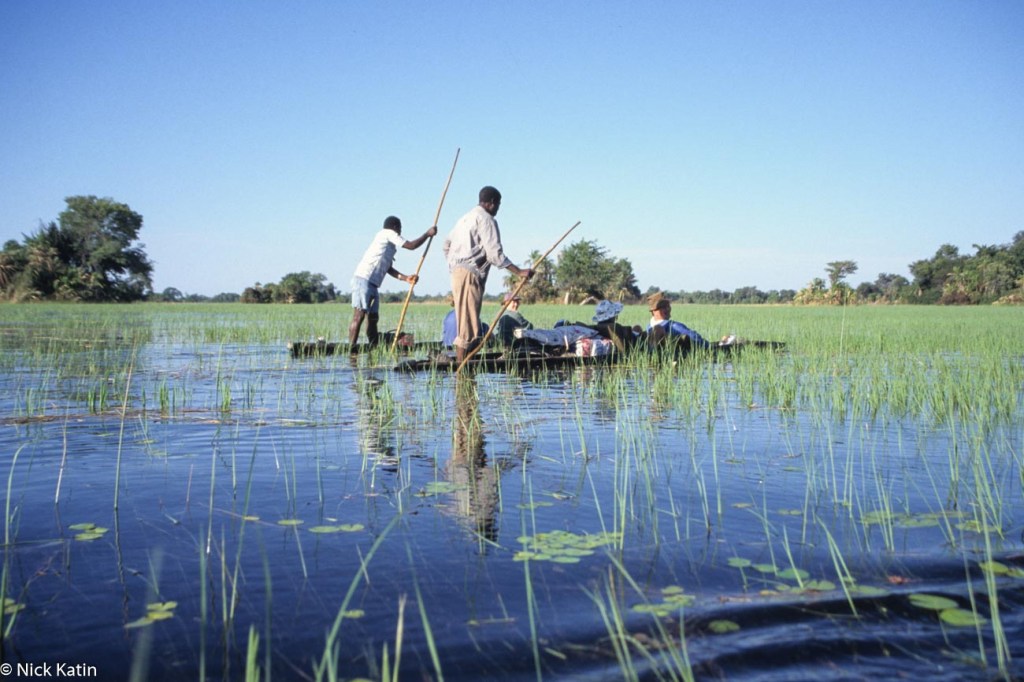
    Young Poler on a makoro (canoe) in the Okavango delta, Botswana
    Young Poler on a makoro (canoe) in the Okavango delta, Botswana


  • The A-Z of places: Botswana

    Canoeing on the Okavango Delta

    Young Poler on a makoro (canoe) in the Okavango delta, Botswana
    Young Poler on a makoro (canoe) in the Okavango delta, Botswana

    Makoros

    Dug out canoes or makoros at the Okavango delta in Botswana
    Dug out canoes or makoros at the Okavango delta in Botswana

    Peek-a-boo

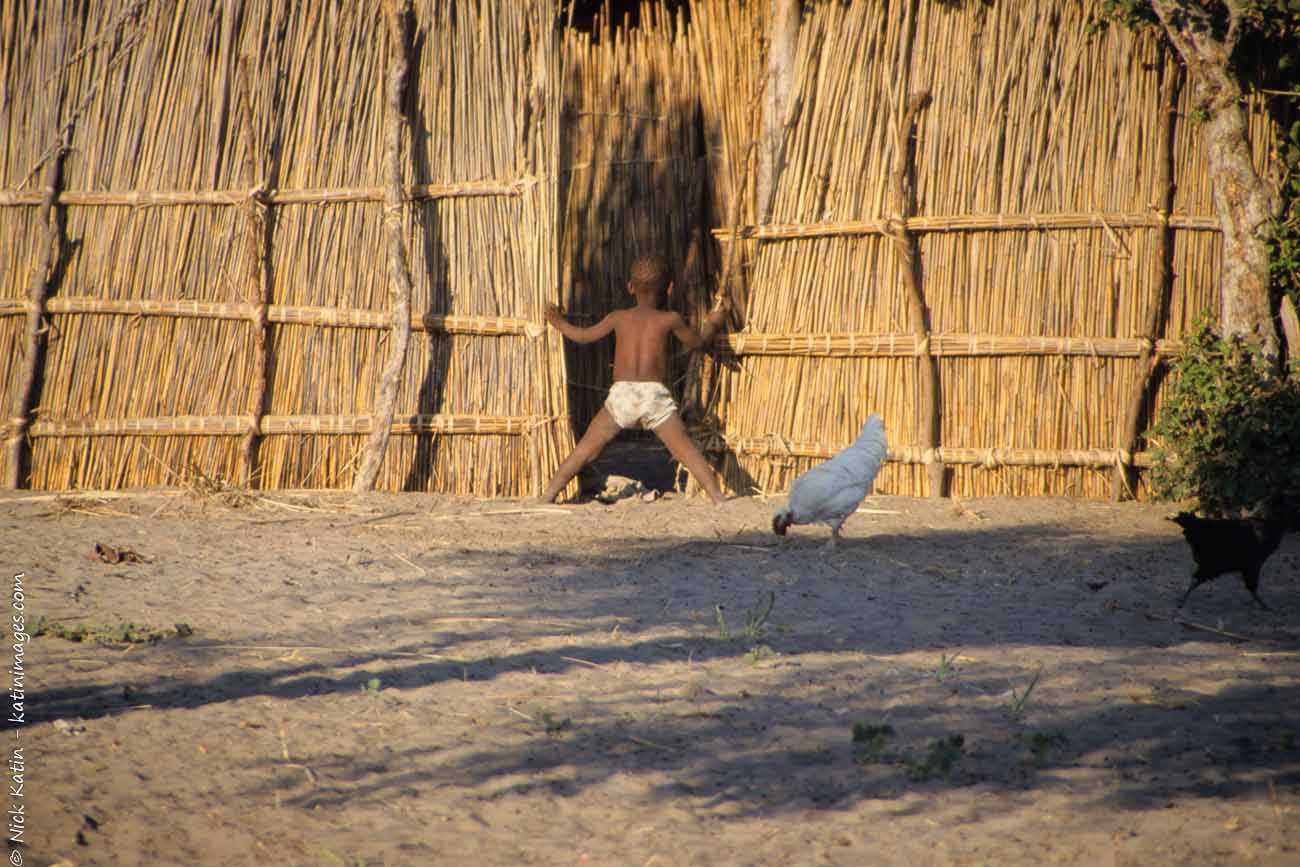
    Young boy peeking in a hut in a small village in Botswana
    Young boy peeking in a hut in a small village in Botswana

    Lion

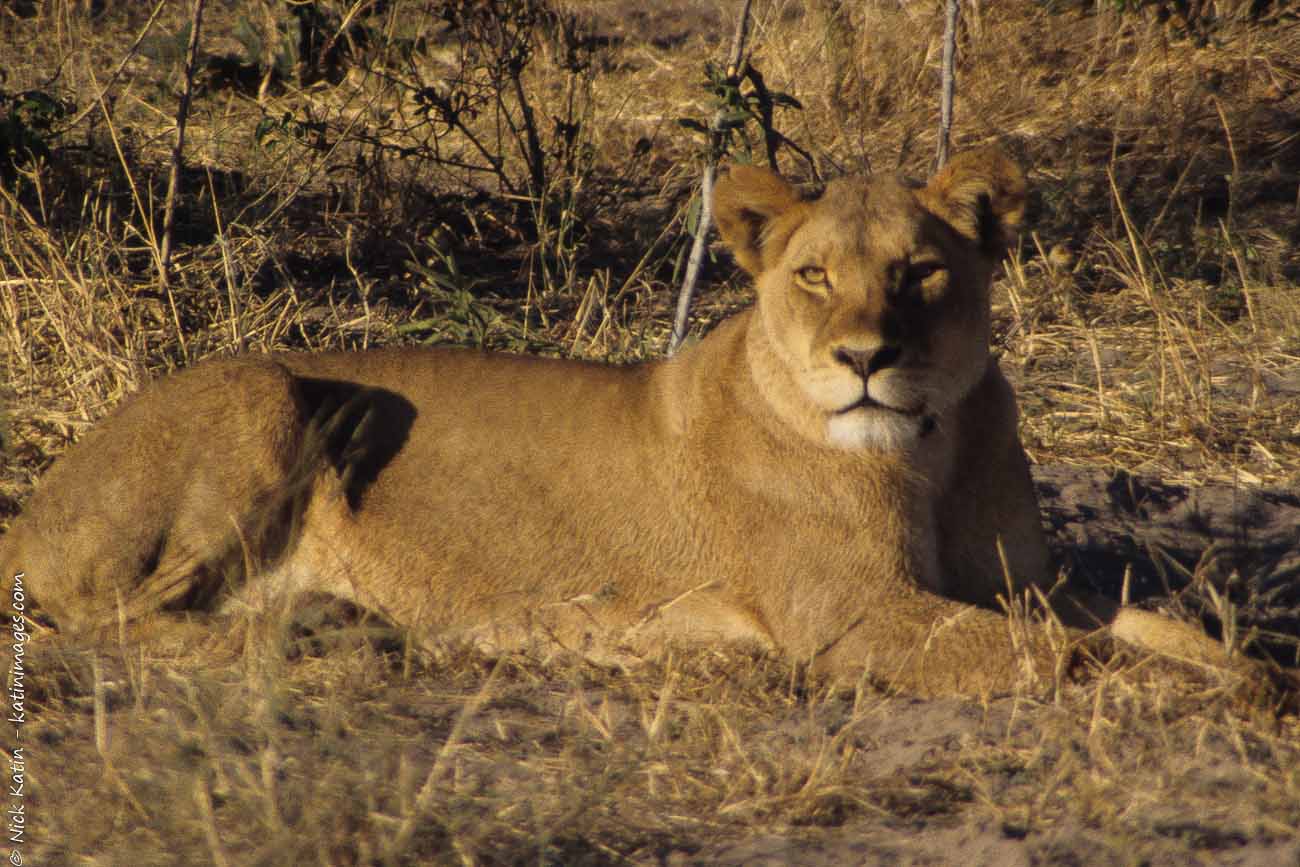
    Lion in chobe NP, Botswana
    Lion in chobe NP, Botswana