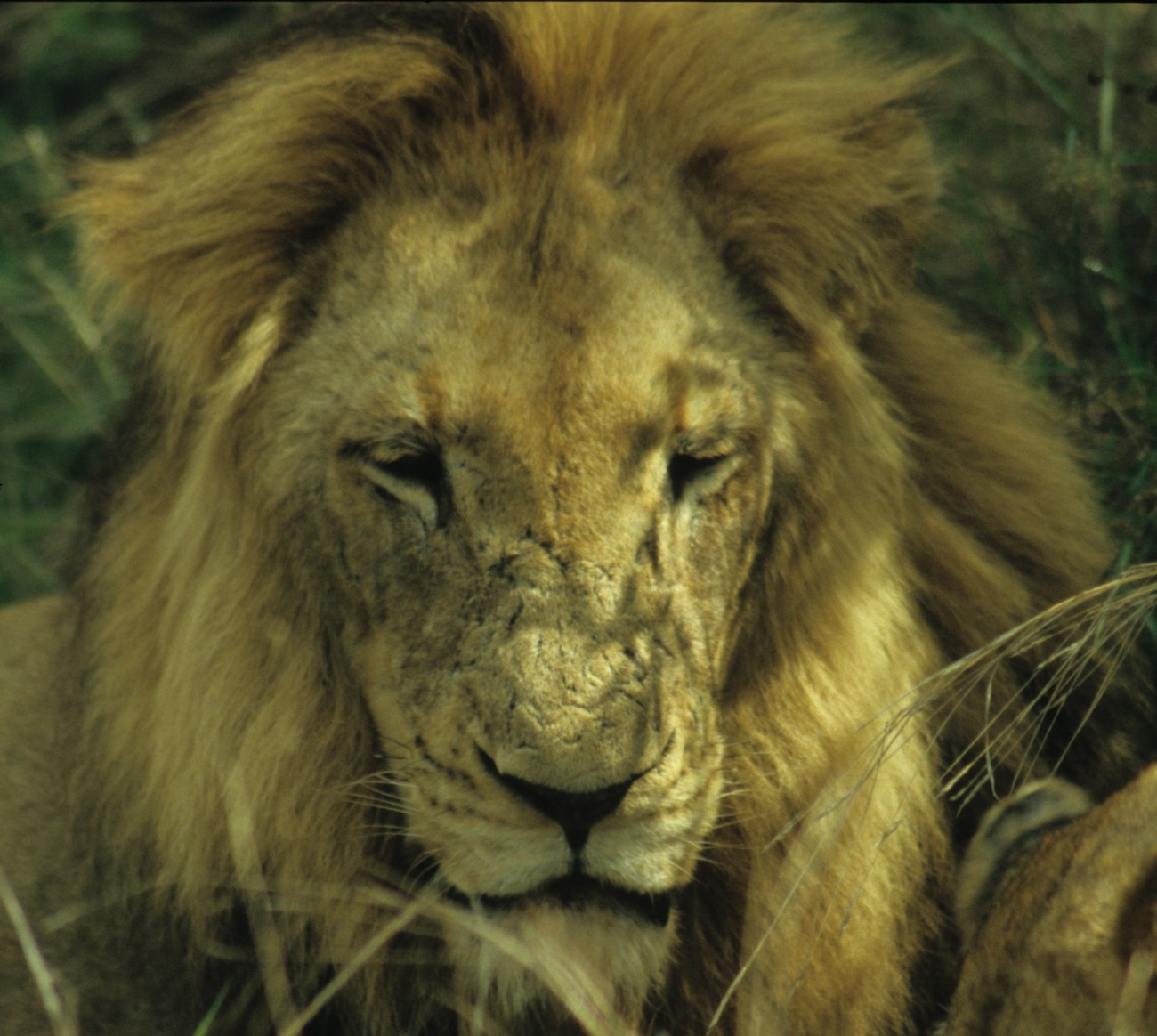
Young male Lion in Timbavati near Kruger NP South Africa. To order a print or digital image click on the image or contact me
Wildlife photography has always been a captivating pursuit for me, a way to connect with the natural world and its magnificent creatures. During my recent adventures in South Africa, I decided to take my passion one step further by reinterpreting my wildlife photographs into fine art.
Once I had a selection of what I thought were good quality wildlife photographs, it was time to transform them into fine art. Post-processing is where the real magic happens. I used Luminar Neo to enhance colours, adjust tones, and add effects that would elevate the images from photographs to artworks.
Fine art is a personal expression, and I wanted to infuse each piece with my own unique perspective. These Images have been transformed into digital paintings, allowing me to add my artistic flair and creativity to the mix. All photos have had the same amount of post processing to show a specific style.
Transforming wildlife photography into fine art is a deeply gratifying journey. It allows you to not only capture the beauty of nature’s creations but also to share your own unique perspective and emotions with the world. Through observation, composition, post-processing, and a touch of personal creativity, I was able to breathe new life into some of my wildlife photographs, turning them into pieces that evoke emotions and opinions. Whether you’re a passionate photographer or a lover of art, I encourage you to explore this fascinating intersection of nature and creativity; you might just discover a new dimension to your passion.
Each image is only available for purchase 15 times and a separate certificate of authenticity will be provided to the purchaser. To order a print or digital image click on the image or contact me Go to Luminar Neo for more info on this creative AI software
Lion 2. Male Lion in Timbavati near Kruger NP South Africa. To order a print or digital image click on the image or contact me
Wildlife photography has always been a captivating pursuit for me, a way to connect with the natural world and its magnificent creatures. During my recent adventures in South Africa, I decided to take my passion one step further by reinterpreting my wildlife photographs into fine art.
Once I had a selection of what I thought were good quality wildlife photographs, it was time to transform them into fine art. Post-processing is where the real magic happens. I used Luminar Neo to enhance colours, adjust tones, and add effects that would elevate the images from photographs to artworks.
Fine art is a personal expression, and I wanted to infuse each piece with my own unique perspective. These Images have been transformed into digital paintings, allowing me to add my artistic flair and creativity to the mix. All photos have had the same amount of post processing to show a specific style.
Transforming wildlife photography into fine art is a deeply gratifying journey. It allows you to not only capture the beauty of nature’s creations but also to share your own unique perspective and emotions with the world. Through observation, composition, post-processing, and a touch of personal creativity, I was able to breathe new life into some of my wildlife photographs, turning them into pieces that evoke emotions and opinions. Whether you’re a passionate photographer or a lover of art, I encourage you to explore this fascinating intersection of nature and creativity; you might just discover a new dimension to your passion.
Each image is only available for purchase 15 times and a separate certificate of authenticity will be provided to the purchaser. To order a print or digital image click on the image or contact me Go to Luminar Neo for more info on this creative AI software
Wildlife photography has always been a captivating pursuit for me, a way to connect with the natural world and its magnificent creatures. During my recent adventures in South Africa, I decided to take my passion one step further by reinterpreting my wildlife photographs into fine art.
Once I had a selection of what I thought were good quality wildlife photographs, it was time to transform them into fine art. Post-processing is where the real magic happens. I used Luminar Neo to enhance colours, adjust tones, and add effects that would elevate the images from photographs to artworks.
Fine art is a personal expression, and I wanted to infuse each piece with my own unique perspective. These Images, the first of which is above, will appear in the coming weeks were transformed into digital paintings, allowing me to add my artistic flair and creativity to the mix.
Transforming wildlife photography into fine art is a deeply gratifying journey. It allows you to not only capture the beauty of nature’s creations but also to share your own unique perspective and emotions with the world. Through observation, composition, post-processing, and a touch of personal creativity, I was able to breathe new life into some of my wildlife photographs, turning them into pieces that evoke emotions and opinions. Whether you’re a passionate photographer or a lover of art, I encourage you to explore this fascinating intersection of nature and creativity; you might just discover a new dimension to your passion.
Each image is only available for purchase 15 times and a separate certificate of authenticity will be provided to the purchaser. To order a print or digital image click on the image or contact me Go to Luminar Neo for more info on this creative AI software
It didn’t start well. We had to cut short the tour of the rock paintings, as Sue was once again sick. What we did see (or what I saw) of it was fascinating. Some of the works are engravings that date back over 6000 years and appear to be still as clear as the day they were created. Fortunately Sue had the presence of mind not to leave a remnant of her stomach over any of them. Somehow I don’t think she enjoyed it one single bit.
We had no choice but to press on. Sue had been sick twice now and I was starting to get concerned, but civilisation was now closer at Terrace Bay. The state of the roads didn’t help either. The road back to the main ‘drag’ was full of potholes and those irritating corrugations that leave you still stammering for hours.
The road to Skeleton Coast was marginally better. There were less potholes but still plenty of corrugations and loose stones that had us slipping and sliding from time to time. It was slow going and bloody hot! Sue began to perk up the closer we got as she slowly recovered much to my relief. She had slept most of the way but really hadn’t missed much.
The Skeleton Coast is as inhospitable as it comes. A waterless terrain of grey sand dunes and gravel plains for as far as the eye can see greeted us as we entered the park at the Springbokwater gate. I was amazed to actually see someone at the gate. The smiling gatekeeper with his house surrounded by a little patch of grass, an oasis continually under pressure from the relentless marching sand. He checked our passes and waved with a big grin on his face as we passed through. Did he know something we didn’t?
The coastline of Namibia is an enigma. A desert that stops right at the waters edge. Certainly there are other examples of similar coastlines elsewhere. Our own North West of Australia is very inhospitable but at least it has some vegetation and even trees at the equivalent latitude. The difference is the temperature of the ocean. The Atlantic in this part of the world is bloody cold, consequently it just doesn’t create enough moisture to make it rain so this area averages less than 50mm (2″) per year! What the cold ocean does do however is keep the temperature down. Just as we experienced in Luderitz the temperature drops sharply at about 100 kilometres inland from the coast. Particularly when a southerly breeze is blowing (as it does most of the time) and covers the coast with a cool layer of fog. We went from a hot, dusty environment to a cool, almost cold, misty but still dusty environment in almost seconds. It was like walking into an air-conditioned shopping centre after having spent time walking in 35-degree heat. The change was that dramatic!
There are many places that we have visited over the years that have not been what we expected and we have sometimes asked ourselves briefly “what are we doing here?” Terrace Bay is one of those places that begged the question continuously.
It’s a small basic resort sandwiched between the ocean and the desert 3 million miles from anywhere and full of white South African and Namibian leisure fisherman all jabbering away in Afrikaans. We got chatting to a group from Paarl in South Africa and they even asked us what we were doing there. “Therre’s nothing ‘ere but fish” one of them said. It did have a restaurant where you have to eat, as full board is obligatory, a bar and a small shop with very little. The accommodation was reasonably comfortable. A few fibro semi detached huts with rather sparse self-contained rooms were dotted around the place.
Fortunately we only had two nights here. We spent the rest of the day and the next day, relaxing, reading, sleeping and for a brief time, exploring.
If you like this then hit “follow” on the side bar
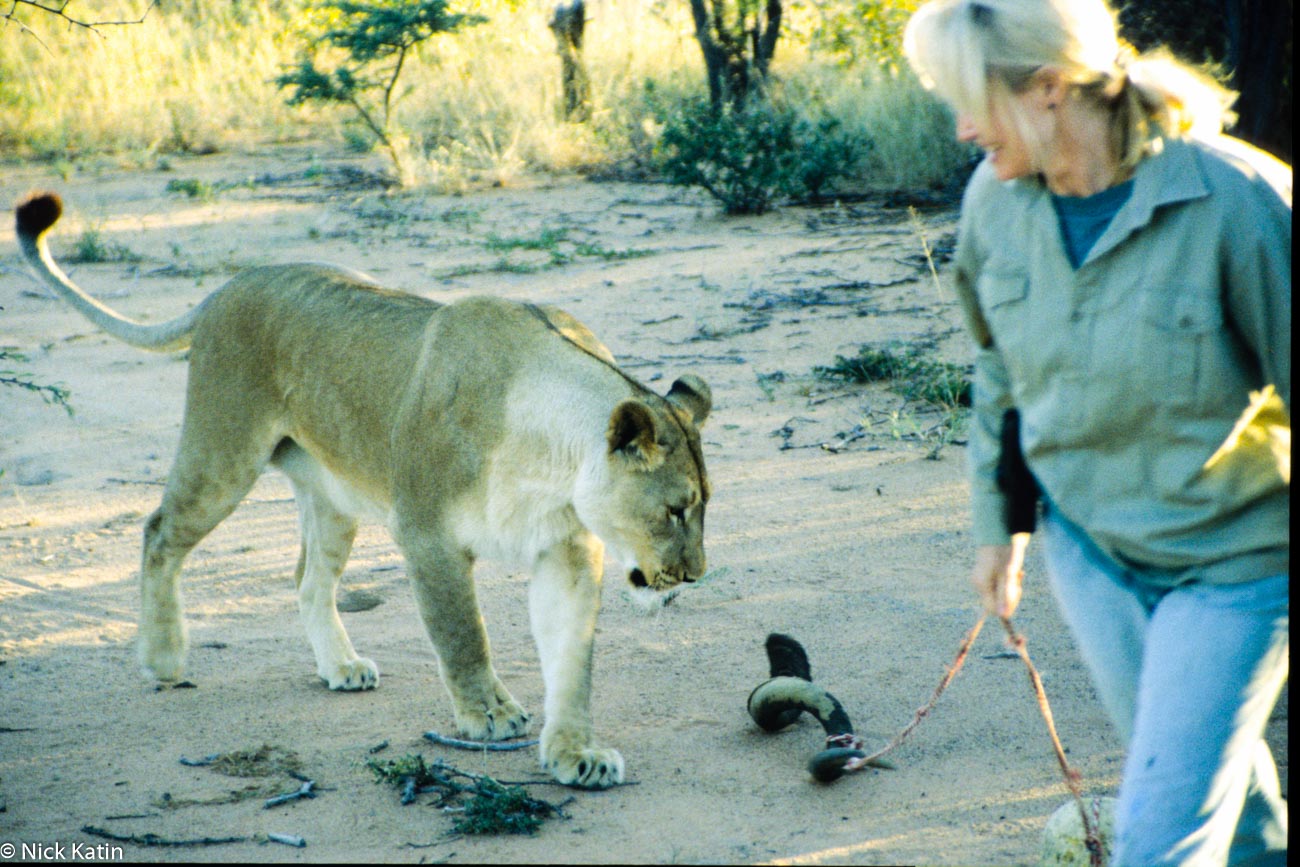
Playing with a female Lion at Okinjima in Namibia.
We got back to the resort in enough time to have another shower (our third) before dinner. Dinner brought us kudu steaks again and again it was the texture that put me off confirming after this second ‘chew’ that the kudu is safe from me in the future. Unfortunately there were no other choices so it was that or go hungry! Nonetheless the remainder of the food was good and really became secondary to the conversation we were having with a South African couple and a couple of journalists from Zambia who now live in New York. We were enjoying the conversation so much that it was almost an inconvenient interruption to be called to the night hide to see a porcupine munch on another slab of meat left there to attract him.
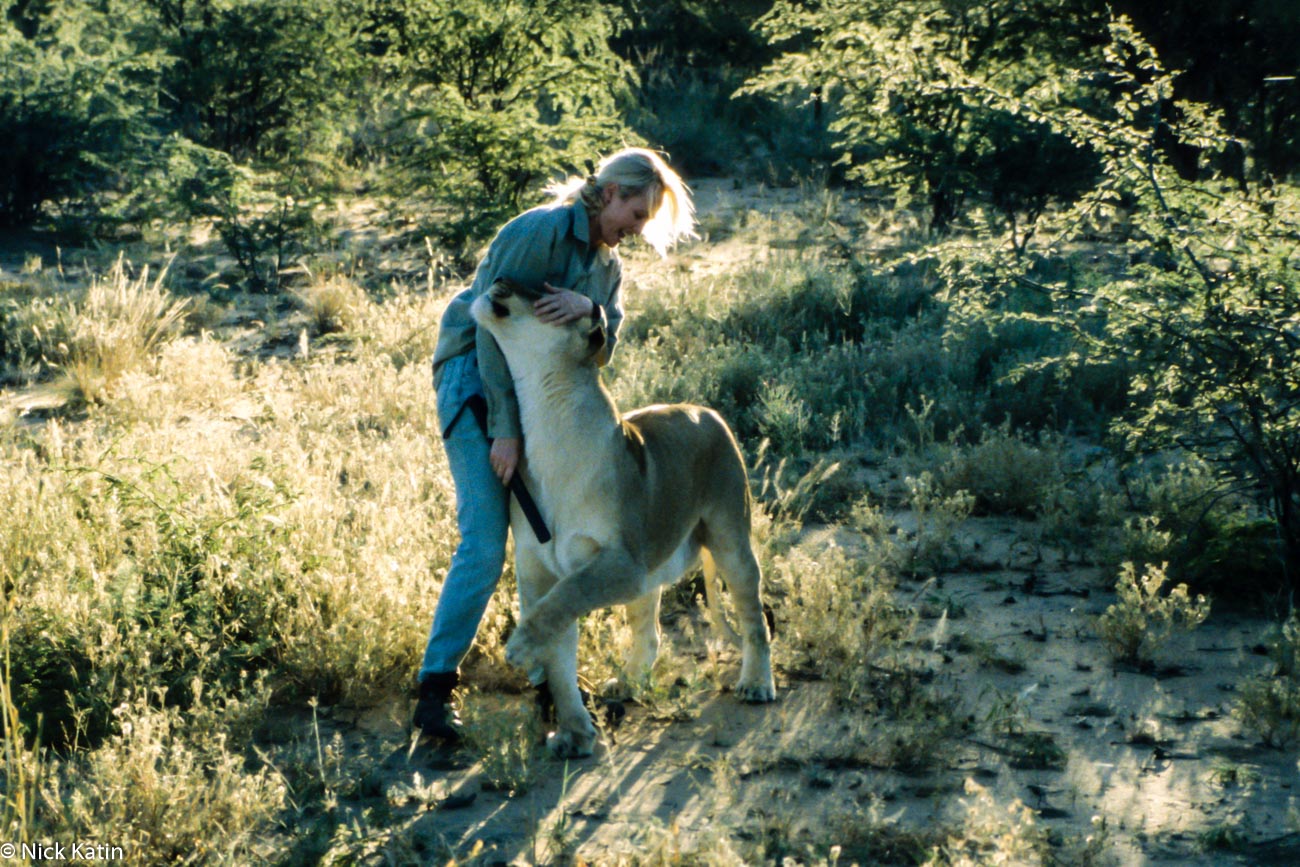
It was all go the next morning. Up at 6 and into the huge long grassed paddock that was the lion’s enclosure, on the back of an open safari truck. These three lions (one female, Tess and two males, Matata and Tyson) were rescued from brainless people who kept and mistreated them in captivity. Even though they were now part of the family, it was intended that they would be relocated back out into the wild. Watching Donna and Roselea Hanssen play with them, I wondered whether how that could ever be. These animals were domesticated and appeared to me to be just big playful pussycats and then I remembered Guy’s story yesterday and made sure that I stayed well within the safety of the truck.
Our final ‘activity’ was a guided bushmen walk trail. Chris our guide (who I noticed showed a healthy respect for the lions in the way he held on tightly to his rifle) took us on a track littered with bushmen artifacts, ‘home comforts’ and tools.
It was interesting without being riveting. The bushmen like many other traditional peoples had no concept of ‘waste’. Everything had a use. A small animal would provide not only food but also pelts for warmth, fat for cooking and skin for shelter. It’s a principle that appears to be have lost over the centuries by Europeans.
Back to the lodge and we only had a few minutes to vacate our room before Brunch (they like you out of the rooms by 9 am) which we enjoyed under the watchful gaze of the resident warthog.
On the drive out Sue was feeling pretty crook and we hadn’t got far when I had to stop whilst Sue got rid of the contents of her stomach. From then on she slept whilst I drove onwards to Terrace Bay in the Skeleton Coast Park, some 380 kilometres away, in the blazing heat of the desert.
As half of the road was gravel, there was no way we were going to make it in a day so our overnight stay was near Twyfelfontein where some of the finest rock art in Africa is found.
Not so fine was the Abu-Huab Camp. Another dust hole masquerading as a ‘rustic and natural desert camp” in the middle of nowhere. Once again we had to put up with dust and sand blowing into every crevice and orifice. Sue was still crook and lay most of the time in the tent and I still had the remnants (in the form of catarrh and dry throat) of the cold I had caught nearly 3 weeks ago at Fish River Canyon.
We were back down to the realities of independent budget travelling with a bump. No comfy bed in a dustless air-conditioned room for us that night. As darkness descended Sue gradually regained some strength to sit outside whilst I eat and we actually began to enjoy relaxing under the gaze of the millions of stars that lit the night sky with their pinpricks of light scattered in and around the milky way. That was until Sue almost put her foot on a scorpion, which could have put us right in the ‘shit’. Somehow this wasn’t the sort of place where emergency medical treatment would have been easy to find. That was enough for us, our beds were calling. Hopefully tomorrow would bring a better day.
Playing with a female Lion at Okinjima in Namibia.
Before we left home the idea of picking up some casual work in Southern Africa had appealed. We emailed several lodges in Namibia and Botswana with no luck. However some of these lodges were quite helpful and invited us to drop in when we were in the area, hoping, of course, that we would stay as guests.
One of these lodges was Camp Setenghi, who had an office in Outjo, the last decent sized town before Etosha. Wayne and Ilvia were genuinely friendly and interested in what we were doing and more than happy to offer advice with no strings attached. They still had no work and in fact warned us that it was illegal to work in Namibia without a work visa and that could lead to some unscrupulous employees taking advantage and basically ripping you off.
We had actually already dismissed the idea of working in Africa. One of the pitfalls of middle age ‘backpacking’ is the fact that you are often parents as well. In our case our grown up sons were both working in London and we hadn’t seen either of them for quite a while. Working would have delayed any reunion, so it seemed a better idea to simply work for longer in England, where there appeared to be plenty of work and where we had no work visa issues.
Etosha National Park is 22,000 square kilometres of animals!
It doesn’t have the same international profile as Botswana’s Okavango Delta and Chobe, Kenya’s Maasai Mara or Tanzania’s Serengeti but it does have an abundance of wildlife that rivals any of it’s more famous counterparts.
The name Etosha means ‘great white place’ after its main feature the mostly dry Etosha pan that is roughly 120 kilometres long and 72 kilometres wide and dominates the Park in area. Game viewing revolves mainly around the many natural and manmade waterholes that dot the southern edge of the pan. That’s not to say that game can’t be seen elsewhere, it’s just they’re the most likely spots.
We stayed in a small chalet in Okaukuejo, the first rest camp. Each camp has a waterhole of it’s own and we were disappointed that our chalet with it’s hospital towels and décor wasn’t closer to it. But we soon forgot that and concentrated on the business of wildlife viewing.
One of the beauties of Etosha is that it’s easy to self-game drive even in the little ‘Chico’. The roads are mostly gravel but are pretty firm so a 4WD is not required. As soon as we got settled in, we were off in search of wildlife.
At the Okondelia waterhole there was an abundance. Zebra, Wildebeest, Gemsbok, Springbok, Jackals and the pièce de résistance, Lions, everyone’s favourite. We spotted one going for a kill and suddenly there were another seven, two females, one male and four young males, strolling down from the hill behind us towards the water hole to our front. Amazingly they just ambled around the five or six vehicles, that were all clambering for the perfect possie and photo, as if they weren’t there. One of them, a young male, got within 2 metres of the car and Sue nearly dropped the camera out of the window in her excitement.
What incredible looking beasts they are, finely tuned, aerodynamically designed and perfectly shaped, they are nature at it’s handsomest. You can go to the best zoo’s in the world and see them up close but nothing beats seeing them on their own turf. In a zoo they are just a caged animal, here free to roam they are Lions! They have that spring to their step and sparkle in their eye. This is who they are!
They all met up at the water hole for I suppose a bit of a sundowner. It was a great start marred only by some dickhead in a red Chico moving his car around to get a better shot at one of the other young males close to his car and frightening him in the process. He should have been dragged out of the car and literally thrown to the lions for dinner by the rest of us, who felt honoured enough just to sit still and experience mother nature at it’s best.
If you like this then hit “follow” on the side bar
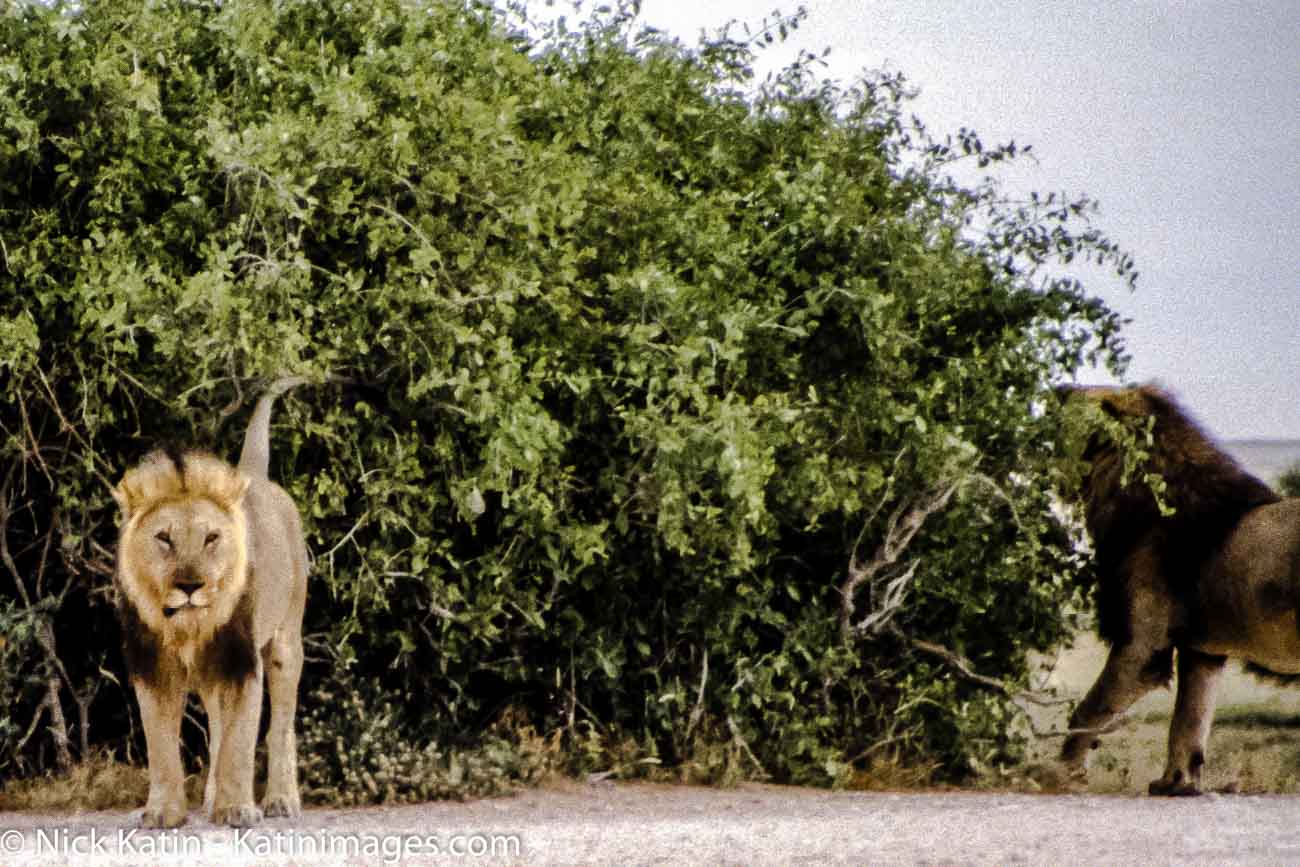
Two lions hanging out together at Etosha National park in Namibia
On that subject, of food, these tours feed you well. Whether it is a budget tour like ours or a five star tour, the tour companies must drum into the tour leaders that the guests must eat. I can just hear them now “Never mind the spectacular scenery or the animals, the object here is for the tourists to eat at least three big meals a day, and if possible morning and afternoon tea and equally as important on time!”
On one tour we did in Kenya the 4WD got bogged in sand in Lake Nakuru and despite our protestations our guide insisted that we get a lift with a passing vehicle so that we wouldn’t be late for lunch. It was a long lunch because he turned up 6 hours later, covered in mud from head to toe. We would have much rather stayed and given him a hand.
In Uganda on a Gorilla safari we had a guide called Charles. Charles had a small straw picnic hamper that he spent a great deal of time arranging and rearranging after use so that all the crockery would fit in a certain way. Watching him go through this ritual for the first time it, was merely amusing, by the time we had our last morning or afternoon tea it was all we could do to prevent ourselves from breaking into absolute hysterics, as he fastidiously and obsessively arranged everything first one way then another until satisfied and then sighed, contented with his final arrangement. What didn’t occur to him was that we could have quite happily saved him all this pain and skipped morning and afternoon tea!
Strangely enough most tourists remember the food they have on these trips more than the experience they had! How often do you hear “Oh and the food was wonderful/crap”
Maybe the tour operators have a point!
We had some unwanted visitors that night. Jackals, like the baboons in Golden Gate come in darkness and scavenge anything they can get at. We weren’t affected but a group of school kids who were sleeping under the stars had a torrid time as the jackals ran off with all their stuff and scattered it around the camp or worse took it into the bush.
The next day was our last of the tour and that meant heading back to Upington, 160 kilometres away, 60 on gravel, slowly at first so that we could search for any game. But once again it appeared that the script had been ignored. We were all now thoroughly depressed and ready to give up.
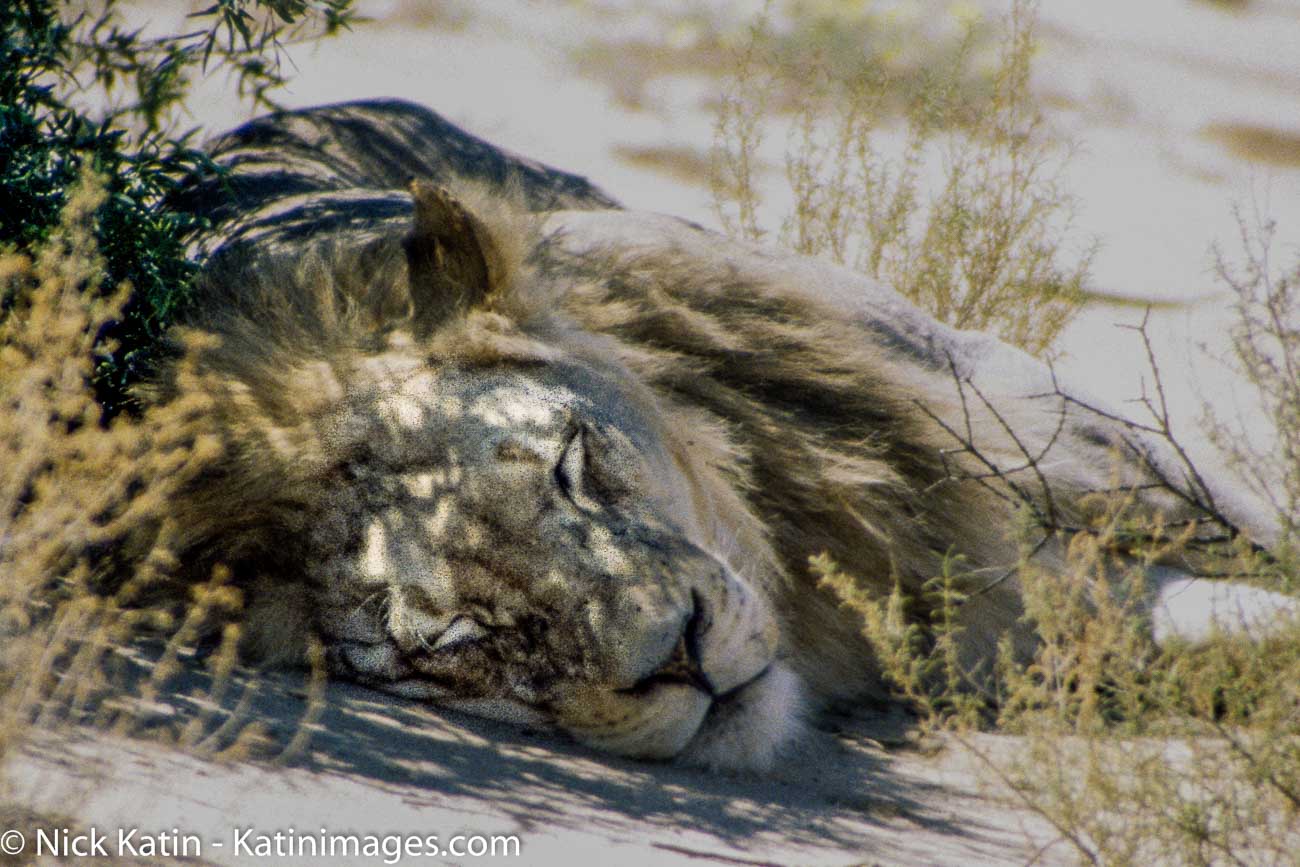
Suddenly by the side of the road Roland exclaimed “Lion”. Sure enough right by the roadside lay two male lions asleep under a small but shady tree. The lions of the Kalahari are meant to be amongst the biggest in Africa and sure enough after seeing them up close, I can see why. They were big! They didn’t really entertain us apart from one of them standing up, moving 5 metres and plonking himself down again with a heavy thud before going back to sleep. But we didn’t care we had finished on a high and all of us had a bit of a smile on the dusty journey back to Upington.
Mind you I think Rolands smile was more one of relief than joy. He had, at the beginning, dangerously bragged about how much game we would see in the park and felt personally responsible for any success or failure. Not that he should have done. Game watching is a bit like trying to win at the races; you can study the form but in the end it’s pretty much out of your control.
If you like this then hit “follow” on the side bar
A lion sleeps in the shade of an acacia tree in the Kalahari national park on the border of South Africa and Botswana
The main reason that we had elected to stay in J’burg the extra night was to see Soweto.
Soweto you say! Why would anyone want to see such a notoriously dangerous place?
Well, most tourists visiting South Africa regardless of budget have minimal contact with black South Africans. Very few get to visit black townships or satellite towns because of their reputation or lack of opportunity.
Hotels and all levels of accommodation, tour companies and other tourist facilities are still in the main, owned and run by white South Africans and generally black South Africans tend to keep their distance particularly from white tourists.
Not surprisingly Soweto has had the biggest media coverage and for most represents South Africa at its worse. It has in reality, been a war zone ever since that fateful day in June 1976 when many black students were killed by police in a march against the use of the Afrikaans language in black schools.
So to see such an infamous place is to observe black South Africa.
Of course we were not stupid enough to go in on our own. Soweto is now a tourist attraction, so there are a number of tours that are run chiefly by black South Africans.
Like most people I expected to see squalor and poverty on a large scale and it stopped me in my tracks to see that parts of Soweto were just like any other middle class suburb in the world. Nic Mbewe, our guide and Padwana his driver lived all their lives in Soweto and as he explained “There are basically three types of housing in Soweto, upper for the educated with good jobs who are moving out because they can, middle for those with jobs and the poor end of town for those who have nothing”.
To be contuined………
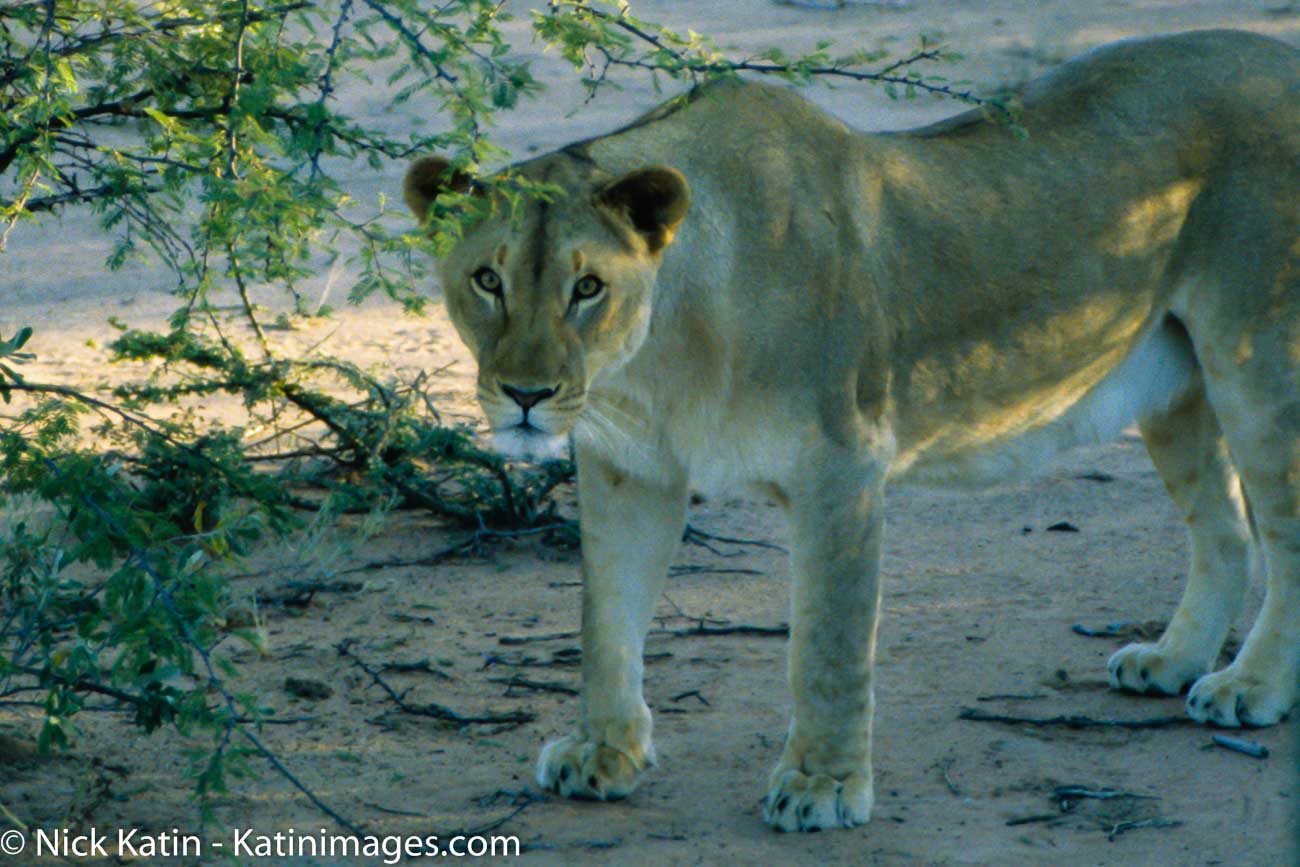
A lioness underneath bush peers at it’s potential prey in Namibia
Last time we flew to South Africa via Qantas we were upgraded to business class. No such luck this time! We were once again mere mortals packed in with our fellow passengers into the Airline industry’s version of the mini.
Now that’s not to say that travelling economy with Qantas is a hardship. It’s not. In fact I think that they’re terrific. Good service, facilities, food and most importantly an unparalleled safety record makes any long haul flight reasonably comfortable. If that doesn’t get me a free flight nothing will!
But a long flight is a long flight and quite tiring.
Some eleven hours and two movies later we arrived at J’burg airport. Once ‘processed’ by the authorities we claimed our bags and moved out into the arrival lounge. We had been to J’burg before and sort of knew what to expect but nonetheless J’burg’s reputation as violent crime capital of the world makes you view everyone with a great deal of suspicion. In fact the biggest danger seemed to be the frustration caused by the ceaseless touting by reps of J’burgs many backpacker hostels. These guys hone in on anyone who looks even faintly potential. I think we got picked because it was such a quiet night and they were getting desperate.
We managed to eventually find our hotel shuttle, which was driven by a young white guy. I make a point of this because several years ago these ‘menial’ jobs were done by black or coloured people, never by a white person especially a young white person.
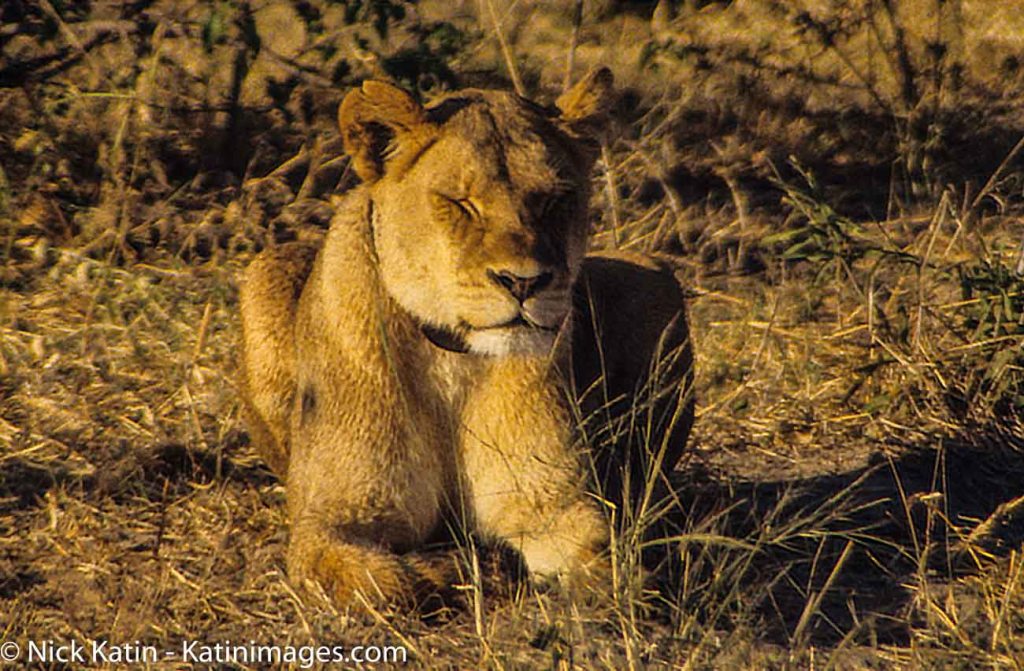
A lioness enjoys the late afternoon sun in Chobe National Park, Botswana
This is a contentious one! Turn off your flash! Unless you can control the power and the way it falls on the subject, inevitably the results you get tend to be cold and often washed out. I see so many people taking pictures outdoors with the auto flash on. In these cases unless you have the subject within a few metres, its a waste of time and power and can detract from the overall scene. So instead of having the flash on as a default, have it off as a default. All cameras including compacts and smartphone have this option. That’s not to say you shouldn’t use it from time to time but more as a last resort. How to overcome low light – that’s the next tip.












 Katin Images Travel Photography