Katin Images Travel Photography

Travel Photos, Travel Photography Tips and Software

Tag: Deadvlei

  • African shoestrings – Namibia Day Sixty – Windhoek

    We got our liquid back in the bar when we got back after cooling the bodies in the cool water of the pool.
    There were three tour guides in there. They were actually running an overlander full of middle-aged Belgium and Dutch tourists. We got chatting and had a bit of banter. One of them was a South African and of course the up and coming Cricket and Rugby union world cups was the main topic of discussion.

    “You know I’ve got a lot of time for you guys, but I’m afraid you’re going to come second in both comps to us mighty Aussies” I bravely predicted. Harmless banter followed and these guys then went on to giving us some great tips and info and where and what to see in Namibia and Zimbabwe where they were also heading.

    One of the things I always desperately miss when we’re away from Australia is the dry laconic wit that is always tinged with a sense of irony. Nobody does it better than we do and often it just doesn’t work with people from other cultures even Anglo-Saxon ones. But on occasion we do strike people who have a similar sense of humour and meeting these guys were one of those times.

    It was time to move on to our next port of call, Etosha National Park, nearly 800 kilometres away. We knew we would never be able to get there in one day, especially with 280 kilometres being on gravel and having a car that struggles at 80 kilometres an hour let alone 100 or 110. We did expect however to get further than Windhoek which was little over half way. …………..but that was not to be.

    The gravel section seemed slower than ever and a puncture slowed us down even more. The irony of this was that it happened only half an hour after chuckling at our overlander friends who had stopped by the side of the road to also change a wheel. We now had the problem of getting the puncture repaired. The overlander drivers had given us the name of a place just near Windhoek but it was closed and a slow search eventually found us a place that seemed to take forever to repair it.

    Another problem was rearing its head, that of cash. We had attempted to get some cash out of several ATM’s before heading out to Namib. For some reason none of them wanted to release any money, so we were now starting to get desperate and the ATM’s still weren’t working. A trip into a bank was necessary, something you try to avoid at all costs. It’s not that the bank tellers are unfriendly, it’s just that African banks are slow, disorganized and very bureaucratic. It usually takes three queues to find the right one, which will always be the longest. When it’s your turn the teller looks at you as if you had asked for the Prime Minister’s bank account number. On this particular occasion I got off lightly at only 40 minutes, which was a good job too as Sue was waiting in the car outside.

    By the time we had restocked our food supplies, we just couldn’t be bothered to travel on. A bed at the Cardboard Box seemed a much better option.

    If you like this then hit “follow” on the side bar
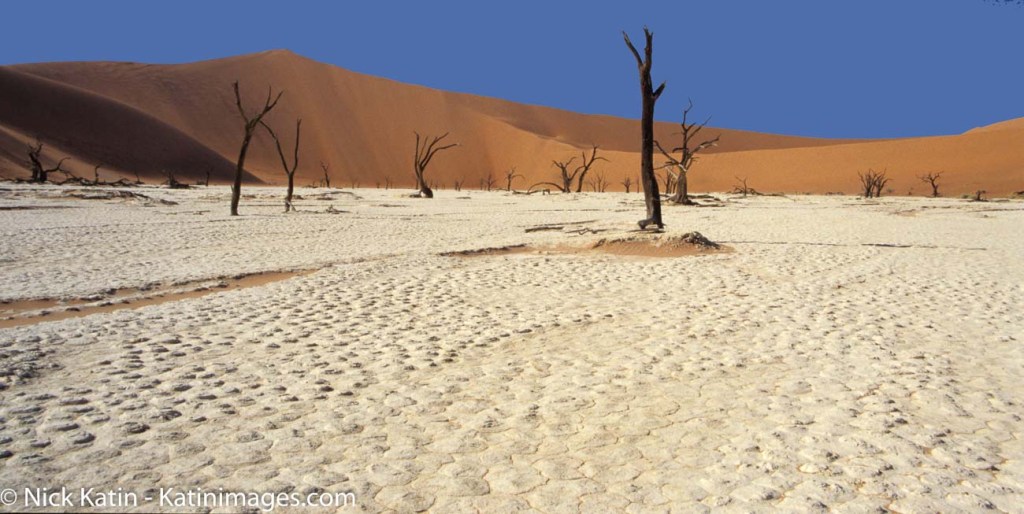
    Deadvlei is a white clay pan located near the more famous salt pan of Sossusvlei, inside the Namib-Naukluft Park in Namibia.
    Deadvlei is a white clay pan located near the more famous salt pan of Sossusvlei, inside the Namib-Naukluft Park in Namibia.


  • African shoestrings – Namibia Day Fifty seven – Namib desert

    We had actually booked a campsite for the next day but took a chance that they had a vacancy for that night. That almost backfired when the camp manager said that they were fully booked but then went on to say, “I think we can make a plan”.

    Strange sort of saying that! I had first heard it in South Africa and we sort of guessed it means “we can work it out” or “I think we can do something” etc. Namibia was effectively colonised by South Africa from the end of World War I until 1990 when it gained independence. They were only meant to administer Namibia for a short period until the League of Nations worked out (‘made a plan!!’) what to do with the place. But the South Africans were a stubborn lot and had also become paranoid about National security, so once they took control, they had no intention of leaving in a hurry.
    The South African influence is still pretty strong. Even though English is the official language, Afrikaans is spoken by nearly everyone as a first language and most of the whites that live here are either South African or have South African ancestry.

    So anyway we had now become accustomed to coming across these pseudo South Africans, who, to be fair think of Namibia as their home.

    The campsites in nearly all of these National parks are big enough to take up to eight people, so in this instance even though there was only about ten sites, a couple of them only had two people and we were able to share a site and still have room to spare.

    It was a beautiful shady campsite nestled in a small but deep valley between huge sandstone boulders on one side and a steep rocky bank on the other. It did have a couple of major drawbacks, no electricity even in the ablutions block and no shop or fuel. Can’t really say that the latter really worried us. But as the days were now quite short we ended up showering in the dark, a unique experience not to be missed especially when you drop the soap.

    We were there for one reason; to walk the 17 kilometre Waterkloof trail…… and quite a hike it was. It felt like thirty kilometres!

    Up at sunrise the next morning, we followed the yellow feet (markers) along a riverbed or two for most of the way. You know, riverbeds are often rather tedious and awkward to walk on. They’re usually cluttered with big boulders, rocks and stones and sometimes an occasional metre or two of sand and this was no exception.
    There were some pockets of small clear pools of water populated with a few frogs, crabs and tiny fish. But they died out after a while and then reappeared around 3 or 4 kilometres from the end, bigger and deeper, deep enough in fact to revitalize our weary bodies and aching feet.
    Between these two riverbeds we had actually climbed till we reached and then crossed a flat treeless plain to reach another, though steeper ascent to the trails highest point of 1910 metres. From here there were great views of the surrounding Naukluft Mountains and the desert, despite the increasing cloud cover.

    Now it was time to follow those yellow feet down the mountain which wasn’t as easy as coming up. It was made even harder by two German blokes virtually skipping down the rocky trail past us as we carefully and slowly scrambled our way down. They were a lot younger we told ourselves. This really doesn’t help much, you know! It just confirms that even though you still feel like a 25-year-old, your body is reminding you that you’re not.

    Why is it that the last few kilometres of any hard walk seem like ongoing hell? We think we instinctively know that we are nearing the end and then we torture ourselves by assuming the end is really just around the corner, knowing full well that it’s nowhere near. Finally it really was just around the corner and we trudged back to our tent, cracked open a couple of beers and flopped down exhausted after nearly 8 hours of walking.

    If you like this then hit “follow” on the side bar

    Deadvlei is a white clay pan located near the more famous salt pan of Sossusvlei, inside the Namib-Naukluft Park in Namibia.
    Deadvlei is a white clay pan located near the more famous salt pan of Sossusvlei, inside the Namib-Naukluft Park in Namibia.